The Big Question
Let me start with a question that is reshaping enterprise technology strategy in 2026.
"We've invested in AI models, infrastructure, and pilots. But moving to production feels impossible—data is fragmented, agents lack context, and governance is an afterthought. What are we missing?"
The honest answer:
You are missing the operating layer that connects intelligence to execution.
Here is the truth:
Most organizations aren't stuck because they lack access to capable AI models. They're stuck because their data is fragmented across ERP systems, electronic health records, core banking platforms, logistics software, and document stores—spread across on-premises infrastructure and multiple clouds—and almost none of it is "AI-ready" .
An AI operating system addresses exactly this problem.
Step 3: What Is an Enterprise AI Operating System?
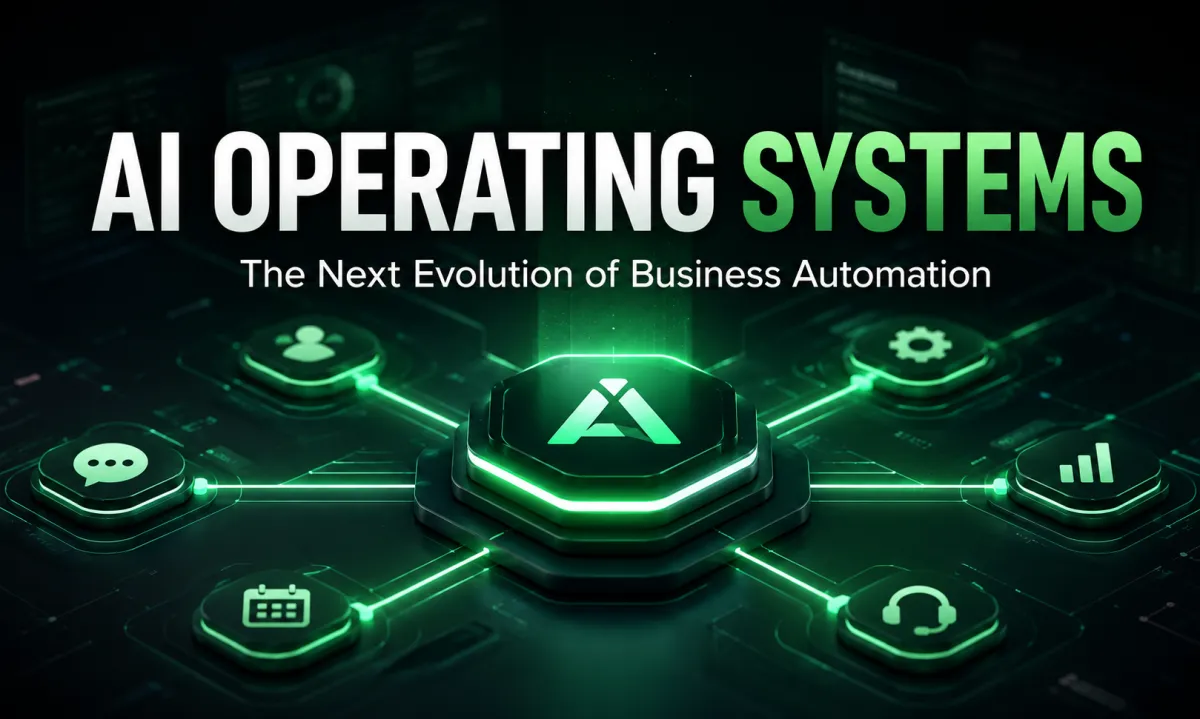
An enterprise AI operating system is not an application that sits on an existing operating system. It is a fully AI-integrated layer that sits between your infrastructure and your business applications—unifying context, orchestration, and execution .
The Three Core Layers
| Layer | Function | What It Enables |
|---|---|---|
| Context Layer | Unifies fragmented data into a governed semantic layer | AI agents understand your business, not just your documents |
| Orchestration Layer | Coordinates multi-agent workflows across systems | Agents work together, not in isolation |
| Execution Layer | Runs agents with governance, audit, and control | Autonomous action with accountability |
Context Before Models
"Enterprise AI should be like an insider who knows how an organisation works. For agents to operate reliably, they need an organisation's memory, a context layer." — Amir Netz, CTO for Microsoft Fabric
The defining insight of the AI OS movement is that models are commoditizing. The strategic differentiator is no longer which LLM you use—it's whether the system understands your business context, can access the right data, and can be tested with real corporate data .
Step 4: The Key Players and Architectures
Microsoft: The Enterprise Agent Canvas
At BUILD 2026, Microsoft executed a massive tactical re-engineering of its entire developer and cloud portfolio, signaling a definitive end to the passive, chat-based assistant era . The company is recasting its operating system and cloud database ecosystem into an integrated, multi-agent Agent Canvas built specifically to observe, contain, and execute automated enterprise intent across secure boundaries .
Key Components:
| Component | Function |
|---|---|
| Microsoft IQ | A comprehensive enterprise intelligence layer engineered on Microsoft Fabric OneLake, mapping operations across Work IQ, Fabric IQ, Foundry IQ, and Web IQ |
| Windows Execution Containers (MXC) | Native OS-enforced sandboxing and local process isolation for autonomous software agents |
| Microsoft Agent 365 Control Plane | Centralized cockpit extending Entra, Purview, and Defender for Cloud to govern, log, and audit agents across edge and cloud |
| Surface RTX Spark Dev Box | Native companion hardware powered by the 1-petaflop NVIDIA RTX Spark superchip for local token execution |
Microsoft's strategy is clear: if you want to run complex agents that execute thousands of iterative tool calls without incurring ruinous cloud GPU egress bills, you must run them locally inside the native primitives of the Windows operating system .
Palantir + Dell: The On-Premises AI Factory
At Dell Technologies World, Palantir and Dell announced a joint solution: Palantir's Foundry and Ontology platform running on-premises inside Dell AI Factory with NVIDIA .
The Architecture:
| Layer | Component |
|---|---|
| Software | Palantir Foundry + Ontology layer—a governed semantic layer that builds a unified, strongly typed representation of business assets, processes, and relationships |
| Hardware | Dell PowerEdge servers with NVIDIA HGX B-series accelerators, Dell ObjectScale and PowerFlex storage, Ethernet-based networking aligned with NVIDIA Spectrum-class fabrics |
| Runtime | Palantir Apollo manages each cluster with zero-trust governance, continuous audit logging, and centralized fleet management—including air-gapped environments |
This is the architecture for organizations where a data breach is a national security event, a regulatory catastrophe, or a patient safety failure .
Commotion: AI OS with Voice AI
Commotion, backed by Tata Communications and built on NVIDIA Nemotron models, has launched an enterprise AI operating system designed to move AI from pilots to production .
Key Differentiators:
-
Context Engineering Layer: Continuously maps enterprise data and activity into a shared understanding
-
Voice AI: Natural speech-to-speech interactions with ultra-low latency—AI Workers can listen, interpret emotion, reason, and respond in real time
-
Governance by Design: Unified visibility, auditability, and control over every AI decision
Live Deployment Results:
| Sector | Outcome |
|---|---|
| Global telecom provider | 40%+ operational issues resolved autonomously; 35% reduction in resolution time |
| International airline | AI expected to handle 30% of inbound customer calls in year one |
| Indian automotive OEM | 50% higher ROI; 30% lower cost/call; 60% fewer calls via elastic scaling |
Kingdee Lingee: AI-Native Enterprise OS
Kingdee's Lingee is an enterprise AI operating system built on 33 years of enterprise management expertise .
Five Core Value Propositions:
| Proposition | What It Means |
|---|---|
| Enterprise Intelligence | AI performs tasks autonomously; humans retain decision-making authority |
| Organizational Self-Evolution | The system evolves with use, becoming more intelligent over time |
| Finance as the Hub | Transforms finance from "after-the-fact bookkeeping" into a real-time hub connecting the entire enterprise |
| Security and Trust | Multi-layered defense-in-depth architecture redesigned for the Agent era |
| Symbiosis | Humans, AI, enterprises, and ecosystem partners achieve mutual value creation |
Emerging Players
| Company | Focus | Key Differentiator |
|---|---|---|
| Bud Ecosystem | Enterprise AI management platform | Full-stack approach from silicon to governance; claims up to 80% cost reduction |
| Dapple | Enterprise OS Cloud | Dedicated, in-country AI infrastructure for regulated enterprises; $100M+ in contracts within five months |
| Deliverance AI | Sovereign enterprise AI | Platform for government and regulated industries to deploy agentic AI inside their own environments |
| Walturn (Steve) | First AI-native OS | Persistent AI memory, natural language interaction, and autonomous workflow orchestration |
Step 5: Why This Matters Now
The Agent Swamp Problem
According to ARC Advisory Group, we stand on the precipice of a dangerous operational failure mode: the Agent Swamp. Unlike a passive data swamp—which merely drains corporate cash through idle cloud storage bills—an ungoverned Agent Swamp introduces active physical chaos .
Without absolute system boundaries, localized software agents from different vendors will inevitably trigger execution conflicts, flooding networks with recursive API tool calls and fighting over control of shared kinetic assets .
Tool Sprawl
As enterprises move from AI experimentation to full-scale production, the absence of a unified enterprise AI operating system is emerging as the single most consequential bottleneck in realizing returns from AI infrastructure investment .
"We're surrounded by a lot of companies that have a lot of tools that do this, that and the other thing. The hype doesn't match the tools. We've got 50 different tools—noise and errors and all of that." — Rob Rollinger, Bud Ecosystem
The Governance Gap
Most AI deployments today lack the operating model to govern agentic AI at scale. Enterprises can have powerful AI, or they can have control—until now, they couldn't easily have both .
Step 6: Implementation Roadmap
Phase 1: Assessment (Weeks 1-4)
| Action | Output |
|---|---|
| Inventory fragmented data sources and AI tools | Current state map |
| Identify high-value, multi-step workflows for automation | Use case pipeline |
| Assess governance maturity and gaps | Governance baseline |
| Define success metrics (resolution rate, cost reduction, time saved) | KPI framework |
Phase 2: Platform Selection (Weeks 5-8)
| Action | Output |
|---|---|
| Evaluate AI OS options based on your requirements | Platform decision |
| Assess integration with existing infrastructure | Architecture plan |
| Define context layer requirements | Data strategy |
Phase 3: Pilot (Weeks 9-16)
| Action | Output |
|---|---|
| Deploy AI OS for one bounded use case | Working deployment |
| Implement governance and audit controls | Governance framework |
| Measure performance against baseline | Early ROI data |
| Refine based on results | Improved deployment |
Step 7: Frequently Asked Questions
Q1: What is the difference between an AI OS and a traditional cloud platform?
A traditional cloud platform provides infrastructure and services. An AI OS provides a unified context layer, orchestration engine, and governance framework specifically designed for autonomous agents. It sits above the infrastructure stack and turns fragmented capabilities into a single, governed deployment .
Q2: Do I need an AI OS if I'm already using AWS or Azure?
Yes—if you are deploying autonomous agents at scale. The hyperscalers provide infrastructure. An AI OS provides the operating layer that makes agents reliable, auditable, and governable. However, Microsoft is embedding AI OS capabilities directly into Windows and Azure, while AWS and others are taking different approaches .
Q3: What is the biggest barrier to AI OS adoption?
Governance and context. Most organizations lack a unified semantic layer that maps their business operations. Without this, agents cannot operate reliably. The technology is ready; the organizational readiness is not .
Q4: Can AI OS run on-premises?
Yes—in fact, this is a core requirement for many regulated industries. Palantir and Dell's joint solution, Dapple's Enterprise OS Cloud, and Deliverance AI all offer on-premises or dedicated, in-country deployments for organizations that cannot let data leave their control .
Q5: How can Innovative AI Solutions help?
We help organizations assess, select, and implement AI operating systems—from context layer design and governance frameworks to platform selection and pilot deployment.
Step 8: Final Tagline
"The most consequential AI decisions being made right now aren't happening in the cloud. They're happening in secured data centers, in air-gapped facilities, in hospital server rooms—places where the data is too sensitive and the stakes too high for anything less than complete control ."
Short version:
The rise of AI operating systems for modern organizations—Microsoft's Agent Canvas, Palantir + Dell AI Factory, Commotion AI OS, and the new enterprise intelligence layer in 2026.
Hashtags:
#AIOS #EnterpriseAI #AgenticAI #AIGovernance #DigitalTransformation #Microsoft #Palantir #InnovativeAISolutions
Ready to Navigate the AI OS Landscape?
The shift to AI operating systems is reshaping enterprise technology strategy. Let us help you understand the landscape and build the right architecture.
Contact Us
Phone: +91 7464 099 059 / +91 96899 67356
Email: info@innovativeais.com
Address: Netaji Subhash Place, Pitampura, Delhi – 110034
Website: https://innovativeais.com
About the Author
Abhishek Kumar
Founder & CEO, Innovative AI Solutions
5+ years building enterprise AI systems. Based in Delhi, serving clients across India.
Related services: to apply this in your business, explore our AI agent development and RAG development.