The Big Question
What are companies actually automating with AI in 2026?
Not the theoretical use cases. Not the vendor demos. The real workflows. The ones that touch customers, revenue, and margins every single day.
The answer is becoming clear: AI is moving into the operating core of Indian businesses.
According to Dun & Bradstreet's AI Momentum Survey for India, 100% of surveyed Indian businesses report AI-related projects underway. But the more telling statistic: 30% are scaling AI into production, 19% have operationalized AI across multiple core business processes, and 7% are already deploying agentic AI workflows.
This isn't experimentation anymore. It's operations.
The use cases differ across companies, but the common thread is that AI is now being applied extensively to operating functions where scale, speed, and accuracy matter. From logistics to lending to customer support, companies are finding that AI doesn't just save money it makes previously unviable transactions possible.
What Companies Are Automating: The Evidence
Logistics and Supply Chain
Delhivery has deployed large language models and multimodal AI across voice, vision, location intelligence, and real-time transaction processing. The company uses AI across order manifestation, mid-mile, last-mile, and post-delivery processes. The result: reduced documentation, improved customer communication, and more efficient claims handling. Delhivery has been able to trim teams handling claims and parts of customer service—without material increase in technology team size or inference costs.
E-commerce and Customer Operations
Meesho reported that more than 70% of its code is now generated using AI. Its personalized feed engine drives more than 75% of orders. But the more striking statistic: its voice and chat agent handled 19 million customer calls without human intervention in 2025-26, reducing customer support costs by 23%. Its address intelligence model improved geocoding accuracy by 20 percentage points and reduced misroute-related costs by 5%. Another model reduced failed deliveries by more than 10%.
As Meesho put it in its shareholder letter: "Every paisa of cost we engineer out of the system is a paisa that makes a previously unviable transaction possible online."
Retail and Offline Operations
Lenskart tied AI to offline productivity. AI-driven scheduling and shorter eye-test cycle times helped stores handle higher footfall without similar headcount additions, contributing to a 270 basis point improvement in employee costs as a percentage of revenue. The company said its priority for 2026-27 is to move from being a consumer-tech company to a "consumer-AI company".
Financial Services and Lending
Mahindra Finance's Samur.AI multi-agent system now covers around 70% of new-loan volumes, up from about 45% in Q1 FY27. The system performs document and data verification, including regional-language documents and highly variable dealer documentation. The broader Udaan transformation has reduced loan turnaround times dramatically: time to first offer fell from 6-7 days to about 20 minutes, and login-to-disbursement from 10-12 days to same day or within two days. Cost per file fell to 54 from a 100 base.
Healthcare and Clinical Operations
Apollo Hospitals adopted an AI clinical assistant developed with Microsoft that helps doctors gather patient data and generate insights quickly. According to Microsoft India's president, that's "20% time given back to doctors. That is 20% time back to patients."
Manufacturing and Industrial Operations
Siemens introduced AI to its electronics equipment factory in Amberg. The barrier wasn't technical it was cultural. Initial resistance came from fears about job displacement. The solution: involving shop floor staff in designing the AI. The result: 30% of products now skip X-ray quality assurance because the AI correctly identifies what doesn't need inspection.
Eni, the Italian energy company, has developed around 300 AI use cases from exploration to operations. In drilling, AI achieved a 35% reduction in drilling time.
The Agentic Shift: From Answering to Executing
The most significant operational shift in 2026 is the move from AI that answers to AI that acts.
Agentic AI systems that can reason through multi-step tasks, use tools, access databases, and take action is moving from pilot to production. SAP's Value of AI Report 2026 found that 67% of Indian organizations are piloting agentic AI use cases, and 85% believe it has moderate-to-very high potential to transform their business. Investment in agentic AI is projected to increase fivefold.
The distinction matters. A chatbot that answers "What's your return policy?" is generative AI. A system that reads an invoice, checks it against a purchase order, flags a discrepancy, drafts a query to the vendor, and routes it for approval without a human triggering each step is agentic.
Mahindra Finance's Samur.AI is a production example. It's a multi-agent system. Different agents handle document verification, data extraction, and exception flagging. When a case is flagged for human review, the system provides a rationale.
The Numbers Behind the Shift
The investment data confirms the operational focus.
AI spending is rising. Indian enterprises plan to invest US$25.9 million in AI, with spending expected to grow 45% over the next two years. Corporate AI budgets are expected to reach 1.7% of revenue in 2026, more than double the increase seen in 2025.
Adoption is deepening. 44% of Indian businesses are planning or piloting AI, 30% are scaling into production, 19% have operationalized across multiple core processes, and 7% are deploying agentic workflows.
ROI is visible. 73% of organizations report measurable returns from AI investments. Half report ROI in specific business functions or pilots; 23% report broad-based returns across multiple AI initiatives.
But data readiness is a constraint. Only 4% of organizations say their enterprise data is fully ready to support AI at scale. 58% describe it as partially ready.
The message is clear: companies that have clean, accessible data are seeing returns. Companies that don't are struggling to scale.
What's Being Automated Across Functions
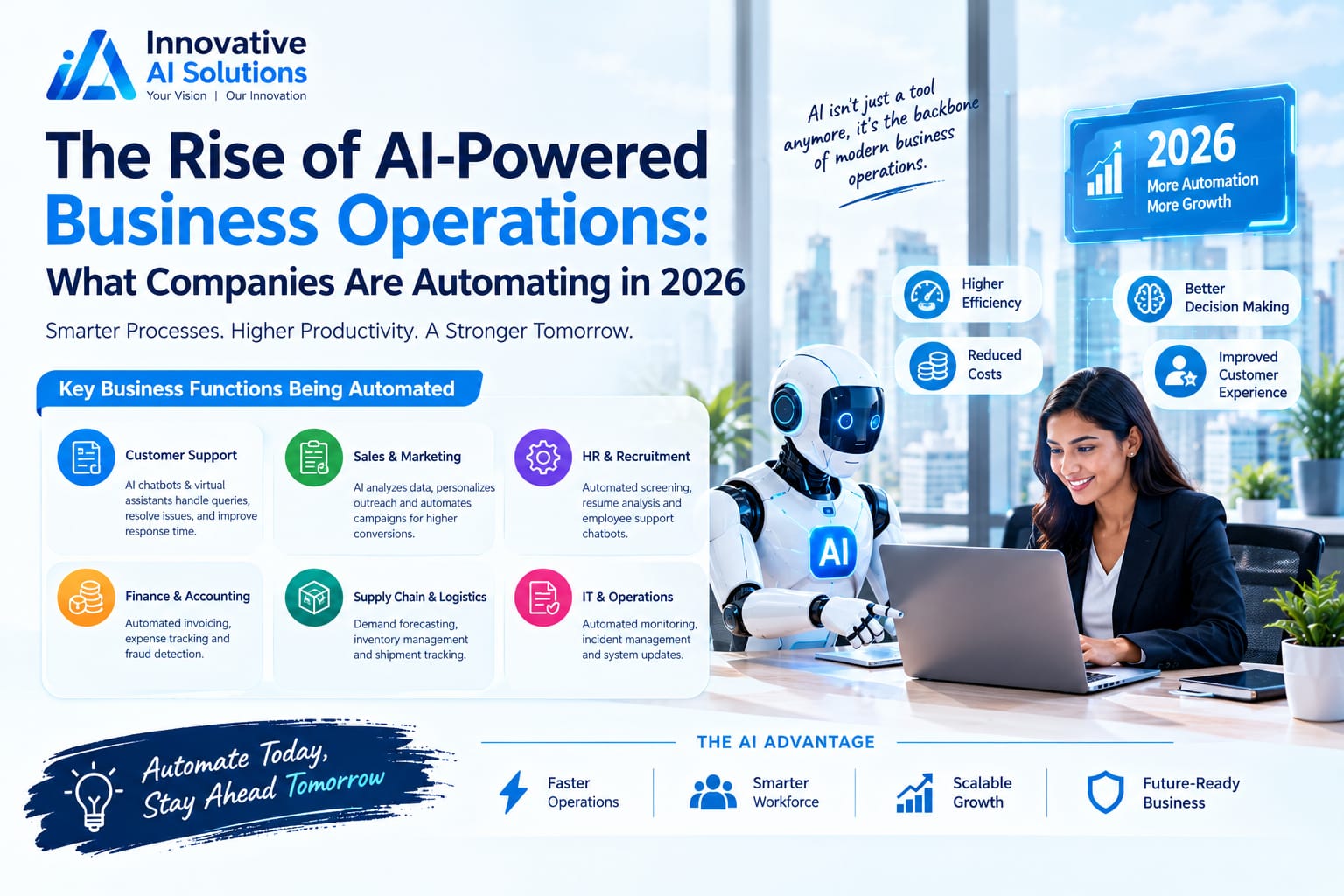
Drawing from earnings calls and implementation reports, here's what companies are automating in 2026:
Customer Operations: Voice and chat agents handling millions of calls without human intervention. Meesho's 19 million calls. Customer support cost reduction of 23%.
Document Processing: AI reading invoices, loan applications, claims, and contracts. Mahindra Finance's document verification covering 70% of new-loan volumes. Delhivery's reduced documentation in logistics.
Code Generation: AI writing production code. Meesho generating 70%+ of its code with AI. This accelerates internal technology deployment.
Scheduling and Resource Allocation: Lenskart's AI-driven scheduling improving store productivity without adding headcount. The 270 basis point improvement in employee costs.
Quality Assurance: Siemens' AI-based X-ray inspection skipping 30% of products. The algorithm was trained by the shop floor teams themselves.
Supply Chain Planning: o9 Solutions reports AI agents helping enterprise planners reduce investigative time by as much as 80% for root cause analysis of supply chain variances. Touchless execution for inventory and logistics saves tens of millions in labor costs.
Clinical Documentation: Apollo Hospitals' AI clinical assistant giving doctors back 20% of their time.
What This Means for Your Business
The pattern is consistent: AI works best when it's applied to specific, high-volume, well-defined workflows.
Not "transform everything." Not "build an AGI." Just pick one process—customer support, document processing, scheduling, quality checks—and automate it.
The companies seeing results started narrow. They proved value in one function. Then they expanded.
Meesho didn't automate everything at once. It started with code generation, then voice agents, then address intelligence, then personalized feeds. Each built on the last.
Mahindra Finance didn't transform lending overnight. It started with document verification, then expanded to 70% of new-loan volumes.
The question for your business isn't "What can AI do?" It's "What's costing us time and money right now that AI could handle?"
Frequently Asked Questions
Q1: What are Indian companies actually automating with AI in 2026?
The most common areas are customer support (voice and chat agents), document processing (invoices, loans, claims), code generation, scheduling and resource allocation, quality assurance, supply chain planning, and clinical documentation.
Q2: How much are Indian enterprises investing in AI?
Indian enterprises plan to invest US$25.9 million in AI, with spending expected to grow 45% over two years. Corporate AI budgets are expected to reach 1.7% of revenue in 2026.
Q3: What is agentic AI, and how is it different from chatbots?
Agentic AI systems can reason through multi-step tasks, use tools, access databases, and take action. Chatbots answer questions. Agents execute workflows. Mahindra Finance's Samur.AI is a production example—it verifies documents, flags exceptions, and provides rationale for human review.
Q4: What ROI are companies seeing from AI automation?
73% of organizations report measurable returns. Half report ROI in specific functions; 23% report broad-based returns. Meesho reduced customer support costs by 23%. Mahindra Finance cut cost per loan file to 54 from a 100 base.
Q5: What's the biggest barrier to scaling AI in Indian enterprises?
Data readiness. Only 4% of organizations say their data is fully ready for AI at scale. 58% describe it as partially ready. Companies with clean, accessible data are seeing returns; others are struggling.
Q6: How many Indian companies are using agentic AI in production?
7% are already deploying agentic AI workflows. 67% are piloting agentic use cases. 85% believe it has significant potential.
Q7: What functions are best suited for AI automation?
High-volume, well-defined, repetitive workflows. Customer support, document processing, scheduling, quality checks, and data verification. Start narrow. Prove value. Expand.
Q8: Will AI replace jobs in Indian companies?
AI is changing jobs, not eliminating them wholesale. Delhivery trimmed teams in claims and customer service but without material increase in technology team size. Lenskart handled higher footfall without similar headcount additions. The pattern is automation absorbing incremental volume, not mass replacement.
Frequently Asked Questions (Continued)
Q9: How long does it take to deploy AI in operations?
Basic automation: 4–8 weeks. AI-enhanced workflows: 8–16 weeks. Agentic systems: 16–24 weeks. Platform-native solutions deploy faster.
Q10: What's the first process most companies automate?
Customer support and document processing are the most common starting points. Both are high-volume, well-defined, and have clear ROI metrics.
Q11: Do I need clean data to start?
You need clean data for the specific process you're automating. You don't need enterprise-wide data readiness. Start with one workflow, clean the data it touches, and expand.
Q12: What technologies power these automations?
Large language models (GPT-4, Claude), multimodal AI (voice, vision), multi-agent orchestration frameworks (LangGraph, AutoGen), and integration with existing systems (CRM, ERP).
Q13: How do companies measure AI ROI?
Cost per transaction, time saved per employee, error rate reduction, customer satisfaction scores, and conversion rate improvements. Meesho tracks customer support cost per interaction. Mahindra Finance tracks cost per loan file.
Q14: What's the risk of AI automation?
Poorly designed automation can create new problems. Start with human in the loop. Build escalation paths. Monitor outcomes. Don't let AI make irreversible decisions without oversight.
Q15: Why should I choose Innovative AI Solutions?
Because we focus on results, not hype. Because we've delivered 100+ projects. Because we offer enterprise grade solutions at startup-friendly prices. Because your code is always yours.
Contact Us
Ready to explore what AI can automate in your business? Let's talk.
Phone:
+91 7464 099 059
+91 9689967356
Email:
info@innovativeais.com
Address:
9th Floor, Pearls Best Heights-I,
Head Office: 904, Netaji Subhash Place,
Delhi – 110034