The Big Question
What happens when your operations stop following instructions and start making decisions?
For decades, digital operations meant one thing: automation. Rules engines. RPA bots. Workflow pipelines. You encoded the process, and the system executed it. Fast, predictable, and reliable as long as nothing changed.
But things change. All the time.
Enterprises now operate in conditions defined by constant regulatory change, fragmented technology estates, unstructured data, volatile demand, and heightened customer expectations . In this environment, exceptions have become the norm. Every exception routed to humans erodes margin, increases cycle time, and introduces risk to the point where most automation programs now spend more time managing exceptions than delivering net efficiency .
This is the problem AI-powered digital operations solve.
Not by eliminating exceptions. By handling them. By reasoning through situations instead of following rigid branching logic. By interpreting context, not just data.
The shift isn't incremental. It's a strategic reset .
What AI-Powered Digital Operations Actually Means
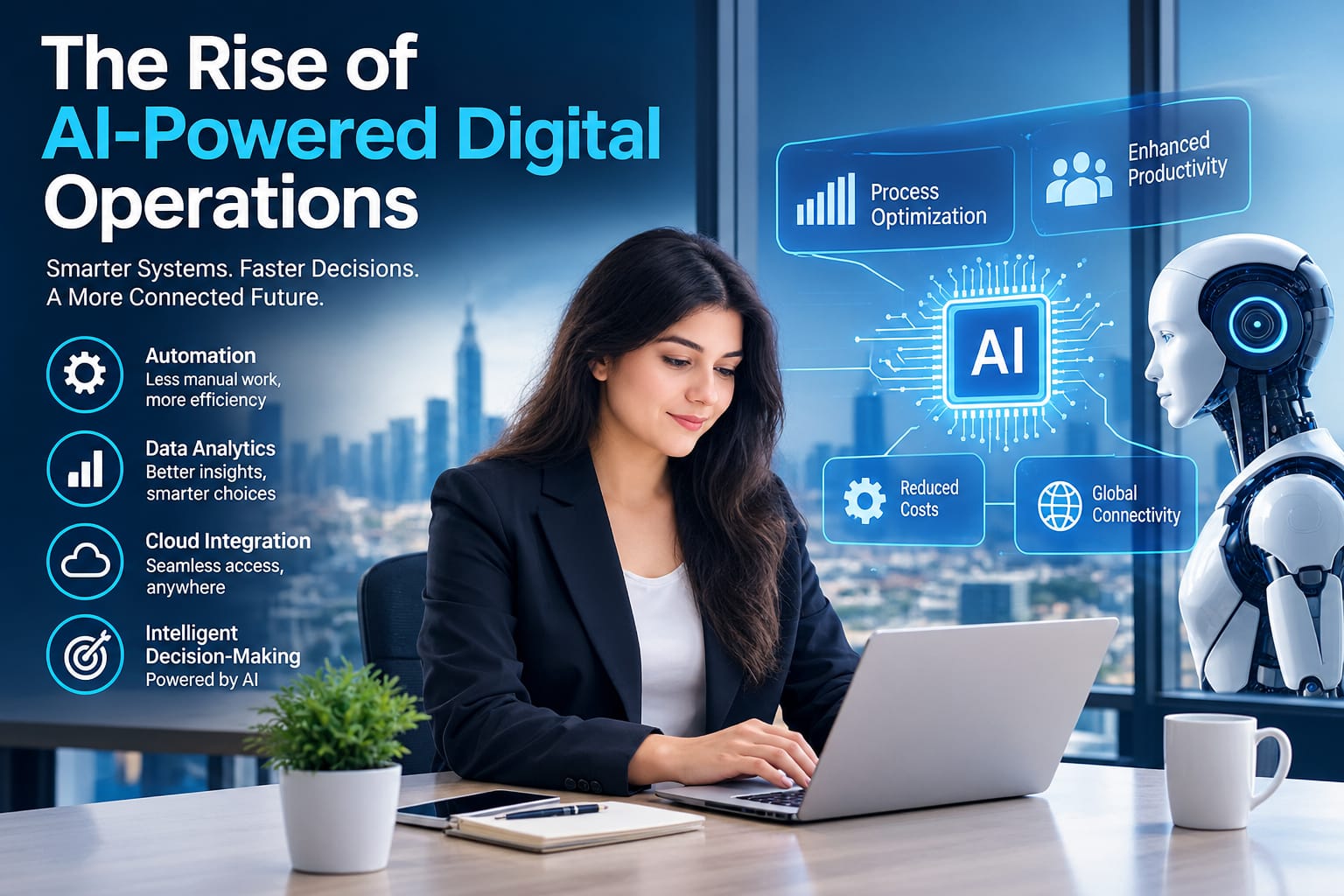
AI-powered digital operations represent a fundamental change in how enterprises think about automation.
Traditional automation executes predefined rule sets on structured data. It's deterministic. It's predictable. It's brittle. A bot can process a form if the form always looks the same. It can't process a form if the format changes, if a field is missing, or if the handwriting is illegible.
AI-powered operations interpret unstructured inputs, infer context, make probabilistic decisions, and improve over time . They can classify documents, extract information from unstructured text, route exceptions for human review, services and services and refine their classification models as new examples accumulate.
The most significant shift in 2026 is happening at a higher level: multi-agent systems. Instead of encoding every decision upfront, organizations deploy teams of intelligent agents that collaborate toward defined business outcomes .
In an agent-driven model:
-
Automation can interpret context, not just data
-
Decisions can be validated, challenged, and corrected in real time
-
Workflows can evolve without constant re-engineering
-
Risk controls can be embedded dynamically, not hardcoded
This is why automation is shifting from rule execution to agent orchestration. Instead of continuing to ask automation to "follow instructions," enterprises are asking it to reason within guardrails .
The Indian Market: Moving Faster Than Most
India is positioned uniquely in this shift.
According to SAP's Value of AI Report 2026, India ranks second worldwide in strategic approaches to AI investment. Indian organizations plan to invest $25.9 million in AI, with spending expected to grow 45% over the next two years .
The adoption data is striking:
-
71% of Indian businesses have defined AI strategies aligned with business goals
-
74% of businesses are satisfied with current AI ROI
-
67% of Indian businesses are piloting agentic use cases
-
85% of organizations believe agentic AI has moderate-to-very high potential to transform their business
But the deeper signal is in data readiness. 63% of Indian organizations are data-ready for AI up from 42% last year, marking the highest year-on-year growth globally .
The MSME sector is accelerating too. Vi Business's MSME Growth Insights Study found that 57% of surveyed enterprises view AI as a core tool for business growth, with 25% already integrating AI into operations . The Digital Maturity Index rose to 60.8, up from 58.0 in 2025 and 55.9 in 2023 .
Real Deployments: What AI-Powered Operations Look Like in Production
The use cases that pay off are specific, measurable, and high-volume. India's largest enterprises are already running AI-powered operations at scale.
Tata Steel deployed more than 300 specialized agents in nine months. Its digital assistant resolves more than 70% of routine HR tickets autonomously. Agents that triage customer complaints cut average turnaround by 50% .
Mahindra runs agents at both ends of the value chain: a self-healing paint shop and an agentic maintenance system in manufacturing, and WhatsApp agents that have handled approximately 400,000 customer conversations .
HDFC Bank is building a unified agent platform. As of April 2026, five use cases were in production and 14 in development, targeting faster turnaround and first-time-right outcomes .
Swiggy connected its food, grocery, and dining platforms to AI assistants through the Model Context Protocol. Assistants can now search, compare, build carts, apply offers, place orders, and track deliveries .
Godrej Enterprises Group is investing ₹1,200 crore over three to five years in AI and digital transformation. Its multi-agent Contract Analyser uses six specialized agents. The group also automated B2B order booking from 7-14 days to one hour .
These aren't experiments. They're operations.
The Operational Resilience Dividend
AI-powered digital operations aren't just about efficiency. They're about resilience servicesand resilience correlates with revenue growth.
PagerDuty's 2026 State of AI-First Operations Report surveyed 1,000 business and IT leaders across seven global markets. The findings are telling :
-
82% of Revenue Risers are increasing operational resilience budgets vs. 62% of Revenue Underperformers—a 20-point investment gap
-
61% of Revenue Risers actively use AI in digital operations vs. 55% of Underperformers
-
59% of global organizations now actively incorporate AI into operational workflows
More than two-thirds of organizations now lose more than $300,000 per hour during major incidents**, with **34% losing at least $500,000 per hour and 8% losing $1 million or more .
The message is clear: operational resilience is a competitive advantage, not a cost center. And AI is accelerating the divide between organizations that have it and those that don't .
The Governance Imperative
Autonomy without governance is risk. The market is responding.
Gartner predicts that over 40% of agentic AI projects will be canceled by the end of 2027, undone by rising costs, fuzzy business value, and weak risk controls . But in the same market, 66% of companies already deploying AI agents report measurable value .
The difference is almost never the model. It's the use case and the governance around it.
Gartner's warning is direct: among organizations piloting autonomous, services capabilities, approximately 80% report workforce reductions but those reductions do not translate into ROI . The organizations that improve ROI are those that amplify people, not eliminate them .
PagerDuty's research confirms this pattern. Organizations aren't pursuing full automation:
-
44% require human involvement when AI remediates customer-facing systems
-
43% insist on human involvement when coordinating cross-functional incident response
-
42% require human involvement when communicating incident status to stakeholders
Looking ahead, 62% of organizations expect an even mix of human and AI work over the next three years .
The Indian banking sector reflects this caution. According to Zeta's 2026 survey of 40 C-suite executives across 18 major Indian banks, 70% of chief data officers report using AI actively, with 30% having reached scaled deployment. But adoption remains constrained to low-stakes, reviewable tasks customer support, fraud detection, document handling, and software quality assurance. When it comes to end-to-end operational workflows or high-consequence decision-making, deployment drops off sharply .
What This Means for Your Business
Stop extending pipelines. Start deploying agents.
Linear pipelines were never built to operate under sustained uncertainty. Pick one high-value process with clear owners, reliable data, and measurable outcomes. Deploy agents. Prove value. Then expand .
Measure outcomes, not activity.
Track cycle time, error reduction, control effectiveness, and customer satisfaction—not automation volume. The businesses that can tie automation to business outcomes will have a sustainable advantage .
Build governance before you scale autonomy.
Every agent action should be logged. Permissions should be enforced. Humans should remain in control. The organizations that treat governance as a feature, not overhead, will be the ones allowed to scale.
Amplify people, don't replace them.
The data is clear: workforce reductions don't deliver ROI. The organizations that succeed invest in skills, roles, and operating models that let humans guide and scale autonomous systems . Long term, autonomous business will create more work for humans, not less .
Frequently Asked Questions
Q1: What are AI-powered digital operations?
AI-powered digital operations use intelligent agents systems that reason, adapt, and execute to run business processes. Unlike traditional automation that follows rules, AI-powered operations interpret context, handle exceptions, and improve over time .
Q2: How is this different from traditional automation?
Traditional automation executes predefined rule sets on structured data. It's deterministic and brittle. AI-powered operations interpret unstructured inputs, infer context, make probabilistic decisions, and improve over time. They handle variation instead of breaking on it .
Q3: How fast are Indian businesses adopting AI-powered operations?
67% of Indian businesses are piloting agentic use cases, and 85% believe agentic AI has significant potential . 25% of MSMEs have already integrated AI into operations .
Q4: What are the most proven use cases?
Customer service, software delivery, and finance/back-office operations. Tata Steel resolves 70% of HR tickets autonomously. Mahindra handled 400,000 customer conversations with agents .
Q5: How much are Indian businesses investing in AI?
Indian organizations plan to invest $25.9 million in AI, with spending expected to grow 45% over two years .
Q6: What is the ROI of AI-powered operations?
74% of Indian businesses are satisfied with current AI returns . Revenue Risers are 20 points more likely to invest in operational resilience .
Q7: What are the biggest risks?
Gartner predicts over 40% of agentic AI projects will be canceled by 2027 due to rising costs, fuzzy business value, and weak risk controls. The organizations that succeed design guardrails before the demo .
Q8: Will AI-powered operations replace jobs?
No. Gartner's research shows workforce reductions do not translate into ROI. Long term, autonomous business will be a net-positive job creator by 2028-2029 .
Q9: What is operational resilience, and why does it matter?
Operational resilience is an organization's ability to detect, respond to, and recover from incidents. PagerDuty's research found that Revenue Risers invest 20 points more in resilience than underperformers. More than two-thirds of organizations lose more than $300,000 per hour during major incidents .
Q10: How do I start with AI-powered digital operations?
Pick one high-value process with clear owners, reliable data, and measurable outcomes. Deploy a bounded agent. Design guardrails. Prove value. Then expand .
Frequently Asked Questions (Continued)
Q11: What is the difference between AI-powered operations and agentic AI?
AI-powered operations is the broader application using AI to run business processes. Agentic AI is the technology systems that plan, execute, and adapt autonomously. Multi-agent systems are the current frontier .
Q12: What industries are adopting fastest in India?
BFSI, manufacturing, and retail. Tata Steel, HDFC Bank, Mahindra, Swiggy, and Godrej are all running production deployments .
Q13: What is the Model Context Protocol (MCP)?
MCP standardizes how AI agents connect to tools and systems. Swiggy used MCP to expose 40,000+ SKUs to AI assistants. HDFC Bank is building its agent platform on MCP .
Q14: How is India positioned globally in AI adoption?
India ranks second worldwide in strategic AI investment. 55% of organizations have dedicated AI leaders the highest globally .
Q15: Why should I choose Innovative AI Solutions?
Because we focus on outcomes, not automation volume. Because we build governance and guardrails from day one. Because we understand that AI-powered operations are about amplifying people, not replacing them. Because your code is always yours .
Contact Us
Phone:
+91 7464 099 059
+91 9689967356
Email:
info@innovativeais.com
Address:
9th Floor, Pearls Best Heights-I,
Head Office: 904, Netaji Subhash Place,
Delhi – 110034