The Big Question
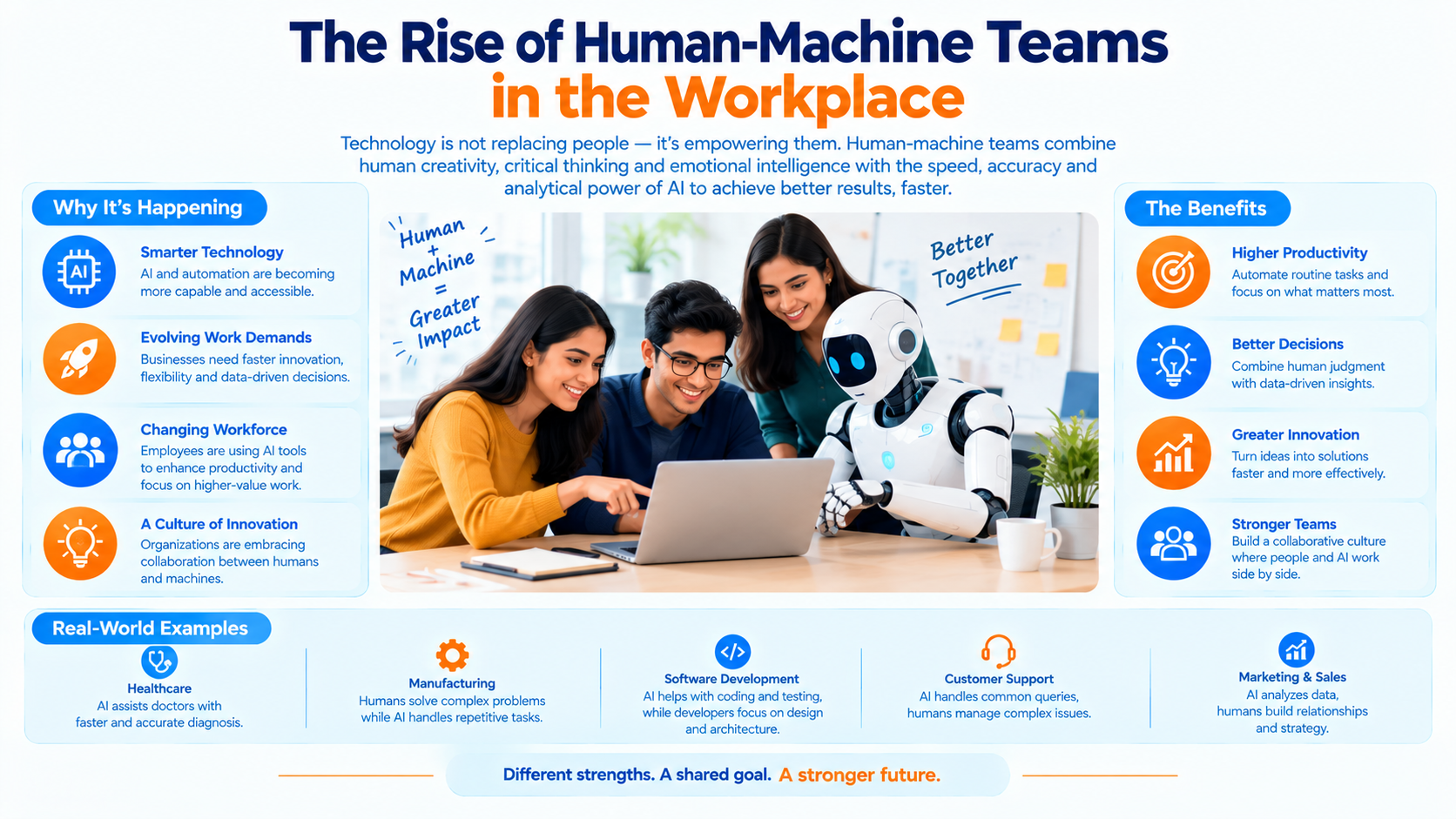
What happens when your team includes colleagues that are not people? When an AI agent is assigned work, tracked against outcomes, and evaluated on performance? When a human and a machine collaborate on a task neither could complete alone, and the result is better than either would produce separately?
This is already happening. The question is no longer whether human-machine teams will form, but whether organizations will design them deliberately or let them emerge chaotically.
What Human-Machine Teams Actually Are
A human-machine team is a working unit in which humans and AI systems share a goal, divide work, and coordinate to achieve an outcome.
The distinction from tool use:
| Traditional Tool Use | Human-Machine Team |
|---|---|
| Human directs, tool executes | Both contribute judgment |
| Tool has no autonomy | Machine takes actions independently |
| Human owns all outcomes | Accountability is shared and defined |
| Machine has no role | Machine occupies a defined role |
| Coordination is manual | Coordination is continuous |
The critical difference is autonomy. A tool does what it is told. A teammate acts, adapts, and sometimes surprises you.
What Changes When Machines Join the Team
Work Is Divided Differently
Humans and machines have different strengths. Teams work best when work is divided to match those strengths.
Where machines excel:
-
Volume and consistency
-
Pattern recognition at scale
-
Tireless execution
-
Simultaneous attention to many signals
Where humans excel:
-
Judgment under ambiguity
-
Empathy and relationship
-
Ethical reasoning
-
Creative reframing
-
Accountability for consequences
The design question: For each task, which party should own it? The answer is rarely "one or the other" — it is usually a division of labour with defined handoffs.
Coordination Becomes the Hard Part
When a team is all humans, coordination happens through conversation, meetings, and shared context. When machines are on the team, coordination must be designed.
What must be defined:
-
How work is handed from human to machine and back
-
What context travels with the work
-
When the machine escalates to a human
-
When the human overrides the machine
-
How both parties know the current state
Accountability Must Be Explicit
A machine cannot be accountable. It can be responsible in the sense of executing, but accountability — the willingness to answer for outcomes remains human.
The design principle: Every human-machine workflow must have a named human accountable for the outcome, even when the machine performs most of the work.
Trust Must Be Built Incrementally
Humans do not trust machines immediately, and should not. Trust is built through demonstrated reliability.
The pattern: Start with the machine in an advisory role. Expand to action with confirmation. Expand to autonomous action within defined bounds. Each expansion is earned by evidence.
Performance Must Be Measured Differently
Traditional performance metrics assume human work. Human-machine teams require metrics that reflect the combined output.
What to measure:
-
Outcome quality, not just throughput
-
Escalation rate and appropriateness
-
Human time freed for higher-value work
-
Error rates and their sources
-
Trust and adoption over time
The Roles That Emerge
Human-machine teams create roles that did not exist before.
The Orchestrator
Designs and manages the workflow. Decides which tasks go to which party. Monitors performance and adjusts.
What they need: Understanding of both the domain and the machine's capabilities and limits.
The Evaluator
Assesses whether machine output is correct. Provides feedback that improves the system.
What they need: Deep domain expertise enough to recognize when the machine is wrong.
The Exception Handler
Takes over when the machine escalates or fails. Handles the cases the machine cannot.
What they need: The ability to work with incomplete context and make judgment calls.
The Trainer
Improves the machine's performance through feedback, prompt refinement, and evaluation design.
What they need: Understanding of how the machine learns and where it fails.
These roles are not always separate people. In small teams, one person may hold several.
Where Human-Machine Teams Work Best
Not every task benefits from human-machine collaboration.
Good candidates:
-
High-volume work with clear success criteria
-
Work where the machine handles the common case and humans handle exceptions
-
Work requiring consistency that humans cannot sustain
-
Work requiring judgment that machines cannot provide
Poor candidates:
-
Work requiring deep relationship and trust
-
Work where errors are catastrophic and the machine is unreliable
-
Work with no clear definition of success
-
Work where the machine cannot be evaluated
The practical question: Can you tell whether the machine did well? If not, you cannot build a team around it.
The Organizational Changes Required
Human-machine teams require changes beyond the workflow design.
Role Redesign
Roles must be redefined around what humans uniquely contribute, not around tasks the machine now handles.
The risk: If roles are not redesigned, humans experience the machine as a threat rather than a teammate.
Skill Development
Humans need skills for working with machines: directing them, evaluating their output, and recognizing their limits.
The gap: Most organizations train people on tools, not on collaboration with autonomous systems.
Management Models
Managers must learn to manage teams that include non-human members.
What changes: Delegation, performance management, and escalation all operate differently.
Cultural Readiness
Trust in machines is not automatic. It is built through experience and evidence.
What helps: Transparency about what the machine does, why, and how to correct it.
The Risks
Human-machine teams introduce risks that purely human teams do not have.
Over-reliance. Humans defer to the machine even when it is wrong, because it is usually right.
Diffusion of responsibility. When the machine acts, humans may feel less accountable for outcomes.
Skill atrophy. Humans who stop practising a skill lose it, even if the machine handles the task.
Opacity. When the machine's reasoning is unclear, humans cannot evaluate it.
Automation complacency. Vigilance declines when the machine performs reliably, making the rare failure harder to catch.
The mitigation: Deliberate design for human oversight, periodic manual practice, and transparency in machine reasoning.
Implementation Roadmap
Phase 1: Identify (Weeks 1-4)
-
Map candidate workflows. Where could a human-machine team improve outcomes?
-
Define success criteria. How will you know the team is working?
-
Identify the division of labour. Which tasks go to which party?
-
Define accountability. Who owns the outcome?
Phase 2: Build (Weeks 5-10)
-
Start with advisory. The machine suggests; the human decides.
-
Expand to action with confirmation.
-
Expand to autonomous action within defined bounds.
-
Build escalation paths.
-
Instrument performance and trust.
Phase 3: Scale (Weeks 11-16+)
-
Redesign roles around human contribution.
-
Train for collaboration, not just tool use.
-
Adapt management models.
-
Review and expand autonomy as trust is demonstrated.
Frequently Asked Questions
Q1: What is a human-machine team?
A working unit in which humans and AI systems share a goal, divide work, and coordinate to achieve an outcome. The machine has autonomy; the human retains accountability.
Q2: How is this different from using AI tools?
Tools execute instructions. Teammates act, adapt, and sometimes surprise you. The difference is autonomy and the coordination it requires.
Q3: Who is accountable when a machine acts?
The human owner of the workflow. A machine cannot be accountable in the sense of answering for outcomes. Every workflow needs a named human accountable for results.
Q4: How do I build trust in a machine teammate?
Incrementally. Start with advisory, expand to action with confirmation, then to autonomous action within bounds. Each expansion is earned by demonstrated reliability.
Q5: What are the biggest risks?
Over-reliance, diffusion of responsibility, skill atrophy, opacity, and automation complacency. All are mitigated by deliberate design for human oversight.
Q6: How can Innovative AI Solutions help?
We help organizations design human-machine workflows from task division and escalation paths to accountability design, performance measurement, and role redesign. Explore our services to see how we approach AI-enabled operations. Based in Delhi, serving clients across India.
Why Delhi is a Great Hub for Human-Machine Collaboration
Delhi is emerging as a hub for enterprise AI adoption, backed by a thriving IT services ecosystem and a large base of organizations integrating AI into operations. As Indian enterprises move from AI pilots to production workflows, designing human-machine teams deliberately becomes the difference between automation that works and automation that is quietly abandoned.
What We Offer at Innovative AI Solutions
-
Workflow Design: We identify where human-machine teams create value and how to structure them.
-
Task Division: We define which tasks go to machines and which remain human.
-
Escalation Design: We build the handoff patterns that keep humans in control of exceptions.
-
Accountability Frameworks: We ensure every workflow has a named human owner.
-
Performance Measurement: We track outcomes, escalation, and trust over time.
-
Role Redesign: We help redefine roles around uniquely human contribution.
Final Thought
The shift is clear: from humans using tools to humans and machines working as teams. This changes how work is divided, how coordination happens, how accountability is assigned, and what skills matter. Organizations that design human-machine teams deliberately will capture the value. Those that bolt AI onto existing processes will discover that a teammate is not a tool, and that collaboration must be designed.
Contact Us:
Phone: +91 7464 099 059 / +91 9689967356
Email: info@innovativeais.com
Address: 904, 9th floor Pearls Best Heights-I, Netaji Subhash Place, Delhi-110034
Website: https://innovativeais.com
About the Author
Abhishek Kumar
Founder & CEO, Innovative AI Solutions