The Big Question
Why is generic AI failing where it matters most?
For three years, the promise was universal. One large model. One platform. One API that could answer any question, automate any task, serve any industry. The "horizontal" dream of AI.
That dream is colliding with reality.
Enterprise buyers have shifted their focus from "soft" efficiency gains to hard ROI. Futurum's 2026 Enterprise Software Decision Maker Survey found that productivity metrics are less important, while direct financial outcomes like revenue growth and profit improvement are nearly twice as critical . And when businesses demand measurable bottom-line impact, generic tools struggle to deliver.
The reason is context. A horizontal AI model trained on internet data doesn't understand your compliance requirements. It doesn't know your industry's edge cases. It can't navigate the messy, undocumented reality of how work actually gets done in your organization.
A16z partner Angela Strange described this gap precisely: much of how an organization actually works is "undocumented, not in training data, and not something anyone can sit down and draw a flowchart for." That's the value that consulting firms like BCG and McKinsey provide entering a company, talking to people across departments, figuring out "how this actually works" versus "how it's supposed to work" .
Generic AI can't do that. Vertical AI can.
What "Vertical AI" Actually Means
Vertical AI isn't a single technology. It's a different philosophy.
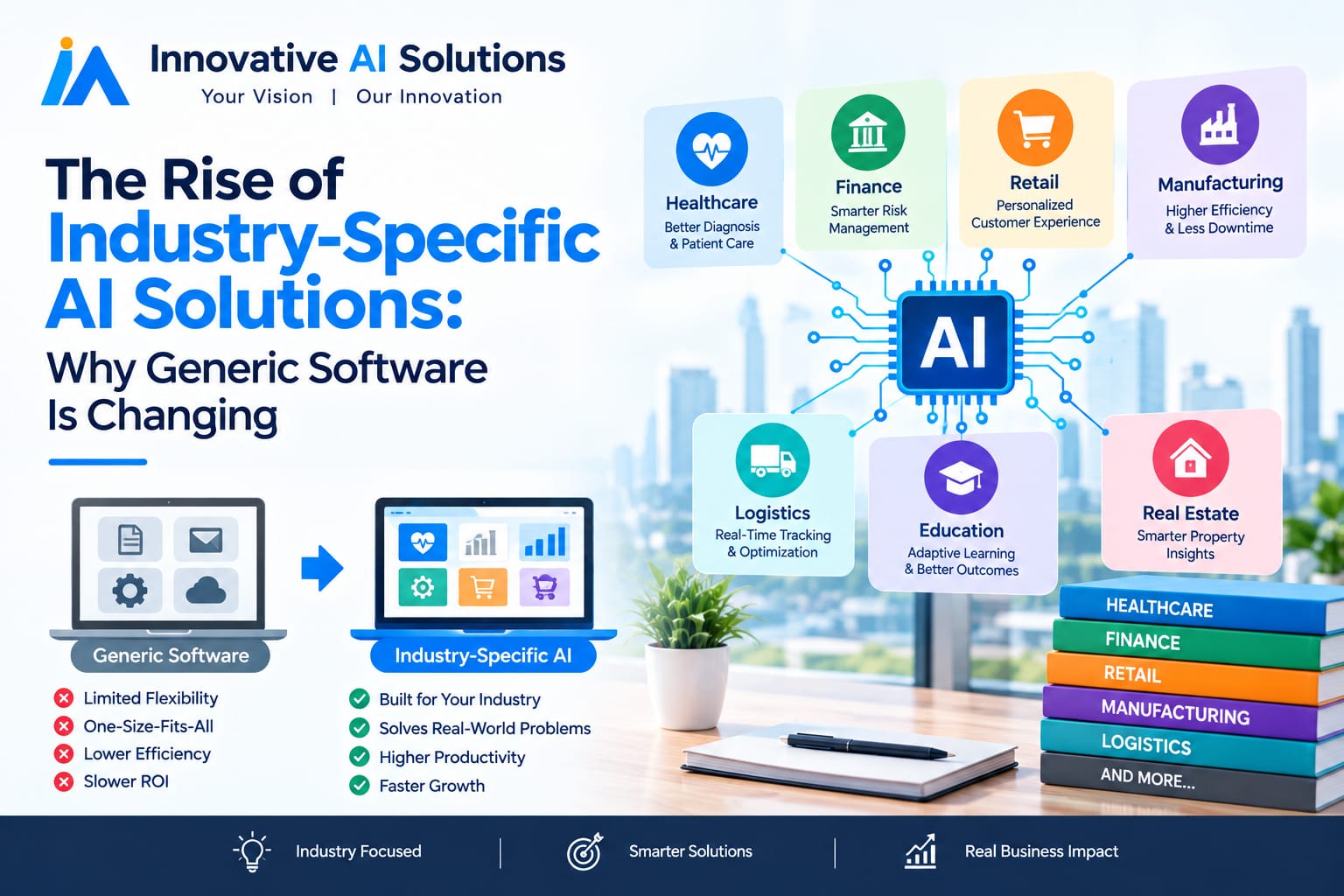
Horizontal AI optimizes for scale. It prioritizes generality, flexibility, and broad applicability. It can draft an email for sales, summarize a meeting for a project manager, and translate a document for marketing. It handles individual actions, not end-to-end processes .
Vertical AI optimizes for consequence. It prioritizes correctness, accountability, and reliability within a specific domain. It's grounded in domain-specific data, follows industry rules, integrates with specialized systems, and executes complete workflows .
The difference is concrete. A horizontal CRM agent drafts an email. A vertical CRM agent scores and routes leads based on pipeline data, schedules follow-ups, and updates deal stages. A horizontal support agent summarizes a ticket. A vertical IT agent triages by severity, assigns based on team capacity and expertise, sets SLA timelines, and tracks resolution metrics .
This is why embedded, pre-built, verticalized AI delivers the fastest and most predictable ROI, especially in regulated and operationally complex industries. These solutions arrive with domain context, compliance controls, and workflow fit that horizontal platforms often lack .
The Data: Where AI Value Actually Lives
The usage data confirms the shift.
An analysis of 100 trillion tokens of real-world AI usage by OpenRouter and Andreessen Horowitz found that the most economically significant applications are highly complex, vertical-specific programming and multi-step agentic workflows. Programming usage exploded from 11% at the start of 2025 to over 50% by year-end .
More telling: the market is not converging on a single "best" model. A multi-model reality is emerging. Anthropic's Claude is used for over 80% of programming tasks, while other models dominate creative or role-playing scenarios . Different domains demand different models trained on different data, optimized for different outcomes.
The agent success data is even more striking. AI agent success on real-world tasks went from 20% in 2025 to over 77% in 2026. The reason wasn't better models. It was smarter deployment. Teams stopped trying to make general AI do specialized work. They started deploying purpose-built agents for specific tasks each narrow, fast, and reliable in its lane. As one analysis put it: "Vertical AI is winning because domain specificity eliminates the customization tax" .
Why Regulated Industries Punish Generality
The strongest case for vertical AI comes from high-stakes environments.
In healthcare, government, infrastructure, and defense, generality is a liability. These sectors operate under four constraints that break horizontal abstractions :
Real-world data is messy. Incomplete, inconsistent, shaped by decades of legacy decisions. A generic model trained on clean internet data doesn't know how to handle a hospital's 15-year-old records system.
Rules matter more than predictions. LLMs run probabilistically. Being "mostly right" isn't enough when systems must encode policies, exceptions, and audit trails. A 90% accurate answer isn't a passing grade in clinical decision support.
Human oversight is a requirement. Supervised intelligence under scrutiny isn't optional it's integral. Regulators don't accept "the AI decided."
Operational risk trumps replacement risk. Customers ask: "What happens if this breaks?" The answer determines whether a system becomes infrastructure or remains a tool.
This is why 99%+ accuracy at scale matters more than feature breadth in these environments . And why the most defensible AI businesses don't ask "What can this model do?" They ask "What must this system never get wrong?"
The Vertical AI Market Is Responding
The market data confirms the shift.
Vertical AI is segmented across IT & Telecommunications, BFSI, Retail & E-commerce, Healthcare, Industrial Manufacturing, Media & Entertainment, and Automotive . The software segment dominates at 47.6% of market revenue in 2025, driven by increasing deployment of AI-driven applications across these industries .
Machine learning holds the largest technology share, but computer vision is growing fastest, fueled by manufacturing quality inspection, surveillance, and autonomous applications . On-premises deployment is also growing fastest driven by data security, privacy, and compliance concerns in BFSI, healthcare, and government sectors .
Funding is following. VerbaFlo, a vertical AI platform for residential real estate, raised $7M in seed funding** to automate conversations across the resident lifecycle answering property queries, scheduling viewings, and handling maintenance requests without human intervention . Rivvun AI raised **$7.55M to deploy vertical-specific AI agents that recover $2 trillion in contractually committed enterprise value that fails to reach the bottom line each year targeting pharma, healthcare, banking, and retail .
Even industrial manufacturing is going vertical. A Shanghai startup founded by former Flexiv executives raised seed funding for vertical industrial AI agents focused on grinding and welding not general-purpose humanoid robots, but domain-specific systems that understand material mechanics and process physics .
What This Means for Your Business
The implication is clear: the generic AI era is ending. The vertical AI era has begun.
This doesn't mean horizontal AI disappears. It means horizontal AI becomes infrastructure a baseline capability, not a differentiator. The value migrates to the intelligence layer: the domain knowledge, the workflow logic, the compliance controls, the proprietary data that makes AI actually useful in a specific context.
For businesses evaluating AI investments, the framework is simple:
Where failure has consequences, choose vertical. Healthcare, finance, legal, industrial operations. These domains demand correctness, auditability, and domain depth that generic tools can't provide.
Where failure is tolerable, horizontal can work. Drafting emails, summarizing documents, basic productivity tasks. These benefit from general-purpose AI at low risk.
Where ROI is measured in P&L impact, vertical wins. Horizontal AI delivers "productivity gains" that are hard to quantify. Vertical AI delivers measurable outcomes tied to specific KPIs pipeline velocity, mean time to resolution, cost per transaction .
The businesses that thrive in 2026 won't be the ones with the most general AI. They'll be the ones with the right vertical AI purpose built for their industry, embedded in their workflows, and accountable for outcomes they can measure.
Frequently Asked Questions
Q1: What is the difference between vertical AI and horizontal AI?
Horizontal AI is general-purpose designed to work across many industries and functions. Vertical AI is industry-specific trained on domain data, embedded in specialized workflows, and optimized for the rules and constraints of a particular sector .
Q2: Why is vertical AI gaining traction now?
Enterprise buyers have shifted from "soft" efficiency metrics to hard ROI. Vertical AI delivers faster and more predictable ROI because it arrives with domain context, compliance controls, and workflow fit that horizontal platforms lack. The customization tax of adapting generic AI to specific workflows erodes its value proposition .
Q3: What industries benefit most from vertical AI?
Regulated and operationally complex industries: healthcare, financial services, manufacturing, life sciences, and government. These sectors have compliance requirements, data residency constraints, and specialized workflows that limit the effectiveness of generic tools .
Q4: How much faster is vertical AI to deliver ROI?
Futurum's analysis concludes that embedded, pre-built, verticalized AI delivers the fastest and most reliable near-term ROI, especially in regulated or physically constrained environments. Custom and add-on approaches can yield higher long-term returns but demand more maturity and take longer .
Q5: Does vertical AI mean smaller models?
Not necessarily smaller, but more focused. A vertical model can be trained on sector-specific data payment records, legal documents, medical reports and adapted to a company's actual data environment. The value comes from domain depth, not parameter count .
Q6: How much does it cost to build a vertical AI model?
Adapting an existing 7-13B model can cost ₹40 Lakh to ₹3 Cr over 3-6 months. Training further on large sector-specific data can cost ₹8 Cr to ₹15 Cr. Building from scratch can cost ₹80 Cr to ₹150 Cr .
Q7: Can horizontal AI platforms move into vertical use cases?
Yes, but with limits. AI enables horizontal platforms to customize for vertical use cases. However, in environments where failure has consequences, embeddedness matters more than reach. Purpose-built vertical platforms have structural moats that general-purpose tools can't replicate quickly .
Q8: What is the "customization tax" in AI?
The cost and friction of adapting a generic AI tool to a specific workflow. It includes data preparation, integration work, and ongoing tuning. Vertical AI eliminates much of this tax because it's built for the workflow from the start .
Q9: How is the vertical AI market growing?
The global AI agents market is projected to reach **$182.9B by 2033**, growing at a **49.6% CAGR** from $10.9B in 2026. Vertical agents are where the investment is moving because they deliver measurable business outcomes tied to specific KPIs .
Q10: What should businesses look for in a vertical AI solution?
Domain-specific training data, compliance certifications, workflow integration depth, measurable outcome metrics, and accountability for results. Ask: "What must this system never get wrong?" rather than "What can it do?" .
Frequently Asked Questions (Continued)
Q11: Is vertical AI only for large enterprises?
No. Small and medium enterprises are the fastest-growing segment for vertical AI, fueled by cost-effective cloud-based platforms and the need for operational efficiency .
Q12: What's the role of proprietary data in vertical AI?
Proprietary data is the moat. The workflow you ship on day one isn't the moat—it's the loop formed by production usage over time. Every escalation, exception, and human override becomes a signal that improves the system. That understanding only comes from running the same workflow thousands of times .
Q13: Can vertical AI run on-premises?
Yes. On-premises deployment is the fastest-growing deployment mode for vertical AI, driven by data security, privacy, and compliance requirements in BFSI, healthcare, and government sectors .
Q14: What happens to horizontal AI as vertical AI grows?
Horizontal AI becomes infrastructure a baseline capability. The value migrates to the intelligence layer: domain knowledge, workflow logic, and proprietary data that makes AI useful in specific contexts .
Q15: Why should I choose Innovative AI Solutions?
Because we build vertical AI that solves real problems. Because we understand that domain depth beats generality. Because we've delivered 100+ projects. Because your code is always yours.
Contact Us
Phone:
+91 7464 099 059
+91 9689967356
Email:
info@innovativeais.com
Address:
9th Floor, Pearls Best Heights-I,
Head Office: 904, Netaji Subhash Place,
Delhi – 110034