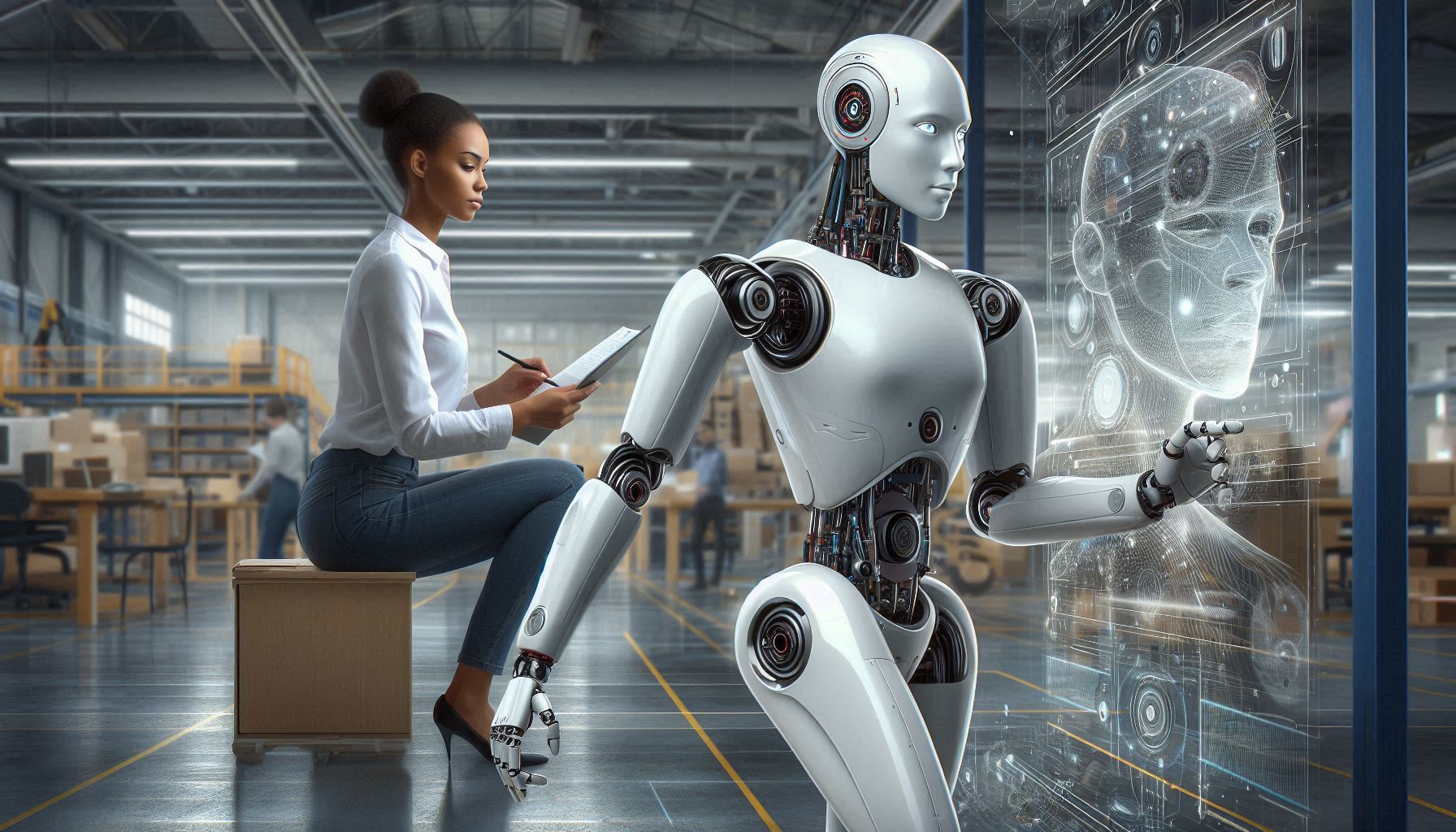
What Is Physical AI?
Physical AI refers to artificial intelligence embedded in machines and systems that interact directly with the physical world. Unlike purely digital AI, which processes data and generates recommendations, physical AI systems perceive, reason, and act – closing the loop between analysis and execution .
The Three Layers of Physical AI
| Layer | Function | How It Works |
|---|---|---|
| Perception | Sensing the environment | Depth sensors, 3D point cloud processing, computer vision capture spatial data about objects, surfaces, and spatial relationships |
| Reasoning | Understanding and deciding | Foundation models analyse sensory data, understand context, and determine appropriate actions. World foundation models trained on massive datasets of physical interaction generate synthetic training environments that mirror actual shop floor conditions |
| Action | Executing in the physical world | The system carries out its decision – picking, placing, assembling, moving – adapting in real time to variations and unexpected conditions |
The connection to the digital twin is crucial. Physical AI systems link simulations and reality through a continuous flow of data, adapting their decisions to real-world conditions . This closes the sim-to-real gap that has long plagued robotics deployment. Where traditional simulation-trained robots frequently underperform in the physical world because lighting shifts, material inconsistencies, and sensor noise create conditions that virtual environments could not faithfully replicate, world foundation models are changing that. Manufacturers pre-training automation on these models report cost and risk reductions of up to 40 percent compared to traditional commissioning .
Step 3: The Rise of Humanoid Robots
Humanoid robots represent the most visible embodiment of Physical AI. Designed to emulate human form and behaviour, they are uniquely suited to operate in unstructured environments originally tailored for humans. Equipped with sensory systems, vision modules, voice recognition, and decision-making algorithms, humanoid robots can engage in complex tasks that require dexterity, cognitive processing, and human-robot interaction .
Key Humanoid Robot Deployments in 2025-2026
| Company | Robot | Deployment Context | Key Capabilities |
|---|---|---|---|
| Agile Robots | Agile ONE | Factory and warehouse (Germany) | Human-height dexterity, fine motor skills for material handling, machine tending, component transport. Runs on factory-trained Physical AI stack that adapts to workflow changes |
| Humanoid | HMND 01 | Siemens Electronics Factory (Germany) | Wheeled robot autonomously picking totes from storage, transporting to conveyor. Achieved 60 tote moves per hour, 90%+ success rate in proof of concept |
| Figure AI | Figure 01 | Catalyst Brands distribution network (US) | Initial rollout focused on physically demanding supply chain tasks in Reno, Nevada Distribution Logistics Center |
| Persona AI | Humanoid platform | POSCO steelworks (South Korea) | Steel product logistics management in high-temperature industrial environment. Part of broader MOU to develop steelworks-specific model |
| Tesla | Optimus | Manufacturing assembly (planned) | Addressing labour shortages and skill gaps in assembly operations, with potential for widespread deployment |
| Doosan Robotics | Agentic Robot OS | Multiple applications | Integrating NVIDIA Isaac Sim, Isaac Lab, Cosmos world models, and Jetson Thor for perception, reasoning, simulation, and on-device inference. Developing depalletizing, sanding, and dual-arm/humanoid platforms |
Schaeffler recently announced plans with Humanoid to deploy between 1,000 and 2,000 humanoid robots across manufacturing sites by 2032 . TrendForce projects that China's humanoid robot output will grow sharply in 2026 as the sector moves closer to commercialisation .
Step 4: Industrial Robots vs. Humanoid Robots – A Comparative Analysis
Understanding the distinct roles of industrial and humanoid robots is essential for strategic automation investment. Research indicates a complementary rather than competitive relationship between the two types .
Head-to-Head Comparison
| Criterion | Industrial Robots | Humanoid Robots |
|---|---|---|
| Primary function | High-speed, high-precision operations in structured environments | Complex tasks requiring flexibility and human-like interaction in unstructured environments |
| Environment | Controlled, predictable settings with fixed workcells | Unstructured or semi-structured environments originally designed for humans |
| Adaptability | Rigid; requires reprogramming for changes | Adaptive; can respond to variations without reprogramming |
| Human collaboration | Limited; typically operates behind safety barriers | Designed for direct collaboration with human workers |
| Core applications | Welding, painting, assembly, material handling in mass production | Sorting, picking, packing, tasks requiring fine motor skills and cognitive processing |
| Speed | Very high | Moderate |
| Precision | Extremely high | High, with advances in dexterous manipulation |
| Cost | Substantial capital investment | Still high but decreasing; China pushing lower-cost models |
| Implementation complexity | Requires significant system integration and skilled personnel | Emerging, with focus on reducing deployment friction |
| Adoption maturity | Mature; over 4.3 million units installed globally by 2023 | Early adoption; rapid growth projected for 2026-2027 |
Source:
Step 5: The Economic and Operational Imperative
The push toward Physical AI and humanoid robotics is driven by concrete economic and operational pressures.
Global Robot Installation Trends
According to International Federation of Robotics data analysed by Karabegović , industrial robot installations have grown at an average annual rate of 10 to 15 percent over the past decade, reaching approximately 541,000 new units in 2023. Total cumulative installations reached roughly 4.3 million units. China accounts for over 51 percent of global installations, followed by Japan, the United States, South Korea, and Germany. Together, these five countries represent approximately 79 percent of total installations.
Asia/Australia leads with about 72 percent of global installations, followed by Europe at 17 percent and the Americas at 11 percent .
Why Physical AI Now?
| Driver | Explanation |
|---|---|
| Labour shortages | Humanoid robots are being explored to address challenges related to labour shortages and skill gaps in assembly operations, particularly in developed economies with aging workforces |
| Rising complexity | Modern production environments require systems that can handle variation, mixed products, and dynamic changes – capabilities that rigid automation cannot efficiently serve |
| Cost reduction | Early physical AI deployments report cost and risk reductions of up to 40 percent compared to traditional commissioning, with edge cases stress-tested in software rather than live production |
| Technological convergence | Advances in foundation models, 3D sensing, simulation, and computing have made physical AI practical at industrial scale |
| Strategic competition | The US-China rivalry in humanoid robotics development is intensifying, with distinct competitive structures emerging (vertical integration, reliability-first in the US; speed-to-market, rapid scaling in China) |
POSCO Group's recent MOU to implement humanoid robots for steel product logistics management exemplifies the industrial adoption trend. The project involves POSCO identifying work sites, POSCO DX designing robot automation systems, and Persona AI developing a humanoid robot platform tailored to the steelworks environment .
Step 6: The Technology Stack Powering Physical AI
The Spatial Intelligence Layer
Traditional machine vision interprets the world through 2D images – a flat projection that works for simple inspection tasks but falls short on complex assemblies, freeform surfaces, and components where fit depends on precise spatial relationships. Depth sensors and 3D point cloud processing provide a fundamentally different input: a dense geometric representation of every surface, capturing exact dimensions, surface normals, and spatial relationships .
Agentic robotics breaks the constraint of fixed programming. Rather than following a script, an agentic system perceives its environment through sensors, reasons about what it sees using a foundation model, and selects an appropriate action from a learned policy. If a component arrives at a slightly different orientation, the system adapts. If a weld surface shows unexpected variation, the system adjusts its approach rather than stopping the line .
From Digital Twin to Digital Thread
The Digital Twin – a virtual replica of the factory floor – has been the dominant paradigm for manufacturing simulation. But physical AI enables a Digital Thread that eliminates the delay between engineering and production. When an AI agent detects a deviation from specification, it feeds back into the engineering model in near real time. When a change is approved, it propagates to production without manual handoff. Manufacturers with mature Digital Thread implementations report time-to-market improvements of 20 to 30 percent .
The Physical AI Stack
| Layer | Components | Function |
|---|---|---|
| Accelerated computing | NVIDIA GPUs, Jetson Thor, AI factory platforms | Compute infrastructure for training and inference |
| Foundation models | Cosmos world models, world foundation models | Generate synthetic training environments, provide reasoning capabilities |
| Simulation | Isaac Sim, Isaac Lab, Newton physics engine | Test and validate behaviours in virtual environments before physical deployment |
| Robotics frameworks | Agentic Robot OS, ROS, custom orchestration | Coordinate perception, reasoning, and action |
| Perception | Depth sensors, 3D point cloud processing, computer vision | Capture accurate spatial data |
| Execution | Robot arms, humanoid platforms, AGVs | Physical action in the factory environment |
Source:
Step 7: The Human Role – Collaboration, Not Replacement
A persistent concern about automation is job displacement. The evidence from physical AI deployments suggests a different trajectory: augmentation, not replacement.
The German Research Council Industrie 4.0 emphasises that skilled workers feed process knowledge into physical AI systems, make decisions in borderline situations, and monitor the AI. At the same time, the AI must learn from human expertise and make its decisions understandable to humans .
The MIT Technology Review, in partnership with Microsoft and NVIDIA, frames this as "human-led, AI-operated systems" where people set intent and intelligent systems execute, learn, and improve over time . This aligns with the "Agent-to-Agent to Human" pattern emerging in autonomous systems – AI handles execution within defined boundaries, while humans provide oversight and handle exceptions.
For physical AI to become an integral part of industrial processes, the systems must be trustworthy, transparent, and human-centred. Responsibilities must be clearly assigned. In addition to technical solutions, this requires procedural standards and certification processes .
Step 8: The Infrastructure Gap – Beyond the Robot
A critical insight from recent logistics automation research is that humanoid robots cannot succeed in isolation. They require the surrounding physical infrastructure to be equally intelligent .
As Terminal Industries points out, a humanoid robot may be able to sort or pack faster, but what happens if the trailer it needs is sitting in the wrong location? What happens if the warehouse believes a trailer is at Dock 12, but physically it is still waiting in the yard? In those moments, the robot is not the constraint. The constraint is the lack of real-time visibility into the physical environment .
The yard of the future is not just a more efficient version of today's yard. It is the operational layer that makes advanced automation possible. A warehouse full of robots still needs accurate arrivals, real-time trailer visibility, faster gate processing, smarter dock coordination, and a connected system of record that reflects the physical world .
This is why the next phase of logistics automation has to extend beyond warehouse robotics and into yard intelligence. Robots need clean data. AI needs physical visibility. Automation needs orchestration. The companies that win will not just automate tasks. They will automate awareness .
Step 9: Challenges and Open Questions
Despite rapid progress, significant challenges remain before physical AI and humanoid robots achieve widespread industrial deployment.
Technical Challenges
| Challenge | Description |
|---|---|
| Sim-to-real gap | Models that work well in the laboratory encounter sensor noise, material wear, malfunctions, and other dynamic environmental conditions in real factories. Digital twins help by continuously integrating feedback from the real environment |
| Adaptability | AI models must react flexibly to new situations without complete retraining. An adaptive robot should not need to be completely retrained for every single screw or workpiece. Special training methods such as continuous learning or transfer learning are intended to make AI applications more adaptable |
| Data quality | Physical AI systems depend on high-quality, real-time data from sensors and connected systems. Inconsistent or delayed data breaks the perception-action loop |
| Interoperability | Industrial systems use diverse interfaces, protocols, and data formats. Standardisation remains incomplete |
Operational Challenges
| Challenge | Description |
|---|---|
| Infrastructure readiness | Most industrial environments lack the real-time visibility and connected systems that physical AI requires. The yard, in particular, remains a manual gray zone |
| Staff qualifications | Skilled workers must be trained to work alongside physical AI systems – a different skillset than traditional automation |
| Safety and trust | Physical AI systems operating alongside humans require rigorous safety validation and certification processes. Trust must be engineered into the platform, not added after |
| SME access | Small and medium-sized enterprises may lack the resources to access and implement physical AI technologies, creating a competitive gap |
Regulatory and Strategic Challenges
The rapid advancement of humanoid robotics has also raised strategic questions about national competitiveness. Fujitsu's Chief Digital Economist, Dr. Jianmin Jin, notes that humanoid robots are emerging not just as automation tools but as a strategic platform reshaping industrial structures, with intensifying US-China development rivalry .
Step 10: The Road Ahead – Implications for Industry Leaders
For manufacturing and logistics executives, the emergence of physical AI requires strategic decisions about investment, infrastructure, and workforce development.
Three Dimensions to Evaluate
| Dimension | Questions to Ask |
|---|---|
| Perception | Are your sensors capturing spatial data or only 2D imagery? Do you have depth sensing and 3D point cloud capabilities? |
| Reasoning | Are your automation systems rule-based or capable of agentic decision-making? Can they adapt to variation without stopping the line? |
| Continuity | Is there a live connection between your engineering and production data, or are they separated by manual processes? Do you have a Digital Thread, not just a Digital Twin? |
Strategic Priorities for 2026-2027
| Priority | Action |
|---|---|
| Foundation infrastructure | Develop real-time visibility into physical operations – yard, inventory, material flow. Automate awareness before automating action |
| Pilot deployment | Begin with bounded, high-value use cases (e.g., tote picking, depalletizing, material transport) where physical AI can demonstrate clear ROI |
| Workforce development | Train skilled workers to operate alongside physical AI systems. Emphasise human-in-the-loop supervision and exception handling |
| Technology partnerships | Engage with platform providers (NVIDIA, Microsoft) and specialised robotics companies to access integrated stacks rather than building point solutions |
| Standards engagement | Participate in industry working groups developing standards for physical AI safety, interoperability, and certification |
Step 11: Frequently Asked Questions
Q1: What is the difference between traditional automation and Physical AI?
Traditional automation follows rigid, pre-programmed rules. If a part arrives at a slightly different orientation, the system fails. Physical AI systems perceive the variation, reason about it, and adapt their actions – recovering without human intervention .
Q2: Are humanoid robots ready for industrial deployment?
Yes, but in bounded use cases. Agile ONE is in production for factory and warehouse tasks . Siemens successfully completed a proof of concept with Humanoid's HMND 01, achieving 60 tote moves per hour with over 90 percent success rate . Figure AI has a commercial agreement with Catalyst Brands for distribution centre deployment . Full-scale, general-purpose humanoid deployment remains several years away.
Q3: Will Physical AI replace human workers?
Current evidence suggests augmentation, not replacement. Humans provide intent, oversight, and judgment. AI handles execution within defined boundaries. The German Research Council Industrie 4.0 emphasises that skilled workers feed process knowledge into physical AI systems and monitor their operation .
Q4: What is the sim-to-real gap, and why does it matter?
The sim-to-real gap is the performance degradation that occurs when systems trained in simulation are deployed in physical environments. Lighting shifts, material inconsistencies, and sensor noise create conditions that virtual environments cannot perfectly replicate. World foundation models are narrowing this gap, enabling pre-training that reduces deployment risk by up to 40 percent .
Q5: How do I know if my facility is ready for physical AI?
Evaluate across three dimensions: perception (spatial data capture), reasoning (agentic decision-making), and continuity (live connection between engineering and production data). If any dimension is weak, address the infrastructure gap before deploying physical AI .
Q6: What is the cost of implementing physical AI?
Costs vary widely based on use case, scale, and existing infrastructure. Early deployments report cost and risk reductions of up to 40 percent compared to traditional commissioning when using simulation-trained models . Humanoid robot costs are declining, with China pushing mass production of lower-cost units .
Step 12: Final Tagline
Physical AI is the bridge between the digital twin and the physical factory floor. Humanoid robots are its most visible expression. The transformation from traditional automation to autonomous systems is not about replacing humans or buying better hardware. It is about building intelligence that can perceive, reason, and act – reliably, safely, and at scale. The constraint is no longer hardware. The constraint is intelligence. And intelligence is now available at a scale and cost that makes deployment practical across a wide range of production environments .
Short version: Physical AI and humanoid robots in Industry 4.0 – technology stack, industrial robots vs. humanoids, real deployments, infrastructure requirements, and strategic roadmap for 2026-2027.
Hashtags: #PhysicalAI #HumanoidRobots #Industry40 #IndustrialAutomation #AgenticRobotics #SmartManufacturing #DigitalTwin #InnovativeAISolutions
Contact Us
Phone: +91 7464 099 059 / +91 96899 67356
Email: info@innovativeais.com
Address: Netaji Subhash Place, Pitampura, Delhi – 110034
Website: https://innovativeais.com
About the Author
Abhishek Kumar
Founder & CEO, Innovative AI Solutions
5+ years building AI systems for manufacturing, logistics, and industrial automation. Based in Delhi, serving clients across India and global markets.
Related services: to apply this in your business, explore our AI agent development and AI development services.