The Big Question
What happens when a business can be defined not by its headcount, but by its code? When a single human orchestrator can coordinate thousands of specialized AI agents to match the operational bandwidth of a 200-person company? When an enterprise can simulate a full year of operations complete with employee rosters, financial ledgers, board minutes, and even a supply-chain crisis without a single real-world transaction?
This is the question at the heart of the Synthetic Enterprise. It's a shift from viewing AI as a tool for efficiency to viewing it as a fundamental material for building organizations.
What Is a Synthetic Enterprise?
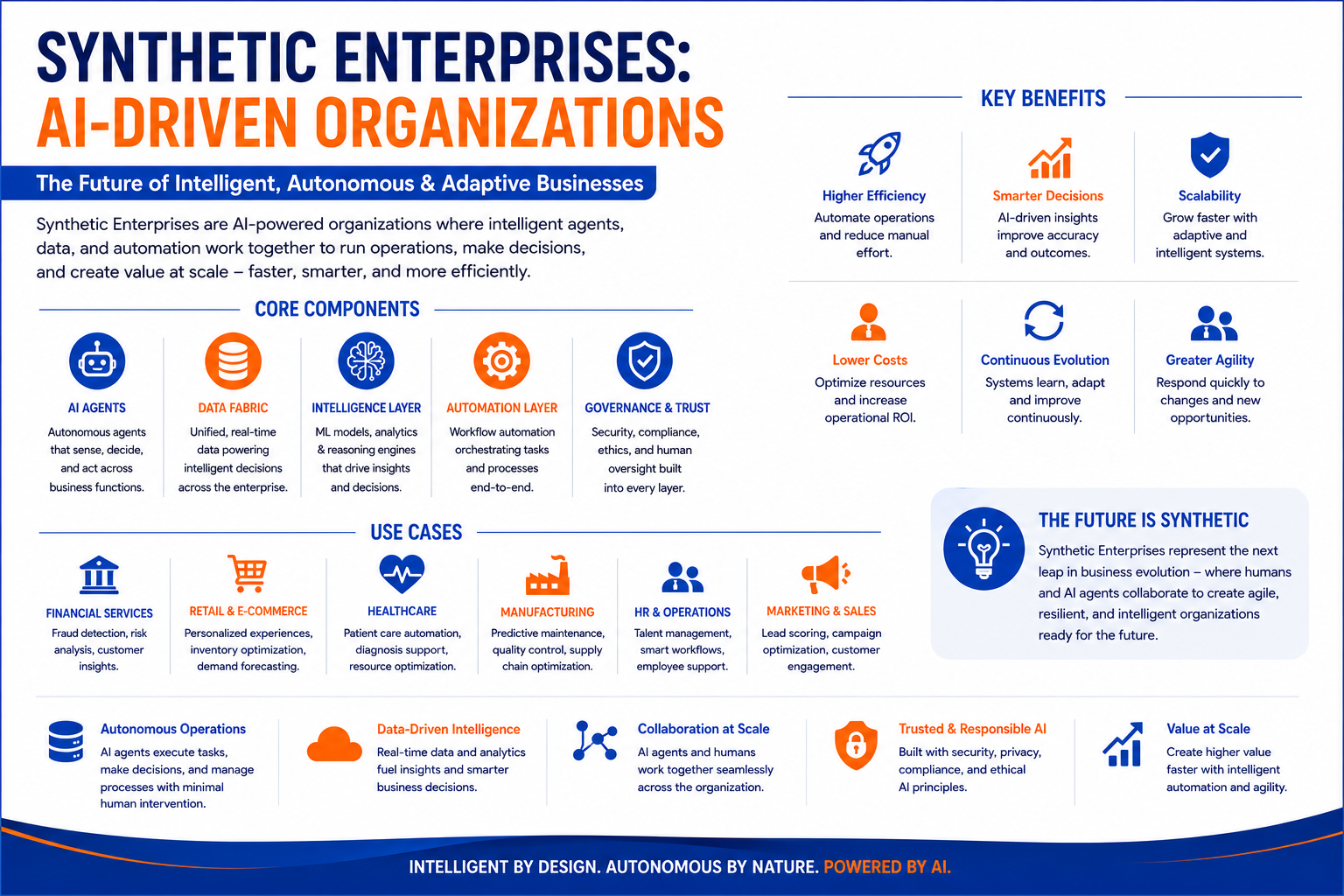
The Synthetic Enterprise is an AI-driven organization where business operations are increasingly defined by code, agentic workflows, and data-driven simulation. It is a conscious move away from rigid hierarchies and manual handoffs toward a fluid, orchestrated system of intelligence.
The "Soft Landing" Hypothesis
The dominant narrative around AI is one of displacement the "hard landing" where white-collar jobs vanish . An alternative view, the "AI Soft Landing" hypothesis, suggests a different outcome: the corporation doesn't disappear; it shrinks . The fundamental equation of scale is rewritten. Instead of measuring a company's capacity by its headcount, we measure it by how much organizational capacity a single human can coordinate . A team of 20 people, orchestrating thousands of agents, can match the capability of a 200-person organization . This shift democratizes scale, enabling a "Great Entrepreneurial Explosion" where the barrier to market entry plummets .
80% Synthetic, 20% Symbion
A model for the emerging enterprise defines it by a new ratio :
-
80% Synthetic (Mechanism): Relentless, fatigue-free execution. AI agents handle the flow of work, removing the "biological glue" of manual approvals, handoffs, and coordination that stitched together fragmented legacy systems .
-
20% Symbion (Meaning): Human leaders provide judgment, intervention, accountability, relationships, and purpose. The Symbion intervenes when the model is wrong, when the rule breaks, or when trust and consequences cannot be computed .
The Role of the "Architect"
This transformation creates an emerging apex role: the Architect . The Architect does not manage work. The Architect designs the system that optimizes it defining boundaries, ethics, escalation paths, and the swarm of agents that will execute the work .
The Promise: Simulation, Training, and Trust
Why build a synthetic company? The answer lies in creating a sandbox for the AI era.
Unlocking Realistic Evaluation
A major challenge in enterprise AI is evaluating models on realistic business tasks without breaching privacy or compliance . Teams often fall back to fragmented evaluations that are hard to compare or trust . Synthetic environments solve this by preserving behavioral patterns and cross-system dependencies while masking sensitive data, making offline evals more trustworthy and creating a clearer path to production .
The "Cirrus Sleep" Pilot
Turing.com recently demonstrated a system capable of generating an entire company from scratch . The pilot, a fictional DTC brand called "Cirrus Sleep, Inc.," includes:
-
A $3M Series A funding round.
-
$1.2M in first-year revenue.
-
15 employees, 90 SKUs, and a documented supply-chain crisis .
-
More than 500 graded tasks spanning product planning, financial forecasting, and board decision-making .
Crucially, the simulation includes "deliberate cross-source conflicts" mismatched inventory counts vs. sales figures specifically designed to test an AI model's ability to detect and reconcile discrepancies .
OrgForge: Multi-Agent Simulation Framework
Another research project, OrgForge, is an open-source multi-agent simulation framework that generates structured, temporally consistent organizational artifacts . By enforcing a strict "physics-cognition boundary," OrgForge produces a deterministic ground truth that prevents the AI from hallucinating contradictory facts across documents . It simulates interleaved Slack threads, JIRA tickets, Confluence pages, and Git pull requests, all traceable to a shared event log .
The Reality: Moving from Theory to Practice
The vision is compelling, but the path is complex. Architects building these systems face challenges in creating representative, realistic, and continuously quality-controlled environments .
What's Hard
The most significant hurdle is maintaining realism + privacy + consistency at the same time . While a simulation like "Cirrus Sleep" provides a self-consistent data set, ensuring that this data accurately mirrors the distributional complexity of a real enterprise is a significant engineering challenge. As one AI leader noted, "What looks like a data problem is usually a trust problem in disguise. Teams don't struggle with evals because they can't run experiments. They struggle because they don't trust what the results are actually telling them" .
What's Possible
Despite these challenges, the technology is moving rapidly. The ability to create a functioning, internally consistent company from scratch is here. The next step is designing the governance and change management frameworks required to make this a reality . The ultimate edge case is the creation of an operational "AI Twin" of the enterprise a parallel digital reflection capable of continuously experimenting and iterating without direct human intervention .
Implementation Roadmap
Phase 1: Audit the "Biological Glue"
Identify the key friction points in your organization the manual approvals, handoffs, and escalations that stitch your systems together . These are the first candidates for agentic automation.
Phase 2: Architect the Swarm
Begin designing the "swarms" of agents and human orchestrators that will operate around specific business outcomes . Define which processes will be fully autonomous ("Synthetic") and where human judgment is required ("Symbion").
Phase 3: Build the Sandbox
Invest in or build a synthetic environment like the "Cirrus Sleep" pilot to begin evaluating AI models on realistic business scenarios .
Phase 4: Formalize the Architect Role
Establish a leadership role responsible for designing the boundaries, ethics, and escalation paths of the agentic system .
Frequently Asked Questions
Q1: Is the Synthetic Enterprise just about replacing people?
No. It is about architecting an organization where a lean team of humans orchestrates a vast network of specialized AI agents. The goal is not a jobless future, but a future of "abundant capability," where humans focus on judgment, empathy, and creativity while agents handle relentless execution .
Q2: What is an "AI Twin"?
An AI Twin is an active, autonomous digital reflection of the enterprise capable of running entirely digital value chains, testing micro-strategies, and interacting with the physical world through automated APIs all while remaining anchored to human strategic guardrails .
Q3: How can I evaluate an AI's performance on business tasks?
Start by building a synthetic enterprise environment. Platforms like Turing.com's "Cirrus Sleep" pilot or frameworks like "OrgForge" allow you to create realistic, internally consistent, and privacy-safe data sets with known "ground truth" against which you can score AI performance .
Q4: How can Innovative AI Solutions help?
We help organizations design, build, and operationalize Synthetic Enterprise strategies. Our expertise spans agentic workflow design, AI evaluation, and governance frameworks for AI-native operations. Based in Delhi, serving clients across India.
Why Delhi is a Hub for Synthetic Enterprise Innovation
Delhi is a major technology hub with a deep pool of talent in software engineering, data science, and enterprise architecture. As enterprises in India look to scale efficiently and compete globally, the Synthetic Enterprise model with its promise of a 10x operational leverage represents a compelling strategic advantage.
What We Offer at Innovative AI Solutions
-
Synthetic Enterprise Strategy: We help you identify friction points in your organization and design an agentic architecture roadmap.
-
Agentic Workflow Design: We help you design "swarms" of Synthetics and Symbions to orchestrate core business outcomes.
-
AI Evaluation Sandboxes: We help you build synthetic environments for risk-free testing and training.
-
Governance & Change Management: We help you establish the ethical guardrails and psychological safety nets required for this structural evolution.
Final Thought
The Synthetic Enterprise is not a blueprint for a smaller company; it is a framework for a more capable one. The shift is clear: from managing people to orchestrating outcomes, from measuring headcount to measuring capacity. The organizations that master this new architecture will be the ones that define the next decade of business.
Contact Us:
Phone: +91 7464 099 059 / +91 9689967356
Email: info@innovativeais.com
Address: Netaji Subhash Place, Pitampura, Delhi – 110034
Website: https://innovativeais.com
About the Author
Abhishek Kumar
Founder & CEO, Innovative AI Solutions
5+ years building AI, cloud, and enterprise systems. Based in Delhi, serving clients across India.
Related services: to apply this in your business, explore our AI agent development and AI development services.