Agentic AI and Multi-Agent Systems
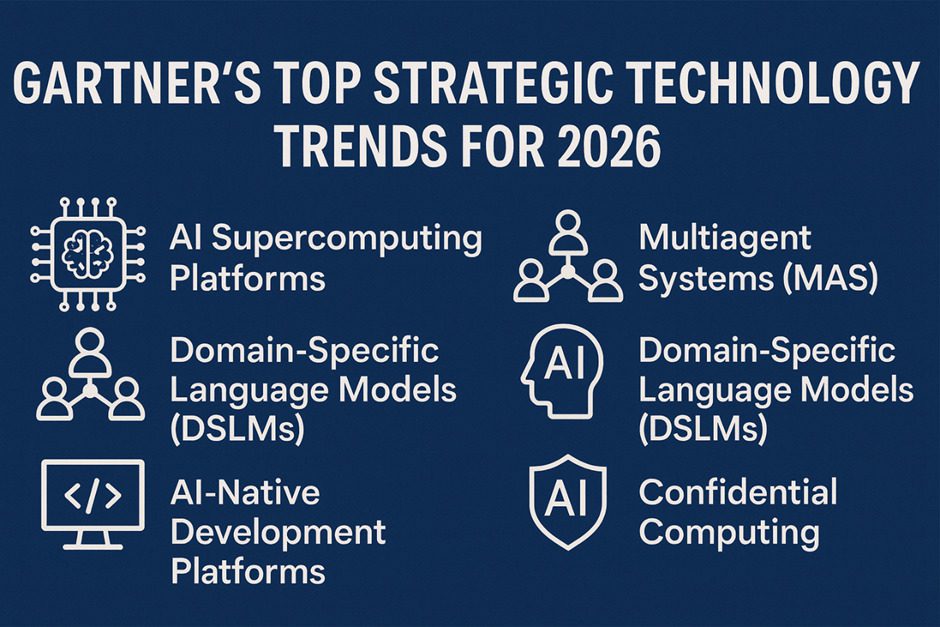
The single most important trend across all major analyst firms is the shift from generative AI to agentic AI. Gartner lists Multiagent Systems as a top strategic trend for 2026, defining them as collections of AI agents that interact to achieve individual or shared complex goals. These agents can be developed and deployed independently across distributed environments .
Forrester specifically calls out Agentic Commerce as a short-term emerging technology that will deliver ROI within two years. Businesses will see returns in owned environments such as apps and websites, where agentic commerce and personalization lower friction and improve sales .
Gartner emphasizes that 2025 was about AI pilots and experimentation. 2026 is about delivering agentic AI ROI. The shift from GenAI to agentic AI is not because it is newer technology, but because it has more potential to generate measurable business value .
IDC reinforces this trend, noting that autonomous AI agents that interact with the real world, search the web, manage knowledge work, and use tools are rapidly becoming central to enterprise AI strategy .
Step 3: Multi-Model and Multi-Architecture AI
The era of relying solely on large language models is ending. IDC argues forcefully that the future of AI is no longer about a single model architecture. A new, more diverse ecosystem is rapidly taking shape, including deep reasoning models with adaptive thinking, multimodal models handling text, image, video, and audio, small efficient models for edge and latency-sensitive use cases, domain-specific models tailored to industries like healthcare and finance, and models with novel architectures beyond transformers, such as structured state space models, mixture of experts, and liquid neural networks .
Forrester confirms this shift, noting that frontier models remain foundational, but AI is no longer confined to digital workflows and software. It is moving into the physical world, powering robots, vehicles, and ambient experiences .
Step 4: Domain-Specific Language Models
Gartner identifies Domain-Specific Language Models as a top strategic trend for 2026. CIOs and CEOs are demanding more business value from AI, and generic large language models often fall short for specialized tasks. DSLMs fill this gap with higher accuracy, lower costs, and better compliance .
These models are trained or fine-tuned on specialized data for a particular industry, function, or process. Unlike general-purpose models, DSLMs deliver higher accuracy, reliability, and compliance for targeted business needs. Gartner predicts that by 2028, over half of the GenAI models used by enterprises will be domain-specific .
IDC echoes this, noting that solving real-world business problems often requires models trained on a more diverse corpus of data. LLMs think in language, but many business problems require reasoning in numbers, space, time, and physics .
Step 5: Physical AI and Humanoid Robots
Forrester identifies physical AI as a transformative force. AI is moving beyond software into physical environments, powering robots, drones, and smart equipment that sense, decide, and act .
Gartner lists Physical AI as a top trend, bringing intelligence into the real world and delivering measurable gains in industries where automation, adaptability, and safety are priorities .
Forrester specifically calls out Humanoid Robots as a medium-term emerging technology, with the potential to eliminate labor bottlenecks across industries. However, the technology will deliver limited near-term value until organizations overcome integration, scaling, safety, data, and workforce challenges .
Step 6: AI Supercomputing Platforms and Neoclouds
Gartner identifies AI Super Computing Platforms as a top strategic trend. These platforms integrate CPUs, GPUs, AI ASICs, neuromorphic, and alternative computing paradigms, enabling organizations to orchestrate complex workloads .
Forrester predicts that neoclouds will grab $20 billion in revenue, eroding hyperscaler dominance in generative AI. Neoclouds are specialized cloud providers that focus on high-performance GPUs for AI workloads. Their adoption will surge as they expand orchestration capabilities, support open-source models, and offer sovereign AI solutions .
Step 7: AI Security and Trust Technologies
As AI scales across enterprises, security has become paramount. Forrester lists AI security and trust technologies as a short-term emerging technology. Integrated security, governance, and trust controls are becoming essential, especially for sectors that depend on high-stakes decisioning systems such as financial services, healthcare, and the public sector .
Gartner specifically calls out AI Security Platforms as a top trend, providing a unified way to secure third-party and custom-built AI applications. These platforms centralize visibility, enforce usage policies, and protect against AI-specific risks such as prompt injection, data leakage, and rogue agent actions. Gartner predicts that by 2028, over 50% of enterprises will use AI security platforms to protect their AI investments .
Step 8: World Models and Physical Reasoning
MIT Technology Review highlights world models as a breakthrough technology for 2026. A research paper from arXiv argues that large language models remain limited in settings requiring causal reasoning, persistent state tracking, and long-horizon planning. These limitations may arise from an objective-level mismatch between sequence prediction and reasoning over latent environment dynamics .
In a controlled study comparing LLMs operating purely over textual observations against agents with explicit access to a latent state space, the latter achieved an aggregate win rate of 79% versus only 11% for LLMs. Qualitative analysis revealed that LLMs struggle with invalid actions, state-tracking errors, and short-horizon reasoning failures .
IDC also identifies vision-action and world models as emerging architectures that interact with real environments, solving problems differently than transformer-based models .
Step 9: AI-Native Development Platforms
Gartner lists AI-native development platforms as a top strategic trend. These platforms use generative AI to create software faster and easier than was previously possible. Software engineers embedded in the business, acting as forward-deployed engineers, can work together with domain experts to develop applications. Organizations can have tiny teams of people paired with AI to create more applications with the same level of developers .
Forrester similarly calls out Agentic Software Development as a medium-term emerging technology, unlocking software development lifecycle acceleration as agents generate and refine software artifacts. However, the technology will take a few more years to deliver significant benefits as agent coordination improves and stronger guardrails are implemented .
Gartner predicts that by 2030, AI-native development platforms will result in 80% of organizations evolving large software engineering teams into smaller, more nimble teams augmented by AI .
Step 10: Quantum Computing and Post-Quantum Security
Forrester identifies quantum computing as a long-term emerging technology that will take longer to deliver tangible value for enterprises. Advances in quantum hardware, algorithms, and hybrid architectures point toward future breakthroughs in optimization, simulation, cryptography, and materials science. Financial services, pharmaceuticals, and manufacturing will benefit from quantum first .
Gartner predicts that quantum security spending will exceed 5% of the overall IT security budget in 2026. Security teams will rapidly ramp up quantum security spending across consulting services to plan quantum security migrations and cryptographic discovery tools to prioritize migrating high-impact systems .
Step 11: Digital Provenance and Geopatriation
Gartner identifies Digital Provenance as a top strategic trend for 2026. As organizations rely more on third-party software, open-source code, and AI-generated content, verifying digital provenance has become essential. Digital provenance refers to the ability to verify the origin, ownership, and integrity of software, data, media, and processes. Gartner predicts that by 2029, those who fail to adequately invest in digital provenance capabilities will be open to sanction risks potentially running into the billions of dollars .
Geopatrion is another top trend, meaning moving company data and applications out of global public clouds into local options such as sovereign clouds, regional cloud providers, or an organization's own data centers due to perceived geopolitical risk. Gartner predicts that by 2030, more than 75% of European and Middle Eastern enterprises will geopatriate their virtual workloads into solutions designed to reduce geopolitical risk, up from less than 5% in 2025 .
Step 12: Preemptive Cybersecurity and Confidential Computing
Gartner identifies Preemptive Cybersecurity as a top trend, trending as organizations face an exponential rise in threats targeting networks, data, and connected systems. Gartner forecasts that by 2030, preemptive solutions will account for half of all security spending, as CIOs shift from reactive defense to proactive protection using AI-powered SecOps and programmatic denial and deception .
Confidential Computing is another Gartner trend, changing how organizations handle sensitive data. By isolating workloads inside hardware-based trusted execution environments, it keeps content and workloads private even from infrastructure owners, cloud providers, or anyone with physical access to the hardware. By 2029, Gartner predicts more than 75% of operations processed in untrusted infrastructure will be secured in-use by confidential computing .
Step 13: Analyst Summary – Investment Horizons
Forrester categorizes emerging technologies by their impact timelines to help enterprises prioritize investments:
Short-term (0 to 2 years): Agentic commerce, AI security and trust technologies. These are quickly moving from trial to real use, delivering benefits to early adopters with solid business cases .
Medium-term (2 to 5 years): Agentic software development, humanoid robots. These require discipline, vision, and tolerance for risk in return for larger rewards .
Long-term (5+ years): Quantum computing. Broad commercial value remains years away, though financial services, pharmaceuticals, and manufacturing will benefit first .
Gartner notes that 64% of CIOs expect moderate or significant change to their planned outcomes within the next 24 months. Technology executives planning budget increases and those planning cuts are both investing heavily in AI, which could lead to future gaps in competitive advantage .
Step 14: Frequently Asked Questions
Q1: What is the single most important AI trend for 2026?
Agentic AI and multi-agent systems appear across all major analyst reports. Gartner states that 2025 was about AI pilots, but 2026 is about delivering agentic AI ROI. Forrester highlights agentic commerce as a short-term priority .
Q2: Are LLMs still relevant in 2026?
Yes, but the strategy has shifted. IDC argues that the future is multi-model, not single-model. Domain-specific language models, small efficient models for edge, and models with novel architectures are increasingly important alongside general-purpose LLMs .
Q3: Which technologies deliver the fastest ROI?
Forrester categorizes agentic commerce and AI security technologies as short-term, delivering benefits within two years. Agentic software development and humanoid robots are medium-term, requiring more patience .
Q4: What is the biggest risk in AI for 2026?
Forrester warns that the gap between inflated vendor promises and delivered value is widening, leading to a market correction. Enterprises will defer 25% of planned AI spend to 2027. Gartner emphasizes that security risks such as prompt injection, data leakage, and rogue agent actions must be addressed .
Q5: How should I prioritize AI investments in 2026?
Forrester recommends spreading investments across horizons: short-term technologies for quick returns, medium-term for larger rewards with more risk, and long-term bets like quantum computing for future positioning .
Step 15: Final Tagline
2026 is the year AI moves from hype to hard ROI. Agentic AI leads the charge, multi-model architectures replace single-model thinking, and physical AI brings intelligence into the real world. The organizations that win will not chase every trend but will invest strategically across short, medium, and long-term horizons.
Short version: Top 10 emerging technologies in AI for 2026 – Forrester, Gartner, and MIT breakdown. Agentic AI, multi-agent systems, domain-specific LLMs, physical AI, neoclouds, AI security, world models, quantum computing, and more.
Hashtags: #EmergingTech #AgenticAI #MultiAgentSystems #PhysicalAI #AITrends2026 #Forrester #Gartner #MIT #InnovativeAISolutions
Contact Us
Phone: +91 7464 099 059 / +91 96899 67356
Email: info@innovativeais.com
Address: Netaji Subhash Place, Pitampura, Delhi – 110034
Website: https://innovativeais.com
About the Author
Abhishek Kumar
Founder & CEO, Innovative AI Solutions
5+ years building AI systems and tracking emerging technology trends. Based in Delhi, serving clients across India.
Related services: to apply this in your business, explore our AI agent development and LLM integration.