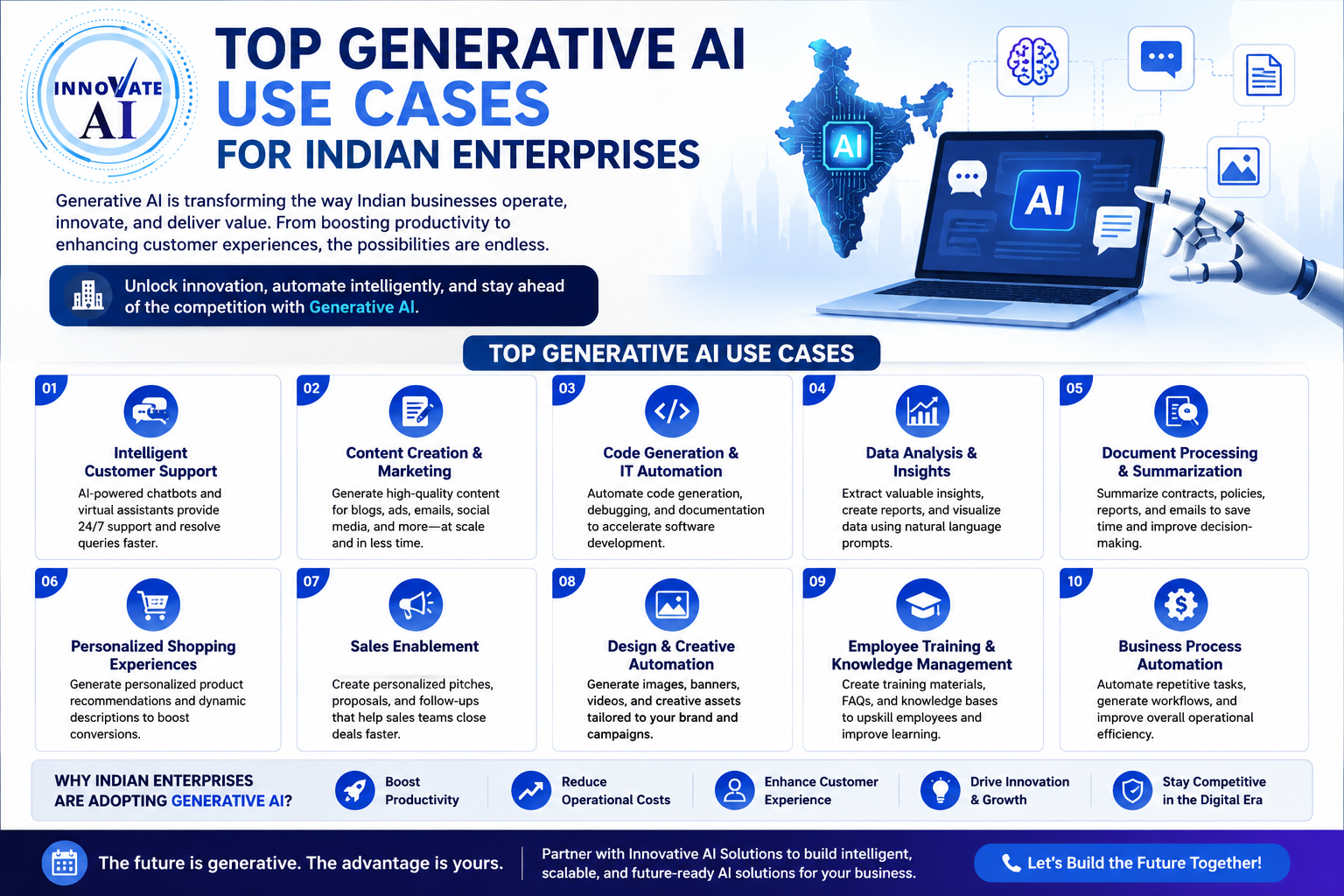
The Big Question
Let me start with a question that every enterprise leader must answer in 2026.
"We have experimented with AI. Now leadership wants to move from pilots to production. What are the highest-impact use cases for Indian enterprises today—and where should we focus our investment?"
The honest answer:
The highest-impact use cases are not the flashy ones. They are the ones that reshape core workflows, reduce costs at scale, and deliver measurable business returns.
Here is the truth:
Indian enterprises are moving AI from pilot to production faster than global peers. The focus has shifted from experimentation to operationalising AI—embedding it into underwriting, compliance, customer engagement, and engineering workflows. The real question is not which AI model to use, but which workflow to redesign.
Step 3: Use Case #1 — Knowledge Workflows and Document Intelligence
The Reality
Knowledge workers spend a significant portion of their time on information synthesis, document drafting, and research automation. OpenAI reported that over 25% of Codex requests in India are now related to non-coding tasks, including information synthesis, document drafting, workflow organisation, communication support, and research automation .
What This Looks Like
| Application | What It Delivers | Measured Impact |
|---|---|---|
| Document summarization | Distilling lengthy reports and contracts | 60-80% reduction in reading time |
| Research synthesis | Compiling insights from multiple sources | Faster decision-making |
| Drafting and writing | Policy documents, emails, proposals | 30-50% improvement in writing productivity |
| Compliance review | Checking documents against regulations | Reduced risk exposure |
| Automated reporting | Generating periodic business reports | 70% reduction in reporting time |
The shift from experimentation to operational usage means enterprises are embedding AI tools into research, documentation, internal workflows, and business processes rather than limiting AI deployment to developer productivity .
Use Case #2 — Engineering Productivity and Code Generation
The Reality
OpenAI reported a 27-fold increase in Codex weekly active users in India since the beginning of 2026, placing the country among the top five globally for Codex adoption . The adoption curve is no longer limited to technical users—founders, operators, researchers, and business teams are using Codex to turn ideas into working outcomes faster.
What This Looks Like
| Application | What It Delivers | Measured Impact |
|---|---|---|
| Code generation and completion | Accelerating development cycles | 50-70% faster code writing for routine tasks |
| Code review and debugging | Reducing human effort | 30-50% efficiency gains in software development |
| Documentation generation | Creating and maintaining code docs | Reduced documentation overhead |
| Legacy code migration | Modernizing old codebases | 60-70% acceleration in legacy modernization |
| Automated testing | Generating unit tests and test scenarios | Improved test coverage with less manual effort |
The figures indicate that India is emerging as one of OpenAI’s fastest-scaling markets for AI-assisted workflow automation . OpenAI has expanded its global systems integrator ecosystem for Codex, onboarding firms including TCS, Infosys, Accenture, Capgemini, Cognizant, PwC, and CGI to support enterprise deployment .
Enterprise IT Deployment
TCS, Infosys, and Wipro have expanded Microsoft Copilot deployments to over 3 lakh employees:
| Company | Users | Active Usage | Measured Results |
|---|---|---|---|
| Infosys | 1 lakh+ | 91% monthly active | 20-25% productivity gains in research and content tasks |
| TCS | 1 lakh+ | 86% active | 2x improvement in insight generation |
| Wipro | 1 lakh+ | 95%+ monthly active | 7.5 million prompts/month; 250,000 FTE workdays saved per quarter |
Source:
Wipro has also developed over 60 enterprise-grade AI agents and more than 29,000 employee-created agents across business functions .
Use Case #3 — Customer Engagement and Personalization
The Reality
Indian enterprises are using generative AI to reimagine customer engagement. Ogilvy India and Google launched an AI Creative Studio that helps creative teams move from abstract ideas to high-fidelity concept cards and final assets at a significantly faster pace. Early pilots have helped reduce concept-to-asset timelines, enabling teams to spend more time on creative development .
What This Looks Like
| Application | What It Delivers | Measured Impact |
|---|---|---|
| Hyper-personalized content creation | Audience-specific social media assets, virtual try-ons | Reduced content production time |
| AI-powered advertising | Cinematic, data-led creative workflows | Faster production cycles |
| Customer interaction automation | AI agents handling routine queries | 24/7 availability |
| Product recommendations | AI-powered discovery and matching | Improved conversion rates |
Star Health Insurance launched a generative AI-powered campaign that uses AI across nearly every layer of production—from scene design and lighting to character rendering and tone—while keeping creative vision human-led . The campaign reflects how emerging tools, when thoughtfully applied, can enrich human storytelling and redefine how everyday themes are brought to life on screen .
WhatsApp Business Agent
In July 2026, Meta launched the Meta Business Agent for Indian WhatsApp Business clients. The generative AI-powered assistant can:
-
Answer business-specific queries
-
Recommend products from business catalogues
-
Book appointments and qualify incoming leads
-
Deliver morning briefings with missed chat insights
-
Provide productivity increases between 10x and 100x
Source:
The agent can be set up in minutes or plugged directly into existing enterprise infrastructure. Meta is also offering the Meta Business Agent Platform for larger companies to build, customise, and deploy agents at scale, with early adopters including Flipkart, Swiggy, Shopify, and Zendesk .
Use Case #4 — Workflow Redesign and Operational Transformation
The Reality
Nearly half of Indian firms have moved beyond task-level automation to full workflow redesign . In the BFSI and tech sectors, firms are embedding AI into underwriting, compliance, and customer engagement processes rather than using it as a stand-alone tool . Companies are reporting efficiency gains of 30-50% in code generation, documentation, and risk assessment .
What This Looks Like
| Application | What It Delivers | Measured Impact |
|---|---|---|
| Underwriting automation | AI-assisted risk assessment | Faster processing times |
| Compliance monitoring | Real-time regulatory checks | Reduced compliance risk |
| Knowledge management | AI-powered internal search and retrieval | 30-50% faster information access |
| Document routing and processing | Automated triage and workflow | Reduced manual handoffs |
Indian corporates are moving from "automation to augmentation," where AI is reshaping how work itself is done . The question for Indian industry has shifted from whether to use AI to how deeply it can be integrated into existing workflows without disrupting business continuity .
The next phase of AI adoption will focus on three essentials: reskilling, responsible data governance, and measurable ROI .
Use Case #5 — Enterprise-Wide HR and Business Operations
The Reality
Indian enterprises are using generative AI across HR, PR, and business operations—often quietly, because these deployments remain experimental and provide competitive benefits they prefer to keep hidden .
What This Looks Like
| Application | What It Delivers | Measured Impact |
|---|---|---|
| Performance management | AI-generated development plans for hundreds of employees | What would take weeks is now done overnight |
| Retention prediction | AI scanning exit interviews and forecasting retention crises | Months-ahead workforce planning |
| Crisis communication | AI modelling media reactions and social sentiment | 2-3 weeks advance warning of PR issues |
| Strategy development | AI-generated market analysis with data from dozens of sources | Faster, more informed decisions |
TCS, Infosys, and Wipro's Copilot rollouts are part of a broader surge. Microsoft said paid Copilot seats have reached 20 million worldwide, while the number of customers with deployments exceeding 50,000 seats has increased four-fold year-on-year .
Use Case #6 — Industry-Specific Applications
Pharmaceutical
Mankind Pharma announced a collaboration with OpenAI to integrate advanced AI across its value chain, including field force enablement, digital marketing, R&D, manufacturing, and medical affairs . The integration enables:
-
Smarter decision-making: GPT-powered dashboards providing real-time insights across R&D, supply chain, and commercial operations
-
Faster compliant communication: Automated, multilingual content for healthcare professionals ensuring speed, accuracy, and regulatory compliance
-
Function-specific AI agents: For Sales & Marketing, R&D, and HR
-
Advanced clinical intelligence: Streamlined literature reviews and real-time insights from clinical and genomic data
-
Manufacturing excellence: AI analyzing batch records and sensor data to detect anomalies early and recommend corrective actions
Since July 2025, Mankind has deployed a wide range of customized GPTs across its workforce, notably enhancing the effectiveness of Sales and Marketing teams .
Healthcare and Insurance
Star Health Insurance has unveiled advertisements created using generative AI, marking a notable shift in how the insurance category approaches storytelling. AI played a role across nearly every layer of production, from scene design and lighting to character rendering and tone .
Engineering and Manufacturing
On Dassault Systèmes' 3DEXPERIENCE platform, generative AI enables engineers to define high-level goals while AI rapidly generates, simulates, and ranks thousands of design variants in minutes. This is achieving design cycle reductions of up to 70%, 40-60% material reductions while preserving strength, and 30-70% reductions in design-to-prototype timelines .
Telecommunications
OpenAI's Codex adoption in India is being driven partly by engineering and problem-solving culture, with the company already announcing Codex-related engagements with TCS, Infosys, and Razorpay .
Use Case #7 — Production-Scale AI Deployment
The Reality
Indian companies are moving AI from experiment to production faster than most global peers . According to an EY-CII report, 47% of Indian enterprises have multiple generative AI use cases live in production, while another 23% are in pilot stage .
What This Looks Like
| Area | Adoption Level | Key Players |
|---|---|---|
| AI in production | 47% of enterprises with multiple GenAI use cases live | TCS, Infosys, Wipro, Mankind Pharma, Star Health |
| Enterprise AI agents | 29,000+ employee-created agents | Wipro |
| AI-enabled IT services | 3 lakh+ employees with Copilot access | TCS, Infosys, Wipro |
| AI-powered pharma operations | Full value chain integration | Mankind Pharma |
The next phase of AI competition will be shaped less by who builds the most advanced models and more by who can deploy them at scale with trust and real-world impact .
Use Case #8 — Cost-Conscious AI Operations
The Reality
The enterprise AI gold rush is giving way to a more disciplined phase. Companies are asking whether every AI rupee is generating measurable business returns . Meta has made reducing inference costs a strategic priority, while Amazon, Walmart, Cisco, and Uber have introduced usage caps or routed employees to cheaper AI models to contain costs .
What This Looks Like
| Strategy | Implementation | Impact |
|---|---|---|
| Right model for the task | Routing to cheaper models for simple tasks | Up to 5x cost reduction |
| Usage governance | Usage caps and employee routing | Controlled AI spend |
| Cost accountability | Tracking token consumption vs. value | Reduced waste |
| Model selection | Cheaper models for 95% of value at 20% of cost | Improved ROI |
In India, a Z47-OpenAI-Zinnov study found nearly 90% of mature AI adopters have reduced some form of BPO spending, with over one-third cutting outsourced work by more than 25% . However, the same study found that only 9% of Indian startup founders have seen a measurable increase in sales or conversions attributable to AI, highlighting the measurement challenge .
Implementation Roadmap
Phase 1: Identify High-Impact Use Cases (Weeks 1-4)
| Action | Output |
|---|---|
| Map current workflows and manual processes | Process inventory |
| Identify repetitive, high-volume tasks | Use case candidates |
| Define success metrics (time saved, cost reduction, revenue) | KPI baseline |
Phase 2: Pilot (Weeks 5-8)
| Action | Output |
|---|---|
| Deploy one AI capability for a bounded use case | Working prototype |
| Measure results against baseline | Early ROI data |
| Refine based on feedback | Improved deployment |
Phase 3: Scale (Weeks 9-16)
| Action | Output |
|---|---|
| Expand to additional workflows and teams | Production deployment |
| Implement governance and cost controls | Operational framework |
| Establish continuous improvement cycles | Ongoing optimization |
Frequently Asked Questions
Q1: What is the most common AI use case in Indian enterprises today?
Workflow automation and knowledge management. Nearly half of Indian firms have moved beyond task-level automation to full workflow redesign, embedding AI into underwriting, compliance, and customer engagement processes .
Q2: How many Indian enterprises have AI in production?
47% of Indian enterprises have multiple generative AI applications in production, with another 23% in pilot stage .
Q3: What are the top industries adopting GenAI in India?
BFSI, IT services, pharmaceuticals, and healthcare. Banks are embedding AI into underwriting and compliance, while IT services firms are deploying AI across their workforces . Mankind Pharma has integrated AI across its full value chain .
Q4: How much are Indian enterprises spending on AI?
Nearly 90% of mature AI adopters have reduced some form of BPO spending, with over one-third cutting outsourced work by more than 25% . The focus is shifting from increasing deployments to improving returns .
Q5: What is the biggest challenge for enterprise AI adoption?
Measuring ROI. The problem is not AI spending itself but spending without accountability. Token consumption became a vanity metric during the first wave—enterprises now need to match the right model to the right task and measure outcomes, not activity .
Q6: How can Innovative AI Solutions help?
We help enterprises identify, implement, and scale generative AI solutions—from use case identification and pilot deployment to production scaling and cost governance. Based in Delhi, serving clients across India.
Contact Us
Phone: +91 7464 099 059 / +91 96899 67356
Email: info@innovativeais.com
Address: Netaji Subhash Place, Pitampura, Delhi – 110034
Website: https://innovativeais.com
About the Author
Abhishek Kumar
Founder & CEO, Innovative AI Solutions
5+ years building enterprise AI solutions. Based in Delhi, serving clients across India.
Related services: to apply this in your business, explore our generative AI development and AI development services.