The Big Question
What if your browser could run professional-grade video editing, 3D CAD modeling, or even AI inference at near-native speeds? What if you could deploy a lightweight module to thousands of edge nodes with millisecond cold starts, using less memory than a container, all without spinning up a single virtual machine?
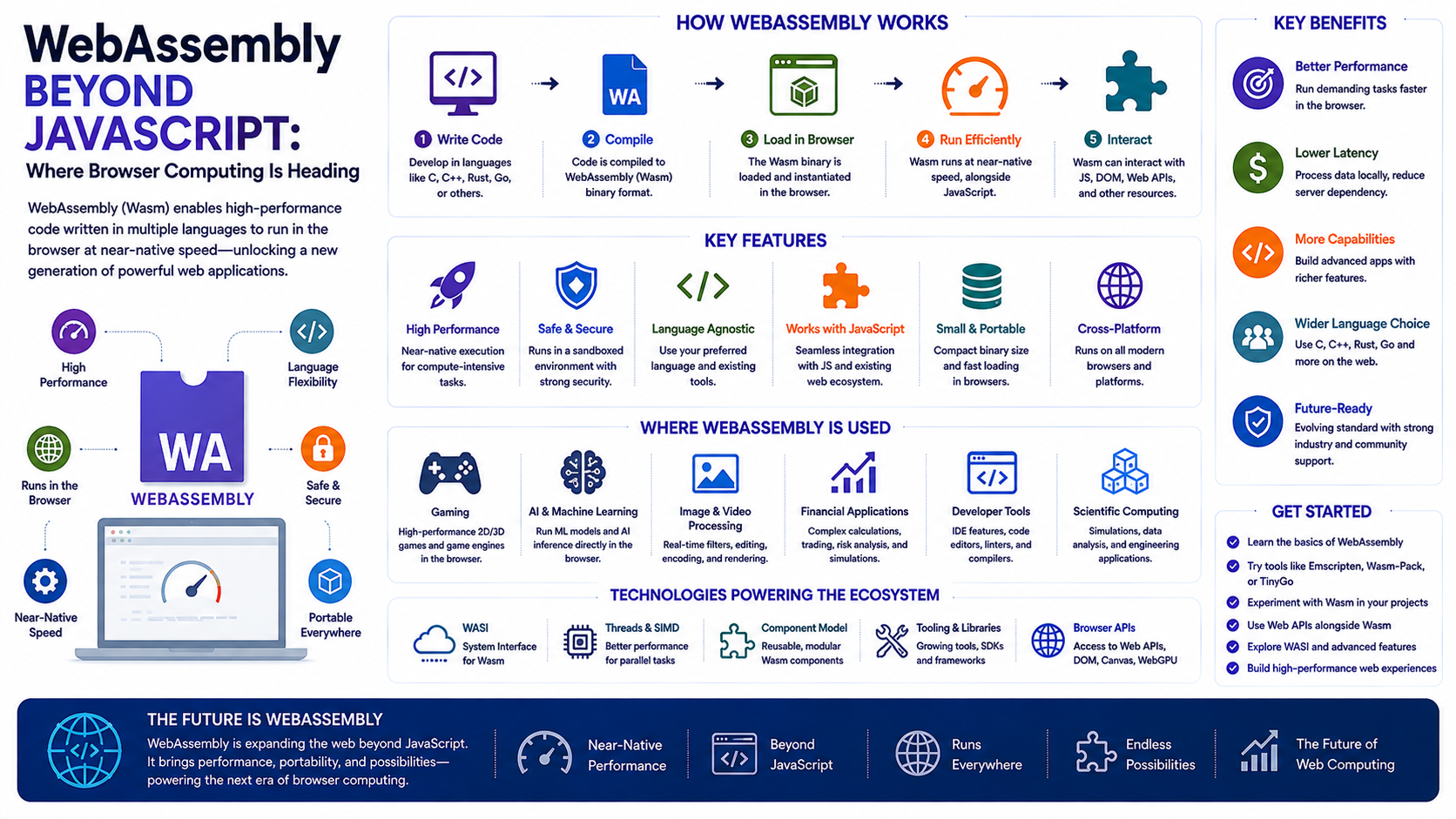
WebAssembly is making this a reality. Once confined to browser performance experiments, it has become a general-purpose computing layer that is as comfortable running on servers and edge nodes as it is in the browser. 2026 marks a turning point: WebAssembly is no longer just for frontend performance it is becoming the new abstraction between applications and infrastructure.
The Evolution: From Browser Tool to Universal Runtime
WebAssembly was first supported by all major browsers in 2017, but its role was narrowly defined: compile C++ code to run efficiently in a browser tab. In 2026, that picture has changed dramatically. W3C's WebAssembly 2.0 specification, finalized in late 2025, has been fully implemented across all major browsers, bringing two transformative capabilities: Garbage Collection (GC) and the Component Model .
The GC proposal enables garbage-collected languages like Java, Kotlin, and Dart to compile directly to WebAssembly without custom memory management or complex runtime adaptations. This dramatically lowers the barrier for teams working outside the Rust and C++ ecosystems. Meanwhile, the Component Model standardizes how Wasm modules from different languages communicate, enabling true polyglot microservices .
Microsoft's Ralph Squillace, speaking at WasmCon during KubeCon 2025, observed that WebAssembly "almost certainly can run in production reliably in any environment" including browsers, servers, CDNs, and backend services . The reference types and interface types specifications have made it possible for Wasm components to expose meaningful APIs without requiring developers to understand Wasm internals .
Beyond the Browser: The Rise of Server-Side and Edge Wasm
The most significant shift in 2026 is WebAssembly's expansion beyond the browser. This is driven largely by WASI (WebAssembly System Interface), which provides a standardized way for Wasm modules to interact with system resources like files, networks, and clocks. WASI 0.3.0, expected in 2026, represents the "last mile" of standardization, enabling WebAssembly to increasingly replace containers in specific workloads .
Why Server-Side Wasm Matters
Server-side WebAssembly is not a container replacement it serves a different purpose. Where containers virtualize operating systems, Wasm virtualizes the runtime. This distinction creates unique advantages:
Cold Start Performance: Wasm modules start in milliseconds, compared to the seconds or minutes required for containers. For serverless workloads, this means near-zero cold start latency .
Resource Efficiency: Memory footprints are a fraction of container equivalents. This makes Wasm particularly valuable for edge deployments where resources are constrained .
Security: Wasm's memory-sandboxed model provides strong isolation without the overhead of virtual machines. Multiple Wasm modules can run safely on the same host .
The numbers tell a clear story: A Wasm module can execute a workload with a fraction of the memory of a container and start instantly. For a serverless platform processing thousands of short-lived requests, this efficiency translates directly to cost savings .
Edge Computing and CDN Deployment
Edge computing is arguably Wasm's most strategically important use case in 2026. Cloudflare Workers, Deno Deploy, Fastly Compute, and similar platforms now natively support WebAssembly deployment, allowing custom logic to run at the network edge, close to end users .
This matters for two reasons. First, Wasm's small footprint enables complex logic in resource-constrained edge environments where container deployments would be impractical. Second, its fast startup ensures that edge nodes can handle burst traffic without the overhead of provisioning containers. The result is faster response times, lower latency, and reduced infrastructure costs .
The Polyglot Microservice Vision
In a multi-language microservice architecture, Wasm provides a single, unified runtime. A team can write performance-sensitive modules in Rust, data pipelines in Python, and API gateways in Go, then compile everything to WebAssembly and run it in the same environment .
This approach eliminates the communication overhead between language-specific services and simplifies deployment and operational management. The Component Model provides the standardized interface for these modules to interoperate, making truly polyglot systems a practical reality .
The Browser Reclaims High-Performance Computing
WebAssembly's origins remain relevant. In 2026, browsers handle workloads that were previously unimaginable. Video editing, CAD rendering, game engines (Unity and Unreal), and even AI inference now run at near-native speeds in the browser .
The "Desktop in a Tab" Effect
The old trade-off web for convenience, desktop for performance has effectively ended. Adobe Photoshop, Figma, and AutoCAD now run in browser tabs with responsiveness comparable to local installations. This is made possible by Wasm's binary instruction format, which bypasses JavaScript's parsing stage and executes code nearly as fast as hardware allows .
As one analysis puts it, "the wall that separated web and desktop software has crumbled" . For business applications, this means deploying professional-grade tools directly to users without managing local installations, updates, or license distribution.
AI Inference at the Edge
One of the fastest-growing use cases for browser-based Wasm in 2026 is AI inference. Small to mid-sized models text classification, image recognition, speech-to-text can now run locally in the browser, using Wasm SIMD instructions and multi-threading support .
This shift is significant for several reasons. First, data never leaves the user's device, solving privacy concerns for sensitive or regulated data. Second, it eliminates the cost of server-side inference a critical consideration for scaled applications. Third, it enables offline functionality, which is essential for many mobile and distributed use cases .
WASM "Brains": A Glimpse of the Future
Some practitioners are pushing Wasm further, building what they describe as "WASM brains" small, deterministic modules that execute attention mechanisms, vector search, lightweight simulations, and parallel execution, all in the browser .
These modules are typically just a few kilobytes, boot instantly, and run close to the user without any cloud infrastructure. The vision is compositional: instead of shipping one monolithic system, applications will be composed of many small, specialized Wasm modules that run directly in the user's browser or mobile device. No cloud rent, no lock-in, no infrastructure hangover .
The Standardization Road Ahead
WebAssembly has made significant progress, but it is not a complete container replacement yet. The Component Model is still being finalized, and the "Docker moment" where any application can be packaged as a Wasm module and deployed anywhere has not fully arrived .
However, the trajectory is clear. As WASI and the Component Model mature, WebAssembly will become the standard runtime for a growing range of workloads: edge functions, serverless tasks, plugin architectures, and polyglot microservices. As Daniel Lopez, CEO of Endor, noted, "many users, likely the vast majority, have no idea Wasm is running underneath them, especially in SaaS and serverless services" .
Implementation Roadmap
Phase 1: Identify Wasm-Ready Workloads (Weeks 1-3)
-
Audit compute-intensive tasks. Look for workloads that are CPU-bound, short-lived, or require fast startup—image processing, video encoding, encryption, or AI inference.
-
Evaluate existing codebases. Assess whether critical components are written in languages with strong Wasm support (Rust, C++, Go, Java, Kotlin, Python) .
-
Review deployment constraints. Identify edge or serverless environments where Wasm's low footprint and fast startup would be advantageous .
Phase 2: Select Tooling and Platforms (Weeks 4-6)
-
Choose a Wasm runtime. For server-side, consider Wasmtime (Bytecode Alliance), Wasmer, or Spin (Fermyon). For edge, evaluate Cloudflare Workers, Deno Deploy, or Fastly Compute .
-
Assess WASI compatibility. WASI Preview 2 and the Component Model are the foundations for production-grade Wasm .
-
Plan integration. Determine how Wasm modules will communicate with existing systems and other services.
Phase 3: Pilot and Scale (Weeks 7-12)
-
Start with a bounded use case. Deploy a single Wasm module in a non-critical edge or serverless workload.
-
Measure performance and cost. Track cold start times, memory usage, and cost compared to equivalent container deployments.
-
Scale to additional workloads. Expand based on validated results, building a library of reusable Wasm components.
Frequently Asked Questions
Q1: Is WebAssembly only for browsers?
No. WebAssembly now runs on servers, edge nodes, CDNs, and backend services. WASI enables system-level operations like file and network access, making Wasm a viable alternative to containers for specific workloads .
Q2: How does server-side Wasm compare to containers?
Wasm modules start in milliseconds (vs. seconds or minutes for containers), use a fraction of the memory, and provide strong sandbox security without VM overhead. However, Wasm is not a drop-in replacement—containers still excel for workloads requiring broad system compatibility .
Q3: Can WebAssembly run AI models?
Yes. Wasm SIMD and multi-threading support enables AI inference to run locally in the browser for small to medium models (text classification, image recognition, etc.). This eliminates cloud costs and preserves data privacy .
Q4: What languages compile to WebAssembly?
C++, Rust, Go, Java, Kotlin, Dart, Python, and many more. The 2026 WebAssembly 2.0 GC proposal makes garbage-collected languages first-class citizens .
Q5: How can Innovative AI Solutions help?
We help organizations identify opportunities for WebAssembly adoption, select the right tooling and platforms, and implement production-ready Wasm deployments. Based in Delhi, serving clients across India.
Why Delhi is a Great Hub for WebAssembly Innovation
Delhi is emerging as a hub for cloud-native and AI innovation, backed by a thriving IT services ecosystem. As enterprises modernize their infrastructure, understanding when and where to use WebAssembly whether at the edge, in serverless environments, or directly in the browser will become a critical architectural decision. The region's strong talent pool positions it to lead in building the next generation of Wasm-powered applications.
What We Offer at Innovative AI Solutions
-
WebAssembly Strategy: We help you assess use cases and design a Wasm adoption roadmap.
-
Platform Selection: We help you choose the right runtimes (Wasmtime, Wasmer, Spin) and deployment platforms (Cloudflare, Fastly, Deno).
-
Implementation Support: We help you build, deploy, and scale Wasm modules in production.
-
Migration Planning: We help you identify legacy code that can be ported to Wasm.
Final Thought
The shift is clear: from a browser-only performance tool to a universal, cross-platform runtime. WebAssembly is redefining what "running code" means lightweight, portable, and secure across a continuum of environments. Organizations that understand this shift will have a significant advantage in building efficient, cost-effective, and resilient systems.
Contact Us:
Phone: +91 7464 099 059 / +91 9689967356
Email: info@innovativeais.com
Address: Netaji Subhash Place, Pitampura, Delhi – 110034
Website: https://innovativeais.com
About the Author
Abhishek Kumar
Founder & CEO, Innovative AI Solutions
5+ years building AI, cloud, and enterprise systems. Based in Delhi, serving clients across India.
Related services: to apply this in your business, explore our AI development services and web development.