The Big Question
The confusion starts with the framing. "Webhook vs API" sounds like a comparison between two competing technologies. It isn't.
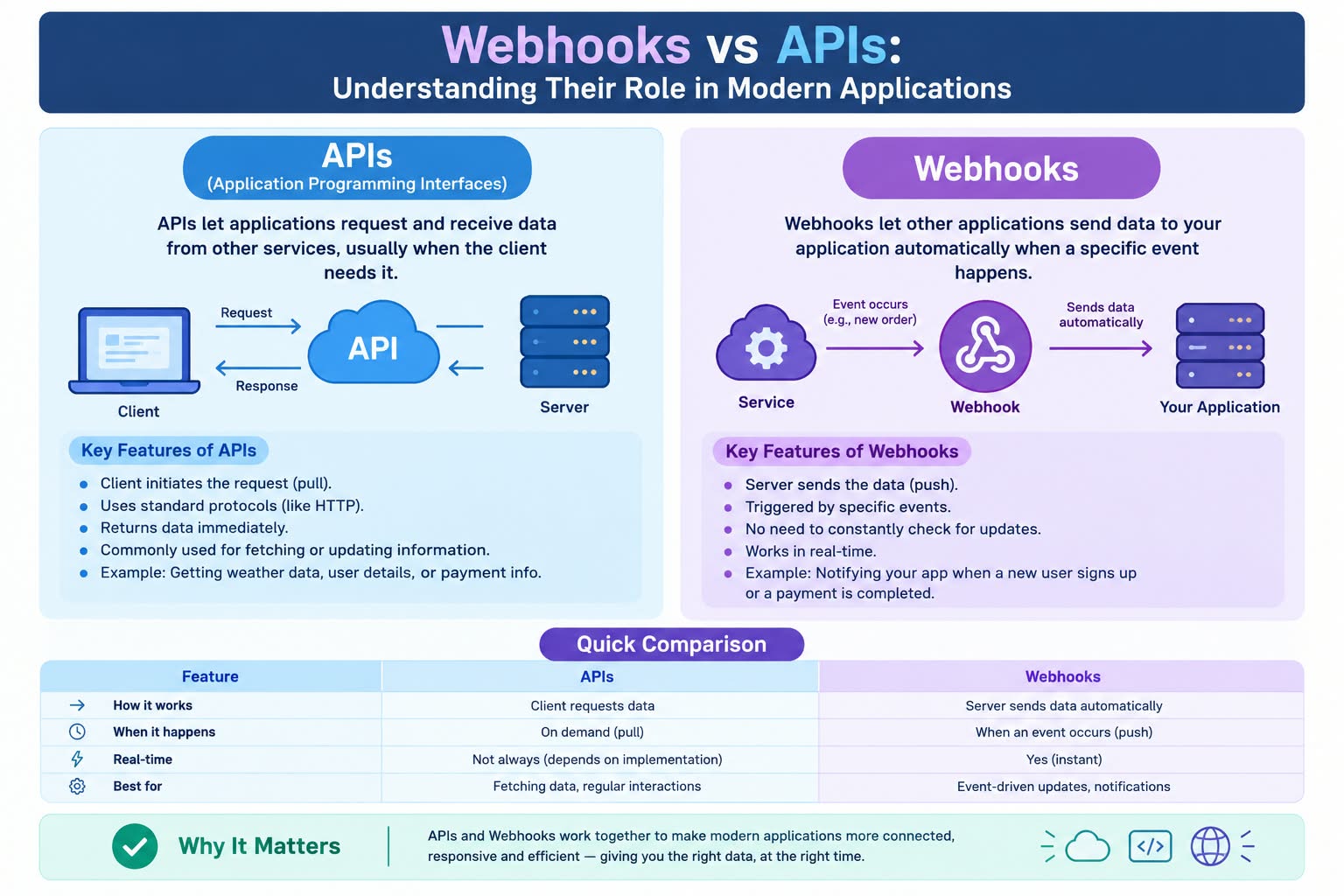
A webhook is an API call pointed in the other direction . The same HTTP machinery, the same JSON payloads, the same URLs just with the client and server roles reversed. When you call a REST API, you are the client and the provider is the server. When a webhook fires, the provider becomes the client and your endpoint becomes the server .
The real distinction is pull versus push. An API pulls data on demand. A webhook pushes data when an event occurs . Everything else follows from that single architectural choice.
Understanding this matters because the wrong choice has real costs. Polling an API every 30 seconds for 10,000 users generates 28.8 million requests per day and if only 1% of those polls return meaningful updates, you've wasted 28.5 million requests for nothing. A webhook system handling the same user base produces only 288,000 deliveries for the same information . That's a 98% reduction in network operations for identical business value.
The efficiency gap isn't theoretical. It's the difference between a system that scales gracefully and one that drowns in its own polling traffic.
Cost Based on Integration Pattern
The cost of implementing webhooks versus APIs depends on what you're building and how you're integrating. Here's the practical breakdown:
| Integration Pattern | Implementation Cost | Ongoing Cost | Best For |
|---|---|---|---|
| API-Only (Polling) | Lower upfront | Higher at scale (requests, compute, egress) | On-demand data reads, actions you initiate |
| Webhook-Only | Higher upfront (endpoint, security, monitoring) | Lower (event-driven, no wasted calls) | Real-time notifications, event reactions |
| Hybrid (Webhook + API) | Moderate | Optimized | Production systems where events trigger data retrieval |
The hidden cost of polling: API calls consume memory and CPU resources to support complex communications. Repeated message exchanges increase the amount of data moving across the network . At scale, this translates directly to higher hosting bills and egress charges.
The hidden cost of webhooks: Your endpoint must be publicly accessible, highly available, and secure. You need signature verification, idempotency handling, dead-letter queues, and monitoring . A webhook receiver that does heavy processing synchronously will time out, causing the provider to retry and you'll process the same event twice .
The hybrid pattern is what most production systems actually use. The webhook delivers a lightweight "something happened" notification, and your handler then calls the provider's REST API to fetch the full, authoritative record. The webhook tells you when. The API tells you what .
Breakdown by Use Case
Different jobs call for different mechanisms. Here's where each one fits:
When to Use an API
Use a request-response API when your application knows it needs information or wants another system to perform an operation . Common scenarios:
-
On-demand data retrieval: Loading a customer's account page, checking order status, searching records
-
Actions you initiate: Creating a charge, updating a record, sending a message, processing a transaction
-
Data that changes on your schedule: Reports, exports, batch operations
-
Environments that can't host a public endpoint: Local scripts, locked-down networks, development environments
APIs give you precise control over what data you request, when you request it, and how you handle the response. The trade-off is that you must poll to catch changes and polling is both late and wasteful .
When to Use a Webhook
Use a webhook when you need to react to events in near real-time and you can host a public endpoint . Common scenarios:
-
Payment processing: Instant notification when a transaction succeeds or fails
-
User engagement: Comments, likes, shares, form submissions as they happen
-
System monitoring: Build failures, security alerts, infrastructure events
-
Inventory changes: Stock level updates, price changes, shipping status
Webhooks eliminate the polling tax entirely. One call, delivered when the event actually occurs .
When to Use Both
The most common production pattern combines them. A demo form submission triggers a webhook, which starts a workflow that calls an enrichment API for account data, then calls another API to update the CRM and assign the lead . The webhook is the trigger. The APIs are the workhorses.
Breakdown by Developer Type (2020-2026)
Who implements your integration architecture matters. The Indian talent market offers a range of options:
| Developer Type | Hourly Rate (India) | Typical Engagement | What They Deliver |
|---|---|---|---|
| Freelancer | ₹1,000 – ₹3,000 | ₹25,000 – ₹75,000 | Basic API integrations, simple webhook receivers |
| Small Agency | ₹2,500 – ₹6,000 | ₹1,50,000 – ₹5,00,000 | Scoped integrations, signature verification, monitoring |
| Mid-Size Firm | ₹6,000 – ₹12,000 | ₹5,00,000 – ₹25,00,000 | Event-driven architectures, idempotency, DLQs |
| Enterprise Consultancy | ₹12,000 – ₹20,000+ | ₹25,00,000+ | Full integration platforms, orchestration, compliance |
The critical question before hiring: "Show me a webhook receiver you built that handles duplicate events correctly." Any team that has shipped a production webhook integration has stories about double-sent emails and double-charged customers. If they don't, they haven't done the work .
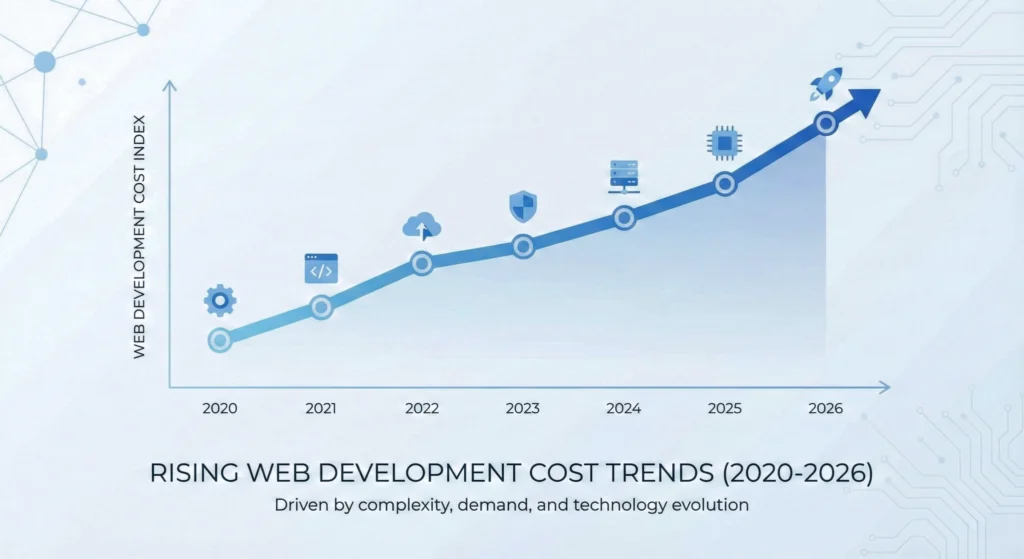
Why Prices Changed in 2026
Three forces have reshaped integration economics.
First, event-driven architecture became the default for modern applications. The integration patterns lesson from Contentstack Academy is clear: event-driven integrations are best when the target system needs to reflect changes within seconds, API-mediated integrations are best when data changes independently at different rates, and batch sync is best for bulk data with tolerance for latency . The choice is now driven by business requirements, not developer preference.
Second, the webhook security surface expanded. Webhook endpoints are publicly accessible URLs that accept POST requests from the internet. Without signature verification, they're an open door for anyone who knows the URL . HMAC-SHA256 signature verification is now standard for Stripe, GitHub, and Shopify. Timestamp validation prevents replay attacks. IP allowlisting adds defense in depth. These aren't optional hardening steps they're the baseline .
Third, idempotency became a production requirement. Every webhook system delivers at-least-once, never exactly-once. Network blips, timeouts, and slow responses will cause the same event to arrive twice. Without idempotency handling, you double-send welcome emails and double-charge customers . The Idempotent Receiver pattern storing processed event IDs and skipping duplicates is now standard practice.
Pro Tips to Save Money in 2026
1. Return 200 within seconds. Your webhook handler should do four things: verify, parse, enqueue, acknowledge . If it does heavy work synchronously, the provider may retry while the first attempt is still running, doubling the work and tripling the side effects .
2. Make every handler idempotent. Every event payload has a unique ID. Store processed IDs in a Redis set or a database table with a unique constraint. Skip duplicates. The first time you ship a webhook without this, you'll learn the hard way .
3. Verify signatures with timing-safe comparison. Use crypto.timingSafeEqual() in Node or hmac.compare_digest() in Python. A standard == comparison is vulnerable to timing attacks .
4. Plan for replay. Most providers offer a "redeliver" button for failed webhooks. Build a small admin endpoint that lets your team replay any event from a dead-letter queue. The first major outage will pay for this .
5. Use exponential backoff with jitter for API retries. When a third-party API fails, wait before retrying. Start short, double each time, add randomness so retries don't cluster. Circuit breakers stop calling consistently failing services .
6. Start with unidirectional sync and a clear source of truth. Data synchronization projects fail when they try to build real-time, bidirectional sync that keeps everything perfectly in sync. Pick one direction. Design for eventual consistency .
Questions to Ask Before Hiring
Before you commit budget to any integration engagement, ask these questions.
1. "How do you handle duplicate webhook events?" Every webhook system delivers at-least-once. The right answer involves idempotency keys, processed event ID storage, and skip logic .
2. "What's your webhook signature verification strategy?" The right answer involves HMAC-SHA256, raw request body comparison, timing-safe functions, and timestamp validation .
3. "How do you handle webhook delivery failures?" The right answer involves exponential backoff, dead-letter queues, and replay endpoints. Without a DLQ, failed events are lost forever .
4. "When would you use polling instead of webhooks?" The honest answer: when the environment can't host a public endpoint, when you need the full current state of a resource, or when the data changes on your schedule, not the provider's .
5. "Show me a production integration you shipped in the last 90 days." Portfolios show architecture diagrams. Production systems expose real error handling, real monitoring, and real maintenance.
Why Delhi is a Great Hub for Integration Development
Delhi-NCR has become a serious destination for API and webhook integration work, and the reason isn't just cost.
The region hosts India's largest cluster of BFSI and FinTech captives. Financial services and fintech are the sectors where event-driven architecture matters most: payment webhooks, real-time fraud detection, and compliance-driven audit trails. Delhi's integration talent pool has been forged in this environment.
The talent density keeps improving. With a steady pipeline of backend engineers, integration specialists, and cloud architects, Delhi offers a combination of cost and capability that's hard to match. And the time zone advantage matters: a Delhi-based team can sync with Middle East morning, European afternoon, and US East Coast evening.
What We Offer
At Innovative AI Solutions, we build integration architectures that handle events correctly and scale without waste.
Our approach:
-
Event-Driven First. We design webhook receivers that verify, parse, enqueue, and acknowledge within seconds. Heavy processing runs in background workers.
-
Idempotency by Default. Every handler stores processed event IDs. Duplicate deliveries are skipped, not processed twice.
-
Hybrid Integration Patterns. Webhooks trigger workflows. APIs fetch authoritative data. Batch sync handles bulk transfers.
-
Signature Verification. HMAC-SHA256, timing-safe comparison, and timestamp validation as standard practice.
-
Dead-Letter Queues and Replay. Failed events are captured, not lost. Admin endpoints let your team replay any event.
-
Retained Operations. Monitoring, alerting, and tuning. Your integrations don't rot because someone forgot them.
Our principle is simple: small steps, fast iteration, data speaks.
Frequently Asked Questions
Q: What's the difference between an API and a webhook?
An API uses a pull model: your application sends a request, the server responds. A webhook uses a push model: the server sends data to your endpoint when an event occurs . The direction of the call is the whole distinction. A webhook is often called a "reverse API" for exactly this reason .
Q: Can I use webhooks without APIs?
Technically, yes a webhook delivers data to your endpoint without requiring you to call the provider's API. But in practice, most production systems use both. The webhook tells you something happened. The API lets you fetch the full record or take action based on that event .
Q: How do I secure a webhook endpoint?
Four layers: (1) Signature verification using HMAC-SHA256 with a shared secret. (2) Timestamp validation to reject old events and prevent replay attacks. (3) IP allowlisting if the provider publishes source IP ranges. (4) HTTPS enforcement. Never expose an HTTP-only webhook endpoint .
Q: What happens if my webhook endpoint is down?
Providers retry failed deliveries with exponential backoff. Stripe retries for up to three days. AWS SNS retries 50 times over approximately six hours. For events that exhaust all retries, dead-letter queues capture failed deliveries for later inspection .
Q: Should I poll or use webhooks for payment processing?
Webhooks, without question. Stripe's documentation explicitly frames specific webhook events as eliminating "the need for manual polling" . Polling for payment status introduces latency and wastes resources. Webhooks deliver confirmation the moment a transaction completes.
Frequently Asked Questions (Extended)
Q: What is idempotency and why does it matter for webhooks?
Idempotency means processing the same event twice produces the same final state, not duplicate side effects. Every webhook system delivers at-least-once. Without idempotency, a network blip causes double-sent emails or double-charged customers. Store processed event IDs and skip duplicates .
Q: How do I test webhooks locally?
Use a tunnel service like ngrok to expose your local endpoint to the internet. Register the tunnel URL with the provider. Events fire to your local machine. This is standard practice for development .
Q: When should I use batch sync instead of webhooks?
When you need to move large data volumes, when the source system doesn't support event-driven integration, or when latency is acceptable. Batch sync introduces latency by design data is only as fresh as the last sync run. For a nightly sync, content could be up to 24 hours behind .
Q: What's the first step I should take tomorrow?
Audit your integrations. List every place where your application asks for data from another system. For each one, ask: "Do I need this data on demand, or do I need to react when it changes?" If the answer is "react," that's a webhook candidate. If the answer is "on demand," that's an API call. Then pick the highest-volume integration and evaluate whether polling is wasting resources. That's how you start.
Contact Us:
Phone: +91 7464 099 059 / +91 9689967356
Email: info@innovativeais.com
Address: 9th Floor, Pearls Best Heights-I, Head Office: 904, Netaji Subhash Place, Delhi, 110034