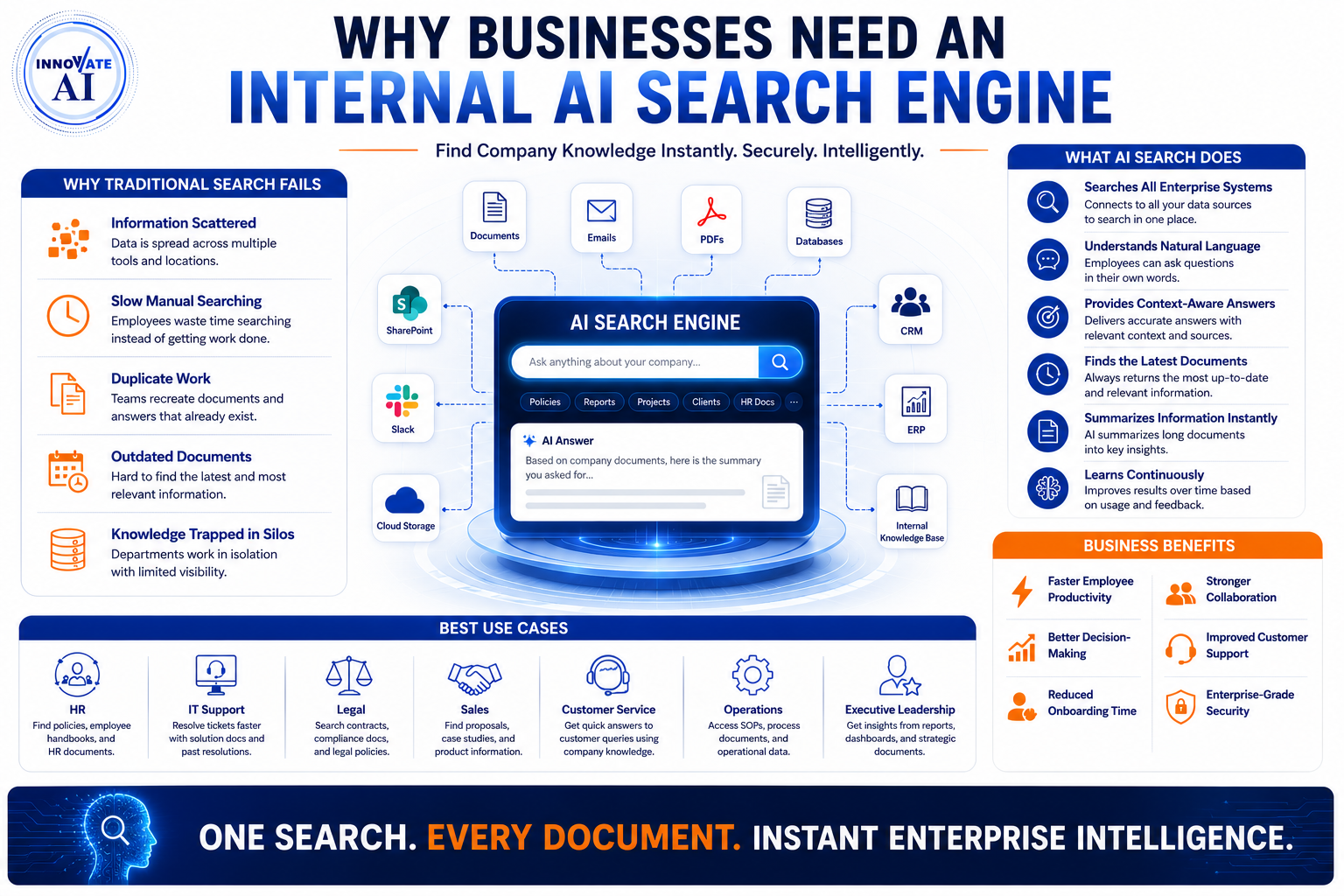
The Big Question
What happens when your organization's knowledge is scattered across Google Drive, Slack, GitHub, Salesforce, Confluence, SharePoint, and a dozen other tools? When employees spend two hours a week just finding information? When every new hire takes months to ramp up because context is buried in threads and outdated wikis?
The scale of the problem is staggering. Fortune 500 companies collectively lose $30 billion annually by failing to share knowledge effectively. Employees spend a quarter of their workweek searching for information . A robust knowledge management program can reduce average time spent searching from 8.5 hours to 4.6—a decrease of approximately 46%.
Internal AI search engines are solving this. They're creating a unified knowledge layer that turns fragmented organizational data into actionable intelligence—accessible to every employee through natural language.
What Is Internal AI Search?
Internal AI search (often called enterprise AI search) is an internal search system designed to let employees ask questions using natural language . Unlike traditional keyword-based search that returns document lists, internal AI search tools can:
-
Understand the intent behind what the employee is trying to accomplish
-
Pull permission-aware answers from connected enterprise systems—HRIS, ITSM, identity, finance, procurement
-
Apply context (role, access, location, system state) to determine relevance
-
Provide citation-backed answers grounded in internal documents
-
Execute next steps by triggering workflows and completing actions
The foundational technology is Retrieval-Augmented Generation (RAG) —a mechanism that finds relevant documents through search and then has an LLM generate answers based on their content . Because answers are generated based on internal documents, RAG can handle company-specific questions that a general-purpose AI cannot answer .
The Evolution: From Keyword Search to Conversational Intelligence
Traditional enterprise search relied on static content, limited indexing, and little awareness of identity or permissions . The shift is significant:
| Traditional Enterprise Search | Internal AI Search |
|---|---|
| Keyword matching | Intent understanding |
| Static document retrieval | Real-time, permission-aware answers |
| No context awareness | Role, location, system state awareness |
| Returns document lists | Returns synthesized, citation-backed answers |
| Single source access | Cross-system reasoning |
| Manual next steps | Agentic execution |
The Real Cost of Not Having Internal AI Search
The Productivity Drain
The data is clear. Federal Reserve analysis found that workers using generative AI save 5.4% of their work hours on average—translating to 2.2 hours per week . When employees can't navigate disconnected systems or find the answers they need, this value becomes lost .
For a company with thousands of employees, the cumulative savings run into tens of thousands of productive hours recovered annually.
The Shadow AI Risk
Employees are already using AI, whether you've approved it or not. 71% of employees use AI tools without approval. 57% hide that usage from leadership.
Without an approved internal AI search solution, employees turn to consumer tools—often feeding sensitive company data into unvetted systems. This creates compliance, security, and privacy risks that can be catastrophic.
The Fragmentation Tax
One of the most important capability gaps internal AI search addresses: pulling information from live systems such as HRIS, ITSM, identity, finance, and procurement . When an employee can rely on a unified AI assistant to find answers, it's one less ticket for HR and internal helpdesk teams .
By providing a single entry point for employees to get things done—whether accessed via collaboration tools or web browser—employees can ask questions, find relevant information, and even progress through common workflows .
The Technology: How Internal AI Search Works
The RAG Pipeline
Modern internal AI search operates through a structured pipeline:
-
Intent Analysis: Analyzes the user's question and classifies intent
-
Search: Retrieves relevant documents across all connected sources
-
Evaluation: The LLM evaluates the relevance of retrieved documents
-
Full-Text Retrieval: Pulls the full text of highly relevant documents
-
Answer Generation: The LLM generates a streaming response with citations
This pipeline mitigates hallucinations and provides answers backed by internal documents .
Architecture Components
From the ElasticGPT case study—a production-grade internal AI assistant built on Elasticsearch—the architecture includes :
Backend and Vector Database
-
Elasticsearch serves as both vector database for RAG and repository for chat data
-
Enterprise Connectors bring in data from internal sources (Wiki, ServiceNow Knowledge Articles)
-
Text undergoes chunking and embedding generation for semantic search
RAG Orchestration with LangChain
-
Manages the entire RAG pipeline end-to-end
-
Ensures only relevant document chunks are retrieved
-
Handles prompt crafting for the LLM
Frontend and User Experience
-
React-based interface with source attribution and feedback buttons
-
Real-time streaming of responses
-
Security through SSO and end-to-end encryption
Platform Solutions
The market has matured significantly. Platform solutions include:
-
OpenAI's Company Knowledge: Connects ChatGPT to internal apps like Google Drive, Slack, GitHub, and SharePoint, providing answers grounded in private data with citations
-
Perplexity Internal Knowledge Search: Searches across both public web content and internal knowledge bases; used by NVIDIA, Databricks, Dell, and Bridgewater
-
Perplexity Spaces: AI-powered collaboration hubs with customizable AI assistants, access controls, and model choices
-
ElasticGPT: Internal RAG-based assistant built on Elasticsearch with SmartSource RAG and OpenAI integration
-
Fess AI Search: Open-source enterprise search with RAG capabilities; supports OpenAI, Gemini, and Ollama
-
Azure AI Search: Cloud-based indexing and querying supporting enterprise search and RAG in generative AI applications
-
Omo: Open-source, AI-native enterprise search with connectors for Google Drive, Notion, Confluence, and more
What Internal AI Search Unlocks for Organizations
1. Stronger Self-Service Culture, Faster Issue Resolution
When employees can reliably find answers themselves, support teams are freed up to work on more complex issues . Enterprise AI search supports a cultural shift away from response-led support toward a more self-directed style of working and learning .
2. Improved ROI on Existing Tools
Enterprises invest heavily in tools like knowledge bases, internal process workflows, and IT service tools. However, when employees can't navigate disconnected systems, this value becomes lost . Enterprise AI search makes content more discoverable, surfacing contextually relevant answers and reaching current versions of documents .
3. A Single Entry Point for Getting Things Done
Employees often need to jump between multiple apps, dashboards, and tools to complete simple tasks . AI search provides a single point of access. Over time, it can become the memory and coordination layer for the organization .
4. Better Use of Existing Knowledge, Not More Documentation
Your organization may already have tons of internal knowledge, but it may not have the value it needs because it's siloed in hard-to-reach systems . Enterprise AI search surfaces relevant information buried in documents, tickets, intranets, HR systems, and repositories—making institutional knowledge easier for employees and leadership to access and apply .
The ROI: It's Not Just Productivity Anymore
The 2026 Shift: From Productivity to P&L Impact
The measurement paradigm has shifted dramatically. Futurum Group's 2026 Enterprise Software Survey of 830 IT decision-makers documented a decisive shift: direct financial impact (combining revenue growth and profitability) nearly doubled to 21.7% as the primary ROI metric for enterprise AI. Simultaneously, productivity gains collapsed 5.8 percentage points as the leading success metric .
Three Categories of ROI
Category 1: Cumulative Productivity Gains — The Multiplier Effect
-
Workers using AI save 2.2 hours per week on average
-
Organization-wide deployments typically deliver measurable gains within the first quarter
-
Full ROI within the first year, compounding as adoption scales
Category 2: High-Value Discovery — The Breakthrough Moments
-
Finding a technology component already developed in another division can save hundreds of thousands in redundant R&D
-
Surfacing a compliance risk before it becomes an enforcement action can save millions in fines
-
Even a handful of high-value discoveries per year can exceed platform cost
Category 3: Competitive Capability — The "Can't Operate Without It" Factor
-
Organizations successfully deploying AI agents report average ROI of 171%
-
74% achieve returns within the first year
-
62% expect ROI exceeding 100%
Real-World Examples
ElasticGPT is an internal RAG-based assistant deployed at Elastic, built on their own technology stack with SmartSource RAG and OpenAI integration .
Perplexity Enterprise is used by NVIDIA, Databricks, Dell, Bridgewater, Latham & Watkins, Fortune, and Lambda .
Algolia's AI Search delivers 213% ROI over three years with a payback period of less than six months . The Forrester TEI study found:
-
$12 million in annual revenue increase driven by improved search
-
Up to 35% time savings for merchandising teams
-
11% increase in click-through rates
Fess AI Search provides open-source RAG-based search with support for OpenAI, Gemini, and Ollama, offering on-premise and cloud options with strict security controls .
Governance and Security: The Critical Enablers
The Permission Problem
One of the biggest challenges in enterprise search is respecting existing permissions. Internal AI search operates within existing access controls—AI can only view data that each user is already permitted to access . Authentication occurs through OAuth, ensuring data access adheres to established identity and compliance rules .
The Data Security Promise
OpenAI does not use customer data to train models by default. All interactions remain within the organization's security boundary. Enterprise controls including SSO, RBAC, SCIM provisioning, and IP allowlisting are fully applied .
The Shadow AI Mitigation
By providing sanctioned, secure access to AI tools, organizations can reduce the potential impact of "shadow AI"—employees using consumer AI tools with company data. Elastic's IT team is using this approach to better control how AI is used while still enabling productivity gains .
The Retention Balance
User chat data is often retained for limited periods to balance analytics needs with privacy. Elastic, for example, deletes chat data every 30 days, retaining only metrics . This practical consideration is an important LLMOps concern.
Implementation Roadmap: The First 90 Days
Phase 1: Foundation (Weeks 1-4)
-
Audit knowledge assets: Identify where information lives and how employees currently search
-
Define governance: Establish permissions, data boundaries, and security requirements
-
Select a platform: Choose between cloud (OpenAI, Perplexity, Azure), open-source (Fess, Omo), or self-hosted
-
Start small: One team, one function, one use case
Phase 2: Connect and Populate (Weeks 5-8)
-
Connect critical sources: Start with the most frequently used tools
-
Authenticate connectors: Set up OAuth and permissions
-
Establish update mechanisms: Define how the knowledge base stays current
-
Build initial skills: Create reusable AI interactions
Phase 3: Scale and Measure (Weeks 9-12+)
-
Expand to additional functions and teams
-
Measure impact: Track time saved, resolution rates, and ROI
-
Enable agentic execution: Let AI initiate workflows
-
Continuous improvement: Refine sources, skills, and governance
Frequently Asked Questions
Q1: What is internal AI search?
An internal search system that lets employees ask questions using natural language, pulling permission-aware answers from connected enterprise systems and providing citation-backed responses .
Q2: How is it different from traditional enterprise search?
Traditional search matches keywords and returns document lists. Internal AI search understands intent, reasons across multiple systems, synthesizes answers, and can execute next steps .
Q3: How much time do employees waste searching for information?
Employees spend a quarter of their workweek searching—2.2 hours per week on average. This represents tens of thousands of productive hours annually for a large organization .
Q4: What's the ROI for internal AI search?
Organizations implementing enterprise AI search typically achieve payback within 6-12 months. AI search platforms deliver 213% ROI over three years with <6 months payback . AI agent deployments average 171% ROI .
Q5: Is my data secure with internal AI search?
Internal AI search operates within existing access controls. AI can only access data the user is permitted to see. Customer data is not used to train models by default. Enterprise controls including SSO, RBAC, and IP allowlisting are applied .
Q6: How can Innovative AI Solutions help?
We help organizations design, build, and operationalize internal AI search—from platform selection and data integration to governance design and measurement frameworks. Based in Delhi, serving clients across India.
Why Delhi is a Great Hub for AI Development
Delhi is emerging as a significant hub for AI development, backed by concrete government support and infrastructure. The recent Delhi Budget 2026-27 allocated ₹8.20 crore for two Artificial Intelligence centres of excellence (AI-CoEs), functioning as hubs for research, innovation, and startup incubation.
The city's AI infrastructure is expanding rapidly. Under the IndiaAI Mission, more than 38,000 high-end GPUs have been onboarded and are available at approximately ₹65 per hour—roughly one-third of the global average cost. This makes AI development remarkably cost-effective compared to other tech hubs.
The government has also announced a ₹350 crore startup policy over five years, aiming to support the emergence of at least 5,000 startups by 2035, with key focus areas including artificial intelligence, machine learning, and automation.
The AI ecosystem in Delhi combines: cost-effective infrastructure, government support, a growing talent pool, and proximity to the country's business decision-makers.
What We Offer at Innovative AI Solutions
After five years of building AI solutions for businesses, we've developed a practical approach that focuses on what actually works:
-
Internal AI Search Strategy: We help you assess your knowledge fragmentation and design a search architecture
-
Platform Selection: We help you choose between cloud (OpenAI, Perplexity, Azure) or open-source (Fess, Omo) solutions
-
Data Integration: We connect fragmented knowledge sources into a unified, governed search layer
-
Governance and Security: We help you establish permissions, audit trails, and compliance frameworks
-
Measurement and ROI: We help you track productivity gains, high-value discovery, and competitive capability
-
Change Management: We help your organization shift from searching to simply asking
Our approach is built on the reality that internal AI search isn't just an IT project—it's a fundamental productivity and competitive advantage.
Final Thought
In a world where knowledge is stored everywhere, the cost of context-switching has become one of our biggest productivity drains. Internal AI search represents a meaningful shift: instead of searching for information across multiple apps, we bring our apps into a single, conversational interface.
As systems become more complex, reducing friction and keeping context accessible become increasingly important. It's a strong step toward a workspace where answers are easier to find—where employees can simply ask and receive accurate, citation-backed answers grounded in your organization's collective intelligence.
Contact Us:
Phone: +91 7464 099 059 / +91 9689967356
Email: info@innovativeais.com
Address: Netaji Subhash Place, Pitampura, Delhi – 110034
Website: https://innovativeais.com
About the Author
Abhishek Kumar
Founder & CEO, Innovative AI Solutions
5+ years building AI systems for enterprises. Based in Delhi, serving clients across India.
Hashtags: #InternalAISearch #EnterpriseSearch #AIAssistant #KnowledgeManagement #EnterpriseAI #Productivity #InnovativeAISolutions
Related services: to apply this in your business, explore our RAG development and AI development services.