The Big Question
We've all heard "data is the new oil." But in an age where 80% of enterprise data is unstructured , and 87% of organizations now prioritize platforms that support both operational and analytical workloads, a more pressing question emerges: If data is fuel, what makes it burn?
The answer is context.
As a Salesforce executive recently told a Calcutta audience: "We have seen many failed AI projects. The number one reason is not that they don't have data. It is because they don't have the context behind the data. The meaning becomes extremely important. Data is, at the end of the day, just bits and bytes. The context is the toughest piece to capture" .
The shift is clear: organizations are data-rich but context-poor .
Data vs. Context: The Critical Distinction
The difference between data and context is not semantic—it's structural.
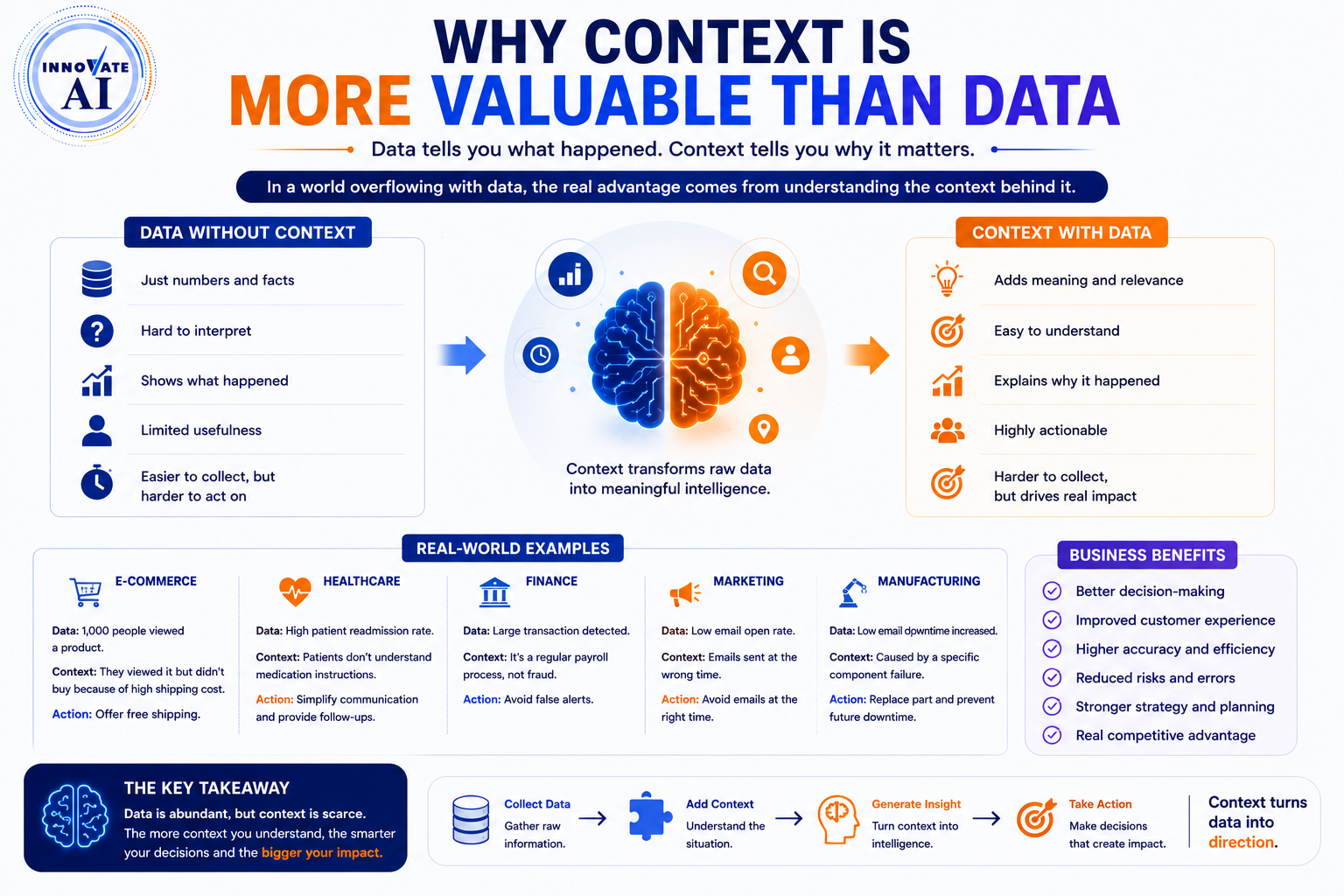
Data is raw information: records, events, measurements, transactions. A customer ID. A machine sensor reading. A sales figure .
Context is the layer of meaning that explains what that information means—how it connects to other things, why it matters, and what should happen as a result .
A Concrete Example
A customer record is data. Knowing that customer is a strategic account, renewed three weeks ago, currently has an unresolved service escalation, and is tied to a shipment delayed by four days—that's context .
A machine alert is data. Knowing that machine is on your highest-margin production line, has shown a recurring failure pattern over the last six months, and has no spare parts available for ten days—that's context .
The difference isn't trivial. An AI system with only the first piece of each pair will produce a generic response. An AI system with both pieces can tell you something operationally useful—and more importantly, something you can act on .
Why More Data Doesn't Automatically Fix This
The intuitive assumption is that AI quality improves with data volume. And to some extent, that's true for training large foundation models.
But in enterprise deployments, the problem is rarely that the model hasn't seen enough data. It's that the model doesn't understand the relationships between the data it has .
Consider a scenario: your AI system detects declining sales in a region and recommends increasing marketing spend. On the surface, that's a reasonable suggestion. But if the real cause is inventory stockouts driven by a logistics disruption—not weak demand—then more marketing doesn't help. It drives demand you can't fulfill .
The model had access to the sales data. What it lacked was the connection between sales performance, inventory levels, logistics events, and supplier status. That connective layer is context .
What AI Context Actually Consists Of
For enterprise AI to perform reliably, it needs to understand several categories of operational meaning :
| Component | What It Means |
|---|---|
| Entity Relationships | How things connect—customers to contracts, machines to components, orders to suppliers |
| Business Rules & Policies | What's allowed, what's restricted, what thresholds matter |
| Operational Priorities | What matters most—highest-margin line, critical service commitments |
| Historical Behavior | What's normal vs. abnormal for a given entity or process |
| Current State | What's changed recently, what's in progress, what's pending action |
When an AI system can answer questions with reference to all of these layers, it stops being a search tool and starts being something closer to operational intelligence .
The Enterprise Context Crisis
The Unstructured Data Problem
Globally, unstructured data represents 80% to 90% of the world's digital information. By 2025, that volume is expected to reach 175 zettabytes .
Most companies today are building their AI strategy around structured data because unstructured data is operationally hard. It's messy, fragmented, and buried in silos .
The result? 45% of companies working with AI say unstructured data is a major obstacle to success .
As the Snowflake VP of AI puts it: "When AI initiatives stall, they rarely fail because the model can't reason. They fail because the model is reasoning over fractured foundations: inconsistent metric definitions, siloed systems, disconnected structured and unstructured data, and missing lineage that undermines trust" .
The Real-World Cost
According to Gartner, poor data quality drains every large company an average of $12.9 million a year . Data cleansing, which comes along with the movement of unstructured data to vectorized data for AI, serves two critically important steps and, in and of itself, can save companies $10 million annually .
What Context Engineering Looks Like in Practice
The Context Layer
The next evolution of enterprise AI is the emergence of the context layer—a living, continuously updated real-time view into the operational state of your business .
This is where intelligent execution begins. The context layer helps answer critical questions in real time :
-
Which signals require attention?
-
Which disruptions will impact customers?
-
Which orders or shipments matter most?
-
Where is revenue or service at risk?
-
What actions should occur next?
The Three-Step Process to Build Context
1. Ingest and store. Bring unstructured data into a flexible environment like a data lake. This gives you room to work with the data in different ways .
2. Vectorize and segment. Use a vector database to translate raw content into searchable, machine-readable representations. Just as important, create metadata during this process that will later drive semantics and ontologies .
3. Build context/semantics. This third step is most often skipped but is critical. Use metadata to create a semantic layer with knowledge graphs and ontologies that define relationships and meaning .
Building a knowledge graph enables 100% traceability. Without traceability, you will never truly understand your AI .
The Financial Services Example
Financial institutions collect massive volumes of information—transaction records, market events, customer documents, system logs—but data volume alone creates no value. Structure and context turn raw data into fuel for business decisions .
CME Group processes 30 billion market events daily. On a single Friday, they captured 5.5 billion market data events and 2.8 billion order entry events. They store 20 years of these snapshots .
CME's CIO explains the value: "We're not in the business of just predicting, we're not in the business of forecasting. We're in the business of identifying worst-case situations for a given portfolio." The value comes from adding historical context—understanding how markets performed during the 1980s stagflation, then applying that pattern to today's environment .
Context Engineering vs. Prompt Engineering
In the early AI days, conversations centered around prompt engineering. Now, experts are talking much more about context engineering .
As one CIO explains: "The value is not necessarily in the bot or AI agent. It is in having the right transactional context, real-time (RAG) information, and historical context of successful and authorized resolutions" .
This is the shift: "The value is not the fact that there is an agent—the value is in the context and what that agent can do given that context" .
The LLM-Context Symbiosis
AI and context have a symbiotic relationship :
-
AI needs refined data—data with context—to produce useful results
-
AI also refines data by adding context at scale
The technology doesn't just process data faster—it adds layers of understanding that were previously impossible .
Why This Matters for Generative AI
Generative AI adds another dimension to the context problem.
Large language models are fluent. They can summarize, draft, and converse in ways that feel remarkably capable. In enterprise settings, fluency isn't enough .
When an employee asks an AI assistant which version of a contract is currently valid, or which inventory number is accurate as of today, or which incident requires immediate escalation—they need answers grounded in operational reality, not answers that are merely well-phrased .
The failure mode is subtle and damaging: generative AI with weak enterprise context produces responses that sound authoritative and turn out to be wrong. After employees encounter this a few times, they stop using the tool. The investment gets written off. And the organization concludes that AI "isn't ready"—when the real issue was that the architecture wasn't ready .
Governance: Context as a Competitive Advantage
Before any team at BNY touches AI tools, their ideas go through a data engineering review board examining privacy, ethics, compliance, legal considerations, and data usage. Many organizations see this as bureaucracy. BNY sees it as adding essential context .
BNY's governance approach provides context about data provenance, usage rights, and appropriate applications. "When we explain that to our customers, they're fired up and they say, 'Hey, could you just tell us how you're doing that?'"
Teams move faster because they understand the boundaries and requirements upfront. What looked like a bottleneck became a competitive advantage .
Implementation Roadmap: The First 90 Days
Phase 1: Foundation (Weeks 1-4)
-
Audit your data estate: What percentage is structured vs. unstructured? Where is context missing?
-
Identify high-value knowledge gaps: Which decisions are currently made without adequate context?
-
Define governance requirements: Permissions, audit trails, data lineage
-
Start with one domain: Pick one high-value business area to build context
Phase 2: Build Context (Weeks 5-8)
-
Ingest and store: Bring unstructured data into a flexible environment
-
Vectorize and segment: Create searchable, machine-readable representations
-
Build the semantic layer: Use knowledge graphs and ontologies to define relationships
-
Connect data to business outcomes: Ensure every initiative has a line of sight into value
Phase 3: Operationalize (Weeks 9-12+)
-
Deploy context-aware AI agents in the chosen domain
-
Measure impact: Track decision quality, time saved, and trust metrics
-
Expand to additional domains
-
Continuous refinement: The context layer is living—it must evolve with the business
Frequently Asked Questions
Q1: What's the difference between data and context?
Data is raw information—records, events, measurements. Context is the layer of meaning that explains what that information means, how it connects to other things, why it matters, and what should happen as a result .
Q2: How much of enterprise data is unstructured?
80% to 90% of the world's digital information is unstructured—medical images, documents, emails, social media, and more .
Q3: Why do AI projects fail?
The number one reason is not lack of data. It's lack of context behind the data . 45% of companies say unstructured data is a major obstacle . 60% of leaders lack confidence in their data-AI readiness .
Q4: What is the context layer?
A living, continuously updated real-time view into the operational state of your business. It helps answer which signals require attention, which disruptions impact customers, and what actions should occur next .
Q5: How do you build context?
Three steps: ingest and store, vectorize and segment, build context/semantics using knowledge graphs and ontologies .
Q6: How can Innovative AI Solutions help?
We help organizations design, build, and operationalize context layers—from data assessment and semantic layer implementation to governance frameworks and context-aware AI deployment. Based in Delhi, serving clients across India.
Why Delhi is a Great Hub for AI Development
Delhi is emerging as a significant hub for AI development, backed by concrete government support and infrastructure. The recent Delhi Budget 2026-27 allocated ₹8.20 crore for two Artificial Intelligence centres of excellence (AI-CoEs), functioning as hubs for research, innovation, and startup incubation.
The city's AI infrastructure is expanding rapidly. Under the IndiaAI Mission, more than 38,000 high-end GPUs have been onboarded and are available at approximately ₹65 per hour—roughly one-third of the global average cost.
The government has also announced a ₹350 crore startup policy over five years, aiming to support the emergence of at least 5,000 startups by 2035, with key focus areas including artificial intelligence, machine learning, and automation.
What We Offer at Innovative AI Solutions
-
Context Engineering Strategy: We help you assess your data estate and build a context-aware architecture
-
Semantic Layer Implementation: We help you build knowledge graphs and ontologies
-
Unstructured Data Pipelines: We help you ingest, vectorize, and operationalize unstructured data
-
Governance and Compliance: We help you establish data lineage, permissions, and audit trails
-
Context-Aware AI Deployment: We help you deploy AI agents grounded in operational reality
Final Thought
The leaders of the next decade will not be those who have the most data or advanced AI, but who can decide with confidence. The gap in decision-making comes from a lack of context, not data .
Context creates trust. Trust creates confident decisions. Confident decisions create impact .
The next era won't be defined by who has the most data. It will be defined by who has the most context.
Contact Us:
Phone: +91 7464 099 059 / +91 9689967356
Email: info@innovativeais.com
Address: Netaji Subhash Place, Pitampura, Delhi – 110034
Website: https://innovativeais.com
About the Author
Abhishek Kumar
Founder & CEO, Innovative AI Solutions
5+ years building AI systems for enterprises. Based in Delhi, serving clients across India.
Hashtags: #ContextEngineering #EnterpriseAI #DataStrategy #AIStrategy #KnowledgeManagement #InnovativeAISolutions
Related services: to apply this in your business, explore our AI development services and LLM integration.