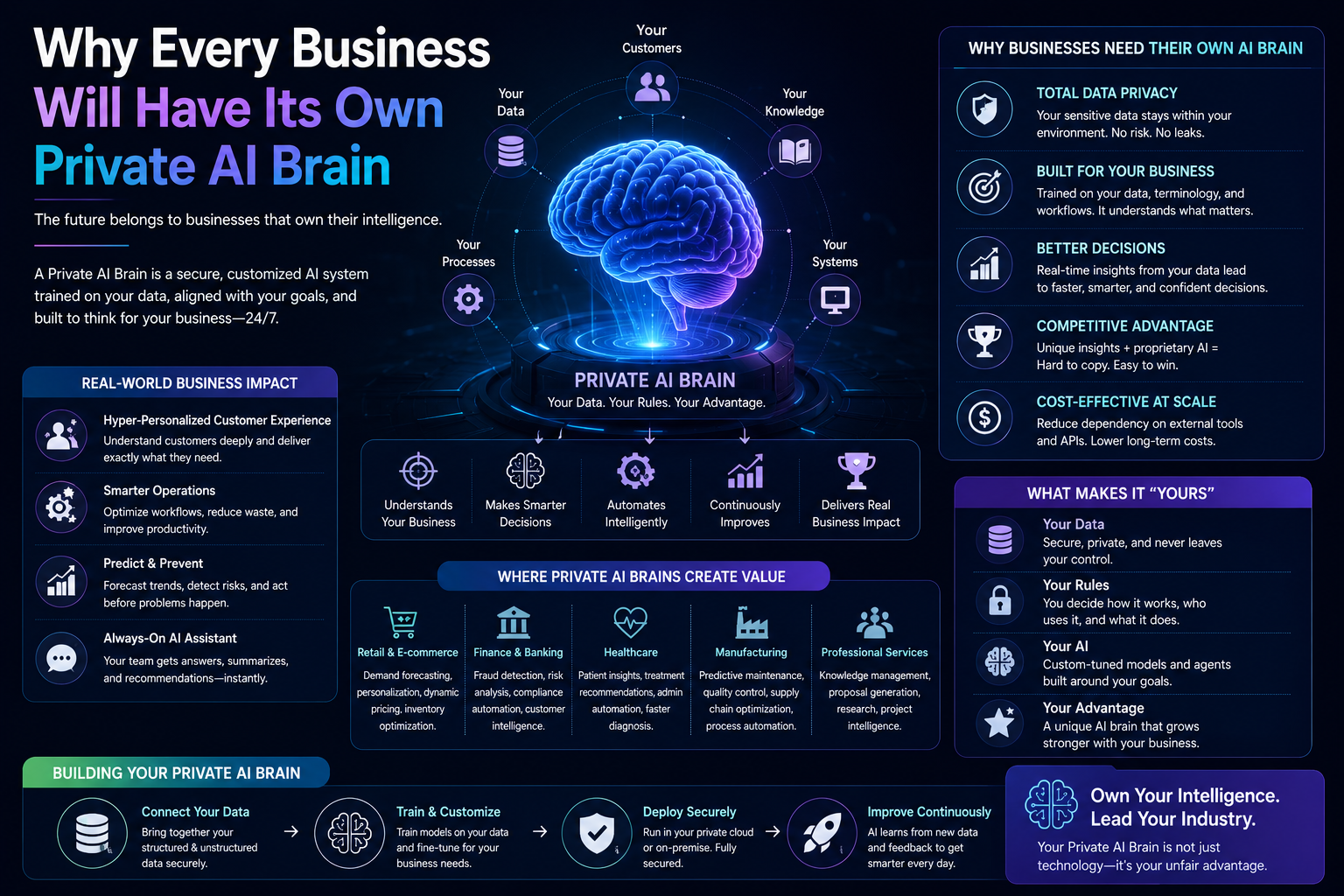
The Big Question
Let me start with a question that every business leader must answer in 2026.
"If we use the same AI models as our competitors, how do we actually differentiate? And is there a way to make AI that truly understands our business?"
The honest answer:
The future of AI is not shared models. It is private, proprietary intelligence built on your unique data.
Here is the truth:
When everyone uses the same public models, everyone gets similar outputs. Marketing copy starts to sound the same. Recommendations converge. Customer interactions become generic. The competitive advantage of AI disappears.
The solution is a private AI brain—an AI system trained on your proprietary data, optimized for your workflows, and deployed on your infrastructure. This is not just about privacy. It is about competitive differentiation.
Step 3: The Private AI Brain—What It Actually Is
The Concept
A private AI brain is an AI system that is uniquely trained on your organization's data, tuned to your specific workflows, and deployed in your controlled environment. It knows what you know—your products, your customers, your processes, your policies, your proprietary knowledge.
The Key Distinction
| Public AI | Private AI Brain |
|---|---|
| Trained on public internet data | Trained on your proprietary data |
| Generic knowledge | Deep domain expertise |
| Same for every business | Unique to your organization |
| Shared intelligence | Owned intelligence |
| Data leaves your control | Data stays in your perimeter |
The Architecture
A private AI brain typically combines several components: a foundation model that is fine-tuned or augmented with your data, a knowledge layer that retrieves relevant documents and context, a workflow layer that adapts to your business processes, a security layer that ensures data sovereignty, and a continuous learning loop that improves with every interaction.
This is not just a chatbot with your documents uploaded. It is a fully integrated intelligence layer that understands your business context, makes decisions aligned with your goals, and improves over time based on your specific interactions.
Step 4: Why Every Business Needs Its Own AI Brain
Reason 1: Competitive Differentiation
When everyone uses the same AI models, the outputs converge. Generic AI gives you generic results. Private AI gives you proprietary advantage.
| Public AI | Private AI Brain |
|---|---|
| Generic recommendations | Hyper-personalized suggestions |
| Standard responses | Brand-aligned communication |
| Commodity insights | Proprietary intelligence |
| "Good enough" answers | Business-optimized decisions |
Reason 2: Data Sovereignty and Compliance
Regulatory pressures are mounting. India's DPDP Act, the EU AI Act, and sector-specific regulations increasingly require that sensitive data stays within controlled environments.
| Regulation | Requirement |
|---|---|
| DPDP Act (India) | Data localization, breach penalties up to ₹250 crore |
| EU AI Act | Risk classification, documentation, human oversight |
| GDPR | Data protection, right to erasure |
| HIPAA | Healthcare data protection |
A private AI brain ensures that your data never leaves your perimeter, making compliance straightforward.
Reason 3: Cost Efficiency at Scale
Public AI APIs charge per token. For high-volume usage, these costs escalate rapidly. A private AI brain has no per-token fees once deployed. The cost model shifts from variable to fixed.
Reason 4: Domain Expertise
Public AI models are generalists. They know a little about everything but a lot about nothing. A private AI brain is a specialist. It deeply understands your domain, terminology, and business logic.
Reason 5: Continuous Learning
A private AI brain learns from every interaction. It improves over time based on your specific usage patterns and feedback. Public AI models improve only when the provider updates them.
Step 5: The Technologies Making Private AI Brains Possible
Open-Source Foundation Models
Several open-source models provide the foundation for private AI brains:
-
Llama 3 (Meta): 8B and 70B parameter versions with strong reasoning capabilities
-
Mistral 7B: Efficient and capable, suitable for fine-tuning
-
Phi-3.5 (Microsoft): Lightweight, runs on consumer hardware
-
Qwen 3 (Alibaba): Strong mathematical and coding capabilities
-
DeepSeek: Cost-effective, high-performance options
These models are openly available, can be fine-tuned on your data, and deployed on your infrastructure—with no external dependencies.
Fine-Tuning and Adaptation
Fine-tuning adapts a foundation model to your specific domain and use case. This can range from lightweight LoRA fine-tuning (requires ~10,000-50,000 examples, costs $10,000–$50,000) to full parameter fine-tuning (requires 100,000+ examples, costs $50,000–$200,000).
The key insight is that even modest fine-tuning on proprietary data can dramatically improve performance for your specific use case.
Private RAG Pipelines
Retrieval-Augmented Generation (RAG) connects your private AI brain to your internal knowledge bases. Documents are ingested and embedded on your infrastructure, vector databases store embeddings in your environment, and retrieval and generation occur entirely within your perimeter.
Self-Hosted Inference
Running the model on your infrastructure eliminates per-token fees and ensures data sovereignty. Options range from single-machine deployments (Ollama, Llama.cpp) to enterprise-scale serving (vLLM, HuggingFace TGI, Kubernetes clusters).
Step 6: Real-World Use Cases
Customer Support
A private AI brain trained on your support tickets, product documentation, and policies can resolve customer issues faster and more accurately than a generic AI. It understands your specific products, your brand voice, and your escalation procedures.
Outcome: 70% resolution rate, 24/7 availability, no data leaving your perimeter.
Sales and Revenue Operations
A private AI brain trained on your CRM data, customer interactions, and sales processes can recommend next best actions, identify upsell opportunities, and personalize outreach at scale.
Outcome: 20-30% increase in conversion rates, deeper customer understanding.
Internal Knowledge Management
A private AI brain connected to your internal documentation, policies, and communication channels can answer employee questions instantly, reducing the burden on HR, IT, and other support functions.
Outcome: 80% reduction in time spent searching for information.
Product Development
A private AI brain trained on your codebases, product requirements, and customer feedback can assist developers, product managers, and designers with context-aware recommendations.
Outcome: Accelerated development cycles, better-aligned features.
Step 7: Implementation Roadmap — 90 Days
Phase 1: Foundation (Weeks 1-4)
| Action | Output |
|---|---|
| Identify high-value use case for your private AI | Clear business problem |
| Inventory internal knowledge sources (documents, CRM, support tickets) | Data inventory |
| Select foundation model and deployment approach | Platform decision |
| Establish governance and security framework | Compliance baseline |
Phase 2: Build and Train (Weeks 5-8)
| Action | Output |
|---|---|
| Prepare data for fine-tuning or RAG integration | Clean data ready for training |
| Deploy model on your infrastructure | Working private AI |
| Build knowledge retrieval pipeline (RAG) | Connected to your data |
| Test with real users | Validation results |
Phase 3: Deploy and Scale (Weeks 9-12)
| Action | Output |
|---|---|
| Deploy to production with governance controls | Production AI brain |
| Monitor performance and user feedback | Continuous improvement |
| Expand to additional use cases | Scaled deployment |
Step 8: Frequently Asked Questions
Q1: How much does a private AI brain cost?
Costs range from $10,000–$50,000 for a lightweight LoRA fine-tune on a small model to $100,000–$500,000 for a full enterprise-grade private AI deployment. The cost model shifts from variable per-token fees to fixed infrastructure costs.
Q2: Do I need a data science team?
Not necessarily. RAG-based approaches can be implemented by skilled engineers with guidance. Fine-tuning and custom model development require specialized ML expertise. Many implementation partners provide the necessary support.
Q3: How do I choose between RAG and fine-tuning?
RAG is faster to implement and works well for knowledge-intensive tasks. Fine-tuning is better for behavior—tone, style, reasoning patterns. Most private AI brains use both approaches.
Q4: What about data privacy?
A private AI brain ensures your data never leaves your infrastructure. You control all data and model access. No third-party training occurs on your data.
Q5: How long does it take to build a private AI brain?
A RAG-based deployment can be operational in 4-8 weeks. Fine-tuning adds 4-8 weeks for data preparation and training. Full custom model development takes longer.
Q6: How can Innovative AI Solutions help?
We help businesses design, build, and deploy private AI brains—from use case identification and data preparation to fine-tuning, RAG implementation, and production deployment. Based in Delhi, serving clients across India.
Step 9: Final Tagline
"When everyone uses the same AI models, everyone gets the same results. The competitive advantage of AI will not come from shared intelligence—it will come from owned intelligence. A private AI brain knows your business, your customers, and your workflows. It is not a generic tool. It is your proprietary advantage."
Short version:
Why every business will have its own private AI brain—from shared intelligence to competitive advantage. A 2026 guide.
Hashtags:
#PrivateAI #AIBrain #CompetitiveAdvantage #EnterpriseAI #DataSovereignty #InnovativeAISolutions
Contact Us
Phone: +91 7464 099 059 / +91 96899 67356
Email: info@innovativeais.com
Address: Netaji Subhash Place, Pitampura, Delhi – 110034
Website: https://innovativeais.com
About the Author
Abhishek Kumar
Founder & CEO, Innovative AI Solutions
5+ years building AI systems for enterprises. Based in Delhi, serving clients across India.
Related services: to apply this in your business, explore our RAG development and AI development services.