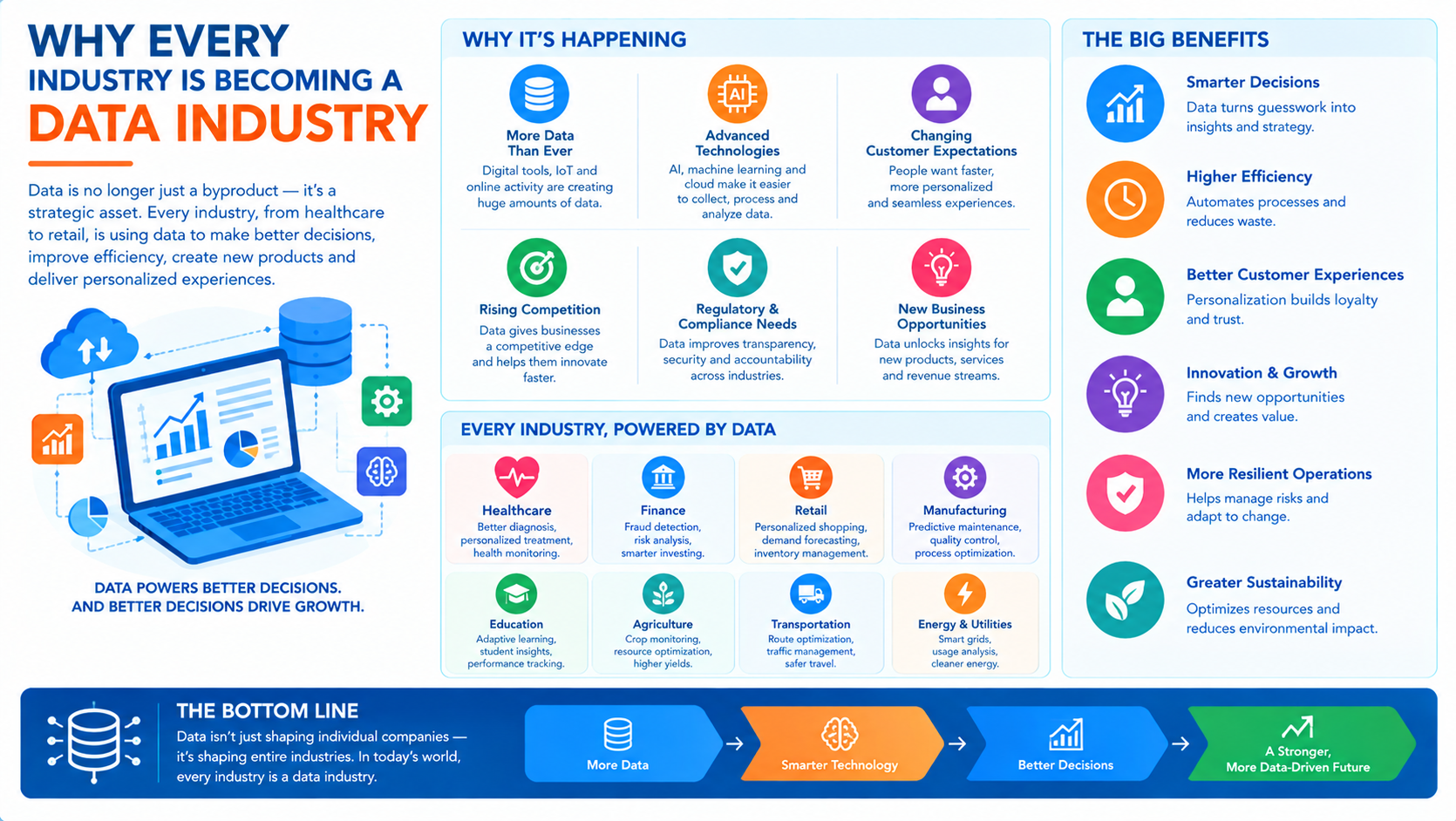
The Big Question
What happens when the competitive advantage in your industry shifts from what you own to what you know? When a tractor manufacturer competes on yield prediction, a logistics company competes on routing intelligence, and a hospital competes on outcomes analytics? When the physical product becomes a vehicle for data rather than the end of the value chain?
This is the structural shift underway across every major industry. The companies that recognize it early gain a compounding advantage. The ones that treat data as a byproduct of operations rather than the source of competitive advantage will find themselves competing on price alone.
What "Becoming a Data Industry" Actually Means
The phrase is often misunderstood. It does not mean every company becomes a software company. It means three specific things:
1. Data becomes a primary input to decisions. Instead of deciding based on experience, intuition, or periodic reports, organizations decide based on continuous streams of operational data.
2. Data becomes a source of differentiation. Two companies with identical physical assets can perform differently because one understands its operations better.
3. Data becomes a product or service component. The value delivered to customers increasingly includes information—predicted maintenance, optimized routes, personalized recommendations, verified provenance.
When these three conditions are present, the industry has become a data industry.
The Mechanics: Why This Is Happening Now
Several converging forces have made this shift inevitable.
The Cost of Sensing Has Collapsed
Sensors, cameras, and connected devices that once cost thousands of dollars are now available for dollars. Every machine, vehicle, shipment, and patient can generate continuous telemetry at negligible marginal cost. The constraint is no longer data collection—it is data interpretation.
The Cost of Storage and Compute Has Collapsed
What required a data center a decade ago runs on a handful of cloud instances today. Storing years of operational data is now cheap enough that organizations do it by default rather than by exception.
The Cost of Analysis Has Collapsed
Machine learning and generative AI have reduced the expertise required to extract insight from data. Tasks that required a data science team anomaly detection, forecasting, classification—are now available as services and APIs.
The Cost of Acting Has Collapsed
Automation and agentic systems can act on data-derived insight without human intervention. This closes the loop: sense, analyze, act, learn, repeat.
When the cost of all four stages falls simultaneously, the economics of every industry change.
Industry by Industry
Agriculture
Farming was once a business of land, weather, and labor. It is becoming a business of precision. Soil sensors, satellite imagery, weather models, and yield prediction allow farmers to apply water, fertilizer, and pesticide exactly where and when they are needed. Equipment manufacturers sell tractors that are also data platforms. The competitive advantage shifts from acreage to insight.
Manufacturing
Factories have been instrumented for decades, but the data was historically used for monitoring, not optimization. Modern manufacturing treats the production line as a continuous data stream predicting equipment failure before it happens, adjusting parameters in real time, and tracing every component through its lifecycle. The digital thread connects design, production, and service into a single information flow.
Logistics and Supply Chain
Logistics was once a business of assets and routes. It is becoming a business of visibility and prediction. Real-time tracking, demand forecasting, dynamic routing, and autonomous decision-making are transforming how goods move. Companies that know where everything is and can predict what will happen next outperform those that simply move things.
Healthcare
Healthcare has always generated data, but it was fragmented across systems and rarely used for decision-making at scale. Electronic health records, wearable devices, imaging analytics, and genomic data are changing that. Diagnostics, treatment selection, and population health management are increasingly driven by data. Outcomes, not just services, are becoming the basis of competition.
Energy
Energy was a business of generation and distribution. It is becoming a business of prediction and optimization. Smart meters, grid sensors, and renewable generation require real-time balancing of supply and demand. Companies that can forecast demand, optimize distribution, and integrate distributed resources outperform those that cannot.
Retail and Consumer
Retail has been data-driven for longer than most industries, but the depth and speed of data use continue to increase. Personalization, demand forecasting, inventory optimization, and pricing are all driven by continuous analysis of customer and operational data.
Financial Services
Financial services has been a data industry for decades, but the scope continues to expand. Risk modeling, fraud detection, algorithmic trading, and customer analytics are all data-intensive. The shift now is toward real-time decisioning and continuous risk assessment rather than periodic reporting.
The Common Pattern
Across every industry, the same structural pattern appears:
| Stage | What Changes |
|---|---|
| Instrumentation | Physical processes generate continuous data |
| Centralization | Data from disparate sources is unified |
| Analysis | Patterns, predictions, and anomalies are extracted |
| Automation | Actions are taken based on analysis |
| Learning | Outcomes feed back to improve the system |
Industries at different stages of this pattern compete differently. Those that have completed the loop sense, analyze, act, learn operate with a structural advantage over those that have not.
The Strategic Implications
Advantage Shifts from Assets to Insight
Two companies with identical physical assets can perform very differently if one understands its operations more deeply. Capital intensity alone no longer guarantees competitive advantage.
Data Becomes a Compounding Asset
Unlike physical assets, data does not depreciate with use. Every interaction adds to the dataset, improving future predictions. This creates a flywheel that favors early movers and sustained investment.
The Definition of the Product Changes
Products increasingly include information as a component. A tractor that predicts maintenance needs, a shipment that reports its own condition, a building that manages its own energy the physical object is the vehicle, and the data is the value.
Organizational Structure Must Adapt
Data-driven organizations require different structures: centralized data platforms, federated ownership of domain data, governance frameworks, and roles that bridge business and technical domains. Companies that bolt data onto existing structures capture only a fraction of the value.
What Gets in the Way
The shift is not automatic. Common obstacles include:
Data silos. Data scattered across systems that cannot be joined limits what analysis can achieve.
Poor data quality. Analysis on unreliable data produces unreliable conclusions.
Lack of governance. Without clear ownership and access controls, data cannot be shared safely.
Cultural resistance. Decisions based on data require a willingness to be contradicted by evidence.
Skills gaps. Data literacy across the organization not just in technical teams is a prerequisite.
Short-termism. Data capabilities compound over years. Companies that expect immediate returns underinvest.
Implementation Roadmap
Phase 1: Assess (Weeks 1-4)
-
Map your data estate. Where does operational data originate, where does it live, and who owns it?
-
Identify high-value decisions. Which decisions would improve most with better data?
-
Assess data quality and accessibility. Can the data actually be used today?
Phase 2: Build Foundations (Weeks 5-8)
-
Unify data sources. Establish a platform that can join data across systems.
-
Implement governance. Define ownership, access, and retention policies.
-
Build analytics and AI capabilities on the unified foundation.
Phase 3: Close the Loop (Weeks 9-12+)
-
Automate actions based on analysis start with bounded, low-risk decisions.
-
Establish feedback mechanisms so outcomes improve the system.
-
Build data literacy across the organization, not just in technical teams.
-
Measure business impact in outcomes, not in data volume.
Frequently Asked Questions
Q1: Does "every company is a data company" mean every company needs to build software?
No. It means every company's competitive position increasingly depends on how well it collects, interprets, and acts on data. That can be achieved through platforms and services without building everything in-house.
Q2: Is this shift relevant to small and mid-sized businesses?
Yes. Cloud platforms, managed services, and AI APIs have made data capabilities accessible without large upfront investment. The barrier is now organizational rather than financial.
Q3: How long does it take to see results?
Some improvements better dashboards, faster reporting appear in weeks. Structural advantages compounding data assets and automated decision-making take years of sustained investment.
Q4: What is the biggest mistake companies make?
Treating data as an IT project rather than a business capability. Data initiatives succeed when they are owned by the business and tied to specific decisions and outcomes.
Q5: How does AI change this?
AI dramatically lowers the cost of analysis, making it possible to extract insight from data that was previously too messy, too large, or too unstructured to use. It also enables automation of actions based on that insight.
Q6: How can Innovative AI Solutions help?
We help organizations assess their data maturity, build unified data foundations, implement governance, and deploy AI-driven decision systems. Based in Delhi, serving clients across India.
Why Delhi is a Great Hub for Data-Driven Transformation
Delhi is emerging as a hub for enterprise data and AI innovation, backed by a thriving IT services ecosystem and a large base of organizations across manufacturing, financial services, healthcare, and logistics. India's Digital Public Infrastructure Aadhaar, UPI, and the India Stack has demonstrated at national scale how data infrastructure can restructure entire sectors. Organizations building data capabilities in the region benefit from both talent depth and a regulatory environment increasingly oriented toward digital transformation.
What We Offer at Innovative AI Solutions
-
Data Maturity Assessment: We evaluate where your organization stands and what to prioritize.
-
Data Platform Strategy: We design unified foundations that connect operational data across systems.
-
Governance Frameworks: We establish ownership, access control, and data quality practices.
-
AI and Analytics Implementation: We build the decision systems that turn data into action.
-
Data Literacy Programs: We build capability across business and technical teams.
Final Thought
The shift is clear: from competing on what you own to competing on what you understand. Every industry is becoming a data industry because the economics of sensing, storing, analyzing, and acting on information have fundamentally changed. The organizations that recognize this and invest accordingly will build compounding advantages. Those that treat data as a byproduct will find themselves competing on price in markets they no longer understand.
Contact Us:
Phone: +91 7464 099 059 / +91 9689967356
Email: info@innovativeais.com
Address: 904, 9th floor Pearls Best Heights-I, Netaji Subhash Place, Delhi-110034
Website: https://innovativeais.com
About the Author
Abhishek Kumar
Founder & CEO, Innovative AI Solutions
5+ years building AI, cloud, and enterprise systems. Based in Delhi, serving clients across India.