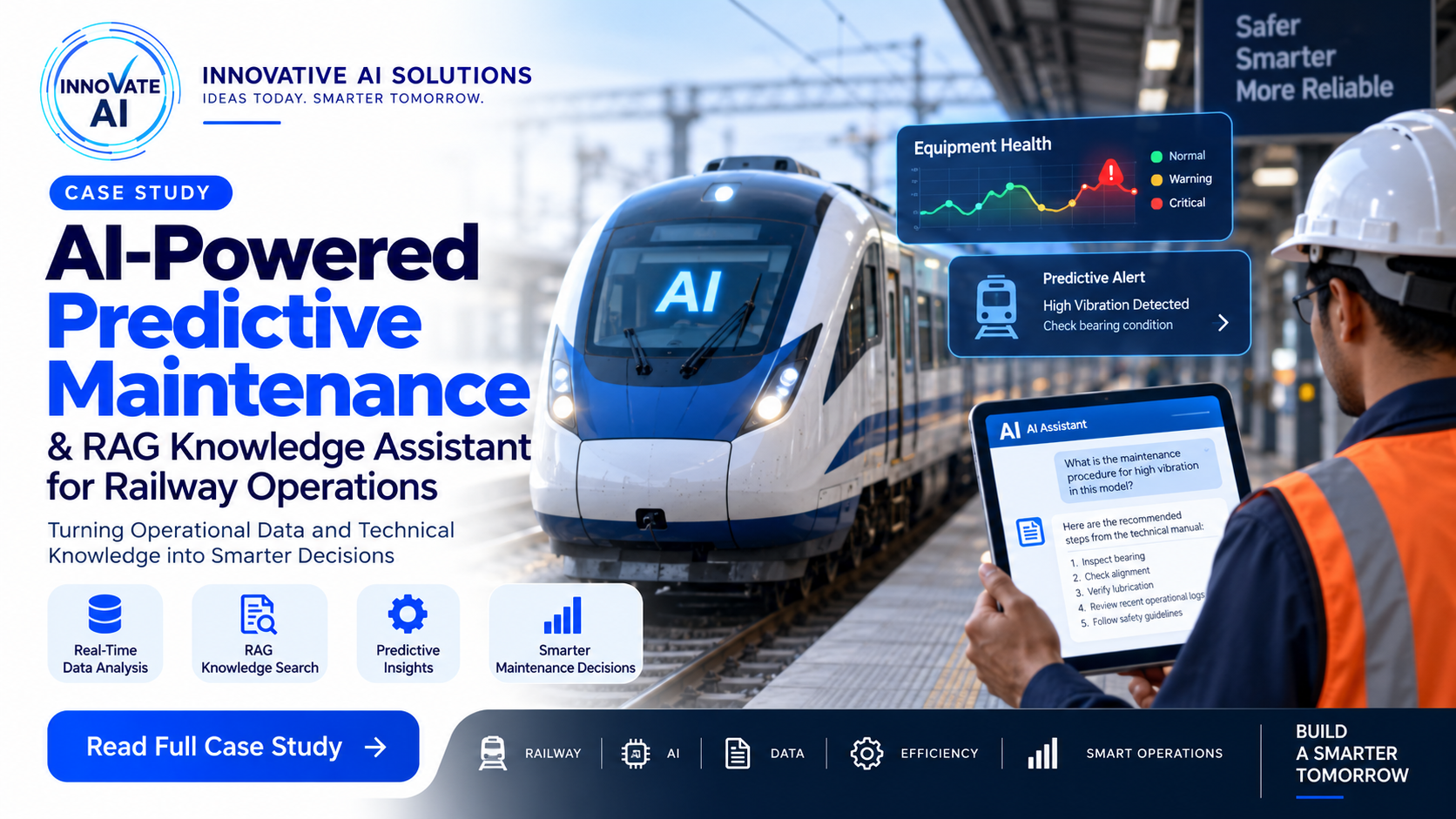
AI-Powered Predictive Maintenance & RAG Knowledge Assistant: Project Case Study Predictive maintenance is one of those areas where AI can solve a very...
AI-Powered Predictive Maintenance & RAG Knowledge Assistant: Project Case Study
Predictive maintenance is one of those areas where AI can solve a very practical business problem.
In large-scale operations, equipment generates a significant amount of information through sensors, maintenance records, technical documentation and operational data.
The challenge is not simply collecting this data.
The real challenge is understanding it quickly enough to make better maintenance decisions.
For this project, Innovative AI Solutions worked on an AI-powered predictive maintenance platform designed around railway operational data.
The solution combined:
- Data processing
- Predictive analytics
- Interactive dashboards
- Document-based AI
- RAG
- Generative AI
- A conversational knowledge assistant
The objective was to bring operational information and technical knowledge together in a single application.
Instead of requiring users to look through different dashboards and documents, the platform provided a more centralized way to understand maintenance information and ask questions about technical knowledge.
Project Overview
Industry
Railway / Transportation
Project Type
AI-Powered Predictive Maintenance Platform
Core Technologies
- React
- Tailwind CSS
- Django
- Django REST Framework
- PostgreSQL
- Python
- Generative AI
- RAG
- Machine Learning
- Data Processing
Major Components
- Predictive maintenance dashboard
- Sensor-data processing
- Maintenance analytics
- AI knowledge assistant
- RAG-based document search
- Conversational interface
- Backend APIs
- Data visualization
The Business Challenge
Railway infrastructure and equipment generate large amounts of operational data.
This information can come from:
- Sensors
- Equipment
- Maintenance records
- Technical manuals
- Operational reports
- Historical data
- Maintenance documentation
When information is spread across different systems, finding the right information can become difficult.
For example, a maintenance team might need to answer:
Which equipment is showing unusual behavior?
Or:
What maintenance procedure should be followed for this equipment?
Or:
Has this type of issue appeared before?
Traditionally, answering these questions may require looking at multiple sources.
The project needed to bring these different information sources together.
The Main Problem We Wanted to Solve
The project had two connected challenges.
Challenge 1: Understanding Equipment Data
Large volumes of sensor and operational data need to be analyzed to identify unusual patterns and potential maintenance requirements.
Challenge 2: Accessing Technical Knowledge
Even when technical documentation exists, finding the right section of a manual or maintenance document can take time.
The solution therefore needed both:
Predictive Analytics + Intelligent Knowledge Retrieval
This led to a combined architecture.
The Solution
We designed the platform around two major AI capabilities.
1. Predictive Maintenance
The system processes sensor and operational data to help identify patterns that may indicate potential maintenance requirements.
2. RAG-Based AI Assistant
The system allows users to ask questions about connected technical and operational documentation.
A simplified architecture looks like this:
                 RAILWAY DATA
                      │
        ┌─────────────┴─────────────┐
        ↓                           ↓
 Sensor / Operational Data     Documents
        ↓                           ↓
 Data Processing                OCR / Extraction
        ↓                           ↓
 Analytics / ML                  Chunking
        ↓                           ↓
 Predictive Insights            Embeddings
        ↓                           ↓
        └─────────────┬─────────────┘
                      ↓
                AI Platform
                      ↓
             Dashboard + RAG
                      ↓
                 AI Assistant
This architecture allowed the platform to combine structured operational information with unstructured technical knowledge.
Predictive Maintenance Using AI
Traditional maintenance often follows predefined schedules.
For example:
Inspect equipment every X days.
Predictive maintenance takes a different approach.
Instead of looking only at time-based schedules, the system can analyze available data to identify patterns that may require attention.
A simplified workflow is:
Sensor Data
     ↓
Data Processing
     ↓
Feature Analysis
     ↓
Pattern Detection
     ↓
Predictive Model
     ↓
Maintenance Insight
The objective is to help maintenance teams make decisions using data rather than relying only on fixed schedules.
Sensor Data Processing
One of the important parts of the project was handling sensor-related information.
Raw sensor data is rarely ready for direct analysis.
It may contain:
- Missing values
- Noise
- Different measurement scales
- Inconsistent timestamps
- Abnormal readings
A preprocessing pipeline can therefore be used:
Raw Data
   ↓
Validation
   ↓
Cleaning
   ↓
Transformation
   ↓
Feature Preparation
   ↓
Analysis
The quality of the input data is critical because poor data can affect downstream analytics.
Interactive Maintenance Dashboard
The frontend was designed to give users a clearer view of operational information.
The application used:
React + Tailwind CSS
for the frontend experience.
The dashboard could bring different information into one interface.
Potential dashboard information includes:
- Equipment status
- Sensor trends
- Maintenance indicators
- Historical information
- Operational metrics
- Alerts
- Predictive insights
Instead of requiring users to manually analyze raw datasets, the dashboard presents information in a more accessible format.
Why We Added RAG
Predictive analytics answers one type of question:
"What does the data indicate?"
But maintenance teams also need answers such as:
"What procedure should I follow?"
"What does this equipment manual say?"
"What are the recommended maintenance steps?"
These answers may already exist inside technical documents.
That's where Retrieval-Augmented Generation (RAG) becomes useful.
Our RAG approach allows the AI assistant to retrieve relevant information from connected knowledge sources before generating a response.
For more information about the architecture, readers can also explore our guide on RAG chatbot development.
How the RAG Knowledge Assistant Works
The document workflow can be represented as:
Technical Documents
        ↓
Document Processing
        ↓
Text Extraction
        ↓
Chunking
        ↓
Embeddings
        ↓
Knowledge Store
        ↓
Retrieval
        ↓
Relevant Context
        ↓
Generative AI
        ↓
Answer
When a user asks a question, the system searches the available knowledge rather than relying only on the model's general knowledge.
Example User Query
Imagine a maintenance engineer asks:
"What should I check when this equipment shows abnormal vibration?"
The system can:
User Question
      ↓
Query Processing
      ↓
Knowledge Retrieval
      ↓
Relevant Technical Documentation
      ↓
Context Selection
      ↓
LLM
      ↓
AI Response
This makes the interaction much more natural than manually searching through multiple technical documents.
Why RAG Instead of Only Using an LLM?
A general-purpose LLM doesn't automatically know a company's private technical documentation.
The information may exist in:
- Internal manuals
- Maintenance documents
- SOPs
- Technical reports
- Equipment documentation
RAG provides a way to connect these knowledge sources with the AI application.
The basic idea is:
Don't expect the AI model to know everything. Give it access to the information it needs.
This is also why RAG can be useful for enterprise AI applications.
Combining Predictive Analytics With RAG
One of the interesting aspects of this project is that the system doesn't treat analytics and Generative AI as completely separate technologies.
They can complement each other.
For example:
Sensor Data
     ↓
Predictive Analysis
     ↓
Potential Issue
     ↓
RAG Knowledge Search
     ↓
Technical Documentation
     ↓
AI Explanation
This creates a more useful workflow.
The analytics layer can identify an operational pattern.
The knowledge layer can help users understand the relevant technical information.
AI Assistant for Maintenance Teams
The conversational AI interface allows users to interact with the knowledge base using natural language.
Instead of searching:
"Maintenance Manual → Chapter 7 → Section 3 → Equipment..."
the user can ask:
"What is the recommended maintenance procedure?"
The AI can then retrieve the relevant information and present it conversationally.
This type of interaction is one reason businesses are increasingly exploring enterprise RAG solutions.
Generative AI Layer
The Generative AI component acts as the natural-language interface.
It receives:
- User question
- Retrieved context
- System instructions
- Conversation context
and produces the final response.
Conceptually:
User Question
      +
Retrieved Knowledge
      +
Application Rules
      ↓
Generative AI
      ↓
Natural Language Answer
The application should still maintain appropriate controls around what information can be accessed and how answers are generated.
Backend Architecture
The backend was designed using:
Python + Django + Django REST Framework
This provided the API layer between the frontend, data systems and AI components.
A simplified architecture:
React Frontend
      ↓
REST APIs
      ↓
Django / DRF
      ↓
Business Logic
      ↓
PostgreSQL
      ↓
AI / RAG Services
This separation makes it easier to maintain the application and integrate additional services.
Database Layer
PostgreSQL was used as the primary relational database.
The database can store structured information such as:
- Equipment
- Sensor information
- Maintenance records
- Users
- Operational information
- System metadata
The database works alongside the AI knowledge layer.
This is important because not every question should be answered using a language model.
For structured data, conventional database queries are often more appropriate.
Structured Data + Unstructured Data
One of the key architectural decisions was recognizing that businesses usually have both types of data.
Structured
Examples:
- Sensor readings
- Equipment IDs
- Dates
- Maintenance records
- Status values
Unstructured
Examples:
- Manuals
- Reports
- SOPs
- Technical documents
- PDFs
A modern AI application may need to work with both.
             BUSINESS DATA
                  │
        ┌─────────┴─────────┐
        ↓                   ↓
   Structured            Unstructured
        ↓                   ↓
 PostgreSQL                RAG
        ↓                   ↓
        └─────────┬─────────┘
                  ↓
              AI Platform
Frontend Experience
The frontend was developed using React and Tailwind CSS.
The objective was to create an interface that allows users to move between:
- Operational dashboards
- Predictive information
- Maintenance information
- AI assistant
- Knowledge search
The AI assistant becomes another part of the application rather than a completely separate product.
API-First Architecture
The system uses APIs to connect different components.
For example:
React
  ↓
Django REST API
  ↓
Database
  ↓
AI Services
This makes the architecture easier to extend.
Additional applications such as mobile clients or other internal tools can potentially consume the same backend APIs.
Challenges During AI Development
AI projects rarely involve only one technical problem.
Some of the major challenges in a project like this include:
Data Quality
Sensor data needs proper preprocessing.
Document Quality
Technical PDFs may have inconsistent formatting.
Retrieval Quality
The AI needs to retrieve the correct document sections.
Context Management
Too much irrelevant information can reduce answer quality.
System Integration
AI needs to work with the existing application rather than operating independently.
Evaluation
A demo response looking correct isn't enough.
The system needs realistic testing.
Improving RAG Retrieval
A RAG system is only as useful as its retrieval pipeline.
Several factors influence retrieval quality:
- Chunking strategy
- Embedding model
- Metadata
- Search method
- Query formulation
- Reranking
- Context selection
The development process therefore shouldn't stop after connecting a vector database.
The retrieval pipeline needs testing and optimization.
This connects directly with our RAG chatbot development guide, where we explain the architecture in greater detail.
AI Hallucination and Grounding
One of the biggest concerns with Generative AI is hallucination.
For a technical application, simply generating a convincing answer isn't enough.
The system should be designed to ground responses in approved information where appropriate.
A safer workflow is:
Question
   ↓
Retrieve Relevant Knowledge
   ↓
Check Available Context
   ↓
Generate Answer
   ↓
Source / Reference
If the required information isn't available, the system should have a way to communicate uncertainty rather than confidently inventing an answer.
Role of Human Experts
AI should support technical teams, not blindly replace their expertise.
For maintenance workflows, human professionals remain important for:
- Final decisions
- Physical inspection
- Safety-critical actions
- Exceptional situations
- Validation of recommendations
The AI system is best viewed as a decision-support and knowledge-access layer.
AI Automation Opportunities
Once an AI knowledge system is available, additional automation opportunities become possible.
For example:
Sensor Alert
     ↓
AI Analysis
     ↓
Identify Equipment
     ↓
Search Technical Knowledge
     ↓
Generate Maintenance Summary
     ↓
Notify Team
This is where predictive maintenance, RAG and AI automation can eventually work together.
Businesses interested in this approach can also read our article on AI automation for businesses.
Potential Business Benefits
The value of a system like this should be measured through actual operational metrics rather than generic AI claims.
Potential areas to measure include:
Faster Information Retrieval
How quickly can engineers find relevant documentation?
Reduced Manual Search
How much time is spent searching through technical documents?
Better Data Visibility
Can teams understand equipment information more easily?
Faster Response
Can maintenance teams respond to potential issues sooner?
Knowledge Accessibility
Can employees access technical knowledge through natural language?
Better Workflow Integration
Can AI insights be connected with existing operational systems?
These measurements should be established according to the actual organization's baseline.
From Dashboard to AI Assistant
A traditional maintenance dashboard might answer:
What is happening?
An AI knowledge assistant can help answer:
Why might this be happening?
and:
What does our technical documentation say about it?
This distinction is important.
The goal isn't to replace the dashboard.
The goal is to add an intelligent layer on top of existing information.
Technology Stack
The project combined several technologies.
| Layer | Technology |
|---|---|
| Frontend | React |
| UI | Tailwind CSS |
| Backend | Python |
| API | Django REST Framework |
| Database | PostgreSQL |
| AI | Generative AI |
| Knowledge | RAG |
| Analytics | Machine Learning / Data Processing |
| Deployment | Cloud-ready architecture |
The exact technology stack for a production deployment can vary depending on requirements.
Why We Didn't Build Everything as an AI Agent
An interesting architectural decision is knowing when not to use an AI agent.
Not every operation requires autonomous decision-making.
For example:
Get Equipment Data
        ↓
Database Query
doesn't necessarily need an AI agent.
But:
Understand User Request
        ↓
Search Technical Knowledge
        ↓
Check Equipment Information
        ↓
Prepare Explanation
may benefit from AI orchestration.
This is why modern AI systems often combine:
Traditional Software + RAG + AI + APIs + Automation
rather than trying to make everything autonomous.
For more information, see our guide on AI Agent Development.
Scalability Considerations
A system like this needs to be designed with future growth in mind.
Potential future requirements include:
- More equipment
- More sensor data
- More documents
- More users
- Additional railway assets
- Multiple departments
- Additional AI capabilities
The architecture should therefore separate:
Data Layer
AI Layer
Application Layer
Presentation Layer
This allows individual components to evolve without rebuilding the entire platform.
Security and Access Control
Enterprise AI systems can potentially access sensitive operational information.
Security therefore needs to be considered at multiple levels:
- Authentication
- Authorization
- API security
- Database security
- Document access
- User roles
- Logging
- Monitoring
For example:
User
 ↓
Authentication
 ↓
Authorization
 ↓
AI Application
 ↓
Approved Data
The AI model itself should not be treated as the security boundary.
Permissions should be enforced by the application.
What We Learned From the Project
One of the biggest lessons from AI development is that the model is only one part of the solution.
A successful AI product requires:
Good Data
+
Good Software Architecture
+
Good Retrieval
+
Good AI
+
Good UX
+
Security
+
Evaluation
If one of these components is weak, the overall experience can suffer.
Why This Case Study Matters for Other Businesses
Although this project focuses on railway maintenance, the underlying architecture can be applied to other industries.
For example:
Manufacturing
Sensor data + machine manuals + maintenance knowledge.
Healthcare
Approved documentation + knowledge retrieval + workflow systems.
Banking
Business documents + customer information + controlled workflows.
E-commerce
Product data + customer support + RAG.
Education
Course material + student assistant + knowledge retrieval.
Enterprise IT
Technical documentation + ticketing + AI assistant.
The exact implementation changes by industry, but the underlying principle remains similar:
Connect business data with AI in a controlled and useful way.
From Predictive Maintenance to Enterprise AI
This project demonstrates how different AI technologies can work together.
Machine Learning
       +
Data Processing
       +
RAG
       +
Generative AI
       +
Software APIs
       +
Dashboards
       ↓
Enterprise AI Application
This is very different from simply embedding a chatbot into a website.
It is a complete software system where AI is one layer of the architecture.
Why Innovative AI Solutions
At Innovative AI Solutions, we focus on building practical AI-powered software rather than treating AI as an isolated feature.
Our AI development capabilities include:
- Generative AI
- RAG applications
- AI chatbots
- AI agents
- AI automation
- Document AI
- OCR
- Machine learning
- Custom software development
- API development
- Cloud and DevOps
Businesses exploring AI can start with a specific workflow and gradually expand the solution.
You can learn more about our approach through our guide to AI development companies in India.
Related AI Resources
If you're researching AI solutions for your business, these resources can help:
AI Development
AI Development Company in India & Delhi NCR
Learn how businesses can work with an AI development partner to build custom AI solutions.
RAG
How to Build a RAG Chatbot for Your Business
A technical and business-focused guide to RAG architecture, document processing and enterprise knowledge assistants.
AI Agents
AI Agent Development: How Businesses Can Automate Multi-Step Workflows
Learn how AI agents can connect multiple tools and automate complex workflows.
AI Development Cost
How Much Does AI Development Cost in India?
Understand the factors that influence AI software development costs.
AI Automation
AI Automation for Businesses: 15 Processes You Can Automate
Explore practical business workflows that can benefit from AI automation.
Frequently Asked Questions
What is predictive maintenance using AI?
Predictive maintenance uses data and analytical or machine-learning techniques to identify patterns that may indicate potential equipment issues or maintenance requirements.
How can AI be used in railway maintenance?
AI can be used for data analysis, anomaly detection, predictive maintenance, document search, knowledge assistance and workflow support.
What is RAG in an AI maintenance system?
RAG allows an AI application to retrieve relevant information from approved technical documents before generating an answer.
Can RAG work with maintenance manuals?
Yes. Technical manuals can be processed and indexed so that users can ask natural-language questions about the available content.
Can predictive maintenance and RAG work together?
Yes. Predictive analytics can provide operational insights while RAG can retrieve relevant technical information to help users understand those insights.
Does AI replace maintenance engineers?
AI should generally be treated as a decision-support and knowledge-access tool. Human experts remain important, particularly for safety-critical and physical maintenance decisions.
What technologies are used in an AI predictive maintenance platform?
Depending on requirements, a platform can combine Python, machine learning, databases, APIs, React, cloud infrastructure, RAG and Generative AI.
Can the same architecture be used in manufacturing?
Yes. Similar approaches can be applied to manufacturing equipment, industrial machines and other sensor-driven environments.
Can AI maintenance systems connect to existing software?
Yes. APIs can be used to connect AI systems with databases, enterprise applications and operational software.
Conclusion
This project demonstrates what becomes possible when AI is integrated into a real software platform rather than treated as a standalone chatbot.
The combination of:
Predictive Analytics + RAG + Generative AI + Data + APIs + Interactive Dashboards
can create a much more useful enterprise application.
For maintenance teams, the goal isn't simply to generate an AI response.
It's to make operational information easier to understand and technical knowledge easier to access.
The same approach can be adapted for manufacturing, transportation, education, healthcare, e-commerce, enterprise IT and other industries.
If your organization has large amounts of operational data, technical documentation or repetitive workflows, AI can potentially become an intelligent layer on top of your existing systems.
Have a business process that could benefit from AI?
Innovative AI Solutions can help you evaluate the use case, design the architecture and build a custom AI-powered solution.
Build smarter systems. Turn business data into actionable intelligence.