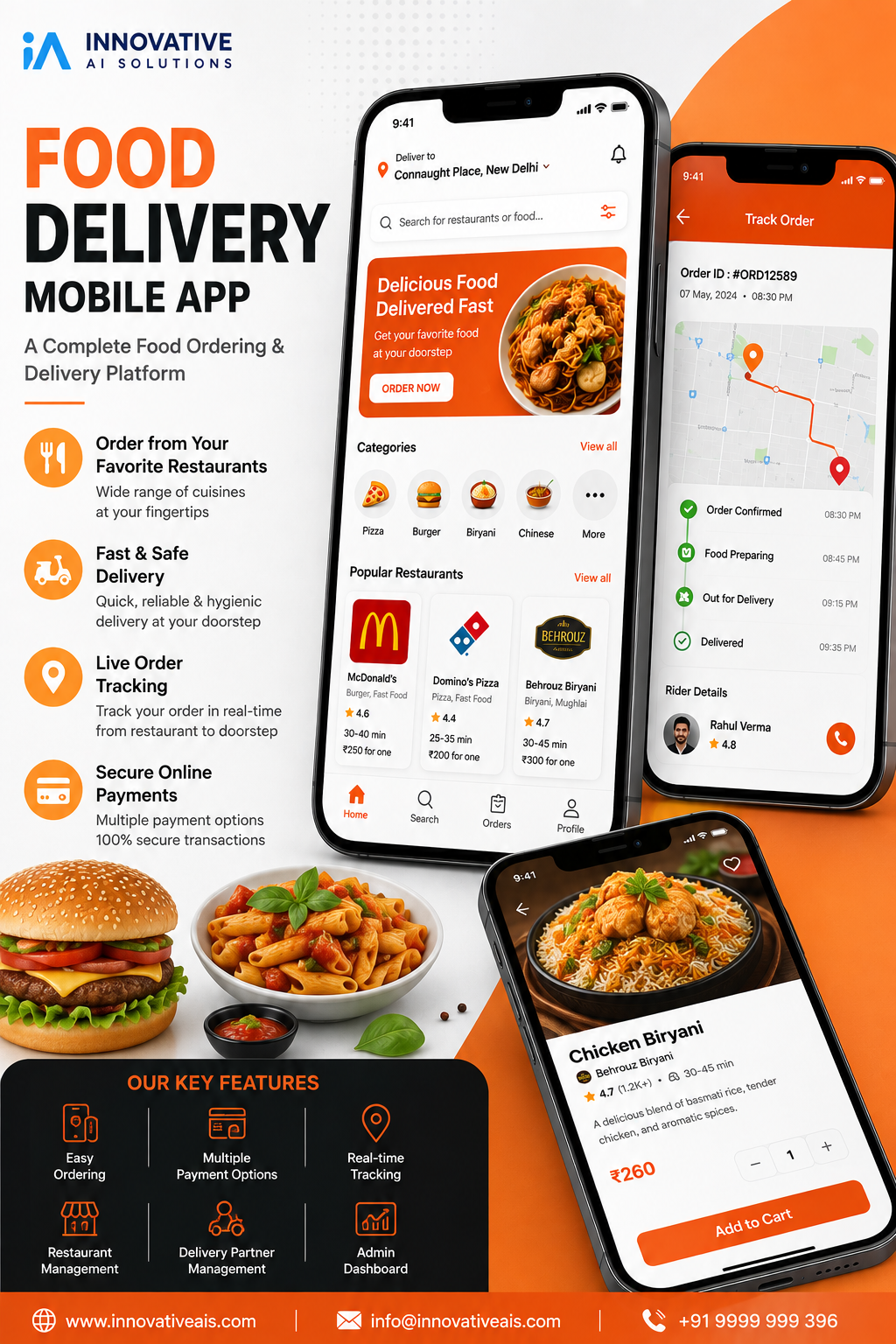
The food delivery industry has transformed the way customers discover restaurants, order meals and receive food at their preferred locations. Customers...
The food delivery industry has transformed the way customers discover restaurants, order meals and receive food at their preferred locations.
Customers increasingly expect a convenient mobile experience where they can browse restaurants, explore menus, select food items, place orders and track deliveries without needing to visit a restaurant physically.
To address these requirements, Innovative AI Solutions developed a concept for a comprehensive Food Delivery Mobile Application connecting customers, restaurants and delivery partners through a unified digital platform.
The application is designed around a multi-sided marketplace model.
Customers use the mobile application to discover restaurants and order food.
Restaurants use the platform to manage menus and incoming orders.
Delivery partners manage assigned deliveries and update delivery status.
Administrators manage the overall ecosystem through centralized management functionality.
The resulting architecture creates a connected food-commerce ecosystem that can be expanded with payment integrations, real-time tracking, notifications, analytics, loyalty programs and AI-powered personalization.
2. Executive Summary
The Food Delivery Mobile App is designed to simplify the complete food ordering journey through a mobile-first experience.
Instead of requiring customers to call restaurants or physically visit them, the application provides a digital interface for discovering restaurants, browsing menus and placing orders.
The platform connects three primary user groups:
Customers
Discover restaurants, browse food items and place orders.
Restaurants
Manage menus, receive orders and process food orders.
Delivery Partners
Receive delivery assignments and manage the delivery journey.
An administrative layer provides centralized control over users, restaurants, products, orders, payments and platform operations.
The platform follows a scalable architecture that can support additional restaurants, users and delivery operations as the business expands.
3. Business Challenge
Traditional food ordering processes can create friction for both customers and restaurants.
Customers may have limited visibility into available restaurants and menus. Phone-based ordering can also result in communication errors, unclear order status and limited transparency.
Restaurants face a different set of challenges.
They need to manage:
- Menu information
- Food availability
- Customer orders
- Order preparation
- Delivery coordination
- Customer communication
As order volumes increase, manual processes become difficult to manage.
The objective was therefore to create a centralized mobile platform capable of bringing customers, restaurants and delivery operations together.
4. Project Objectives
The major objectives of the platform were:
Digital Food Ordering
Create a mobile application through which customers can order food digitally.
Restaurant Discovery
Make it easier for customers to discover restaurants and explore available menus.
Menu Management
Provide restaurants with a structured way to manage their food items.
Order Management
Create a connected workflow from customer order placement to restaurant processing and delivery.
Delivery Coordination
Support delivery operations through a dedicated delivery workflow.
Centralized Administration
Provide administrators with visibility and control over the platform.
Scalable Architecture
Create a technology foundation that can support future growth and additional functionality.
5. Platform Architecture
The food delivery ecosystem can be divided into four primary components:
Customer Mobile App
↓
Backend & API Layer
↓
Restaurant / Delivery Operations
↓
Admin Management System
The platform can support communication between these components through APIs.
A simplified business workflow is:
Customer
↓
Restaurant Discovery
↓
Menu
↓
Cart
↓
Checkout
↓
Order
↓
Restaurant
↓
Food Preparation
↓
Delivery Partner
↓
Customer
This connected workflow forms the core of the food delivery platform.
6. Customer Mobile Application
The customer application is designed around convenience and simplicity.
A typical customer journey begins with discovering nearby or available restaurants.
The customer can then:
- Browse restaurants
- Search for food
- View menus
- Open food item details
- Select quantities
- Add items to cart
- Review the order
- Select delivery details
- Complete checkout
- Track order progress
The mobile-first interface is designed to reduce unnecessary steps between food discovery and order placement.
7. User Registration and Login
The application can provide account-based authentication for customers.
User accounts allow the platform to associate customer activity with individual profiles.
Depending on the implementation, authentication can support:
- Registration
- Login
- Logout
- Password management
- Profile management
- Account verification
Authentication also creates the foundation for personalized experiences and order history.
8. Restaurant Discovery
Restaurant discovery is one of the most important features of a food delivery application.
Customers need a simple way to identify restaurants based on their preferences.
The application can organize restaurants using:
- Cuisine
- Location
- Restaurant category
- Availability
- Rating
- Delivery options
The discovery experience can be expanded in the future with personalized recommendations and intelligent search.
9. Search Functionality
A powerful search experience allows customers to quickly find restaurants or food items.
For example, users may search for:
- Pizza
- Burger
- Biryani
- Chinese food
- South Indian food
- Desserts
- Healthy food
The search architecture can later be enhanced with natural-language search.
For example:
"Show me vegetarian food under ₹500."
An AI-powered search layer could interpret the request and return relevant restaurants or dishes.
10. Restaurant Menu
Once a customer selects a restaurant, the application presents its available menu.
Menu organization can include:
- Categories
- Food items
- Images
- Descriptions
- Prices
- Availability
- Customization options
A structured menu allows restaurants to maintain their digital food catalogue while making discovery easier for customers.
11. Food Item Details
The food detail page provides customers with information before they add an item to their cart.
Information can include:
- Food name
- Image
- Description
- Price
- Category
- Availability
- Customization options
A clear food detail experience helps customers make informed purchasing decisions.
12. Shopping Cart
The cart collects all selected food items before checkout.
Customers can review:
- Food items
- Quantity
- Individual prices
- Subtotal
- Applicable charges
- Total amount
Customers can also modify quantities or remove items before placing an order.
A well-designed cart minimizes errors and gives customers a clear understanding of their order.
13. Checkout
The checkout process is where the customer's food selection becomes an actual order.
The process can include:
Cart Review
↓
Delivery Address
↓
Order Summary
↓
Payment Method
↓
Order Confirmation
The checkout experience should be simple and transparent.
Unexpected complexity during checkout can increase abandonment, so the interface should focus on essential information and clear actions.
14. Address Management
Food delivery requires accurate delivery information.
The customer application can support address management, allowing users to provide the location where the order should be delivered.
Potential functionality includes:
- Add address
- Edit address
- Delete address
- Select saved address
- Delivery instructions
Future versions can also integrate mapping and location services.
15. Online Payment
A food delivery platform can integrate online payment functionality based on business requirements.
Payment capabilities may include:
- Payment initiation
- Payment confirmation
- Transaction status
- Failed payment handling
- Order-payment association
Different payment providers can be integrated depending on the target market.
The final payment provider should be documented according to the actual implementation.
16. Order Management
Order management connects customers, restaurants and delivery operations.
A typical order lifecycle can be:
Order Placed
↓
Restaurant Receives Order
↓
Order Accepted
↓
Food Preparation
↓
Order Ready
↓
Delivery Assigned
↓
Out for Delivery
↓
Delivered
Each status gives the relevant participants visibility into the order lifecycle.
17. Restaurant Application
The restaurant-facing application or dashboard provides businesses with tools to participate in the food delivery marketplace.
Restaurants can manage their digital presence and operational workflow.
Potential capabilities include:
- Restaurant profile
- Menu management
- Food item management
- Pricing
- Availability
- Incoming orders
- Order status
- Business information
The restaurant experience should remain simple because staff may need to process orders while simultaneously managing physical restaurant operations.
18. Restaurant Menu Management
Restaurant operators need control over their digital menu.
Menu management can include:
- Add food item
- Edit food item
- Delete food item
- Update price
- Change availability
- Manage categories
- Upload food images
This allows restaurants to keep their online menu aligned with actual availability.
19. Restaurant Order Management
When a customer places an order, the restaurant needs to receive and process it.
The restaurant workflow can include:
New Order
↓
Accept / Reject
↓
Prepare Food
↓
Mark Ready
↓
Delivery Pickup
The system can synchronize order status with the customer's application.
20. Delivery Partner Application
The delivery partner side of the platform manages the final stage of the food ordering journey.
Delivery partners can receive assigned orders and update their delivery status.
Potential functionality includes:
- Delivery partner login
- Assigned orders
- Pickup information
- Customer information
- Delivery status
- Delivery completion
A dedicated delivery application can provide better visibility and operational control.
21. Delivery Tracking
Delivery tracking can provide customers with visibility after an order leaves the restaurant.
Depending on the implementation, tracking can include:
- Order status
- Delivery partner assignment
- Estimated delivery information
- Pickup status
- Delivery status
Real-time location tracking can be added using mapping and location technologies where required.
22. Push Notifications
Notifications keep customers and operational teams informed about important events.
Customer notifications can include:
- Order confirmation
- Restaurant acceptance
- Food preparation
- Order ready
- Delivery assignment
- Out for delivery
- Delivery completion
Restaurants and delivery partners can also receive notifications for relevant operational events.
23. Admin Panel
A food delivery marketplace requires centralized administration.
The admin system can provide management functionality for:
- Customers
- Restaurants
- Delivery partners
- Food categories
- Food items
- Orders
- Payments
- Offers
- Platform configuration
The administrative layer provides centralized visibility into the marketplace.
24. Restaurant Management
Administrators can manage restaurant accounts and marketplace participation.
Potential administrative functionality includes:
- Restaurant registration
- Restaurant verification
- Restaurant profile management
- Restaurant status
- Menu oversight
- Restaurant activity
This helps maintain marketplace quality and operational control.
25. Customer Management
The platform can maintain customer records for account and order management.
Administrative functionality may include:
- Customer profiles
- Account status
- Order history
- Customer activity
- Support-related information
Customer management should follow appropriate privacy and security requirements.
26. Offer and Coupon Management
Food delivery businesses often use promotions to encourage repeat orders.
A promotional system can support:
- Discount codes
- Percentage discounts
- Fixed discounts
- Restaurant-specific offers
- Minimum order conditions
- Promotional campaigns
The rules should be implemented carefully to prevent incorrect discount calculations.
27. Order Notifications
Real-time order communication is important in an on-demand application.
For example:
Customer places order
↓
Customer receives confirmation.
Restaurant accepts order
↓
Customer receives status update.
Food prepared
↓
Customer receives notification.
Delivery begins
↓
Customer receives delivery update.
This creates transparency throughout the ordering journey.
28. API Architecture
The mobile applications can communicate with backend services through APIs.
API functionality can manage:
- Authentication
- Restaurants
- Menus
- Food items
- Search
- Cart
- Orders
- Payments
- Delivery
- Notifications
- User profiles
An API-driven architecture allows different applications to use the same business logic.
For example:
Customer App
and
Restaurant App
and
Delivery App
can communicate with the same backend ecosystem through controlled APIs.
29. Database Architecture
The platform requires structured data management.
Important entities can include:
- Users
- Restaurants
- Delivery Partners
- Categories
- Food Items
- Carts
- Orders
- Order Items
- Payments
- Addresses
- Notifications
- Offers
A properly structured database helps maintain consistency across customer, restaurant and delivery operations.
30. Security
Security is an important consideration for a food delivery platform because the application manages user accounts, orders and potentially payment-related information.
Security practices should include:
- Secure authentication
- Authorization
- API validation
- Input validation
- Secure communication
- Protected credentials
- Server-side validation
- Secure payment integration
Sensitive credentials should never be exposed through mobile application code.
31. Performance Optimization
A food delivery application needs to respond quickly because customers interact with the platform frequently.
Performance optimization can include:
- Image compression
- Lazy loading
- API optimization
- Pagination
- Efficient database queries
- Caching
- Optimized network requests
The objective is to maintain a responsive experience across different mobile devices and network conditions.
32. Mobile UX Design
The application needs to be designed for touch-based interaction.
Important UX considerations include:
- Clear navigation
- Large touch targets
- Simple checkout
- Easy restaurant discovery
- Readable menu information
- Clear order status
- Fast interactions
The interface should prioritize usability over unnecessary visual complexity.
33. Scalability
A food delivery platform may start with a limited number of restaurants and gradually expand.
The architecture should therefore support:
- More customers
- More restaurants
- More food items
- More delivery partners
- Higher order volumes
- Multiple geographic regions
A scalable architecture provides the foundation for future business growth.
34. Development Challenges
Developing a food delivery marketplace involves several interconnected workflows.
Multi-User Ecosystem
Customers, restaurants and delivery partners have different requirements.
The system must ensure that each participant sees the functionality relevant to their role.
Order Synchronization
Order status needs to remain consistent between customers, restaurants and delivery operations.
Real-Time Communication
Important events may need to reach users quickly through notifications.
Large Product Catalogues
Restaurants may have many food items and categories.
Delivery Operations
The platform needs to connect order fulfilment with delivery operations.
35. Solutions
The application architecture addresses these challenges through role-based workflows and centralized backend services.
Customers interact with the customer-facing mobile experience.
Restaurants manage menus and orders through their operational interface.
Delivery partners manage assigned deliveries.
Backend APIs coordinate information between the different components.
This separation improves maintainability while allowing each participant to have an experience tailored to their role.
36. Testing Strategy
A food delivery application requires extensive testing because multiple workflows depend on one another.
Testing areas include:
- User registration
- Login
- Restaurant discovery
- Search
- Menu browsing
- Cart
- Checkout
- Payment
- Order creation
- Restaurant order management
- Delivery assignment
- Notifications
- Order status
- Admin functionality
Testing should be performed across different devices and screen sizes.
37. Deployment
A production-ready food delivery platform requires deployment of its mobile and backend components.
The deployment process can include:
Development
↓
Testing
↓
Staging
↓
Production
Monitoring and logging can then be used to identify application errors and operational issues.
38. Business Benefits
A custom food delivery mobile application can provide businesses with several advantages.
Digital Customer Acquisition
Customers can discover restaurants through a dedicated digital platform.
Convenient Ordering
Customers can order food without making phone calls.
Better Order Visibility
Customers can receive updates throughout the order lifecycle.
Restaurant Digitization
Restaurants gain a digital channel for menu and order management.
Operational Efficiency
Centralized systems reduce dependence on manual communication.
Scalable Marketplace
The platform can expand as more restaurants and customers join.
39. Future AI Integration
Artificial intelligence can significantly enhance the food delivery experience.
AI Food Recommendations
The system can recommend food based on customer preferences and previous orders.
Intelligent Search
Customers could search using natural language.
For example:
"Find spicy vegetarian food near me."
AI Customer Support
An AI assistant could answer common questions related to:
- Orders
- Delivery
- Restaurants
- Refunds
- Menu items
Demand Forecasting
AI could help restaurants forecast food demand.
Personalized Offers
The platform could identify suitable promotions based on customer behaviour.
Restaurant Analytics
AI-powered analytics could identify:
- Popular dishes
- Peak ordering periods
- Customer preferences
- Repeat ordering patterns
Delivery Optimization
Intelligent routing could potentially help optimize delivery operations.
40. Technology Stack
The final published case study should list the actual technologies used in the project.
A modern food delivery platform can include:
Mobile Development
Cross-platform or native mobile development technologies.
Backend
API-driven backend architecture.
Database
A scalable relational or NoSQL database depending on requirements.
Cloud
Cloud infrastructure for backend deployment and scalability.
APIs
RESTful or other appropriate API architecture.
Integrations
Payment, maps, notifications and analytics integrations.
The exact stack should always reflect the actual implementation rather than being added for marketing purposes.
41. Complete Customer Journey
The customer experience can be summarized as:
Open App
↓
Login
↓
Discover Restaurants
↓
Select Restaurant
↓
Browse Menu
↓
Select Food
↓
Add to Cart
↓
Review Cart
↓
Select Address
↓
Checkout
↓
Payment
↓
Order Confirmation
↓
Restaurant Preparation
↓
Delivery
↓
Order Completion
This creates a complete digital food ordering experience.
42. Complete Restaurant Journey
The restaurant workflow can be represented as:
Restaurant Login
↓
Manage Menu
↓
Receive Order
↓
Accept Order
↓
Prepare Food
↓
Mark Order Ready
↓
Delivery Pickup
↓
Order Completed
This workflow gives restaurants a structured method of managing digital orders.
43. Complete Delivery Journey
The delivery process can follow:
Delivery Partner Login
↓
Receive Assignment
↓
Navigate to Restaurant
↓
Pickup Order
↓
Navigate to Customer
↓
Deliver Order
↓
Update Delivery Status
↓
Complete Delivery
This creates a connected fulfilment workflow.
44. Why Choose Innovative AI Solutions
Innovative AI Solutions provides custom digital product development services for businesses looking to transform their ideas into technology platforms.
Our capabilities include:
- Mobile App Development
- Custom Software Development
- E-commerce Development
- Marketplace Development
- API Development
- AI Solutions
- Cloud Solutions
- Business Automation
Our development approach focuses on understanding the business model first and then designing technology around actual operational requirements.
For businesses planning a food delivery platform, we can build customized customer applications, restaurant platforms, delivery applications and administrative systems.
45. Potential Business Models
A food delivery platform can support multiple monetization models.
Restaurant Commission
The platform can charge restaurants a percentage of order value.
Delivery Fee
Customers can be charged a delivery fee depending on distance and operational conditions.
Subscription
A membership program can provide customers with benefits such as discounted delivery.
Featured Restaurants
Restaurants can pay for increased visibility.
Promotional Campaigns
Restaurants can participate in paid promotional campaigns.
The appropriate business model depends on the target market and platform strategy.
46. Expansion Opportunities
Once the core food delivery platform is established, the business can expand into additional areas.
Potential expansion includes:
- Grocery delivery
- Pharmacy delivery
- Cloud kitchens
- Corporate food ordering
- Catering
- Subscription meals
- Restaurant loyalty programs
- AI-powered food recommendations
- Multi-city operations
This creates opportunities to evolve the platform into a broader on-demand commerce ecosystem.
47. SEO Opportunities for Food Delivery Businesses
A food delivery platform can also support a strong digital marketing ecosystem.
Potential SEO landing pages can target:
- Food delivery in [City]
- Best restaurants in [City]
- Online food ordering in [City]
- Restaurant delivery in [Area]
- Pizza delivery in [City]
- Biryani delivery in [City]
- Healthy food delivery in [City]
However, location pages should contain genuinely useful, unique information rather than automatically generating thin duplicate pages.
48. Project Summary
| Category | Details |
|---|---|
| Project | Food Delivery Mobile App |
| Platform | Mobile Application |
| Business Model | Food Delivery Marketplace |
| Primary Users | Customers, Restaurants, Delivery Partners |
| Core Function | Online Food Ordering |
| Restaurant Features | Menu & Order Management |
| Customer Features | Discovery, Cart, Checkout & Orders |
| Delivery | Delivery Assignment & Status |
| Administration | Centralized Marketplace Management |
| Payments | Payment Gateway Integration |
| Notifications | Order & Delivery Updates |
| Future Scope | AI, Analytics, Personalization & Automation |
49. Conclusion
A modern food delivery platform requires more than a simple ordering interface.
It needs a connected ecosystem capable of supporting customers, restaurants, delivery partners and administrators.
The Food Delivery Mobile App architecture described in this case study provides a foundation for creating such an ecosystem.
Customers receive a convenient way to discover restaurants and order food.
Restaurants gain a digital platform for managing menus and incoming orders.
Delivery partners receive structured delivery workflows.
Administrators gain centralized control over marketplace operations.
The platform can also evolve over time through AI-powered recommendations, intelligent search, predictive analytics, automated customer support and delivery optimization.
This combination of mobile application development, backend engineering, API integration and future AI capabilities allows businesses to create scalable digital food-commerce platforms tailored to their specific requirements.
50. Frequently Asked Questions
What is a food delivery mobile app?
A food delivery mobile app allows customers to discover restaurants, browse menus, order food and receive deliveries through a digital platform.
How much does food delivery app development cost?
The cost depends on the number of applications, features, integrations, backend architecture, design complexity and scalability requirements.
Can a food delivery app support multiple restaurants?
Yes. A multi-vendor architecture can allow multiple restaurants to participate in the same marketplace.
Can restaurants manage their own menus?
Yes. Restaurant-side functionality can allow businesses to manage food items, prices, categories and availability.
Can customers track food delivery?
Yes. Delivery tracking and order status functionality can be integrated depending on the operational requirements.
Can payment gateways be integrated?
Yes. Payment gateway integration can be implemented according to the target market and selected payment provider.
Can a delivery partner app be developed separately?
Yes. A dedicated delivery partner application can be developed to manage delivery assignments and order fulfilment.
Can AI be added to a food delivery application?
Yes. AI can support recommendations, intelligent search, customer support, demand forecasting and personalization.
Can the application support multiple cities?
Yes. The architecture can be designed to support geographic expansion and multi-city operations.
Can a food delivery application be customized?
Yes. Custom features, workflows and integrations can be developed according to the business model.
51. Build Your Food Delivery Mobile App
Planning to build a food delivery application for your business?
Innovative AI Solutions can help design and develop customized:
- Food Delivery Apps
- Restaurant Ordering Apps
- Multi-Vendor Marketplace Apps
- Delivery Partner Apps
- E-commerce Mobile Apps
- Customer Mobile Applications
- Admin Dashboards
- API-Based Platforms
- AI-Powered Commerce Applications
From product strategy and UI/UX design to mobile development, backend APIs, integrations, deployment and future AI enhancements, we can help transform your food delivery business idea into a scalable digital platform.