How an AI Chatbot Helped an E-commerce Company Increase Customer Conversions by 35% Executive Summary The e-commerce industry has become increasingly...
How an AI Chatbot Helped an E-commerce Company Increase Customer Conversions by 35%
Executive Summary
The e-commerce industry has become increasingly competitive, with customers expecting fast responses, personalized recommendations, simple purchasing experiences, and support at every stage of their buying journey. While online shopping offers convenience, many e-commerce businesses still struggle to convert website visitors into paying customers.
This case study explores how an e-commerce company used an AI-powered chatbot to address one of its biggest challenges: a large number of website visitors were leaving without making a purchase.
The company had a growing online customer base and strong website traffic, but its conversion rate was not increasing at the same pace. Customers frequently had questions about product specifications, pricing, availability, delivery times, returns, sizes, payment methods, and product comparisons. The existing customer-support team could not respond instantly to every visitor, particularly outside business hours.
As a result, potential customers often abandoned their shopping journey before completing a purchase.
The company decided to introduce an AI chatbot capable of answering frequently asked questions, understanding customer intent, recommending relevant products, assisting with product comparisons, providing order information, and guiding customers toward checkout.
The implementation was designed around the customer's existing shopping journey rather than simply adding a generic chatbot to the website.
After implementation, the company observed significant improvements across several areas. Customer questions were answered almost immediately, product discovery became easier, support teams spent less time handling repetitive questions, and customers received more personalized assistance.
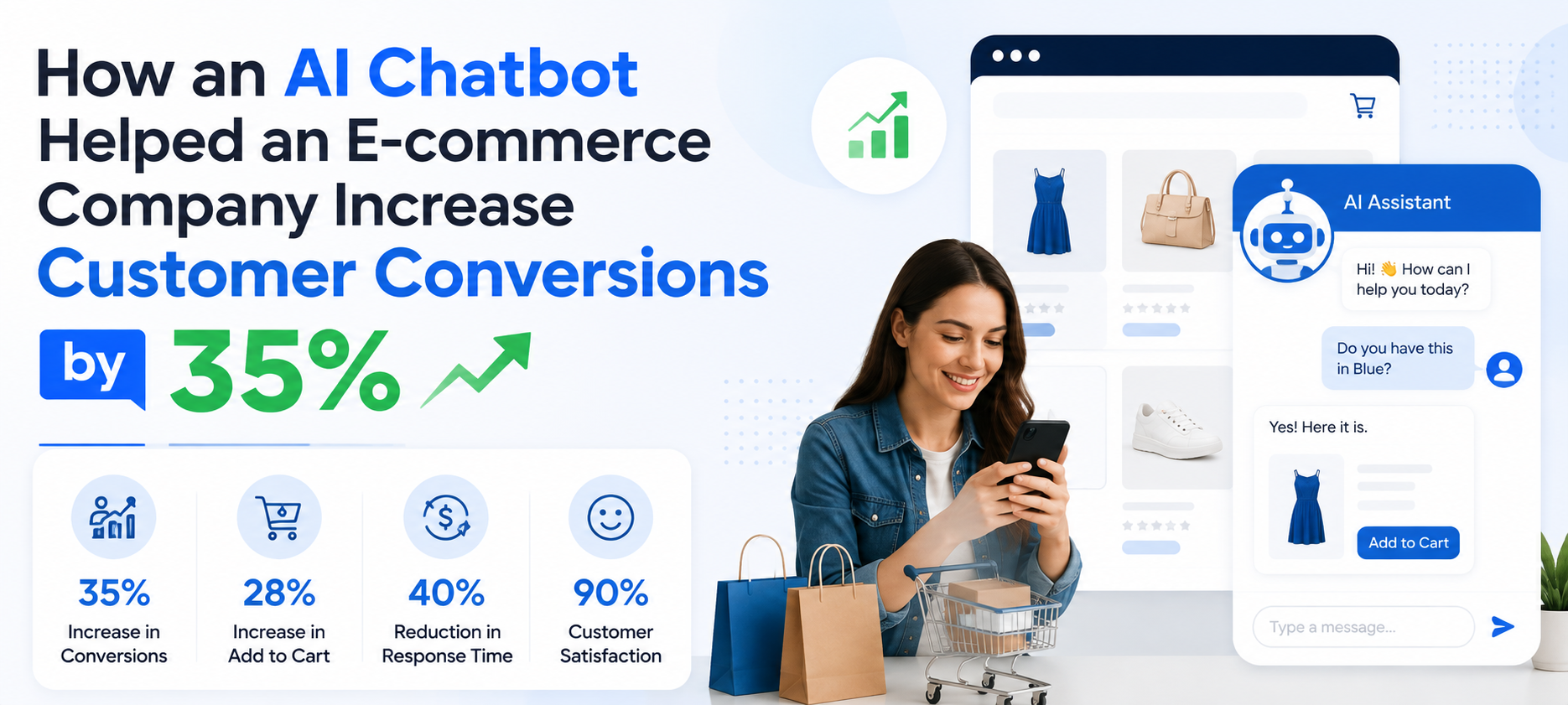
In the illustrative scenario presented in this case study, the company's conversion rate increased by 35%, while customer-support response times decreased substantially. The chatbot also helped the business identify common customer concerns and provided valuable insights that could be used to improve product pages and the overall shopping experience.
The project demonstrated that AI chatbots are not simply customer-support tools. When properly designed and integrated with an e-commerce website, they can become an important part of the sales and conversion strategy.
1. Introduction
Online shopping has transformed the way consumers discover, compare, and purchase products. Customers can now browse thousands of products from their smartphones or computers without visiting a physical store. However, the convenience of online shopping also creates a unique challenge for e-commerce businesses.
In a physical store, a customer can immediately approach a salesperson and ask a question.
They might say:
"Is this product available in another size?"
"Which model would you recommend?"
"How long will delivery take?"
"Can I return this item if it doesn't fit?"
A salesperson can respond immediately and potentially help the customer complete the purchase.
An online store does not always provide the same level of assistance.
Customers may have to search through product descriptions, FAQs, delivery pages, return policies, reviews, or multiple product pages to find an answer. If the information is difficult to locate, unclear, or unavailable, customers may simply leave the website.
For an e-commerce company, this creates a major business problem.
A visitor who leaves the website without purchasing represents a missed opportunity.
The company examined in this case study faced exactly this challenge.
The business had invested heavily in website development, digital advertising, search engine optimization, social media marketing, and product expansion. Website traffic was growing, but the conversion rate was not improving at the same pace.
The company discovered that many visitors were interested in its products but hesitated because they had unanswered questions.
The business therefore explored whether artificial intelligence could provide customers with immediate assistance while simultaneously helping the company increase conversions.
The solution was an AI-powered chatbot integrated directly into the e-commerce website.
The objective was not simply to create a chatbot that answered questions.
The larger objective was to create an AI shopping assistant capable of helping customers move from product discovery to purchase.
2. Company Background
For this illustrative case study, we will refer to the company as UrbanCart.
UrbanCart is a growing online retail company selling lifestyle, fashion, home, and consumer products to customers across India.
The company operates primarily through its e-commerce website and receives traffic from several channels, including:
- Organic search
- Google advertising
- Social media
- Influencer campaigns
- Email marketing
- Direct traffic
- Returning customers
- Referral traffic
Over several years, UrbanCart had built a strong online presence.
Its product catalog continued to grow, and marketing campaigns successfully attracted thousands of visitors to the website every month.
However, the management team noticed an important gap.
Traffic was increasing faster than sales.
This meant that the company was successfully attracting potential customers but was not converting enough of them into buyers.
The marketing team initially believed that the issue might be related to advertising quality.
However, further analysis showed that visitors were reaching relevant product pages and spending meaningful amounts of time on the website.
Many customers were clearly interested.
The problem was happening further down the purchasing journey.
Customers were hesitating.
Some were uncertain about which product to choose. Others wanted additional information before purchasing. Some wanted to know about shipping and returns. Others simply needed reassurance before entering their payment information.
The company therefore began looking for a solution that could provide customers with immediate assistance.
3. The Business Challenge
The primary challenge was straightforward:
How could UrbanCart help more website visitors make confident purchasing decisions?
The company identified several specific problems.
3.1 Customers Had Unanswered Questions
Product pages contained detailed information, but customers often wanted answers that were not immediately visible.
For example, a customer might ask:
- Is this product suitable for daily use?
- Which version should I choose?
- Does this come in another color?
- What is the delivery time to my location?
- Is cash on delivery available?
- What is the return period?
- Are there any discounts available?
- What is the difference between these two products?
These questions were common.
However, answering every question manually was difficult.
The customer-support team had limited working hours and could not have a human representative available for every website visitor.
3.2 Slow Response Times
Before the AI chatbot was implemented, customers could contact support through email, phone, or traditional chat.
Although these channels were useful, they were not always immediate.
A customer browsing the website at night might not receive an answer until the following day.
In e-commerce, even a short delay can affect purchasing decisions.
A customer who is ready to buy at 10:30 PM may not want to wait until the next morning.
They might visit another website and complete the purchase there.
3.3 Product Selection Was Difficult
UrbanCart's growing catalog was both an advantage and a challenge.
Having many products gave customers more choices, but too many choices could also create confusion.
A customer looking for a particular type of product might encounter dozens of similar options.
Without guidance, customers could experience decision fatigue.
The business realized that simply increasing the number of products was not enough.
It also needed to help customers select the right product.
3.4 Customer Support Was Handling Repetitive Questions
The support team spent a considerable amount of time answering basic questions.
Examples included:
"Where is my order?"
"How long does delivery take?"
"What is your return policy?"
"Do you offer cash on delivery?"
"Is this product currently available?"
These questions were important, but many were repetitive.
The support team could have used that time to handle more complicated issues, customer complaints, and high-value interactions.
3.5 Customers Were Abandoning Their Shopping Journey
Website analytics indicated that a significant percentage of visitors were leaving after viewing products or adding items to their cart.
The company could not assume that all abandoned sessions were caused by price.
Some customers simply needed more information.
This became one of the most important insights in the project.
The company realized that conversion optimization was not only about attracting more visitors. It was also about removing uncertainty.
4. Project Objectives
UrbanCart defined several objectives before implementing the AI chatbot.
The first objective was to increase the percentage of website visitors who completed purchases.
The second objective was to provide customers with immediate assistance.
The third was to reduce the workload associated with repetitive customer-support questions.
The fourth objective was to improve product discovery.
Finally, the company wanted to collect useful customer insights that could help improve its website and product catalog.
The project therefore had five major goals:
- Increase customer conversions.
- Provide 24/7 customer assistance.
- Reduce repetitive support requests.
- Improve product recommendations.
- Understand customer questions and purchasing barriers.
The company did not want the chatbot to replace its support team.
Instead, it wanted AI and human employees to work together.
5. Why the Company Chose an AI Chatbot
Traditional website chat systems typically depend on human representatives.
This approach can provide excellent service, but it becomes difficult to scale.
If website traffic increases significantly, the company needs additional support employees.
An AI chatbot provides a different approach.
It can handle many conversations simultaneously and respond instantly.
More importantly, a modern AI chatbot can understand natural language.
Customers do not need to select from a complicated list of predefined options.
They can simply type:
"I need a good product for a small apartment under ₹5,000."
The chatbot can interpret the request and provide relevant recommendations.
Similarly, a customer can ask:
"What's the difference between these two products?"
Instead of forcing the customer to search manually, the chatbot can explain the differences.
This makes the interaction feel more like speaking with a knowledgeable shopping assistant.
6. Designing the AI Shopping Assistant
UrbanCart decided that the chatbot should not be treated as a simple FAQ tool.
The company designed it as an AI shopping assistant.
The assistant was given access to relevant information about:
- Products
- Product descriptions
- Prices
- Availability
- Product categories
- Shipping information
- Return policies
- Frequently asked questions
- Promotions
- Customer-service information
The system was designed to provide useful answers while avoiding unsupported claims.
For example, if a product was unavailable, the chatbot should not tell a customer that it was in stock.
If it did not know an answer, it should direct the customer to human support.
This approach helped maintain trust.
7. Key Features of the Chatbot
7.1 Instant Question Answering
The most basic feature was instant customer assistance.
Visitors could ask questions at any time.
Instead of waiting for an employee, they received an immediate response.
For example:
Customer:
"How long does delivery usually take?"
AI Assistant:
"Standard delivery generally takes 3–7 business days. Delivery time may vary depending on your location. Would you like help checking delivery information for a specific product?"
The interaction was short but useful.
7.2 Product Recommendations
One of the most valuable features was product recommendation.
The chatbot could ask customers questions about their requirements.
For example:
AI Assistant:
"What are you looking for today?"
Customer:
"I need a gift for my sister, preferably under ₹3,000."
The chatbot could then narrow down relevant products based on the available catalog.
This reduced the amount of browsing required.
Instead of forcing customers to navigate multiple categories, the chatbot helped them discover relevant products quickly.
7.3 Product Comparison
Another important feature was product comparison.
Customers often hesitate when two products appear similar.
The chatbot could explain differences in areas such as:
- Features
- Price
- Size
- Specifications
- Use cases
- Customer suitability
This helped customers make more informed decisions.
7.4 Shipping Information
Delivery questions were among the most common customer concerns.
The chatbot could provide general shipping information and, where the system was integrated with order data, help customers understand their order status.
This reduced unnecessary support requests.
7.5 Return and Refund Information
Return policies can significantly influence online purchasing decisions.
Customers often want to know what happens if a product does not meet their expectations.
The AI assistant provided clear information about the company's return and refund policies.
This reduced uncertainty before checkout.
7.6 Human Handoff
AI was not designed to handle every situation.
When a customer had a complex problem, complaint, or unusual request, the chatbot could transfer the conversation to a human representative.
This created a hybrid support model.
AI handled simple and repetitive interactions.
Human employees handled situations requiring judgment, empathy, or deeper investigation.