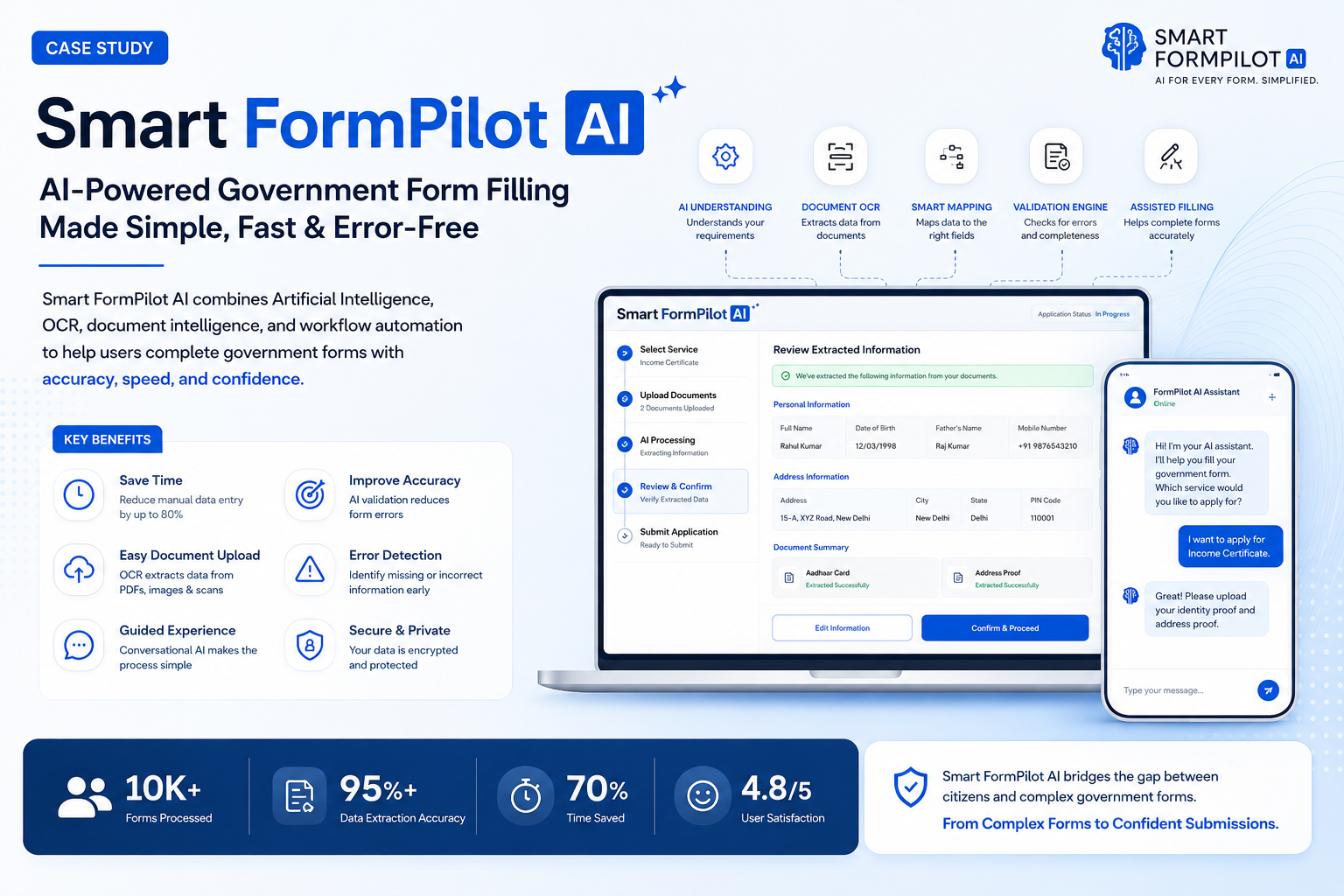
Government services are becoming increasingly digital. From certificates and registrations to applications, welfare schemes, licenses, admissions,...
Government services are becoming increasingly digital. From certificates and registrations to applications, welfare schemes, licenses, admissions, permits, and other citizen services, people are expected to complete a growing number of forms online.
However, digital does not always mean simple.
For many citizens, filling a government form can still be a complicated and time-consuming process. Users may need to understand eligibility requirements, identify the correct government portal, enter personal information repeatedly, upload documents in specific formats, understand unfamiliar terminology, and carefully verify every field before submitting an application.
A small mistake can sometimes result in an incomplete application, rejection, the need to resubmit information, or unnecessary delays.
At Innovative AI Solutions, we wanted to solve this problem with a different approach.
Instead of expecting users to understand complicated government forms, we asked a simple question:
What if AI could understand the user's requirements and help complete the form automatically?
This idea led to the development of Smart FormPilot AI, an AI-powered government form filling and application assistance platform designed to simplify the process of completing online government forms.
Smart FormPilot AI combines Artificial Intelligence, document understanding, OCR, intelligent data extraction, form mapping, workflow automation, and human-friendly interfaces to create a simpler experience for users.
The objective is not merely to automate typing.
The objective is to make government form filling faster, easier, more understandable, and less error-prone.
The Challenge: Government Forms Are Digital, But Not Always User-Friendly
Government websites provide access to a large number of digital services. However, the user experience can vary significantly between departments, portals, and applications.
A citizen may encounter:
- Different government websites
- Different login processes
- Different form layouts
- Different document requirements
- Different terminology
- Different field formats
- Different validation rules
- Different upload requirements
- Different application workflows
For a technically experienced user, this may be manageable.
For a first-time applicant, senior citizen, student, small business owner, rural user, or someone unfamiliar with online government services, the process can become difficult.
A typical form-filling journey may look like this:
Find the service → Identify the correct portal → Understand eligibility → Create account → Login → Understand form → Collect documents → Enter information → Upload documents → Verify details → Submit → Save acknowledgement
Every additional step creates another opportunity for confusion or error.
The problem becomes even larger when the same user has to fill multiple government forms.
Personal information such as:
- Name
- Date of birth
- Address
- Mobile number
- Father's or mother's name
- Aadhaar-related information
- PAN information
- Educational details
- Employment details
- Business information
may have to be entered repeatedly.
This repetitive data-entry problem became one of the key opportunities for AI automation.
Our Solution: Smart FormPilot AI
Smart FormPilot AI is an AI-powered platform designed to assist users in completing government forms through intelligent automation.
Instead of making users manually understand every field, the system is designed to understand the user's information and map it to the relevant form fields.
At a high level, the platform follows an intelligent workflow:
User Information → AI Understanding → Document Processing → Data Extraction → Form Mapping → Validation → User Review → Assisted Form Completion
The platform can be designed to work with a wide range of government applications and digital service workflows, depending on portal availability, technical integration possibilities, authentication requirements, and applicable government rules.
The goal is to create a single intelligent layer between the user and complex form-filling processes.
What Is Smart FormPilot AI?
Smart FormPilot AI is a government form filling AI assistant that helps users prepare and complete information required for online government applications.
Instead of treating every form as an isolated document, FormPilot approaches the problem as an intelligent data and workflow system.
The platform can understand information from multiple sources, including:
- User-entered information
- Uploaded documents
- Scanned documents
- Images
- PDFs
- Structured profiles
- Previously saved information
- Application-specific questions
AI can then extract relevant information and determine where that information belongs within the application workflow.
For example, instead of asking a user to manually type their address into multiple fields, the system can potentially understand an address from an uploaded document and break it into relevant components such as:
House/Building → Street → Locality → City → District → State → PIN Code
The user can then review the extracted information before it is used.
This creates an important distinction:
Smart FormPilot AI is not simply an autofill tool. It is designed as an intelligent form understanding and application assistance system.
Why We Built FormPilot AI
The idea behind FormPilot came from observing a common problem in digital services.
The internet has made government services more accessible, but accessibility does not automatically mean usability.
A person may know that a service exists but still struggle to complete the application.
For example, a user might search:
“How to apply for a government certificate online?”
They may find multiple pages, government portals, instructions, PDFs, eligibility documents, and application links.
Then comes the actual form.
The user must determine:
- Which fields are mandatory?
- What information should be entered?
- What document should be uploaded?
- What format should the document have?
- What does a particular field mean?
- Which address should be used?
- How should the name be entered?
- What happens after submission?
FormPilot AI was designed around this gap.
The objective was to build a system where AI assists the user rather than forcing the user to become an expert in government portals.
Core Technology Behind Smart FormPilot AI
Building an AI-powered form automation platform requires much more than integrating an LLM.
The system needs multiple technology layers working together.
A conceptual architecture for FormPilot AI includes:
1. AI / LLM Layer
The AI layer helps understand natural-language instructions, user information, field descriptions, and application requirements.
Users can potentially communicate with the system in a conversational manner rather than navigating complex technical terminology.
For example:
“Mujhe is government form ko fill karna hai.”
The AI can guide the user through the required information.
2. OCR and Document Intelligence
Many important user details already exist inside documents.
Instead of asking users to manually type everything, FormPilot can use OCR and document processing technologies to extract information from documents.
Potential document types include:
- Identity documents
- Address documents
- Educational certificates
- Business documents
- Registration certificates
- Income-related documents
- Application supporting documents
- Scanned PDFs
- Images
The extracted information can then be structured into usable fields.
3. Intelligent Data Extraction
OCR alone is not enough.
OCR converts visual information into text, but the system still needs to understand what that text represents.
For example:
RAHUL KUMAR
15-A XYZ ROAD
NEW DELHI
110001
An intelligent system needs to determine:
Name = Rahul Kumar
Address = 15-A XYZ Road
City = New Delhi
PIN = 110001
This semantic understanding is where AI becomes important.
4. Form Field Mapping
Different forms may use different labels for similar information.
One application may ask:
Applicant Name
Another may ask:
Full Name of Applicant
Another may use:
Name as per Official Document
The underlying information may still be the same.
FormPilot's intelligent mapping layer can be designed to understand the relationship between user information and form fields.
5. Validation Engine
Government forms often contain validation requirements.
Examples include:
- Required fields
- Date formats
- Mobile number formats
- Email formats
- PIN codes
- Document types
- File size requirements
- Age requirements
- Conditional fields
A validation engine can identify potential issues before submission.
This is important because AI should not blindly fill fields.
The system needs deterministic validation wherever possible.
AI + Rule-Based Automation
One of the most important architectural decisions in FormPilot AI is the combination of AI and deterministic rules.
AI is excellent at:
- Understanding natural language
- Extracting semantic information
- Classifying documents
- Understanding different field descriptions
- Assisting users conversationally
- Resolving ambiguous information
But deterministic software is better for:
- Required field validation
- Date validation
- Numeric validation
- File size checks
- Format validation
- Workflow states
- Audit logging
- Permission control
Therefore, FormPilot can use a hybrid architecture:
AI for understanding + Software rules for validation + Automation for execution.
This approach can provide better reliability than depending on an LLM for every decision.
How Smart FormPilot AI Works
A typical workflow can be divided into several stages.
Step 1: User Selects a Government Service
The user begins by identifying the service they want.
For example:
“I want to apply for this government certificate.”
The system can help identify the relevant workflow based on the available service catalogue.
The user does not necessarily need to understand technical government department terminology.
Step 2: AI Understands the Requirement
The AI assistant asks relevant questions.
For example:
What is your full name?
What is your date of birth?
What is your current address?
Which state are you applying from?
Do you have the required supporting document?
Instead of presenting a large form immediately, the system can turn the process into a conversational interaction.
This creates a more approachable experience.
Step 3: Upload Documents
The user can upload relevant documents.
FormPilot can process supported documents using OCR and document intelligence.
The system extracts potentially useful information and presents it to the user.
For example:
Extracted Information
Name: Rahul Kumar
Date of Birth: 12 March 1998
Address: New Delhi
PIN Code: 110001
The user can review the information.
Step 4: AI Structures the Information
The extracted information is converted into structured data.
For example:
{
  "full_name": "Rahul Kumar",
  "date_of_birth": "1998-03-12",
  "city": "New Delhi",
  "state": "Delhi",
  "pin_code": "110001"
}
This structured representation can then be used by the form automation layer.
Step 5: Form Mapping
The system determines which information corresponds to which fields.
For example:
| Form Field | Source |
|---|---|
| Applicant Name | User Profile |
| Date of Birth | Identity Document |
| Address | Address Document |
| State | User Input |
| PIN Code | Extracted Address |
| Mobile Number | User Profile |
This reduces unnecessary manual data entry.
Step 6: Validation
Before the application is submitted, FormPilot can check the information.
For example:
- Is the name missing?
- Is the date valid?
- Is the PIN code correctly formatted?
- Is a mandatory document missing?
- Is the uploaded file supported?
- Is the mobile number valid?
- Are there inconsistent details?
Potential issues can be shown to the user before proceeding.
Step 7: Human Review
A critical principle of the system is:
AI should assist, but the user should remain in control.
The user should be able to review the information before final submission.
This is especially important for government applications because personal information can be highly sensitive and mistakes may have real-world consequences.
Therefore, FormPilot can provide a review stage:
Review Before Submission
Name: Rahul Kumar
DOB: 12 March 1998
Address: New Delhi
Mobile: XXXXXXXX21
The user can edit any incorrect information.
Step 8: Assisted Form Completion
Once the user approves the information, the system can assist with the form completion workflow where technically and legally permitted.
Depending on the government portal, available integrations, authentication requirements, CAPTCHA mechanisms, OTP requirements, and terms of service, the automation may range from:
Data preparation → Browser assistance → Form autofill → User-controlled submission
The architecture is therefore designed to be flexible rather than assuming every government portal can be fully automated.
The Role of OCR in FormPilot AI
OCR is one of the most important technologies in the platform.
Traditional form-filling systems depend heavily on manually entered information.
FormPilot takes another approach.
Documents can become a source of structured information.
For example, a user may upload a PDF containing several pages.
The system can process the document, identify relevant text, classify the document, and extract potentially useful information.
This transforms the workflow from:
Document → Human reads → Human types → Human checks
into:
Document → AI reads → Structured information → Human reviews → Form completion
This can significantly reduce repetitive data entry.
Intelligent Document Understanding
Modern document AI goes beyond traditional OCR.
A document contains both text and context.
For example:
Date of Birth: 12/03/1998A basic OCR system sees text.
An intelligent document processing system understands:
Field = Date of Birth
Value = 12/03/1998
Similarly:
Father's Name: Raj Kumarcan become:
relationship = father
name = Raj Kumar
This semantic layer makes AI-powered form automation possible.
Conversational Government Form Filling
Another important aspect of FormPilot AI is conversational interaction.
Traditional applications typically present a large form containing dozens of fields.
FormPilot can instead provide an AI assistant.
For example:
AI: What is your full name?
User: Rahul Kumar.
AI: What is your date of birth?
User: 12 March 1998.
AI: Do you have an address proof document?
User: Yes.
AI: Please upload it.
This creates a more natural interaction.
The user does not need to understand the complete form structure.
The AI becomes an interface between the citizen and the application.
Multilingual and Natural-Language Interaction
India is linguistically diverse.
A truly accessible government form assistant should not depend entirely on technical English.
A future-ready architecture can support interactions in multiple Indian languages and Hinglish.
For example:
“Mujhe income certificate ke liye apply karna hai.”
The system can understand the user's intent and guide the workflow.
Similarly:
“Mera address document mein hai, main upload kar deta hoon.”
The assistant can understand that the user intends to provide a supporting document.
This makes AI particularly valuable for citizen-facing applications.
Reducing Repetitive Data Entry
One of FormPilot AI's most important use cases is reusable user information.
Imagine a user has already created a verified profile containing information such as:
- Name
- Date of birth
- Contact details
- Address
- Educational details
- Professional details
When another application requires the same information, the user should not necessarily need to type everything again.
The platform can potentially reuse approved information within the user's profile.
This creates a reusable digital application profile.
Instead of filling the same information repeatedly:
Enter once → Review → Reuse when appropriate
Smart Form Profile
A future version of the platform can maintain a structured profile containing user-provided information.
For example:
Personal Information
Name
Date of Birth
Gender
Contact Information
Address Information
Permanent Address
Current Address
State
District
City
PIN Code
Education
Qualification
Institution
Year of Passing
Professional
Occupation
Organization
Experience
Documents
Uploaded documents
Document type
Document metadata
The AI can use this information to assist with future workflows, subject to user permissions and applicable privacy requirements.
Privacy and Security by Design
Government forms frequently involve sensitive personal information.
Therefore, privacy cannot be treated as an optional feature.
FormPilot AI should be designed around principles such as:
- Data minimization
- User consent
- Secure authentication
- Encryption
- Role-based access
- Secure file storage
- Audit logging
- Access controls
- Controlled retention
- Secure API communication
The system should only collect information required for the intended workflow.
Where sensitive documents are involved, security architecture becomes a core part of the product rather than an afterthought.
Human-in-the-Loop AI
One of the most important design principles behind FormPilot AI is human-in-the-loop automation.
Government applications can have serious consequences.
Therefore, completely autonomous submission may not always be appropriate.
Instead, the system can follow:
AI → Recommendation → User Review → Confirmation → Action
This approach allows AI to perform repetitive work while keeping the user involved in important decisions.
The user remains the final authority over their application information.
Handling Ambiguous Information
Real-world documents are not always perfect.
A scanned document may contain:
- Blurry text
- Different spellings
- Missing information
- Multiple addresses
- Inconsistent dates
- Poor image quality
An AI system should not silently assume that uncertain information is correct.
Instead, FormPilot can flag uncertain information.
For example:
We found a possible date of birth: 12/03/1998. Please confirm.
This is better than automatically submitting potentially incorrect information.
Building a Scalable Form Automation Architecture
From a technology perspective, FormPilot AI can be designed as a modular platform.
A possible architecture includes:
Frontend Layer
The frontend provides:
- User dashboard
- AI chat interface
- Form workflow
- Document upload
- Profile management
- Application history
- Review screen
- Notifications
Backend Layer
The backend manages:
- Authentication
- User profiles
- Application workflows
- Document metadata
- Form schemas
- Validation
- AI requests
- Automation jobs
- Audit logs
AI Layer
The AI layer handles:
- Natural-language understanding
- Intent detection
- Document understanding
- Information extraction
- Field mapping
- Conversational assistance
- Error explanation
Automation Layer
The automation layer can manage supported workflows using appropriate browser automation, APIs, or integrations.
It can potentially handle:
- Navigation
- Field population
- Document selection
- Workflow progression
while respecting authentication and other portal requirements.
Why a Form Schema Is Important
Instead of hard-coding every form directly into the application, a scalable system can represent forms using structured schemas.
For example:
{
  "field": "full_name",
  "label": "Full Name",
  "type": "text",
  "required": true
}
Another field might be:
{
  "field": "date_of_birth",
  "label": "Date of Birth",
  "type": "date",
  "required": true
}
This allows the platform to support new forms more efficiently.
A form engine can understand:
- Field type
- Label
- Required status
- Validation
- Data source
- Dependencies
- Document requirements
This creates the foundation for a scalable form automation platform.
AI-Powered Form Field Mapping
One of the interesting technical challenges is mapping different field names to the same underlying information.
For example:
Full Name
Applicant Name
Name of Applicant
Candidate Name
Name as per document
These may represent related information.
An AI-powered mapping system can understand semantic similarity while deterministic rules can handle known fields.
This hybrid approach can make the system more adaptable.
Application Status Tracking
Another useful feature is application tracking.
Users can potentially view:
Draft
Information Verified
Documents Uploaded
Ready for Submission
Submitted
Under Processing
Completed
The dashboard can give users a single place to understand the state of their applications.
This is especially valuable when users interact with multiple government services.
Centralized Government Application Dashboard
FormPilot AI can evolve into a centralized application workspace.
Instead of remembering every government website, the user can access their supported workflows from one dashboard.
For example:
My Applications
Income Certificate
Residence Certificate
Government Scheme Application
Business Registration
License Application
Education Application
Other Supported Services
Each application can have its own status and history.
Search + AI for Government Services
Another important component is intelligent service discovery.
Instead of requiring users to know the exact service name, the user can describe what they need.
For example:
“I have started a small business. Which government registration or certificate do I need?”
The AI can help explain potentially relevant services and guide the user toward the appropriate official workflow.
This creates a powerful combination:
AI Search + Government Service Discovery + Form Automation
The system should clearly distinguish between general guidance and official requirements and direct users to authoritative government information wherever appropriate.
SEO Opportunity for Smart FormPilot AI
Smart FormPilot AI is not only a product opportunity.
It also creates a large SEO and AEO opportunity.
Government form-related searches have strong informational intent.
People frequently search for queries such as:
- How to fill government forms online
- How to apply for government certificates
- Documents required for government forms
- How to fill online application forms
- Government form filling assistance
- How to apply for certificates online
- Online government application help
- How to fill government forms using AI
- AI form filling assistant
- Government form automation
- How to fill forms online
- Documents required for government applications
These queries can become the foundation of an extensive content ecosystem.
AEO: Answer Engine Optimization
Traditional SEO focuses heavily on ranking web pages.
AEO focuses on making content useful for answer engines and AI-powered search experiences.
FormPilot's content strategy can therefore answer specific questions directly.
For example:
Question
What is an AI government form filling assistant?
Answer
An AI government form filling assistant is a software system that helps users understand, prepare, and complete online government application forms using technologies such as artificial intelligence, OCR, document processing, data extraction, validation, and workflow automation.
This type of concise answer can make content more suitable for AI-powered search and conversational systems.
Building Topical Authority Around Government Forms
Instead of publishing only one product page, FormPilot can build a complete knowledge ecosystem.
Possible content categories include:
Government Form Guides
How to fill different application forms.
Document Guides
Which documents may be required for different applications.
Eligibility Guides
Who can apply for specific services.
Application Process Guides
Step-by-step explanations.
AI Form Filling Guides
How AI can help automate form completion.
OCR Guides
How documents can be converted into structured information.
Digital Government Guides
Explaining how citizens can access digital services.
This creates topical depth.
Programmatic SEO Opportunity
FormPilot can also potentially create structured pages around supported services.
For example:
AI Form Filling for [Service]
How to Fill [Service] Form Online
Documents Required for [Service]
[Service] Application Guide
Each page should provide genuinely useful, unique information rather than simply replacing a keyword inside a template.
A strong programmatic SEO architecture can combine:
Service + State + User Intent + Document Requirement + Process
where sufficient authoritative information exists.
Example SEO Content Cluster
A potential cluster could look like:
Pillar Page
Complete Guide to Online Government Form Filling
Supporting pages:
- How to Fill Government Forms Online
- Government Form Filling Using AI
- Documents Required for Online Government Applications
- Common Government Form Errors
- How OCR Helps With Online Forms
- AI Document Processing for Government Applications
- How to Check Government Application Information
- How to Protect Personal Data When Filling Online Forms
This creates internal linking opportunities and builds topical relevance.
Featured Snippet and AEO Strategy
Every important page can contain structured question-and-answer sections.
Examples:
What is FormPilot AI?
FormPilot AI is an AI-powered form assistance platform designed to help users understand, prepare, validate, and complete supported online government application workflows.
Can AI fill government forms?
AI can assist with understanding form fields, extracting information from documents, mapping data to fields, validating information, and preparing forms. Actual submission depends on the specific government portal, authentication requirements, technical integrations, and applicable rules.
Can I upload documents?
Supported workflows can allow users to upload documents for AI-powered extraction and verification.
Does AI submit the form automatically?
Submission capabilities depend on the specific portal and workflow. Some processes may support automation or assisted completion, while others may require user interaction such as OTP, CAPTCHA, authentication, or final confirmation.
This type of content is useful for both traditional search and AI answer engines.
Why FormPilot AI Is Different
There are many autofill tools available.
But FormPilot's vision is broader.
Traditional autofill generally depends on browser-stored information.
FormPilot is designed around:
Understanding → Extraction → Mapping → Validation → Assistance → Automation
The platform combines multiple AI capabilities into a single workflow.
This creates a more intelligent experience.
Business Impact
The potential value of FormPilot AI extends beyond saving typing time.
1. Reduced Manual Work
Users spend less time entering repetitive information.
2. Better Understanding
AI can explain complicated fields in simpler language.
3. Fewer Data Entry Errors
Validation and review can help identify potential mistakes before submission.
4. Better Document Utilization
Existing documents can become sources of structured information.
5. Better User Experience
Conversational workflows can be easier for non-technical users.
6. Scalable Automation
A form-schema architecture can make it easier to support additional workflows.
The Technical Challenge of Government Portal Diversity
One of the biggest challenges is that government websites are not necessarily standardized.
Different portals may have:
- Different technologies
- Different workflows
- Different authentication systems
- Different field structures
- Different document requirements
- Different session mechanisms
- Different security controls
Therefore, building one universal automation mechanism is unrealistic.
FormPilot needs an abstraction layer.
At the platform level:
Common User Data
↓
Common AI Understanding Layer
↓
Common Form Schema
↓
Portal-Specific Adapter
↓
Supported Government Workflow
This architecture allows the core AI system to remain consistent while individual integrations can handle portal-specific behavior.
Portal Adapter Architecture
Each supported workflow can have an adapter responsible for translating the common FormPilot data model into the requirements of a particular service.
For example:
FormPilot User Profile
        ↓
AI Data Extraction
        ↓
Normalized Data Model
        ↓
Service Adapter
        ↓
Specific Form Workflow
This makes the architecture more maintainable.
When a specific portal changes its form structure, the relevant adapter can be updated without redesigning the entire platform.
Reliability and Validation
AI systems can occasionally produce incorrect interpretations.
Therefore, FormPilot should not assume that every AI output is correct.
A robust architecture can use:
AI confidence + deterministic validation + user confirmation
For example:
AI Extracts Data
       ↓
Confidence Check
       ↓
Validation Rules
       ↓
User Review
       ↓
Approved Data
       ↓
Form Completion
This layered approach is particularly important when handling personal and government application information.
Security Architecture
Security should exist across the entire application.
Important areas include:
Authentication
Secure login and session management.
Authorization
Users should only access their own information.
Encryption
Sensitive information should be protected during transmission and storage.
Document Security
Uploaded documents should not be publicly accessible.
Audit Logging
Important actions should be recorded where appropriate.
Access Control
Internal users and services should have only the permissions they require.
Data Retention
Data should not be retained indefinitely without a legitimate purpose.
Responsible AI
FormPilot AI is designed around a responsible AI philosophy.
The platform should not invent information.
If information is missing, the system should ask the user.
If information is uncertain, the system should highlight it.
If a requirement cannot be verified, the system should avoid presenting speculation as fact.
This principle can be summarized as:
Never guess critical application information.
For government applications, correctness is more important than making the automation appear intelligent.
User Experience Philosophy
The technology should remain invisible whenever possible.
A user should not need to understand:
- LLMs
- OCR pipelines
- APIs
- JSON
- document embeddings
- AI agents
- browser automation
They should simply experience:
“I tell the system what I need, provide my documents, review the information, and get help completing the application.”
That is the core UX vision behind FormPilot AI.
AI Agents in FormPilot
The platform can also evolve toward an agentic architecture.
Different AI agents can handle different responsibilities.
Service Discovery Agent
Understands what service the user needs.
Document Agent
Analyzes uploaded documents.
Information Agent
Maintains structured user information.
Form Understanding Agent
Understands application fields.
Validation Agent
Identifies potential inconsistencies.
Workflow Agent
Coordinates the application process.
Support Agent
Answers user questions.
An orchestration layer can coordinate these components.
Example Agentic Workflow
A user says:
“Mujhe government certificate ke liye apply karna hai.”
The system can:
Agent 1: Understand the requirement.
↓
Agent 2: Identify the supported service.
↓
Agent 3: Explain required information and documents.
↓
Agent 4: Process uploaded documents.
↓
Agent 5: Extract structured data.
↓
Agent 6: Map data to the application.
↓
Agent 7: Validate information.
↓
User: Reviews and confirms.
↓
Workflow Agent: Assists with the supported application workflow.
This is where FormPilot moves from simple automation toward agentic form assistance.
Future Vision: A Personal Government Application Assistant
The long-term vision of FormPilot AI goes beyond form filling.
We envision a personal AI assistant that can help users navigate their digital government service journey.
A user could ask:
“Mere liye kaun se government services available ho sakte hain?”
Or:
“Meri application ka status kya hai?”
Or:
“Is application ke liye kaun se documents chahiye?”
Or:
“Maine pehle jo information save ki thi usse ye form prepare kar do.”
This transforms FormPilot from a form-filling tool into a digital government service assistant.
Potential Use Cases
Smart FormPilot AI can potentially support a wide range of citizen and organizational workflows, depending on integrations and official portal compatibility.
Potential categories include:
Certificates
Assistance with supported certificate applications.
Education
Application and registration workflows.
Employment
Government employment-related applications.
Business
Business-related registrations and applications.
Licenses
Supported license application workflows.
Welfare Schemes
Guidance and application assistance for eligible schemes.
Registrations
Various online registration processes.
Public Services
Other supported digital government services.
The exact availability depends on the specific service, portal, authentication method, and technical feasibility.
Impact on Citizens
The ultimate goal of FormPilot is not technology.
It is accessibility.
A successful AI form assistant can potentially help users who struggle with complicated digital workflows.
This includes:
- First-time internet users
- Senior citizens
- Students
- Small business owners
- Professionals
- Rural users
- People unfamiliar with government terminology
- Users who have difficulty understanding long forms
By turning a complex form into a guided interaction, AI can make digital services easier to approach.
Impact on Organizations
The same technology can also have value for organizations that help users complete applications.
For example:
- Citizen service centers
- Education organizations
- Financial service providers
- Legal service organizations
- Business service providers
- Consultants
- Assisted digital service providers
A centralized AI-powered workflow can potentially reduce repetitive manual data entry and improve operational efficiency.
Measuring Success
Rather than focusing only on the number of forms completed, FormPilot can measure meaningful product metrics.
Potential KPIs include:
Completion Rate
Percentage of started applications reaching completion.
Data Accuracy
Percentage of fields correctly extracted or mapped.
Time Saved
Reduction in manual data-entry time.
Document Processing Accuracy
Accuracy of information extracted from uploaded documents.
Validation Detection
Number of potential errors identified before submission.
User Assistance Rate
Percentage of users successfully completing workflows with assistance.
User Satisfaction
Feedback regarding ease of use and clarity.
These metrics provide a more meaningful understanding of product performance.
SEO and AEO Growth Strategy for FormPilot AI
The product itself can become the foundation of a content-driven acquisition strategy.
The website can target three major search intents:
Informational Intent
Users looking for information.
Examples:
How to fill government forms online
Documents required for government applications
How does AI form filling work?
Commercial Intent
Users evaluating solutions.
Examples:
Best AI form filling software
AI government form filling assistant
Government form automation software
AI document processing platform
Transactional Intent
Users looking to use the service.
Examples:
Fill government form online
AI form filling assistant online
Government application assistance
AEO Content Structure
Every major page should answer the user's main question quickly.
A recommended structure is:
Direct Answer
↓
Step-by-Step Process
↓
Eligibility / Requirements
↓
Documents
↓
Common Problems
↓
Frequently Asked Questions
↓
Official Resources
↓
Related Guides
This makes content useful to humans, search engines, and AI answer systems.
Internal Linking Strategy
FormPilot's website can build a strong internal linking network.
For example:
Government Form Filling
links to:
AI Form Filling
which links to:
OCR Document Processing
which links to:
Government Application Guides
which links to:
Specific Service Pages
which links back to:
Smart FormPilot AI
This creates a connected topical ecosystem.
Structured Data and Search Visibility
The website can also implement appropriate structured data where applicable, such as:
- Organization
- SoftwareApplication
- FAQPage where eligible
- Article
- BreadcrumbList
- WebPage
Structured information helps search engines better understand the website and its content.
However, structured data should accurately represent visible page content rather than being used to manipulate search results.
Building Trust Around Government-Related Content
Because FormPilot operates in the government-services space, trust is especially important.
The website should clearly communicate:
- Who operates the platform
- What the platform does
- What it does not do
- Which services are supported
- Which information comes from official sources
- When users need to visit an official government portal
- Privacy and security practices
- Terms of service
- Contact information
The platform should avoid creating the impression that it is itself a government department unless there is an official relationship.
This distinction is essential for user trust.
The Bigger Vision
Smart FormPilot AI represents a broader shift in software design.
Traditional software asks:
“Which button should the user click?”
AI-powered software can ask:
“What is the user trying to accomplish?”
That difference is significant.
Instead of forcing users to learn the software, the software can increasingly understand the user's intent.
For government applications, this can mean:
From forms → to conversations
From manual typing → to intelligent data reuse
From documents → to structured information
From complicated workflows → to guided journeys
From isolated portals → to an intelligent assistance layer
Conclusion
Smart FormPilot AI was created to address a simple but important problem: government forms should not be difficult simply because the underlying digital process is complicated.
By combining AI, OCR, document intelligence, structured data extraction, form mapping, validation, conversational assistance, and workflow automation, FormPilot aims to create a new approach to online government form completion.
The platform's vision is not to replace government systems.
Instead, it aims to create an intelligent assistance layer that helps users interact with supported digital services more easily.
The architecture combines the flexibility of AI with the reliability of deterministic validation and the control of human review.
At the same time, FormPilot creates a powerful opportunity for SEO and AEO by building a comprehensive knowledge ecosystem around government forms, document requirements, application processes, digital services, and AI-powered form automation.
The long-term vision is ambitious:
Make government form filling as simple as having a conversation with an AI assistant.
Instead of asking citizens to understand complicated forms, FormPilot AI aims to help technology understand what citizens need.
Smart FormPilot AI — turning complex forms into intelligent, guided workflows.
Frequently Asked Questions
What is Smart FormPilot AI?
Smart FormPilot AI is an AI-powered platform designed to help users understand, prepare, validate, and complete supported online government application workflows.
Can Smart FormPilot AI fill government forms automatically?
The platform is designed to assist with form filling through AI-powered data extraction, document processing, field mapping, validation, and supported workflow automation. The level of automation depends on the specific government portal and its technical and authentication requirements.
Can AI extract information from documents?
Yes. AI-powered OCR and document intelligence can extract potentially useful information from supported PDFs, images, and scanned documents.
Can FormPilot reuse my information?
A profile-based architecture can allow users to save and reuse approved information for supported applications, subject to user consent, security controls, and applicable privacy requirements.
Does FormPilot replace government websites?
No. FormPilot is designed as an assistance and automation layer. Official government portals and government processes remain the authoritative source for applications and requirements.
Can FormPilot handle OTP and CAPTCHA?
Some government portals require user-controlled authentication mechanisms such as OTPs or CAPTCHA. Such steps may require direct user interaction and cannot necessarily be fully automated.
Is government form automation safe?
It depends on how the system is designed. A responsible implementation should use encryption, authentication, access controls, secure document storage, validation, audit logging, and human review for important information.
Can FormPilot support multiple government services?
The platform is designed to be extensible so that additional supported workflows can be added through service-specific form schemas and integration/automation adapters.
How does OCR help government form filling?
OCR converts information from images or scanned documents into machine-readable text. AI can then interpret that text and potentially map it to relevant application fields.
Can I use natural language with FormPilot?
The platform is designed around conversational AI, allowing users to describe their requirements naturally rather than having to understand complex technical form terminology.
What makes FormPilot different from browser autofill?
Browser autofill primarily fills previously saved values into fields. FormPilot's broader vision combines AI understanding, document extraction, semantic field mapping, validation, user review, and supported workflow automation.
How can AI reduce government form errors?
AI can help identify missing information, extract information from documents, detect inconsistencies, explain fields, and validate data before the user proceeds. Final information should still be reviewed by the user.
Is Smart FormPilot AI a government website?
No. Smart FormPilot AI is an AI technology platform developed to assist users with supported government application workflows. Users should always verify important information and requirements with the relevant official government source.
Who can benefit from AI-powered form filling?
Students, professionals, senior citizens, small business owners, first-time digital-service users, service providers, consultants, and other users who regularly interact with online application forms may benefit from guided form assistance.
What is the future of AI-powered government services?
The future can involve conversational service discovery, intelligent document processing, reusable user profiles, automated form preparation, application tracking, multilingual assistance, and agentic workflows that help users navigate complex digital services.