The Big Question
What's the difference between an AI agent and a chatbot?
Most explanations you'll find online are either too technical or too vague. They talk about "autonomous reasoning" and "goal-driven services entities" without explaining what that means for your actual business.
Let me simplify it.
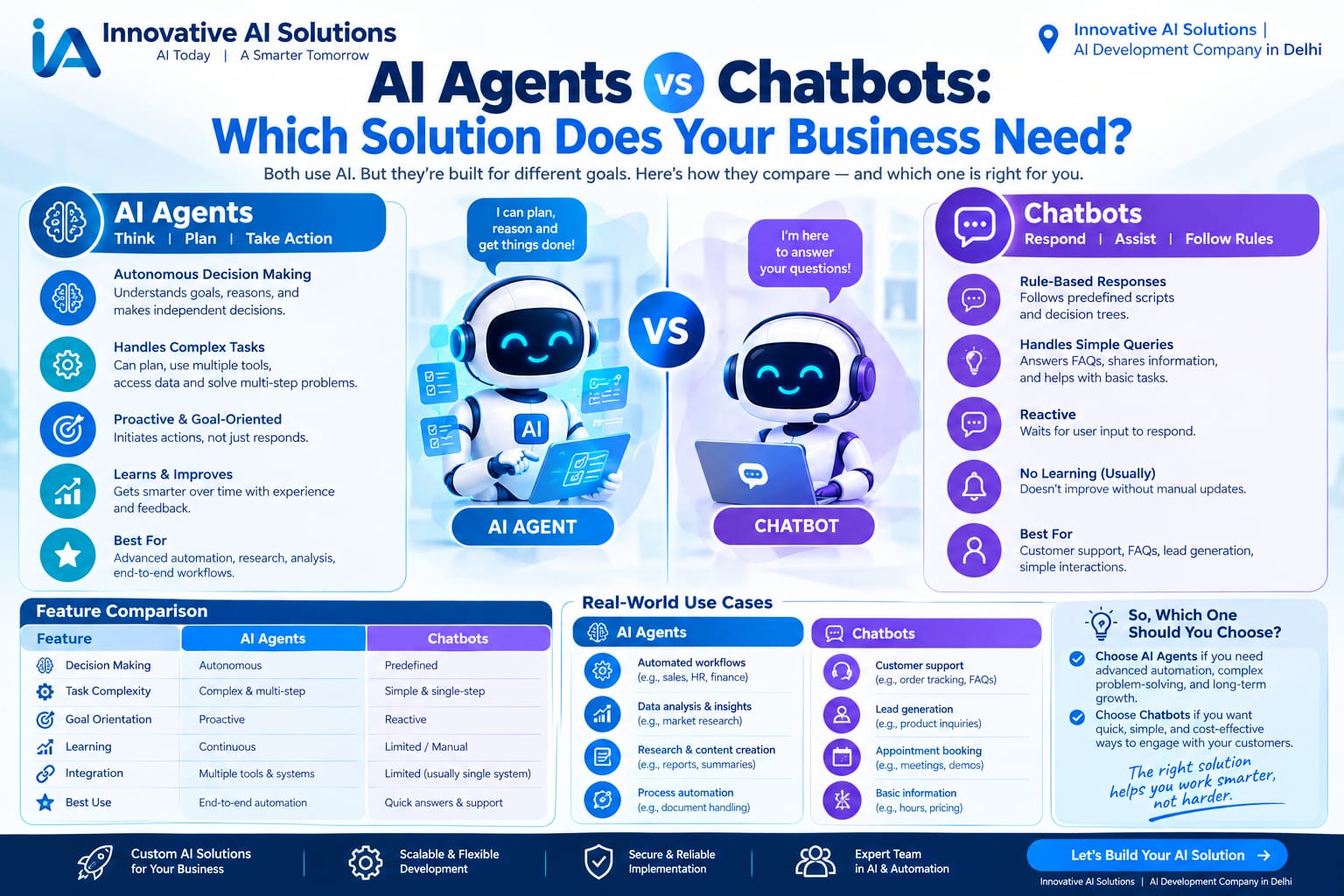
A chatbot answers questions. An AI agent gets things done.
That's the core distinction. Everything else flows from it.
When a customer asks "What's your return policy?"—a chatbot can pull that answer from your knowledge base and respond. That's a single-step interaction. Query in, answer out.
But when a customer says "I want to return this order and get a refund to a different card"—that's a multi-step problem. You need to verify the order, check return eligibility, process the refund, update the payment method, send confirmation, and log the transaction. A chatbot can't do that. An AI agent can.
Microsoft's training documentation puts it well: chatbots follow predetermined conversational paths, while agents dynamically plan and execute multi-step workflows to achieve an outcome.
The difference isn't just technical. It's economic. A chatbot costs a fraction of what an AI agent costs to build and run. Choosing the wrong one means either wasting money on unnecessary capability or frustrating customers with a tool that can't solve their problem.
So the real question isn't "which is better?" It's "which does your business actually need?"
Cost Based on Solution Type
Let's talk numbers. What does each solution actually cost in 2026?
Simple FAQ Chatbot
Think: a knowledge base assistant that answers common questions. No integrations. No actions. Just retrieval and response.
Typical cost: ₹8,00,000 to ₹15,00,000 ($10,000–$18,000) through an Indian agency. Timeline: 6–8 weeks. Monthly running cost: ₹15,000–₹30,000 ($200–$400).
RAG Chatbot (Retrieval-Augmented Generation)
Think: a chatbot that searches your actual documentation—help pages, policy PDFs, product guides—and answers with citations.
Typical cost: ₹15,00,000 to ₹28,00,000 ($18,000–$34,000). Timeline: 8–12 weeks. Monthly running cost: ₹25,000–₹50,000.
The biggest cost driver here isn't the technology. It's content preparation. Pulling information from six different places—a help page from 2023, a policy PDF, a product sheet, tribal knowledge from two support people—into one clean source often takes longer than building the bot itself.
Tool-Using Assistant (Lightweight Agent)
Think: a chatbot that can also check order status, update records, or book appointments. It has some agency, but with strict boundaries.
Typical cost: ₹28,00,000 to ₹37,00,000 ($34,000–$45,000). Timeline: 12–16 weeks. Monthly running cost: ₹40,000–₹75,000.
Supervised AI Agent
Think: an agent that takes actions—processes refunds, updates CRM records, schedules follow-ups—but requires human approval before committing.
Typical cost: ₹33,00,000 to ₹54,00,000 ($40,000–$65,000). Timeline: 14–20 weeks. Monthly running cost: ₹75,000–₹1,50,000.
Autonomous AI Agent
Think: an agent that runs unattended, handles high-volume workflows, and only escalates to humans when genuinely needed.
Typical cost: ₹54,00,000 to ₹75,00,000 ($65,000–$90,000). Timeline: 20–24 weeks. Monthly running cost: ₹1,50,000+.
The cost gap is real. An autonomous agent costs 5–7x more than a chatbot. That's not because agents are "better"—it's because they're riskier. An agent that reads is cheap to get wrong. An agent that writes to your systems requires permissions, confirmation steps, audit trails, and cost ceilings. That machinery is most of the budget.
Breakdown by Solution Type (2020–2026 Rates)
How have costs evolved for chatbots and agents in India?
2020–2021: The Scripted Era
Chatbots were simple decision trees. If-this-then-that flows. Development was cheap—₹50,000 to ₹2,00,000 for basic bots. But they were brittle. Ask something outside the script, and they broke.
2022–2023: The NLP Wave
Natural language processing improved. Chatbots could understand intent better. Costs climbed to ₹2,00,000–₹8,00,000 for competent implementations. But multi-step workflows remained out of reach.
2024–2025: The LLM Revolution
Large language models changed everything. Chatbots became genuinely conversational. RAG pipelines made them accurate. But the industry conflated "chatbot" and "agent," creating confusion and inflated expectations.
2026: The Clarity Phase
The market has matured. Buyers understand the difference. Here's what you should expect:
Freelance Developers: ₹2,000–₹5,000 per hour for chatbot work. ₹4,000–₹8,000 per hour for agent development—if you can find someone with real experience.
Dedicated Teams (Offshore): ₹1,50,000–₹3,00,000 per month per developer for chatbot projects. ₹2,50,000–₹4,50,000 per month per developer for agent projects.
Full-Time Salaries in India: Mid-level AI engineers earn ₹8–15 LPA. Senior AI architects with agent experience command ₹20–40 LPA.
The talent gap is the real constraint. One LinkedIn post put it bluntly: "An AI Architect in India costs ₹50–70 lakhs/year. And that's before compute, vector databases, and iteration cycles. For most early-stage startups, Agentic AI isn't a strategy problem. It's a resource problem".
Why Prices Changed in 2026
Chatbot and agent costs have shifted. Here's why.
Reason 1: LLM APIs Became Commoditized
In 2023, GPT-4 API calls were expensive. In 2026, competition from Claude, Gemini, Llama, and Mistral has driven prices down. The intelligence layer is no longer the expensive part.
Reason 2: Retrieval Got Cheaper
Vector databases and embedding models have matured. Turning your content into searchable vectors costs a few rupees per month at typical SMB scale.
Reason 3: The Framework Explosion
LangChain, LlamaIndex, CrewAI, AutoGen, and Microsoft Agent Framework have simplified development. Building an agent in 2026 is faster than building a chatbot in 2020.
Reason 4: The "Agent Washing" Problem
In 2024–2025, every vendor claimed to sell "AI agents." Many were just chatbots with better marketing. In 2026, buyers are wiser. They ask for production references. They want audit trails. Competition has forced honesty.
Reason 5: Cloud Costs Dropped
Serverless architectures mean you pay only for what you use. A chatbot handling 1,000 conversations per month might cost ₹3,000–₹15,000 in model usage, depending on the model tier.
Reason 6: The Evaluation Tax
Here's the counter-trend: agents require rigorous evaluation. You need test sets, scoring pipelines, and human review. This adds 15–20% to development costs—but skipping it means launching something that will fail in production.
Pro Tips to Choose Wisely
After building both chatbots and agents, here's what I've learned.
Tip 1: Start with a Chatbot, Not an Agent
The vast majority of business problems are single-step or simple multi-step. "What's my order status?" "How do I reset my password?" "What are your hours?" These don't need an agent. They need a good chatbot. Deploy the chatbot first. Measure what falls through the cracks. That tells you where an agent might actually help.
Tip 2: Use the "Multi-System" Test
If answering a query requires data from more than one system, you probably need an agent. Order status from your e-commerce platform? That's one system. A chatbot can handle it. A return that needs order verification, payment processing, inventory update, and customer notification? That's four systems. That's agent territory.
Tip 3: Consider the Hybrid Approach
You don't have to choose. Many production deployments use both. The chatbot sits on the front line, handling tier-1 volume—FAQs, routing, simple confirmations. When a request crosses a complexity threshold, it hands off to an agent that can reason, access tools, and resolve end-to-end.
This layered architecture gives you the best of both: the chatbot's speed and cost efficiency, the agent's problem-solving capability.
Tip 4: Plan for Evaluation from Day One
A chatbot that answers wrong is embarrassing. An agent that acts wrong is expensive. Build your test set before you build the bot. Collect 50–100 real customer questions with correct answers. Every change runs against that set. This is the only way to know you haven't broken something.
Tip 5: Choose the Right Model for the Job
Not every task needs GPT-4. For FAQ retrieval and simple intent recognition, smaller models like Claude Haiku or GPT-4o-mini work perfectly at a fraction of the cost. Save the expensive models for genuine reasoning tasks.
Tip 6: Budget for the Hidden Costs
The chat window is the cheap part. The real money goes into content preparation, evaluation harnesses, safety rails, and handoff mechanisms. A quote that doesn't account for these is incomplete.
Tip 7: Own Your Code and Data
Always. Any vendor who refuses IP transfer isn't worth working with. Your conversation data is valuable. Don't let a vendor lock you out of it.
Questions to Ask Before Hiring
Before you commit to a chatbot or agent project, ask these questions.
1. "Can you show me a live system you've built—not a demo?"
Demos are scripted. Production systems have edge cases, failures, and lessons learned. If they can't show you something live, walk away.
2. "How do you handle the handoff to a human?"
Every AI system fails sometimes. The quality of the escalation path determines whether users trust it or abandon it. Ask for specifics: What triggers a handoff? How is context passed? What does the human see?
3. "What's your evaluation process?"
Good vendors have a test set and a scoring pipeline. They measure accuracy against real customer questions. If they say "we test it manually," that's not enough.
4. "Who owns the code and the data?"
You do. Full transfer. No exceptions.
5. "What happens when the AI doesn't know the answer?"
The answer should include fallback behavior, confidence thresholds, and escalation. "It always knows" is a lie.
6. "How do you prevent runaway costs?"
Agents can loop. They can make expensive API calls. Ask about cost ceilings, step limits, and monitoring. A hard monthly spend cap isn't optional.
7. "What's the ongoing maintenance requirement?"
Models drift. Content changes. Business rules evolve. Budget 15–20% of development cost annually for maintenance.
8. "Can I start small and expand?"
You should be able to. Start with a chatbot. Add agent capabilities incrementally. Any vendor who insists on building the full agent system upfront is optimizing for their revenue, not your risk.
9. "What technologies do you use?"
Look for modern stacks: LangChain, LlamaIndex, OpenAI/Claude APIs, vector databases, and orchestration frameworks. But the "why" matters more than the "what."
10. "Can I speak with your existing clients?"
References matter. Ask for named contacts. Ask about the good and the bad.
Why Delhi is a Great Hub for AI Development
I run an AI company in Delhi. I'm biased. But there are real reasons why Delhi NCR is a powerhouse for conversational AI and agent development.
Talent Density
Delhi-NCR is second only to Bengaluru in tech talent concentration. IIT Delhi, DTU, and NSIT produce thousands of graduates annually. Many specialize in AI, ML, and conversational systems.
Cost Advantage
Delhi offers a 20–30% cost advantage over Bengaluru and Mumbai. Office rents are lower. Salaries are competitive. You get the same quality at lower cost.
Enterprise Client Base
Delhi is India's administrative and corporate capital. Government agencies, PSUs, and large enterprises are here. For AI systems serving regulated industries, proximity matters.
Time Zone Advantage
IST overlaps with US, UK, and Southeast Asian business hours. Real-time communication is possible without overnight shifts.
Ecosystem Maturity
Delhi NCR has a mature ecosystem of AI providers, cloud infrastructure, and consulting firms. AWS, Azure, and GCP all have strong presence.
What We Offer
At Innovative AI Solutions, we've spent five years building conversational AI systems that actually work. Not hype. Not buzzwords. Results.
AI Chatbots
We build intelligent chatbots that understand your business, answer customer questions, and integrate with your existing systems. Starting at ₹19,999 per month.
AI Agents
We build goal-driven agents that take actions across your systems—processing returns, updating records, scheduling follow-ups. With proper guardrails, audit trails, and cost controls.
RAG Pipelines
We build retrieval-augmented generation systems that give your AI access to business knowledge—accurately and with citations.
Hybrid Architectures
We design layered systems where chatbots handle volume and agents handle complexity. The best of both, working together.
Enterprise Integrations
We connect AI systems to CRM, ERP, ticketing platforms, and custom APIs. API-first architecture. Documented patterns.
Ongoing Support
AI systems need tuning. We offer flexible support packages to keep your systems performing.
What Sets Us Apart
We focus on Small AI. Practical solutions. Right-sized for your actual problem. Affordable pricing. Fast delivery. And a team that actually cares about your success.
Frequently Asked Questions
Q1: What's the main difference between an AI agent and a chatbot?
A chatbot answers questions. An AI agent takes actions to achieve a goal. Chatbots respond to single queries. Agents plan and execute multi-step workflows, using tools and remembering context.
Q2: How much does a chatbot cost in India?
Simple FAQ chatbots start at ₹8,00,000. RAG chatbots that search your documentation range from ₹15,00,000 to ₹28,00,000. Tool-using assistants cost ₹28,00,000 to ₹37,00,000. Monthly running costs range from ₹15,000 to ₹75,000.
Q3: How much does an AI agent cost?
Supervised agents range from ₹33,00,000 to ₹54,00,000. Autonomous agents cost ₹54,00,000 to ₹75,00,000+. Monthly running costs range from ₹75,000 to ₹1,50,000+.
Q4: Do I really need an AI agent, or will a chatbot suffice?
Use the multi-system test. If answering a query requires data from more than one system, or if it requires taking an action (not just providing information), you probably need an agent. For FAQs, order status, and simple routing, a chatbot is sufficient.
Q5: What are common use cases for chatbots?
FAQ deflection, knowledge base search, appointment booking with fixed rules, order status lookups, lead qualification with simple routing, and website navigation assistance.
Q6: What are common use cases for AI agents?
Automated reporting pipelines, multi-system data enrichment, code review and release automation, complex onboarding workflows, and end-to-end customer support resolution that spans multiple systems.
Q7: Can I use both a chatbot and an agent together?
Yes. The hybrid approach is common in production. The chatbot handles tier-1 volume—FAQs, routing, simple confirmations. When complexity increases, it hands off to an agent with full context.
Q8: What's the biggest risk with AI agents?
Runaway costs and unintended actions. Agents can loop, make expensive API calls, or take actions you didn't intend. Proper guardrails—cost ceilings, step limits, confirmation for state changes—are essential.
Q9: How long does it take to build a chatbot?
Simple chatbots take 6–8 weeks. RAG chatbots take 8–12 weeks. Tool-using assistants take 12–16 weeks.
Q10: How long does it take to build an AI agent?
Supervised agents take 14–20 weeks. Autonomous agents take 20–24 weeks. The extra time goes into guardrails, evaluation, and audit infrastructure.
Frequently Asked Questions (Continued)
Q11: Can a chatbot handle multiple languages?
Yes. Modern LLMs support multiple languages. Hindi written in Devanagari takes more tokens than English, so bilingual bots cost more per conversation. But it's absolutely feasible.
Q12: What happens if the AI makes a mistake?
Good systems have fallback mechanisms. For chatbots, escalation to a human. For agents, confirmation steps before irreversible actions and rollback paths. Logging and monitoring catch issues quickly.
Q13: Who owns the code and IP?
You do. We provide full IP transfer and complete source code ownership upon project completion.
Q14: Can I start with a chatbot and add agent capabilities later?
Absolutely. That's exactly what we recommend. Start with a chatbot. Measure what falls through the cracks. Add agent capabilities where they're actually needed.
Q15: Why should I choose Innovative AI Solutions?
Because we focus on right-sizing the solution. We won't sell you an agent if a chatbot will do. We've delivered 100+ projects. We offer enterprise-grade solutions at startup-friendly prices. Your code is always yours.
Contact Us
Phone:
+91 7464 099 059
+91 9689967356
Email:
info@innovativeais.com
Address:
9th Floor, Pearls Best Heights-I,
Head Office: 904, Netaji Subhash Place,
Delhi – 110034