The Big Question
How much revenue are you losing to missed appointments?
I've asked this question to hundreds of business owners across India. Clinic owners. Salon managers. Consultants. Real estate agents. And the answers are almost always the same: "I don't know exactly, but it's a lot."
Here's the uncomfortable truth. Every no-show is lost revenue. Every double booking is a frustrated customer. Every minute spent on phone scheduling is a minute not spent growing your business.
The global appointment scheduling software market is projected to grow from $546 million in 2025 to $1.29 billion by 2032—a compound annual growth rate of about 13%. In India alone, the appointment scheduling software market is estimated at $90.11 million in 2026, with an expected annual growth rate of 11.38%.
Why is this market exploding?
Because businesses have finally realized that manual scheduling doesn't scale. You can't hire your way out of phone tag. You can't train your way past human error. And you can't compete with businesses that respond to booking requests in seconds—while you respond in hours.
This is where AI appointment booking agents come in.
But here's what most people get wrong: they think they need a superintelligent AI that understands everything. They don't. They need Small AI—a focused, reliable agent that does one thing exceptionally well: book appointments.
That's the difference between chasing AGI and solving real problems.
Cost Based on Business Type
Let's talk numbers. What does it actually cost to build an AI appointment booking agent in 2026?
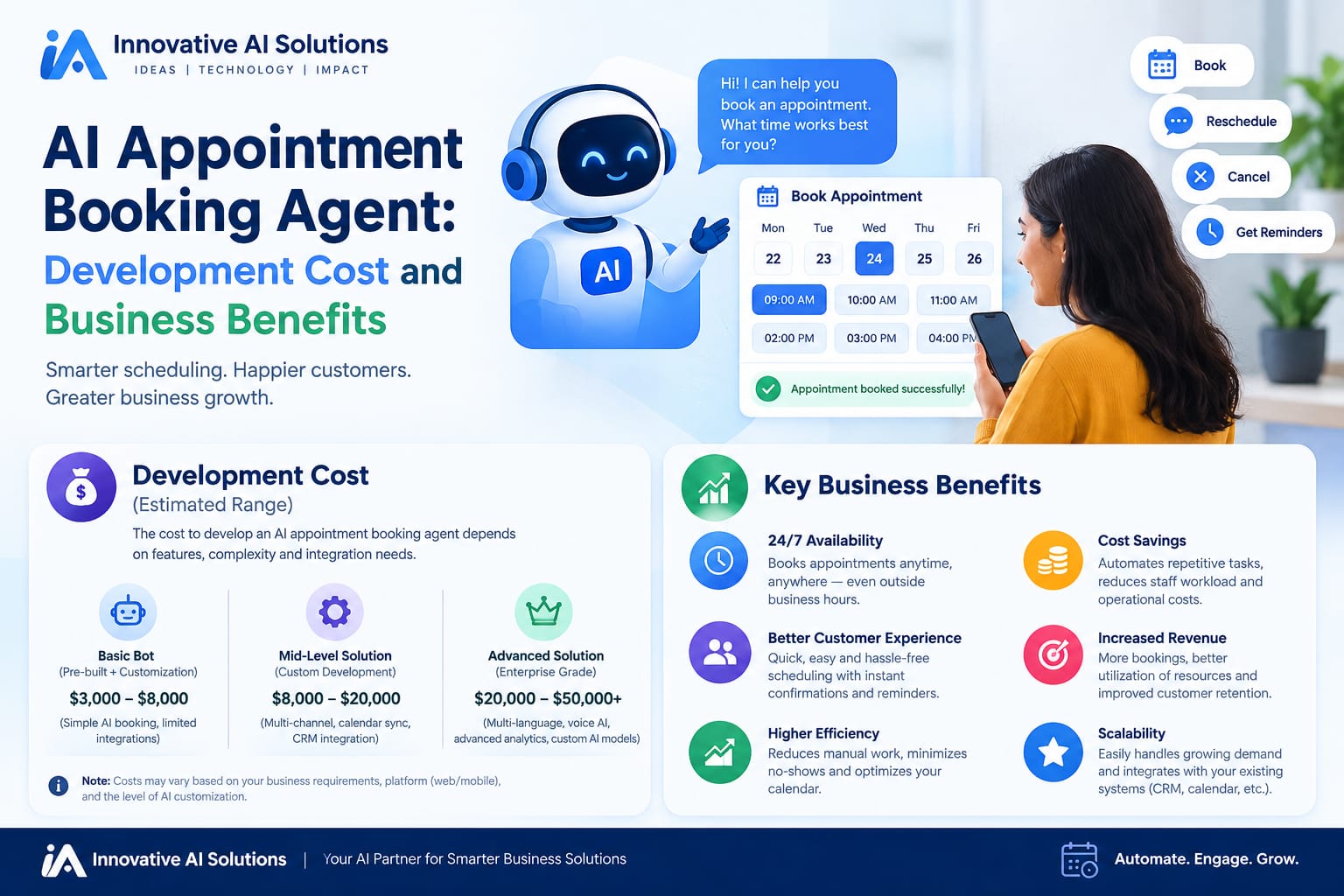
The answer depends on complexity. Here's a realistic breakdown for Indian businesses.
Basic Booking Agent (Single Calendar, Simple Flows)
Think: a salon with one location and three stylists. Or a consultant with a simple calendar. Features include: calendar integration (Google/Outlook), basic availability checking, confirmation emails/SMS, and a simple conversational interface.
Typical cost: ₹75,000 to ₹1,50,000. Timeline: 4–6 weeks. Monthly running cost: ₹8,000–₹15,000 for hosting, APIs, and maintenance.
Mid-Tier Booking Agent (Multi-Resource, Multi-Location)
Think: a clinic with multiple doctors, a spa with multiple therapists, or a multi-location service business. Features include: multi-resource scheduling, buffer times, recurring appointments, waitlist management, payment integration, and CRM sync.
Typical cost: ₹1,50,000 to ₹4,00,000. Timeline: 8–12 weeks. Monthly running cost: ₹15,000–₹35,000.
Advanced Booking Agent (Industry-Specific, Compliance-Heavy)
Think: healthcare with EHR integration and HIPAA compliance, or legal services with intake workflows. Features include: EHR/EMR integration, insurance verification, pre-visit questionnaires, compliance logging, and multi-language support.
Typical cost: ₹4,00,000 to ₹10,00,000+. Timeline: 3–6 months. Monthly running cost: ₹35,000–₹75,000+.
Enterprise-Grade Solution
For large organizations with hundreds of resources, complex routing rules, and deep integrations. Costs start at ₹10,00,000+ and scale upward. But most SMBs don't need this.
What Affects Your Cost
The biggest factors are: number of integrations (calendar, CRM, payment, EHR), complexity of scheduling logic (buffer times, resource matching, timezone handling), conversational sophistication (scripted responses vs. natural language understanding), compliance requirements (HIPAA, DPDP), and ongoing maintenance (typically 15–20% of development cost annually).
The key insight: you don't need to build everything at once. Start with a basic agent. Prove value. Then expand.
Breakdown by Developer Type (2020–2026 Rates)
AI development talent costs have shifted dramatically. Here's the historical context.
2020–2021: The Pre-Boom Era
AI developers were rare. Conversational AI meant simple chatbots with scripted flows. Booking agents were custom-built and expensive. Freelance developers charged ₹2,000–₹3,500 per hour. Agencies charged ₹5,000–₹8,000 per hour. Most SMBs couldn't afford it.
2022–2023: The Chatbot Wave
Businesses wanted chatbots. Demand surged. Supply couldn't keep up. Rates climbed to ₹3,000–₹5,000 per hour for freelancers and ₹7,000–₹12,000 per hour for agencies. But something else happened: frameworks matured. Dialogflow, Rasa, and custom NLP pipelines became more accessible. Development time dropped.
2024–2025: The LLM Revolution
Large language models changed everything. Instead of scripted flows, developers could build agents that understood natural language. GPT-4, Claude, and open-source alternatives became building blocks. Development accelerated. Rates stabilized around ₹2,500–₹4,500 per hour for mid-level AI engineers.
2026: The Small AI Era
Today, building an AI appointment booking agent is faster and cheaper than ever. Here's what you should expect to pay:
Freelance AI Developers: Mid-level rates run $20–$40 per hour. Senior specialists command $40–$60 per hour. Freelancers work for well-defined, short projects—but they carry hidden costs: no replacement guarantee, limited accountability, and coordination overhead.
Dedicated Teams (Offshore): A dedicated team through a vetted firm runs $25–$45 per hour per person. You get a project manager, AI engineers, backend developers, and QA—working exclusively on your project, with built-in attrition replacement.
Full-Time Salaries in India: Junior AI engineers (0–2 years) earn ₹4–7 LPA. Mid-level AI/ML engineers earn ₹8–15 LPA. Senior AI architects can command ₹20–35 LPA.
The Global Comparison
A senior AI engineer in India costs 20–30% of what an equivalent engineer costs in San Francisco. The quality difference? Increasingly negligible. Indian engineers have built AI systems used by millions. The skill gap is a myth.
Why Prices Changed in 2026
Appointment booking agent costs have shifted. Here's why.
Reason 1: LLM APIs Became Commoditized
In 2023, GPT-4 API calls were expensive. In 2026, competition from Claude, Gemini, Llama, and Mistral has driven prices down dramatically. What cost $0.03 per 1,000 tokens now costs a fraction of that. The intelligence layer is no longer the expensive part.
Reason 2: Pre-Built Frameworks Emerged
You don't need to build conversational AI from scratch. Frameworks like LangChain, LlamaIndex, and Vapi provide the scaffolding. Calendar APIs (Google Calendar, Outlook, Calendly) are well-documented. Payment gateways (Razorpay, Stripe) are plug-and-play. Development time dropped by 50–60%.
Reason 3: No-Code and Low-Code Platforms
For simpler booking needs, platforms like Calendly, Cal.com, and Zoho Bookings offer AI-powered scheduling out of the box. But for businesses needing custom flows, integrations, and branding, custom development remains the better choice.
Reason 4: Cloud Costs Dropped
Serverless architectures mean you pay only for what you use. A booking agent that handles 1,000 conversations per month might cost ₹5,000–₹10,000 in infrastructure—down from ₹25,000+ in 2021.
Reason 5: The Market Matured
In 2023, every vendor claimed to do "AI." In 2026, buyers are smarter. They ask for demos. They check references. They want proof. Competition has forced vendors to compete on outcomes, not buzzwords. That's good for you.
Reason 6: Open Source Models
Models like Llama 3, Mistral, and Falcon can be hosted locally. For businesses with data privacy concerns, this eliminates API dependency and reduces long-term costs. You own the model. You control the data.
Pro Tips to Save Money in 2026
After building dozens of AI agents, here's what actually saves money.
Tip 1: Start with a Narrow Scope
Don't build an agent that does everything. Build one that does one thing well: book appointments. Add features later based on user feedback. A focused agent is cheaper to build, easier to test, and faster to launch.
Tip 2: Use Pre-Built Calendar APIs
Don't build calendar infrastructure from scratch. Google Calendar API, Microsoft Graph, and Calendly's API handle the hard parts. Focus your budget on the conversational layer and business logic.
Tip 3: Choose the Right LLM for the Job
Not every task needs GPT-4. For simple intent recognition and slot filling, smaller models like GPT-3.5 Turbo or open-source alternatives work perfectly at a fraction of the cost. Use the big models only when necessary.
Tip 4: Implement Human-in-the-Loop from Day One
AI makes mistakes. Build fallback mechanisms. If the agent can't handle a request, route it to a human. This reduces risk and builds user trust. It also lets you launch faster you don't need 100% accuracy before going live.
Tip 5: Prioritize SMS and WhatsApp Over Voice
Voice AI is impressive, but it's expensive and complex. SMS and WhatsApp booking agents are simpler, cheaper, and often more effective. Start there. Add voice later if needed.
Tip 6: Plan for Maintenance
AI systems need updates. Calendar APIs change. Business rules evolve. User expectations shift. Budget 15–20% of development cost annually for maintenance.
Tip 7: Own Your Code and Data
Always. Any vendor who refuses IP transfer isn't worth working with. Your booking data is valuable. Don't let a vendor lock you out of it.
Questions to Ask Before Hiring
Before you hire an AI development partner, ask these questions. The answers will tell you everything.
1. "Can you show me a live booking agent you've built?"
Not a demo. Not a prototype. A live system handling real appointments. If they can't show you, walk away.
2. "How do you handle calendar conflicts and edge cases?"
Good vendors have thought about timezone handling, buffer times, double bookings, and cancellations. Vague answers signal trouble.
3. "What happens when the AI doesn't understand a request?"
The answer should include human escalation, fallback flows, and error logging. If the answer is "it always understands," they're lying.
4. "Who owns the code and IP?"
You do. Full transfer. No exceptions.
5. "How do you integrate with my existing systems?"
Look for API-first architecture, webhooks, and documented integration patterns. If they say "we'll figure it out," be worried.
6. "What's your testing process?"
Good vendors have automated tests, manual QA, and real-world simulation. They test edge cases. They test failure modes.
7. "How long until we see a working prototype?"
For a basic agent, 2–4 weeks. For complex integrations, 4–8 weeks. If the timeline is longer, ask why.
8. "Can I speak with your existing clients?"
References matter. Ask for named contacts. Ask about the good and the bad.
9. "What technologies do you use?"
Look for modern stacks: Python, Node.js, LangChain, OpenAI/Claude APIs, Google Calendar API, Twilio, etc. But the "why" matters more than the "what."
10. "What's your track record on budget and timeline?"
Many AI projects go over budget. Ask how your partner plans to avoid that.
Why Delhi is a Great Hub for AI Development
I run an AI company in Delhi. I'm biased. But there are real reasons why Delhi NCR is a powerhouse for AI development.
Talent Density
Delhi-NCR is second only to Bengaluru in tech talent concentration. The region's engineering colleges—IIT Delhi, DTU, NSIT—produce thousands of graduates annually. Many specialize in AI, ML, and conversational systems.
Cost Advantage
Delhi offers a 20–30% cost advantage over Bengaluru and Mumbai. Office rents are lower. Salaries are competitive. You get the same quality at lower cost.
Startup Ecosystem
Delhi is home to thousands of startups. The ecosystem includes incubators, accelerators, investors, and support networks. Founders here understand the journey because they've lived it.
Industry Diversity
Delhi's client base spans healthcare, fintech, retail, education, and more. This diversity creates depth. AI engineers here have solved booking problems across industries.
Time Zone Advantage
IST overlaps with US, UK, and Southeast Asian business hours. Real-time communication is possible without overnight shifts.
Government Support
The Indian government is actively promoting AI through initiatives like Digital India and AI for All. Delhi benefits from this ecosystem.
What We Offer
At Innovative AI Solutions, we've spent five years building AI systems that actually work. Not hype. Not buzzwords. Results.
AI Appointment Booking Agents
We build intelligent booking agents that handle scheduling end-to-end—from availability checking to confirmation and reminders. Integrated with your calendar, CRM, and payment systems.
RAG Chatbots
We build chatbots that understand your business, answer customer questions, and integrate with your existing systems.
AI Automation
We automate workflows invoice processing, lead scoring, document analysis, and more. Save hundreds of hours every month.
Web & Mobile App Development
We build modern, scalable applications with AI integrated from day one.
Healthcare AI
We specialize in healthcare solutions teleconsultation platforms, remote patient monitoring, EHR integration, and HIPAA-compliant AI.
Offshore Development
We provide dedicated developers who work as an extension of your team.
What Sets Us Apart
We focus on Small AI. Practical solutions. Affordable pricing. Fast delivery. And a team that actually cares about your success.
Frequently Asked Questions
Q1: What is an AI appointment booking agent?
An AI appointment booking agent is a software system that uses artificial intelligence to handle scheduling tasks—checking availability, booking appointments, sending confirmations, and managing cancellations without human intervention.
Q2: How much does it cost to build an AI appointment booking agent in India?
Basic agents start at ₹75,000. Mid-tier agents with multi-resource scheduling and integrations range from ₹1,50,000 to ₹4,00,000. Advanced, compliance-heavy solutions cost ₹4,00,000 to ₹10,00,000+.
Q3: How long does it take to build a booking agent?
Basic agents take 4–6 weeks. Mid-tier agents take 8–12 weeks. Complex, industry-specific solutions take 3–6 months.
Q4: What are the business benefits of an AI booking agent?
Reduced no-shows through automated reminders. 24/7 availability for bookings. Lower staffing costs. Fewer scheduling errors. Faster response times. Higher customer satisfaction. And more time for your team to focus on high-value work.
Q5: Can the AI agent handle cancellations and rescheduling?
Yes. A well-built agent handles the full appointment lifecycle booking, confirmation, reminders, cancellations, and rescheduling. It can also manage waitlists and fill gaps automatically.
Q6: How does the agent integrate with my existing calendar?
Through APIs. Google Calendar, Microsoft Outlook, and other calendar systems have well-documented APIs. We connect your agent to your calendar so availability is always accurate.
Q7: What happens if the AI makes a mistake?
Good systems have fallback mechanisms. If the agent can't handle a request, it escalates to a human. We also implement logging and monitoring to catch and fix issues quickly.
Q8: Do I need a custom solution, or can I use an off-the-shelf tool?
Off-the-shelf tools like Calendly work for simple needs. Custom solutions are better for businesses with complex scheduling rules, multiple resources, industry-specific compliance, or unique branding requirements.
Q9: How do you handle data privacy and compliance?
We use encryption, secure APIs, and comply with data protection regulations. For healthcare clients, we ensure HIPAA compliance. For Indian businesses, we comply with DPDP Act requirements.
Q10: What's the ROI of an AI booking agent?
It depends on your volume. A clinic that books 500 appointments per month and reduces no-shows by 20% could recover the development cost in 3–6 months. A salon with 1,000 bookings per month could see ROI even faster.
Frequently Asked Questions (Continued)
Q11: Can the agent handle multiple languages?
Yes. Modern LLMs support multiple languages. We can build agents that converse in English, Hindi, and regional languages.
Q12: Can the agent process payments?
Yes. We integrate with payment gateways like Razorpay, Stripe, and PayU. The agent can collect deposits or full payments at the time of booking.
Q13: What happens after the project is delivered?
We provide ongoing support and maintenance. AI systems need monitoring, updates, and occasional retraining. We offer flexible support packages.
Q14: Can I start with a small project and scale later?
Absolutely. That's exactly what we recommend. Start with a basic agent. Prove value. Then add features and integrations.
Q15: Why should I choose Innovative AI Solutions?
Because we focus on results, not hype. Because we've delivered 100+ projects. Because we offer enterprise-grade solutions at startup-friendly prices. Because your code is always yours.
Contact U
Ready to build your AI appointment booking agent? Let's talk.
Phone:
+91 7464 099 059
+91 9689967356
Email:
info@innovativeais.com
Address:
9th Floor, Pearls Best Heights-I,
Head Office: 904, Netaji Subhash Place,
Delhi – 110034