The Big Question
Let me ask you something that keeps maintenance managers awake at night.
What if you could know with genuine confidence that a critical machine was going to fail three days from now? Not a vague guess based on manufacturer schedules. Not a "we think it might be time for service" hunch. But actual, data-backed intelligence that tells you: this specific component, in this specific machine, will break down in approximately 72 hours unless you intervene.
What would that knowledge be worth to your business?
For most industrial operations, the answer is staggering. Unplanned downtime in manufacturing costs billions annually across global industry. In oil and gas, a single gas turbine shutdown on an offshore platform can cost hundreds of thousands of dollars sometimes millions in lost production and emergency repairs. A generator failure at a power plant can result in months of downtime and massive energy production losses.
The traditional approach to maintenance has always been a gamble. You either fix things when they break reactive maintenance which means accepting whatever downtime and damage the failure causes. Or you follow manufacturer schedules preventive maintenance which means replacing parts that might still have thousands of hours of useful life left, wasting money and resources .
Neither approach is intelligent. Both are guesses dressed up as strategy.
AI-powered predictive maintenance is the third path. It is the shift from guessing to knowing. And for businesses that make the transition, the results are not incremental. They are transformative.
What Is AI-Powered Predictive Maintenance?
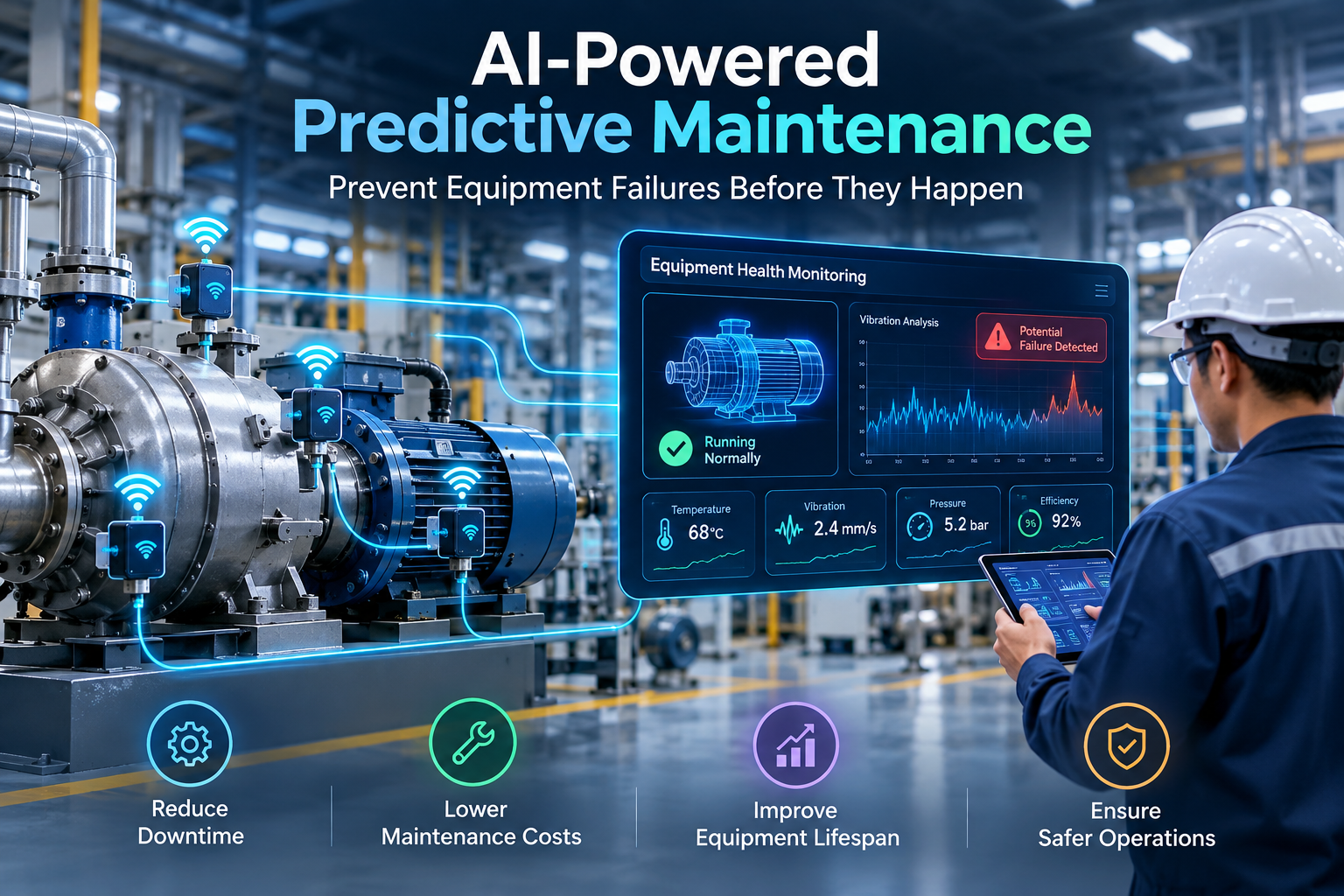
At its core, predictive maintenance uses artificial intelligence to analyze data from equipment sensors and predict when failures are likely to occur. Instead of relying on fixed schedules or waiting for something to break, the system continuously monitors machine health and alerts you when intervention is needed ideally before a problem escalates into a crisis .
The technology stack typically involves three interconnected layers:
The Data Layer: IoT Sensors
Modern equipment generates enormous amounts of operational data. Vibration, temperature, acoustic emissions, power consumption, pressure, and rotational speed all of these signals carry information about what is happening inside a machine . IoT sensors capture this data continuously, streaming it to processing systems in real time.
For older equipment that was not designed with sensors, retrofittable solutions exist. Low-cost microcontrollers and off-the-shelf sensors can transform legacy machines into data-generating assets, making predictive maintenance accessible even for smaller operations with limited budgets .
The Intelligence Layer: Machine Learning Models
Raw sensor data is meaningless without interpretation. This is where machine learning comes in. Advanced algorithms including Long Short-Term Memory networks, Convolutional Neural Networks, and hybrid architectures analyze patterns in the data to detect anomalies and predict equipment health .
These models learn what "normal" looks like for each machine and can identify subtle deviations that indicate degradation. They calculate something called Remaining Useful Life an estimate of how much operational time a component has left before failure . When RUL drops below a critical threshold, the system generates alerts and can even trigger maintenance work orders automatically.
The Action Layer: Integration with Maintenance Systems
Prediction without action is worthless. The most effective predictive maintenance systems integrate directly with Computerized Maintenance Management Systems and Enterprise Resource Planning platforms . When the AI predicts an impending failure, it does not just send an email. It creates a prioritized work order, allocates resources, and schedules the repair at the optimal time—balancing production demands with maintenance urgency.
The Results: What Businesses Actually Achieve
The academic research and real-world case studies paint a compelling picture. Organizations that successfully implement AI-powered predictive maintenance consistently report dramatic improvements.
Reduced Unplanned Downtime
The headline benefit is downtime reduction. Studies show that AI-driven predictive maintenance can decrease unplanned downtime by 20% to 50% . In some implementations, the reduction is even more dramatic—one manufacturing deployment achieved a 67% reduction in unexpected equipment failures.
A deployment across 20 lathe machines in India's MSME sector demonstrated 18% downtime reduction with a return on investment achieved in just 14 months . For small and medium enterprises with tighter margins, these economics are game changing.
Lower Maintenance Costs
Predictive maintenance does not just prevent failures it optimizes when maintenance happens. Instead of replacing components on fixed schedules regardless of their actual condition, businesses replace them only when data indicates it is necessary. This alone reduces maintenance expenses by 10% to 40% .
One comprehensive deployment documented annual savings of $1.399 million against implementation costs of $487,000, achieving a simple payback period of approximately 4.5 months . Emergency repair labor dropped nearly 49%. Production losses from downtime fell by almost 45%. The numbers speak for themselves.
Extended Equipment Life
Machines that receive timely maintenance last longer. Predictive systems help businesses get maximum value from their capital investments by preventing the cascading damage that occurs when small problems are ignored. Research indicates that equipment operational life can be extended by 10% to 20% when predictive maintenance is properly implemented .
Improved Safety and Compliance
In industries like oil and gas, chemical processing, and power generation, equipment failures are not just expensive—they are dangerous. Predictive maintenance systems provide early warning of conditions that could lead to catastrophic failures, allowing intervention before safety is compromised . One study found that safety incident-related costs fell by nearly 45% after implementation, illustrating that avoided equipment failures protect workers as much as they protect assets .
The Business Case: Numbers That Matter
Let me put this in concrete terms.
A large manufacturing facility with critical production equipment might experience 100 hours of unplanned downtime annually at a cost of $10,000 per hour. That is $1 million in lost production alone, before counting emergency repair costs, expedited parts shipping, and overtime labor.
If predictive maintenance reduces that downtime by just 40%, the annual savings reach $400,000. Add 25% savings on maintenance labor and parts—say another $150,000—and you are looking at $550,000 in annual value. If the system costs $200,000 to implement and $50,000 annually to operate, the payback period is measured in months, not years.
For a single retail location, the economics are smaller but still compelling. The predictive maintenance market is expected to reach approximately $14.1 billion in 2025 and expand to $40-50 billion by 2030, reflecting strong adoption driven by AI, IIoT, and digital transformation strategies .
The math works across scales. What changes is the implementation approach.
Challenges and How to Overcome Them
I would be dishonest if I suggested predictive maintenance is plug-and-play. It is not. The path from pilot to production involves real obstacles, and understanding them before you start is essential.
Data Quality and Availability
Machine learning models are only as good as the data they are trained on. Many organizations discover—often painfully—that their historical maintenance data is incomplete, inconsistently recorded, or locked in proprietary systems that do not share easily . Sensor coverage may be sparse on older equipment.
The solution is to start where you have the best data. Instrument your most critical assets first. Establish clean data pipelines before worrying about sophisticated models. Progressive instrumentation over time builds the foundation for broader deployment .
Integration Complexity
Brownfield environments—factories with a mix of legacy and modern equipment—present unique integration challenges. Air-gapped networks, proprietary control systems, and incompatible communication protocols all complicate deployment .
Successful implementations use middleware to bridge legacy and modern systems. Duplicating historian data into accessible data lakes, with proper access controls, enables cloud-based analytics without disrupting existing operations .
Model Interpretability
Deep learning models can achieve impressive accuracy—current approaches achieve 83% to 98% accuracy—but they often function as black boxes . When a system says "this machine will fail in three days," maintenance teams want to understand why. Without explainability, trust suffers, and trust is essential for adoption.
The answer is a hybrid approach. Combine high-accuracy deep learning with interpretable methods that can explain their reasoning. Provide maintenance teams with not just predictions, but the sensor signals and patterns that triggered them.
Workforce Readiness
Perhaps the most overlooked challenge is people. Maintenance technicians who have spent decades relying on their ears and experience may be skeptical of algorithmic predictions. Training programs are essential—not just on how to use the new systems, but on why they work and how to validate their recommendations.
The goal is not to replace human expertise. It is to augment it. The best systems combine AI prediction with human judgment, creating a feedback loop that improves both over time.
Getting Started: A Practical Roadmap
If you are convinced predictive maintenance is worth pursuing, here is how to begin without getting overwhelmed.
Step 1: Identify Your Critical Assets
Not every machine needs predictive monitoring. Focus first on equipment where failure would cause the greatest operational or financial impact. A single critical compressor or production line motor may be worth more attention than a dozen auxiliary systems.
Step 2: Assess Your Data Foundation
What sensors already exist on your equipment? What historical maintenance records do you have? What is the quality and completeness of that data? This assessment will determine what is possible in your first phase.
Step 3: Start with a Pilot
Choose one asset or one production line for an initial deployment. Instrument it thoroughly. Collect data for several months to establish baseline patterns. Then deploy models and measure results against your current maintenance approach. An initial proof of value typically takes 6 to 8 weeks to demonstrate results .
Step 4: Prove Value, Then Scale
A successful pilot generates the business case for expansion. Document the downtime avoided, the maintenance costs saved, the production hours recovered. Use those numbers to justify broader deployment. Organizations are scaling up to over 10,000 monitoring points in a single plant within 6 to 12 months .
Step 5: Build Internal Capability
Do not outsource everything. Your team needs to understand how the system works, how to interpret its outputs, and how to maintain it over time. Partner with vendors who offer training and knowledge transfer, not just software licenses.
Why This Matters Now
The convergence of affordable IoT sensors, powerful edge computing, and mature machine learning frameworks has made predictive maintenance accessible to businesses of all sizes. What was once the exclusive domain of Fortune 500 companies with massive R&D budgets is now within reach for mid-sized manufacturers and even small enterprises.
The market reflects this shift. Small and medium enterprises represent the most dynamic constituency in predictive maintenance adoption, advancing at a 36.2% compound annual growth rate as barriers to adoption fall . The businesses that move now will build operational advantages that compound over time. Those that wait will find themselves competing against organizations that simply do not experience the same downtime, do not waste the same maintenance dollars, and do not suffer the same unexpected failures.
The technology works. The economics are proven. The only question is whether you will act before your competitors do.
What We Offer at Innovative AI Solutions
We have spent five years building AI systems that solve real business problems. Our predictive maintenance practice focuses on practical deployments that deliver measurable results not science projects that look impressive in presentations but never make it to the factory floor.
Custom Predictive Models: We build machine learning models tailored to your specific equipment, operating conditions, and failure modes. No generic solutions. No one-size-fits-all approaches. Just systems designed for your reality.
Retrofittable IoT Solutions: For legacy equipment that was not born with sensors, we design and deploy retrofittable monitoring systems that transform existing machines into data-generating assets. Our approach ensures you do not need to replace equipment to benefit from predictive maintenance .
Edge-to-Cloud Architecture: We architect systems that process data where it makes sense at the edge for low-latency anomaly detection, in the cloud for fleet-wide analytics and model training.
Integration Services: We connect predictive insights to your existing maintenance workflows, whether that is a CMMS, ERP, or custom ticketing system.
Training and Support: We do not disappear after deployment. We train your teams, monitor system performance, and continuously improve models as your operations evolve.
Frequently Asked Questions
Q: How long does it take to see results from predictive maintenance?
Initial insights can emerge within weeks of sensor deployment, but meaningful ROI typically requires 3-6 months of data collection and model refinement. The timeline depends on how quickly equipment goes through enough operational cycles to establish reliable patterns. Successful prescriptive AI deployments are achieving complete return on investment in 3 to 6 months .
Q: Do I need to replace my existing equipment to implement this?
Absolutely not. Most of our clients deploy predictive maintenance on equipment that has been in service for years. Retrofittable sensors and modern integration tools make legacy equipment fully capable of generating valuable operational data. Successful industrial AI solutions operate on a sensor-agnostic model, ingesting process data across highly heterogeneous equipment vintages without requiring a "rip and replace" of existing hardware .
Q: What if I do not have historical maintenance data?
Historical data accelerates initial model training, but it is not strictly necessary. We can start with sensor-based monitoring to establish baseline behavior and build predictive capability from there. The system learns as it operates.
Q: How accurate are the predictions?
Accuracy varies by equipment type and data quality, but well-implemented systems typically achieve 85-95% accuracy in failure prediction, with lead times ranging from hours to days depending on the failure mode. Current research indicates that approaches achieve high accuracy of 83% to 98%, though challenges such as missing data and the trade-off between accuracy and interpretability remain areas of active development . We always provide confidence intervals so your team knows how much to trust each prediction.
Q: Is this only for large enterprises?
No. While the earliest adopters were large industrial operations, costs have dropped dramatically. Solutions are now viable for small and medium enterprises. Retrofittable options exist that start at accessible price points, and MSME-focused deployments have demonstrated 22% maintenance cost savings with ROI in 14 months .
Q: What about data security?
We take this seriously. Systems can be deployed entirely on-premise if your data cannot leave your network. Cloud deployments use encryption in transit and at rest, with strict access controls and compliance with relevant industry standards.
Contact us:
Phone: +91 7464 099 059/+91 9689967356
Email: info@innovativeais.com
Address: 9th Floor, Pearls Best Heights-I, Head Office :- 904, Netaji Subhash Place, Delhi, 110034