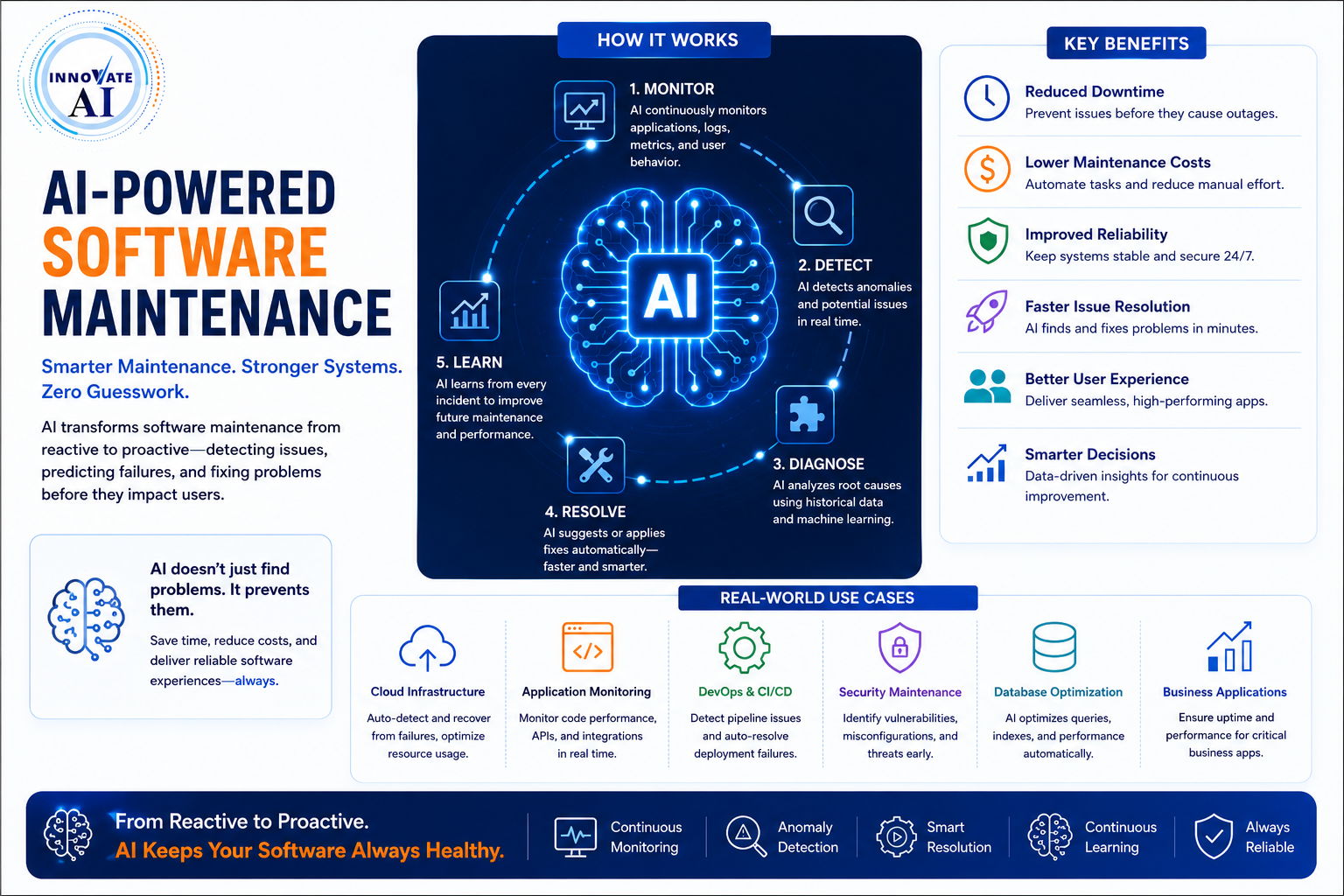
The Big Question
What happens when software can fix its own bugs, patch its own vulnerabilities, and recover from its own runtime errors—without a developer writing a single line of code? What if maintenance stopped being a drain on development resources and became an autonomous, self-improving process?
The numbers are staggering. Software maintenance consumes 50-70% of development resources . In large organizations, addressing security vulnerabilities forces developers to pause planned work, disrupting delivery cadence and impacting project planning . But AI is changing this equation—and the results are already remarkable.
The Maintenance Problem: Why Traditional Approaches Fail
The Scale of the Challenge
In large-scale proprietary software ecosystems (PSECO)—complex networks of interdependent software artifacts managed by a central organization—addressing security vulnerabilities is particularly challenging due to strict quality standards, regulatory constraints, and the risk of cascading failures . These challenges compromise delivery schedules, increase operational risk, and force teams to interrupt planned work to address urgent issues .
Static analysis tools help identify security vulnerabilities. But in most cases, the fixing process remains manual and time-consuming .
The Runtime Error Problem
Unanticipated runtime errors—errors lacking predefined handlers—can abruptly terminate execution and lead to severe consequences, such as data loss or system crashes . Despite extensive efforts to identify potential errors during development, such unanticipated errors remain a persistent challenge .
Traditional self-healing systems rely on predefined heuristic strategies, such as rolling back to a checkpoint or matching existing error handlers . However, limited by their rule-based nature, these strategies are not adaptive enough to deal with diverse errors, which impedes their adoption . A large-scale industry study highlights that one of the main challenges encountered with engineering such systems is the complexity of defining adaptation rules .
GenAI-Powered Vulnerability Remediation
The PSECO-SafePatch Approach
A participative case study in a large global financial organization designed and evaluated PSECO-SafePatch, an approach that combines a structured remediation process with a web-based tool integrating Fortify static analysis with GenAI-based patch generation .
The results were remarkable: reduced mean remediation time by 84% with an 89% patch success rate . The approach also reduced cognitive overload by guiding developers through structured validation, fostering trust without overreliance .
Human-in-the-Loop Validation
Crucially, PSECO-SafePatch includes human-in-the-loop validation aligned with DevOps practices . The findings show that GenAI-supported remediation is feasible and effective in complex enterprise environments, while human oversight preserved critical thinking and addressed concerns about blind automation and knowledge erosion .
Runtime Error Handling with LLMs
Healer: The First LLM-Assisted Runtime Error Handler
Healer, the first LLM-assisted self-healing framework, operates in real-time :
-
Detection: When an unexpected, unhandled runtime error occurs, Healer is activated
-
Context Gathering: It collects runtime context—error messages, program states, and the erroneous source code
-
Code Generation: An LLM generates a bespoke error-handling code snippet
-
Execution & Recovery: The handling code executes in an isolated environment to produce a corrected program state
-
Continuation: The program continues execution from the point of error without termination
The Results
Without any fine-tuning, GPT-4 successfully helped programs recover from 72.8% of runtime errors . Healer introduced negligible latency in normal code execution (less than 1 ms per program) and acceptable overhead for error handling (less than 4 seconds for LLM code generation) .
Agentic Runtime Healing
This work represents the first step toward agentic runtime healing, paving the way for more adaptive, resilient, and self-healing software systems . Challenges remain, particularly regarding the trustworthiness of LLM-generated code and its integration into existing systems .
Agent-Based Program Repair
RepairAgent: Autonomous Program Repair
RepairAgent is the first work to address program repair through an autonomous agent based on an LLM . Unlike existing approaches that prompt a model with a fixed prompt, RepairAgent treats the LLM as an agent capable of autonomously planning and executing actions to fix bugs .
Key contributions include:
-
A set of tools useful for program repair
-
A dynamically updated prompt format for tool interaction
-
A finite state machine guiding the agent in invoking tools
The evaluation on Defects4J: RepairAgent autonomously repaired 164 bugs, including 39 bugs not fixed by prior techniques . The average cost: 270k tokens per bug—14 cents per bug under GPT-3.5 pricing .
The Google Experience: GITS-Eval
Researchers at Google curated GITS-Eval, an evaluation set of 178 bugs from Google's internal issue tracking system, to assess agentic repair in an enterprise context .
The Passerine baseline agent achieved:
-
25.6% plausible patches for human-reported bugs
-
73% for machine-reported bugs (68% TOD, 78% SAN)
-
17.9% semantically equivalent patches for human-reported bugs
-
43% for machine-reported bugs
Key observation: Agentic repair systems that perform well on open-source benchmarks (SWE-Bench) may not achieve similar success in enterprise settings due to differences in language diversity, patch size, and bug description characteristics .
The Suggestion-Guided Approach: SGAgent
The "Localize-Suggest-Fix" Paradigm
Existing software repair approaches follow a localize-then-fix paradigm—jumping directly from "where the bug is" to "how to fix it," leaving a fundamental reasoning gap .
SGAgent introduces a localize-suggest-fix paradigm inspired by expert debugging practices:
-
Localizer: Identifies candidate fault regions
-
Suggester: Performs backward analysis to convert coarse localization signals into actionable, repository-aware edit plans
-
Fixer: Executes the plan and synthesizes patches
The suggest stage closes the gap between where and how to fix issues, enabling interpretable, step-wise repair .
The Knowledge Graph Advantage
SGAgent constructs a fine-grained Knowledge Graph from the target repository, enabling global contextual awareness and repository-level reasoning . The toolkit includes 14 specialized tools for context retrieval and repository understanding.
The results on SWE-Bench: SGAgent with Claude-3.5 achieved 51.3% repair accuracy, 81.2% file-level, and 52.4% function-level localization accuracy at an average cost of $1.48 per instance . When extended to vulnerability repair, SGAgent achieved 48% accuracy on VUL4J and VJBench .
AI-Driven Defect Prediction and Automated Refactoring
The Shift to Predictive Maintenance
Conventional approaches to fault prediction and code rearrangement encounter scalability problems in large-scale, dynamic environments . Traditional SQA methods—heuristic rules, statistical models, manual code inspections—can't match the massive and ever-changing codebases of modern systems .
AI-driven frameworks use ML, DL, and NLP to detect, prevent, and fix software problems before they happen . Graph Neural Networks, reinforcement learning, and predictive analytics enable code structure optimization and automated refactoring decisions with minimal human intervention .
The Research Frontier
A review of the latest advancements identifies key emerging trends:
-
Graph neural networks for source code analysis
-
Reinforcement learning for automated refactoring
-
Self-supervised models for quality improvement
Challenges remain: data quality, model interpretability, and integration with CI/CD workflows . Future research should focus on explainable, adaptive, and domain-independent frameworks that make software maintenance an autonomous, self-improving process .
Structured Exception Handling for Agentic Workflows
The SHIELDA Framework
LLM agentic systems frequently encounter exceptions during execution . Existing solutions treat exceptions superficially, failing to trace execution-phase exceptions to their reasoning-phase root causes .
SHIELDA (Structured HandlIng of Exceptions in LLM-Driven Agentic Workflows) introduces:
-
A comprehensive taxonomy of 36 exception types across 12 agent artifacts
-
Phase-aware recovery linking exceptions to root causes
-
Composable handling strategies via local handling, flow control, and state recovery
Validation on the AutoPR agent demonstrated effective, cross-phase recovery from reasoning-induced exceptions .
Implementation Roadmap: The First 90 Days
Phase 1: Foundation (Weeks 1-4)
-
Audit your maintenance burden: Measure time spent on debugging, patching, and refactoring. Calculate the cost of interruptions to planned work .
-
Identify high-value patterns: Which bugs are most frequent and costly? Which vulnerabilities recur?
-
Establish governance: Define permissions, human review gates, and rollback mechanisms .
Phase 2: Pilot (Weeks 5-8)
-
Start with vulnerability remediation: Deploy a GenAI-based patching workflow like PSECO-SafePatch .
-
Test runtime error handling: Implement Healer for bounded, low-risk error types .
-
Measure success rates: Track remediation time reduction, patch success rate, and recovery percentage .
Phase 3: Scale (Weeks 9-12+)
-
Expand to agent-based repair: Deploy RepairAgent or SGAgent for repository-level bugs .
-
Implement structured exception handling: Use SHIELDA for agentic workflows .
-
Enable predictive maintenance: Deploy ML-based defect prediction .
-
Continuous improvement: Track metrics, refine models, expand coverage.
Frequently Asked Questions
Q1: How much time can AI save in software maintenance?
Studies show GenAI can reduce mean vulnerability remediation time by 84% with an 89% patch success rate . LLM-assisted runtime error handling recovers from 72.8% of errors in real-time .
Q2: What is the cost of AI-powered program repair?
RepairAgent costs approximately 14 cents per bug under GPT-3.5 pricing . SGAgent costs $1.48 per instance with Claude-3.5 .
Q3: Can AI replace human developers in maintenance?
No. Human-in-the-loop validation remains essential. PSECO-SafePatch demonstrated that human oversight preserves critical thinking and prevents overreliance on automation . Agent-based repair systems also require human validation .
Q4: What are the main challenges for AI-powered maintenance?
Trustworthiness of AI-generated code, integration with existing systems, model interpretability, data quality, and enterprise-specific constraints like regulatory compliance .
Q5: What is the "localize-suggest-fix" paradigm?
Instead of jumping directly from "where the bug is" to "how to fix it," a suggester agent provides actionable, repository-aware repair plans before patch generation—improving repair accuracy by 13.3% .
Q6: How can Innovative AI Solutions help?
We help organizations design, build, and operationalize AI-powered software maintenance—from vulnerability remediation and runtime error handling to agent-based program repair and predictive defect prediction. Based in Delhi, serving clients across India.
Why Delhi is a Great Hub for AI Development
Delhi is emerging as a significant hub for AI development, backed by concrete government support and infrastructure. The recent Delhi Budget 2026-27 allocated ₹8.20 crore for two Artificial Intelligence centres of excellence (AI-CoEs), functioning as hubs for research, innovation, and startup incubation.
The city's AI infrastructure is expanding rapidly. Under the IndiaAI Mission, more than 38,000 high-end GPUs have been onboarded and are available at approximately ₹65 per hour—roughly one-third of the global average cost.
The government has also announced a ₹350 crore startup policy over five years, aiming to support the emergence of at least 5,000 startups by 2035, with key focus areas including artificial intelligence, machine learning, and automation.
The AI ecosystem in Delhi combines: cost-effective infrastructure, government support, a growing talent pool, and proximity to the country's business decision-makers.
What We Offer at Innovative AI Solutions
After five years of building AI solutions for businesses, we've developed a practical approach that focuses on what actually works:
-
Maintenance Automation Strategy: We help you assess your maintenance burden and design an automation roadmap
-
Vulnerability Remediation: We help you deploy GenAI-based patching with human validation
-
Runtime Error Handling: We help you implement Healer-style recovery frameworks
-
Agent-Based Repair: We help you deploy RepairAgent, SGAgent, or custom solutions
-
Predictive Maintenance: We help you implement ML-based defect prediction
-
Structured Exception Handling: We help you implement SHIELDA for agentic workflows
-
Governance and Validation: We help you establish human review gates, rollback mechanisms, and audit trails
Our approach is built on the reality that AI-powered software maintenance isn't just about speed—it's about building systems that get smarter with every failure.
Final Thought
The question facing engineering leaders isn't whether AI-powered maintenance is coming. The question is whether you'll be ready when it does. From GenAI reducing vulnerability remediation time by 84% to autonomous agents repairing 164 bugs for 14 cents each, the technology is maturing rapidly.
The systems that can achieve truly autonomous maintenance—where failures become data, agents get smarter with every incident, and humans are freed from endless debugging—will have an enormous competitive advantage in reliability, cost, and speed.
The shift is clear: from responding to failures after they happen, to anticipating and repairing them before they impact users.
Contact Us:
Phone: +91 7464 099 059 / +91 9689967356
Email: info@innovativeais.com
Address: Netaji Subhash Place, Pitampura, Delhi – 110034
Website: https://innovativeais.com
About the Author
Abhishek Kumar
Founder & CEO, Innovative AI Solutions
5+ years building AI systems for enterprises. Based in Delhi, serving clients across India.
Hashtags: #AIPoweredMaintenance #SoftwareMaintenance #AutomatedProgramRepair #RuntimeErrorHandling #AIOps #DevOps #InnovativeAISolutions
Related services: to apply this in your business, explore our LLM integration and AI development services.