The Big Question
What is an AI receptionist, and why should your business care?
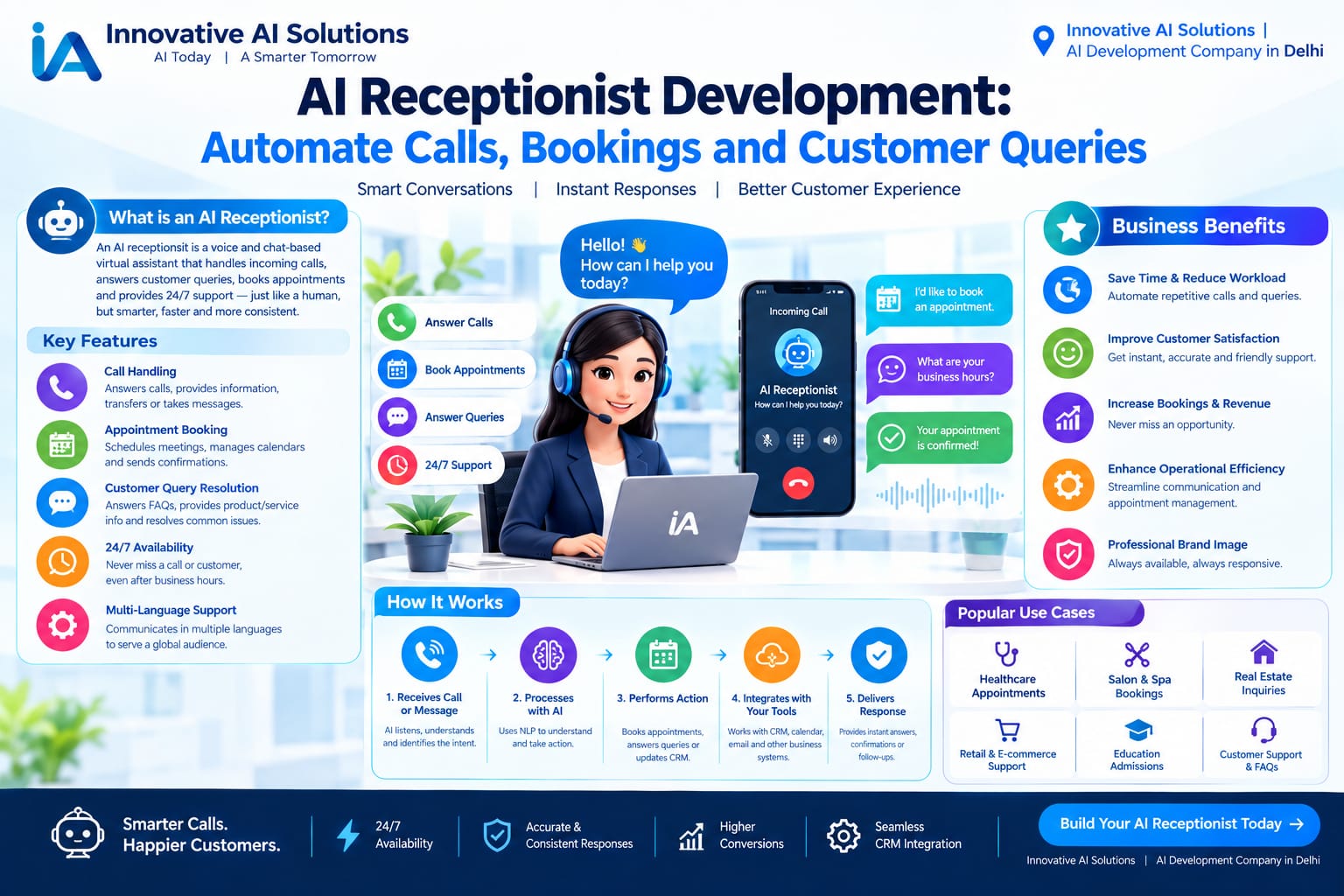
An AI receptionist is a voice-powered virtual agent that handles inbound calls the way a human receptionist would: greeting callers, understanding their needs, answering questions, scheduling appointments,services and routing calls to the right person or department.
The difference from traditional IVR? Natural language understanding. Instead of "press 1 for sales, press 2 for support," callers simply speak. They say "I need to reschedule my appointment for next Tuesday," and the AI understands, checks availability, and confirms the new time.
The business case is compelling. RingCentral's AI Receptionist now serves more than 11,800 businesses, automating customer interactions and extending availability beyond traditional business hours. Keller Interiors, an installation partner for Lowe's, deployed AIR across 33 locations and went from 12-minute wait times to 90 seconds, with CSAT scores rising 3 points in four months—without adding headcount.
But here's the reality most vendors don't tell you: AI receptionists aren't replacements for human front desk staff. They're force multipliers. A MyOperator deployment for DavaIndia screened the Group CEO's inbound calls, giving him 2 hours of focused time daily. His PA's workload shifted from 4 hours of daily manual interrogation to 15 minutes of reviewing WhatsApp summaries.
The goal isn't eliminating humans. It's eliminating the repetitive, predictable work that consumes their time—so they can focus on the conversations that actually require human judgment.
Cost Based on Business Type
Let's talk numbers. What does it actually cost to deploy an AI receptionist in India in 2026?
Per-Minute Pricing (Volume Spiky or Unknown)
₹4 to ₹11 per minute. Best for businesses with unpredictable call volumes. You pay only for what you use.
Per-Resolved-Call Pricing (Outcome-Tied)
₹9 to ₹22 per completed intent. Best when you want cost tied directly to business outcomes—a booking made, a query resolved.
Flat Monthly (Steady Volume)
₹6,000 to ₹25,000 for a defined call band. Best for predictable call volumes. This is where most SMBs land.
Real-World Comparison
A single-location clinic doing 600 inbound calls per month lands somewhere around ₹8,000 to ₹14,000 on the AI side. Compare that to a human front desk at ₹22,000 to ₹34,000 monthly in Tier-1 cities, plus training and attrition costs.
Custom Enterprise Deployments
For businesses needing deep CRM integration, multi-location routing, and custom workflows, costs range from ₹32,000/month (platform + managed service) to ₹75,000 setup + ₹32,000/month for production-grade deployments.
What Affects Your Cost
The biggest factors are: call volume (per-minute vs. flat monthly), integrations (CRM, calendar, WhatsApp), language requirements (English, Hindi, regional), custom workflows (multi-step booking, escalation logic), and ongoing management (dedicated AI manager vs. self-service).
The honest framing: almost nobody fires their front desk. What happens is the front desk stops being a phone operator and starts being present for the people physically in the room—and the business stops needing a second hire when volume doubles.
Breakdown by Architecture (2020–2026)
How has AI receptionist development evolved?
2020–2021: The IVR Era
Reception automation meant phone trees. Press 1, press 2. Rigid, frustrating, and effective only for routing. No intelligence. No natural language.
2022–2023: Scripted Voice Bots
Basic voice bots emerged. They could answer simple questions with pre-written responses. But they broke outside their scripts. Callers got stuck in loops. Adoption was limited.
2024–2025: The LLM Revolution
Large language models changed everything. Voice agents could understand natural language, handle complex intents, and generate contextual responses. The technology moved from experimental to practical.
2026: The Production Era
Today, AI receptionists are production infrastructure. The architecture includes:
Telephony Layer: Carrier-grade SIP trunking, HD audio, low latency.
Speech-to-Text: Real-time transcription handling accents, background noise, and natural speech.
Large Language Model: Intent understanding and response generation. GPT-4, Claude, or open-source alternatives.
Text-to-Speech: Natural-sounding voice output with appropriate pacing and tone.
Tool Calls: Integration with calendars, CRMs, and databases for actions like availability checking and booking.
Orchestration: Conversation flow management, multi-turn dialogue, and human handoff logic.
The SDK ecosystem has matured too. The @atchonk/ai-receptionist package provides autonomous handling of voice, SMS, and email with built-in calendar, CRM, and communication tools. SignalWire's open-source Ethan demonstrates multi-tenant support, RAG knowledge base, and appointment scheduling.
Why Prices Changed in 2026
AI receptionist costs have shifted. Here's why.
Reason 1: Telephony APIs Became Commoditized
Twilio, Telnyx, and SignalWire have reduced per-minute costs. HD voice is now standard, not premium.
Reason 2: Speech Recognition Improved
Modern STT systems handle accents, background noise, and natural speech patterns. Transcription quality directly impacts understanding—and it's now good enough for production.
Reason 3: TTS Voices Became Natural
ElevenLabs and similar providers produce voices nearly indistinguishable from humans. Callers don't feel like they're talking to a robot.
Reason 4: The Market Matured
In 2024, every vendor claimed to do "AI voice." In 2026, buyers ask for production references. They want call recordings. They want metrics. Competition has forced honesty.
Reason 5: Native Platform Offerings
Zoom, RingCentral, and others now offer AI receptionist as a native feature. This reduces the need for custom development—for standard workflows.
Reason 6: The Compliance Layer
DPDP Act compliance adds cost. Consent capture, audit logging, and data retention policies must be built in. This isn't optional for Indian businesses handling personal data.
Pro Tips for AI Receptionist Development
After building these systems, here's what actually works.
Tip 1: Define Escalation Triggers from Day One
Not every call should be handled by AI. Define what triggers human handoff: emotional callers, edge cases, complex multi-stakeholder situations, and callers who explicitly ask for a person.
Tip 2: Start with Inbound Only
Outbound calling adds complexity—consent requirements, regulatory considerations, and higher risk. Master inbound first. Prove value. Then expand.
Tip 3: Build for Mid-Call Language Switching
In India, conversations move between English, Hinglish, and regional languages—often mid-sentence. An AI built in one language with a translation layer breaks. Build for native switching.
Tip 4: Connect to Your Existing Systems
Don't build isolated. Integrate with Google Calendar, Outlook, Calendly, CRM, and WhatsApp. An AI receptionist that can't book appointments or update records is just an expensive answering machine.
Tip 5: Send Post-Call Summaries
After every call, send the team a WhatsApp or email summary with caller details, intent, and action taken. This turns the AI into a useful team member, not a black box.
Tip 6: Test with Real Callers Before Launch
Don't go live untested. Run realistic scenarios. Test edge cases. Test failure modes. Test the escalation path. A bad first impression with callers is hard to recover from.
Tip 7: Plan for Maintenance
AI systems need tuning. Call patterns change. Business rules evolve. Budget 15–20% of development cost annually for maintenance.
Tip 8: Own Your Data and Integration Logic
Platform-native solutions are convenient but can lock you in. Build your integration layer so you can switch platforms without rebuilding everything.
Questions to Ask Before Hiring
Before you commit to an AI receptionist project, ask these questions.
1. "Can you show me a production deployment handling real call volume?"
Not a demo. A live system. If they can't show you, walk away.
2. "How do you handle escalation to a human?"
The answer should include defined triggers, warm handoff, and context transfer. "It just transfers" isn't enough.
3. "What languages does it support natively?"
For India, look for English, Hindi, and regional languages with mid-call switching.
4. "How do you prevent the AI from hallucinating?"
Look for RAG-based knowledge retrieval, confidence thresholds, and fallback responses.
5. "What's your integration architecture?"
Google Calendar, Outlook, CRM, WhatsApp—all should be supported. API-first, documented patterns.
6. "Who owns the conversation data and transcripts?"
You do. Full transfer. No exceptions.
7. "What's the testing process?"
Good vendors have sandbox environments, simulated caller scenarios, and edge case testing.
8. "How long until we see a working prototype?"
Basic deployments: 2–4 weeks. Complex integrations: 4–8 weeks. If longer, ask why.
9. "Can I speak with your existing clients?"
References matter. Ask for named contacts. Ask about the good and the bad.
10. "What's your track record on missed calls and customer satisfaction?"
Look for measurable outcomes: wait time reduction, call capture rate, CSAT improvement.
Why Delhi is a Great Hub for AI Development
I run an AI company in Delhi. I'm biased. But there are real reasons why Delhi NCR is a powerhouse for AI receptionist development.
Talent Density
Delhi-NCR is second only to Bengaluru in tech talent concentration. IIT Delhi, DTU, and NSIT produce thousands of graduates annually. Many specialize in AI, speech, and telephony.
Multilingual Talent
Delhi's workforce includes native speakers of Hindi, English, Punjabi, and other languages. Building multilingual agents is easier when your team speaks the languages.
Enterprise Client Base
Delhi is India's administrative and corporate capital. Clinics, law firms, real estate agencies, and hospitality businesses are here. For AI receptionists serving these industries, proximity matters.
Cost Advantage
Delhi offers a 20–30% cost advantage over Bengaluru and Mumbai. Office rents are lower. Salaries are competitive.
Time Zone Advantage
IST overlaps with US, UK, and Southeast Asian business hours. Real-time communication is possible without overnight shifts.
What We Offer
At Innovative AI Solutions, we've spent five years building AI systems that actually work. Not hype. Not buzzwords. Results.
AI Receptionist Development
We build voice-powered agents that answer calls, book appointments, handle queries, and route to humans when needed. From single-location SMBs to multi-location enterprises.
Multi-Language Support
English, Hindi, Hinglish, and regional Indian languages with mid-call switching.
CRM and Calendar Integration
Google Calendar, Outlook, Salesforce, HubSpot, Pipedrive, and custom APIs.
WhatsApp Summaries
Post-call summaries delivered to your team in seconds—caller details, intent, action taken.
Human Handoff Logic
Defined escalation triggers. Warm transfers. Context preservation.
Ongoing Management
Dedicated AI manager to watch, adjust, and optimize as call patterns change.
What Sets Us Apart
We focus on Small AI. Practical solutions. Right-sized for your actual problem. Affordable pricing. Fast delivery. And a team that actually cares about your success.
Frequently Asked Questions
Q1: What is an AI receptionist?
An AI receptionist is a voice-powered virtual agent that handles inbound calls—greeting callers, answering questions, scheduling appointments, and routing to the right person—using natural language understanding instead of rigid menus.
Q2: How much does an AI receptionist cost in India?
Per-minute pricing: ₹4–₹11 per minute. Per-resolved-call: ₹9–₹22 per intent. Flat monthly: ₹6,000–₹25,000 for defined call bands. Custom enterprise: ₹32,000/month+.
Q3: How does AI receptionist cost compare to hiring a receptionist?
A human front desk costs ₹22,000–₹34,000 monthly in Tier-1 cities. A single-location clinic doing 600 calls/month pays ₹8,000–₹14,000 on the AI side.
Q4: Can the AI book appointments directly on my calendar?
Yes. Integration with Google Calendar, Outlook, Calendly, and other systems enables real-time availability checking and booking.
Q5: What happens when the AI can't handle a call?
Good systems have escalation triggers. Emotional callers, edge cases, and callers who ask for a person are routed to humans with full context.
Q6: Does the AI support Hindi and regional languages?
Yes. Modern AI receptionists support English, Hindi, Hinglish, and regional languages with mid-call switching.
Q7: Can the AI send me summaries after each call?
Yes. WhatsApp or email summaries with caller details, intent, and action taken are standard in production deployments.
Q8: How long does it take to deploy an AI receptionist?
Basic deployments: 2–4 weeks. Complex integrations: 4–8 weeks. Platform-native solutions can deploy in minutes.
Q9: Will the AI make mistakes?
Yes. That's why escalation triggers and fallback mechanisms matter. The AI handles routine calls; humans handle complex ones.
Q10: What's the ROI of an AI receptionist?
Aditya Hospitality's Hotel Maharaja Inn automated 80% of routine inbound guest inquiries, creating a 50% lift in direct booking conversions.
Frequently Asked Questions (Continued)
Q11: Can I start with a small deployment and scale?
Yes. Start with inbound calls and basic booking. Prove value. Add integrations and languages as you grow.
Q12: What happens after the project is delivered?
We provide ongoing support and tuning. Call patterns change. Business rules evolve. We adjust.
Q13: Who owns the conversation data and transcripts?
You do. Full transfer. No exceptions.
Q14: Can the AI handle after-hours calls?
Yes. 24/7 availability is a core benefit. After-hours calls are captured, queries answered, and bookings made.
Q15: Why should I choose Innovative AI Solutions?
Because we focus on results, not hype. Because we've delivered 100+ projects. Because we offer enterprise-grade solutions at startup-friendly prices. Because your code is always yours.
Contact Us
Ready to build an AI receptionist for your business? Let's talk.
Phone:
+91 7464 099 059
+91 9689967356
Email:
info@innovativeais.com
Address:
9th Floor, Pearls Best Heights-I,
Head Office: 904, Netaji Subhash Place,
Delhi – 110034