The Big Question
Let me start with a question that every security leader must answer in 2026.
"We want to use AI for internal knowledge, document processing, and automation. But our legal and compliance teams are terrified of sending sensitive data to public AI APIs. Is there a way to get the benefits of AI without the security risks?"
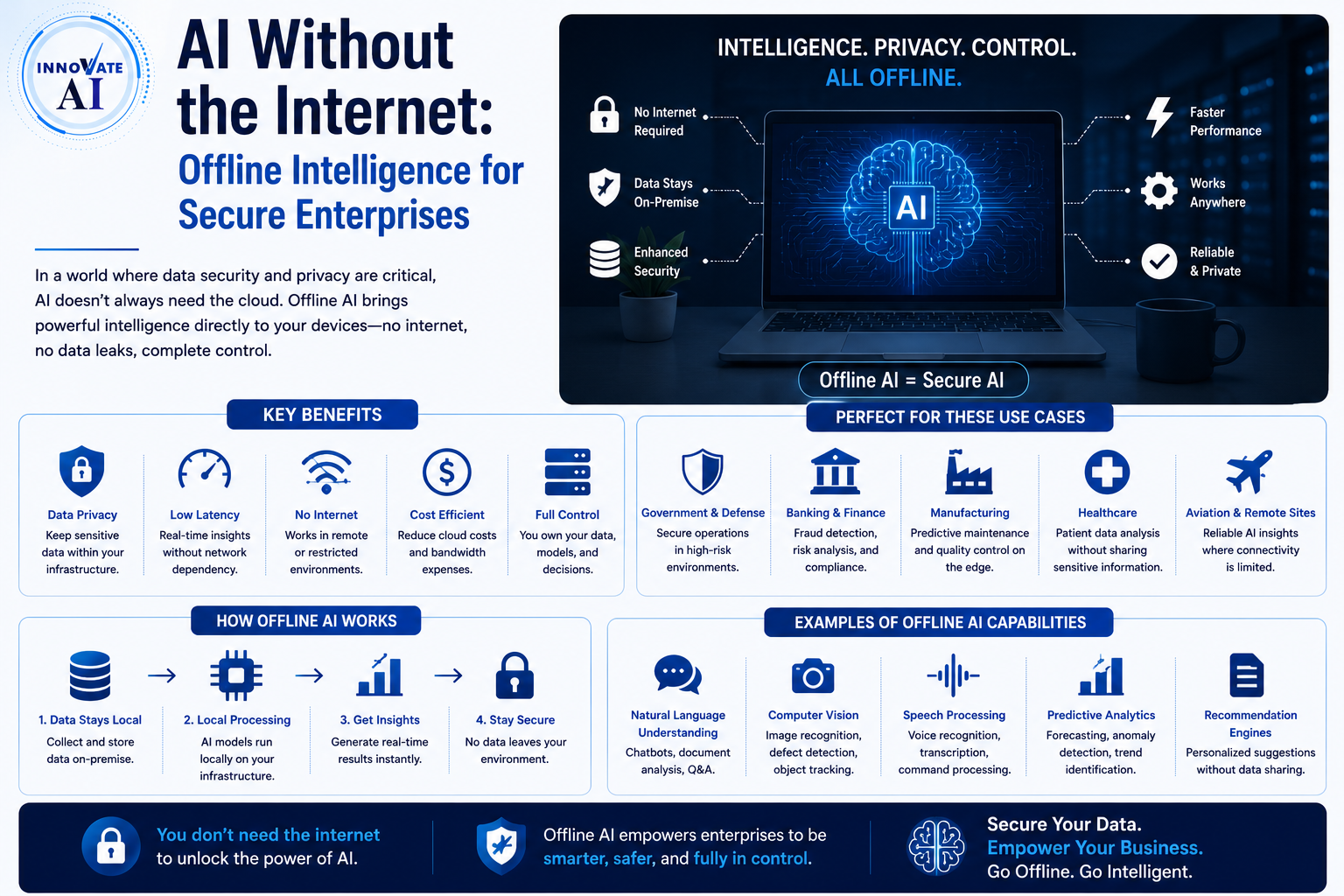
The honest answer is yes. Offline AI runs entirely on your infrastructure—with your data, your models, your controls.
Here is the truth:
Offline AI is not a compromise on capability. It is a strategic choice for organizations that cannot afford to let their proprietary data leave their control. With open-source models, private deployments, and edge-optimized inference, enterprises can now deploy AI that is secure, sovereign, and self-contained.
Step 3: What Is Offline AI? (No Jargon)
The Core Concept
Offline AI refers to artificial intelligence systems that operate without requiring internet connectivity or external cloud services. All data processing, model inference, and storage occur locally—on your servers, your devices, or your private cloud.
The Key Distinction
Cloud AI sends data to external servers; offline AI keeps everything in your control. Cloud models are hosted by third parties; offline models run on your infrastructure. Cloud AI charges per token; offline AI has no per-token fees once deployed. Cloud AI can use your data for training; offline AI ensures your data never leaves your perimeter.
The Architecture
A typical offline AI architecture starts with the user device, which connects to private infrastructure. Inside that private infrastructure, a local LLM runs on your hardware. This LLM connects to a RAG pipeline with a vector database and document retrieval, all running locally. The local data store contains your PDFs, contracts, policies, and internal documents. No data ever leaves this environment.
In a truly private AI setup, your assistant's memory, message history, and files stay on your hardware. No third-party training occurs. Your personal emails and schedules are not used to train future commercial models.
Step 4: Why Offline AI Matters in 2026
The Regulatory Pressure
Several major regulations are driving the need for offline AI. India's DPDP Act, 2023, requires data localization and imposes penalties up to ₹250 crore for breaches. The EU AI Act imposes risk classification, documentation, and human oversight requirements. The U.S. executive order requires that AI systems handling government data remain under U.S. control. GDPR protects personal data and enforces the right to erasure.
The Cost Advantage
Cloud-based AI agents often become expensive when they use long-term memory or proactive searching, which consume massive amounts of tokens. With offline AI, inference runs on your own GPU or CPU. Once a model is pulled, there are no per-token fees. You can let your assistant summarize thousands of unread emails or research complex topics for hours without worrying about a surprise API bill at the end of the month.
The Security Advantage
Offline AI offers 100 percent privacy—no data leaves your device. Everything runs locally. No internet is required after setup. You own your data. Conversations are stored locally. There is no tracking, no analytics, and no telemetry.
Step 5: Key Technologies for Offline AI
Small Language Models (SLMs) for On-Device Inference
Several open-source models are well-suited for offline deployment. Microsoft's Phi-3.5 has 3.8 billion parameters and requires about 3GB of RAM, making it ideal for lightweight, fast responses on 8GB systems. Meta's Llama 3 has 8 billion parameters and requires 6-8GB of RAM, offering general-purpose capabilities with strong reasoning. Mistral 7B has 7 billion parameters and requires about 6GB of RAM, providing a balance of performance and efficiency. Alibaba's Qwen 3 is available in multiple sizes, with strong mathematical reasoning and coding capabilities.
Local Inference Engines
Several engines make it easy to run models locally. Ollama provides a simple CLI for running models on your machine. Llama.cpp is optimized for CPU-first inference and runs LLMs on consumer hardware. vLLM offers high-throughput inference for private cloud deployments. HuggingFace's TGI (Text Generation Inference) is designed for enterprise production serving.
Private RAG Pipelines
Offline AI systems can still use Retrieval-Augmented Generation (RAG) without sending data to external servers. Local document ingestion means documents are parsed and embedded on your infrastructure. Local vector storage uses databases like Chroma, FAISS, or pgvector running in your environment. Local retrieval compares query vectors against local embeddings. Local generation means the LLM produces responses using only retrieved local documents.
Self-Hosted AI Platforms
Khoj is an open-source platform that works with any LLM, any data source, and any interface, and is self-hostable on your infrastructure. Privacy Copilot offers private RAG with per-user data isolation and bring-your-own-model capabilities. The Personal AI Assistant is lightweight, local, fast, and runs on your own hardware. Docker Model Runner (DMR) provides self-hosted, sandboxed execution with privacy by design.
Step 6: Real-World Use Cases
Secure Enterprise Document Q&A
A law firm needs to analyze thousands of contracts and legal documents. Sending these documents to public AI APIs is a compliance risk. The solution is to deploy a private RAG system. All documents stay on the firm's servers. The LLM runs locally. Lawyers ask questions in natural language; the system retrieves relevant clauses and generates answers—all without any data leaving the firm's perimeter. The outcome is a 90 percent reduction in manual document review time with 100 percent data sovereignty.
Healthcare Data Analysis
A hospital wants to use AI to analyze patient records and clinical notes. HIPAA and DPDP requirements prohibit sharing patient data with external services. The solution is to deploy a small language model on-premise with a local RAG pipeline. Patient data never leaves the hospital network. Clinicians get AI-assisted insights without privacy violations. The outcome is faster diagnosis support with full compliance with healthcare regulations.
Manufacturing Quality Control
A factory needs to analyze equipment sensor data and maintenance logs to predict failures. Internet connectivity is unreliable, and data cannot be shared externally. The solution is to deploy edge AI. A compact model runs on factory servers. Sensor data is processed locally. Predictive maintenance alerts are generated without internet dependence. The outcome is a 70 percent reduction in unplanned downtime with zero data exposure.
Step 7: Implementation Roadmap — 90 Days
Phase 1: Assessment and Selection (Weeks 1-4)
Start by identifying internal knowledge sources to connect, creating a data source inventory. Assess hardware and infrastructure requirements to determine infrastructure readiness. Select an open-source solution such as Ollama, Khoj, Privacy Copilot, or a custom platform. Establish governance and access controls with a security framework. Define success metrics including time saved, accuracy, and adoption rates, establishing a KPI baseline.
Phase 2: Deployment and Integration (Weeks 5-8)
Set up a local LLM using Ollama, Docker Model Runner, or a custom solution to get a working model. Deploy the private assistant platform to have a working assistant. Connect to internal data sources including documents, email, and calendars for data integration. Implement RAG for document grounding to enable knowledge retrieval. Configure role-based access controls to complete security implementation.
Phase 3: Pilot and Scale (Weeks 9-12)
Run a pilot with 5 to 10 users to gather pilot results. Refine retrieval and responses to improve accuracy. Expand to additional departments for broader deployment. Establish ongoing model updates and maintenance for continuous improvement.
Step 8: Key Statistics Driving Offline AI Adoption
The U.S. federal executive order mandates U.S. control for government AI. India's DPDP Act imposes penalties up to ₹250 crore. Local AI response times on mid-range hardware range from 5 to 20 seconds. Once models are pulled, there are no per-token fees. Eighty-six percent of organizations report no visibility into AI data flows.
Step 9: Frequently Asked Questions
Q1: What is the difference between cloud AI and offline AI?
Cloud AI sends data to external servers. Offline AI runs entirely on your infrastructure. The difference is data sovereignty and security.
Q2: Do I need specialized hardware to run offline AI?
Mid-range hardware with 8GB RAM can run lightweight models like Phi-3.5 with 10-20 second response times. For faster responses and larger models, 16GB or 32GB RAM is recommended.
Q3: Can offline AI match the performance of cloud-based models?
For general-purpose tasks, cloud models still lead. For domain-specific tasks fine-tuned on your data, offline AI can match or exceed cloud performance at lower cost.
Q4: How does RAG work in an offline AI system?
RAG connects your private LLM to your document repositories. When you ask a question, the system retrieves the most relevant documents from your internal knowledge base and passes them as context to the LLM, generating answers grounded in your proprietary data.
Q5: Can I connect an offline AI system to internal collaboration tools?
Yes. Solutions like Khoj support browsers, Obsidian, Emacs, desktop, phone, and WhatsApp. Clawdbot integrates with messaging apps and can execute actions across your devices and services.
Q6: How can Innovative AI Solutions help?
We help enterprises design, build, and deploy offline AI systems—from selecting the right open-source models and infrastructure to RAG implementation and enterprise integration. Based in Delhi, serving clients across India.
Step 10: Final Tagline
The era of sending sensitive corporate data to public AI APIs without a second thought is ending. Offline AI runs on your infrastructure, with your data staying under your control. No third-party training. No per-token fees. No data sovereignty concerns. The technology is mature. The economics are compelling. The regulatory pressure is mounting. The question is not whether to deploy offline AI—it is how quickly you can build it.
Short version:
AI without the internet—offline intelligence for secure enterprises. Private LLMs, edge deployment, RAG pipelines, and implementation roadmap.
Hashtags:
#OfflineAI #PrivateAI #DataSovereignty #EdgeAI #SecureAI #EnterpriseAI #InnovativeAISolutions
Contact Us
Phone: +91 7464 099 059 / +91 96899 67356
Email: info@innovativeais.com
Address: Netaji Subhash Place, Pitampura, Delhi – 110034
Website: https://innovativeais.com
About the Author
Abhishek Kumar
Founder & CEO, Innovative AI Solutions
5+ years building AI systems for enterprise. Based in Delhi, serving clients across India.
Related services: to apply this in your business, explore our RAG development and LLM integration.