The Big Question
What happens to your company's hard-won expertise when experienced employees leave? How do you prevent decades of institutional knowledge from walking out the door? And what if AI could not only preserve that knowledge but make it actively available to every employee and agent in real-time?
These questions have haunted business leaders for decades. But now, AI is providing answers that were previously impossible.
The Knowledge Crisis: A $31 Billion Problem
Institutional knowledge is disappearing faster than it can be replaced. Every year, knowledge loss costs large companies $31 billion . As retirements accelerate and turnover climbs, organizations are losing decades of expertise—and with it, their competitive edge.
Consider this scenario from Sandia National Laboratories. A researcher faced an unusual observation during an experiment. He recalled documents published nearly 50 years earlier that explained the phenomenon. But what happens when that researcher retires? What happens to the decades of accumulated expertise that exists only in people's minds ?
As subject matter experts retire, transferring decades of knowledge to new staff—each with diverse learning styles shaped by contemporary academic experiences—becomes a significant challenge. The departure of experienced experts jeopardizes knowledge retention. These individuals carry invaluable insights, intuition, and practical wisdom that cannot be easily documented and accessed .
Traditional knowledge management can't keep up. It relies on voluntary uploads, static files, and outdated repositories . Industrial leaders like ABB face this challenge head-on: "As experienced employees retire, the loss of decades of collective knowledge threatens operational continuity, efficiency and innovation if not properly addressed" .
The AI Solution: Knowledge Vaults and Company Brains
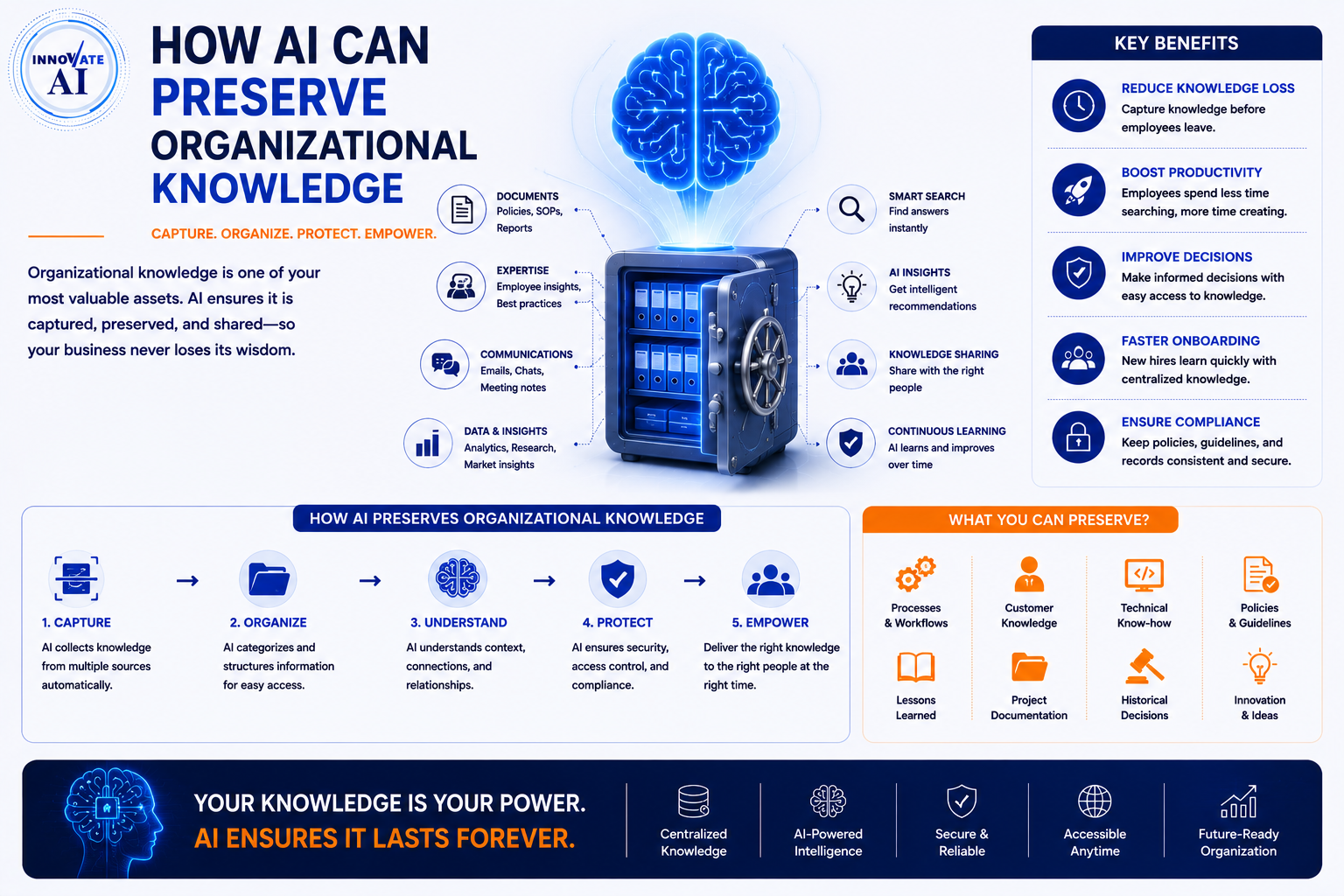
AI is transforming how organizations preserve and leverage institutional knowledge. The solution isn't just better documentation—it's creating living, operational knowledge systems.
What Is a Knowledge Vault?
ABB has pioneered the Industrial Knowledge Vault—a generative AI-driven solution designed to solve the growing challenge of knowledge loss . Using Microsoft Azure OpenAI Service, the solution can :
-
Store, retain, and safeguard critical expertise
-
Transform knowledge into step-by-step workflows through natural language input
-
Provide real-time guidance to workers with in-the-moment insights
-
Continuously learn from real-world operations, refining workflows and best practices
The measurable results from ABB's benchmark testing are impressive :
-
85% effort reduction in workflow creation
-
45% increase in overall team productivity
-
90% reduction in human errors
The Company Brain: Shared Organizational Memory
The concept is evolving from personal knowledge bases to shared "company brains." As Andrej Karpathy, former Tesla AI lead, popularized: personal knowledge bases give AI agents durable memory and turn scattered information into compounding assets .
But the moment AI becomes a team workflow, the personal vault breaks. Teams need a shared source of truth that multiple people and multiple agents can use safely. They need to know :
-
Who can access specific information?
-
Who can update it?
-
Which version is current?
-
How do we review agent-generated changes?
-
Can outputs be traced back to source material?
The company brain solves these challenges—a governed repository of company context, product knowledge, customer information, operating rules, and generated outputs. Unlike traditional documentation, this knowledge is operational. Agents can read it, update it, apply it to workflows, and generate outputs from it .
How It Works: The Technology Behind Knowledge Preservation
Retrieval-Augmented Generation (RAG)
Traditional AI models have significant limitations: they can't access your private data, they're constrained by knowledge cutoff dates, and they generate generic responses without your company's context. When they lack factual grounding, they often create incorrect information .
Retrieval-Augmented Generation (RAG) solves this problem . RAG connects AI agents to real-time information from your organization's knowledge bases. When you query the system, it first searches your knowledge repository, retrieves relevant chunks of information, and then uses that context to generate a grounded, accurate response.
This approach is far superior to relying solely on LLMs: "The LLM is only as good as the data from which it was trained. New information cannot be easily added to the model" .
Knowledge Graphs and Advanced Techniques
More advanced generative AI techniques leverage structured representations of information chunks, such as knowledge graphs, to provide solutions for complex queries requiring the connection of multiple pieces of information through intermediate steps to achieve reasoning .
The goal is to create a "virtual subject matter expert" that has access to a comprehensive knowledge base comprising various data types, including text, images, and videos. This virtual SME can respond to a wide range of queries, provide historical analyses, and assist in developing tailored learning curricula .
Compounding Intelligence: Learning from Every Interaction
A key principle of modern knowledge preservation is that knowledge should compound—get better with every use. F2's Institutional Knowledge platform for private markets illustrates this :
"Most AI tools generate answers, but they do not retain judgment. Institutional Knowledge compounds firm-specific knowledge and reasoning, so that every investor can apply and evolve the firm's secret sauce with every model they build, every memo they write, and every deck they create" .
Similarly, ABB's Industrial Knowledge Vault "continuously learns from real-world operations, refining workflows and best practices to drive continuous improvement" .
Governance: The Critical Success Factor
The moment knowledge becomes a team workflow, governance becomes critical . A local folder works when one person owns the context. It doesn't work when the founder, engineer, customer success lead, product lead, and sales teammate all need the same source of truth .
Key Governance Requirements
Enterprise-grade knowledge preservation systems must include :
-
Permissions and Access Controls: Who can see, edit, or use specific information
-
Version History: Track changes and revert when needed
-
Collaboration: Multiple people and agents working from the same source
-
Review and Approval Workflows: Human oversight before outputs are deployed
-
Auditability: Trace outputs back to source materials
-
Role-Based Access: Different access levels for different roles and functions
The Write Protocol: Agents as Contributors
A common misunderstanding is that these systems are read-only from the agent's perspective. The actual design is the opposite—agents are primary authors . Any process that creates or modifies knowledge files must update the metadata to ensure changes propagate correctly .
The company brain becomes the system that humans and agents use to operate the business. As one startup founder described: "The founder isn't emailing around a new rule to multiple teammates. The company brain does the work" .
Real-World Applications
Industrial Manufacturing: ABB's Knowledge Vault
ABB's Industrial Knowledge Vault addresses the critical knowledge gap in industrial environments :
-
Natural language queries transform knowledge into action
-
Workers can create structured procedures in seconds, eliminating manual document parsing
-
Policy and procedure management ensures up-to-date, role-based access
-
Real-time guidance empowers workers with in-the-moment insights
The solution is deployed across cloud, on-premise, or ABB SaaS, making it accessible to diverse industrial operations .
Private Markets: F2's Institutional Knowledge
F2 transforms historical deal activity into a proprietary data asset that compounds with each deal underwritten . The platform enables firms to :
-
Identify whether a new opportunity resembles past deals
-
Benchmark underwriting assumptions against actual outcomes
-
Analyze portfolio-wide exposure, performance, and risk
-
Surface patterns that preceded underperformance
-
Query the firm's entire deal history through a global agent
"Most AI makes analysts faster. Institutional Knowledge makes the firm smarter" .
Virtual Subject Matter Experts
In scientific and technical fields, AI can create virtual SMEs that preserve decades of specialized knowledge. As one researcher explains: "The preservation of knowledge is not merely an academic concern; it is a vital necessity for the continued advancement of our field" .
These virtual SMEs can answer questions like :
-
"What are the properties of material A compared to material B?"
-
"What are the common causes for failures in similar experiments?"
-
"Who are the leading experts in this field?"
-
"What safety measures are recommended for handling specific materials?"
Implementation Roadmap: Building Your Knowledge Preservation System
Phase 1: Foundation (Weeks 1-4)
-
Audit Existing Knowledge Assets: Identify where company knowledge currently lives—documents, wikis, Slack, email, meeting recordings
-
Define Governance Rules: Establish permissions, version control, and review workflows
-
Select a Platform: Choose a solution that supports permissions, version history, and AI integration
-
Start Small: Create one vault for a specific function or team. Learn from the pilot.
Phase 2: Populate (Weeks 5-8)
-
Upload Core Documents: Brand guidelines, product specs, customer FAQs, operating principles
-
Connect to Live Sources: Integrate meeting transcripts, Slack discussions, and customer call recordings
-
Establish Update Mechanisms: Define who updates what and how often
-
Build Initial Agent Skills: Create reusable agent capabilities that call the vault
Phase 3: Operationalize (Weeks 9-12+)
-
Connect to Workflows: Integrate the vault into daily operations—onboarding, content creation, decision support
-
Measure Impact: Track time saved, accuracy improved, and new capabilities unlocked
-
Expand: Roll out to additional functions and teams
-
Continuous Improvement: Refine content, skills, and governance based on real-world usage
Frequently Asked Questions
Q1: How does AI preserve organizational knowledge?
AI captures, structures, and operationalizes institutional knowledge through knowledge vaults and retrieval-augmented generation (RAG). These systems transform scattered information into accessible, governed repositories that both humans and AI agents can use .
Q2: What is a "company brain"?
A company brain is a governed repository of company context, product knowledge, customer information, operating rules, and generated outputs. Unlike traditional documentation, this knowledge is operational—agents can read it, update it, apply it to workflows, and generate outputs from it .
Q3: How much does knowledge loss cost companies?
Knowledge loss costs large companies approximately $31 billion annually .
Q4: What results have companies achieved with knowledge preservation AI?
ABB's Industrial Knowledge Vault achieved 85% effort reduction in workflow creation, 45% increase in overall team productivity, and 90% reduction in human errors .
Q5: What is the role of governance in AI knowledge preservation?
Governance ensures that knowledge is trustworthy and accessible—with permissions, version history, review workflows, and audit trails. Without governance, knowledge vaults become fragmented and unreliable .
Q6: How can Innovative AI Solutions help?
We help businesses design, build, and operationalize AI knowledge preservation systems—from governance design and platform selection to content population and agent integration. Based in Delhi, serving clients across India.
Why Delhi is a Great Hub for AI Development
Delhi is emerging as a significant hub for AI development, backed by concrete government support and infrastructure. The recent Delhi Budget 2026-27 allocated ₹8.20 crore for two Artificial Intelligence centres of excellence (AI-CoEs), functioning as hubs for research, innovation, and startup incubation.
The city's AI infrastructure is expanding rapidly. Under the IndiaAI Mission, more than 38,000 high-end GPUs have been onboarded and are available at approximately ₹65 per hour—roughly one-third of the global average cost. This makes AI development remarkably cost-effective compared to other tech hubs.
The government has also announced a ₹350 crore startup policy over five years, aiming to support the emergence of at least 5,000 startups by 2035, with key focus areas including artificial intelligence, machine learning, and automation.
The AI ecosystem in Delhi combines: cost-effective infrastructure, government support, a growing talent pool, and proximity to the country's business decision-makers. For businesses looking to develop practical AI solutions, it's becoming an increasingly attractive location.
What We Offer at Innovative AI Solutions
After five years of building AI solutions for businesses, we've developed a practical approach that focuses on what actually works:
-
Knowledge Preservation Strategy: We help you assess your knowledge assets and design a preservation architecture that works for your organization
-
Platform Selection and Implementation: We help you choose and deploy the right platform for your needs
-
Governance and Compliance: We help you establish permissions, review workflows, and audit trails
-
Content Population and Integration: We help you connect the vault to live sources—meetings, Slack, customer calls
-
Agent Integration: We help you build reusable agent skills that leverage the vault
-
Organizational Change Management: We help you shift from fragmented knowledge to a shared, living company brain
Our approach is built on the reality that preserving institutional knowledge isn't just about documentation—it's about ensuring business continuity in the AI era.
Final Thought
The preservation of knowledge is not merely an academic concern; it is a vital necessity for business continuity and innovation . AI is finally providing the tools to solve the knowledge crisis that has plagued organizations for decades.
When context is systematized, onboarding is no longer just a lengthy adaptation process. AI is no longer just a collection of isolated tools. The value of enterprise AI may ultimately lie not in how many agents you deploy, but in whether you can first establish a trustworthy, readable, and reusable knowledge foundation .
The knowledge crisis is real. But the solution is finally within reach.
Contact Us:
Phone: +91 7464 099 059 / +91 9689967356
Email: info@innovativeais.com
Address: Netaji Subhash Place, Pitampura, Delhi – 110034
Website: https://innovativeais.com
About the Author
Abhishek Kumar
Founder & CEO, Innovative AI Solutions
5+ years building AI systems for enterprises. Based in Delhi, serving clients across India.
Hashtags: #KnowledgePreservation #InstitutionalKnowledge #AIKnowledgeVaults #CompanyBrain #EnterpriseAI #AIStrategy #InnovativeAISolutions
Related services: to apply this in your business, explore our RAG development and AI development services.