The Big Question
What happens when your frontend team is blocked waiting for backend APIs to be built? When a mobile app breaks because an undocumented API change wasn't communicated? When integrating third-party services becomes a nightmare because your APIs weren't designed with external consumption in mind?
The answer is often found in the difference between building APIs first and building APIs as an afterthought. API-first development addresses these challenges by making the API the foundation of your architecture, not a later addition .
What Is API-First Development?
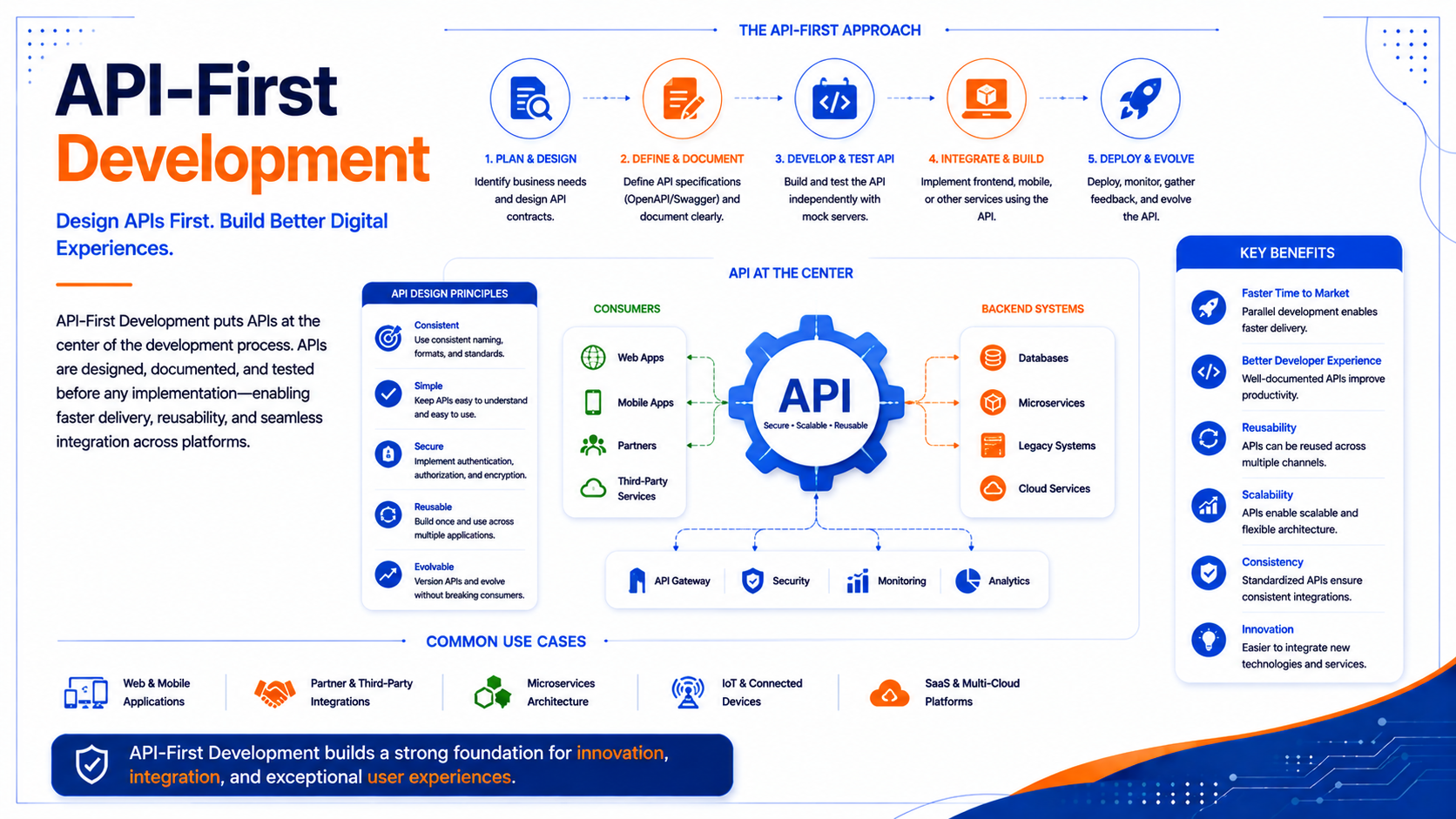
API-first development is an approach where the API contract defining endpoints, data structures, and expected behavior is created and finalized before any coding begins . This contract defines how systems interact and ensures consistency across all services . Instead of writing code and generating APIs from it (the code-first model), API-first ensures that APIs are the foundation of your application architecture .
Code-First vs API-First: The Core Differences
| Aspect | Code-First | API-First |
|---|---|---|
| Focus | Implementation and business logic first. API built later (if at all). | API at center. API contract starting point in design-first approaches. |
| Speed | Faster start but slower to iterate. | Slower start but faster to iterate. |
| Workflow | Frontend dependent on backend progress. | Parallel, based on API contract. |
| Scalability | Changes often require greater adjustments. | Growth accounted for in contract via versioning. |
| Consistency | Low, depends on developers. | More consistency because of contracts. |
In a code-first approach, teams often start with the database, define tables and relationships, then write business logic. APIs emerge later, often becoming a "leaky abstraction" that creates synchronous development dependencies . The frontend team is stuck waiting for the backend team to finish their work, and any changes can lead to heavy rework .
In an API-first approach, the organization starts with the API contract a machine-readable definition (usually an OpenAPI spec) that defines endpoints like GET /users or POST /photos . The contract informs each team what they must do and allows them to work in parallel . Frontend developers can create the UI with mock APIs, and backend devs can build their contract-defined services .
Why API-First Matters
Faster Time-to-Market
API contracts enable teams to code simultaneously. Backend developers build functionality while frontend developers work with mock APIs, allowing for faster release cycles . A 2022 survey by Postman found that API-first companies are more likely to have happier, more productive developers who create better software and launch new products faster .
Better Developer Experience
Clear documentation and predictable responses reduce friction for internal and external developers, enabling faster development . A well-designed and documented API can improve developer productivity and satisfaction .
Scalability and Reusability
Mobile applications, web applications, and third-party integrations can all utilize the same APIs, creating a more modular and scalable environment . Because APIs are standardized interfaces, systems can expand more predictably across cloud environments and digital channels .
Consistency Across Platforms
Because all clients utilize the same API contract, data representation and behavior are consistent . The loose connections of APIs ensure that the services they expose are as stateless and RESTful as possible, supporting scalability and minimizing dependencies .
Strategic Business Value
APIs enable partnerships, integrations, and monetization through an API marketplace . Amazon's 2002 mandate forcing the company to adopt an API-first approach led to the creation of AWS . Netflix transitioned from a monolithic architecture to a microservices-based platform powered by APIs, enabling them to scale to hundreds of millions of users across thousands of different device types .
Platform Agnostic
With an API, it is easy to incorporate new services or applications regardless of their underlying platforms or languages . A study published in the Journal of Systems and Software found that a well-designed API can improve developer productivity by up to 40% .
The API-First Workflow
A typical API-first development workflow follows a structured process:
Step 1: Define the Consumer and Purpose
An internal team building a dashboard has different needs than a third-party developer integrating against a public API. Mobile clients want smaller payloads. Enterprise customers need stronger backward compatibility guarantees .
Step 2: Map the Resources
Identify the real-world entities your API needs to expose. Figure out how they relate. Then decide what data each should return and what it absolutely should not leaking your database schema into API responses creates problems later .
Step 3: Spec First, Then Code
Write every endpoint, method, request body, response shape, and error case in OpenAPI before anyone starts implementing . Treat this spec with the same gravity as a database schema change it's a contract, and contracts aren't changed casually .
Step 4: Mock It, Then Share It
Generate mock responses from the spec and get them in front of consumers early, before implementation has started. Feedback at this stage is essentially free to act on. Feedback after three weeks of development is not .
Step 5: Test the Contract Early
Before coding starts, validate that what you've specced actually solves what the consumer needs. Map out your API testing strategy against the contract, not against the implementation .
Step 6: Launch, Then Watch
After shipping, watch actual usage. Which endpoints carry the most traffic? Where do errors concentrate? API observability reveals patterns that logs alone won't show .
Best Practices for API-First Development
Use One Source of Truth
Either generate code from the spec, or generate the spec from code, and always verify they match . In a contract-first flow, the spec is the reference and everything should follow from it. In a code-first flow, the running server is the reference, and the spec and docs often follow afterward .
Version Strategically
The most common approach is URI path versioning, putting the version in the URL (e.g., /v1/users, /v2/users) . Header versioning and query parameter versioning are alternatives . Pin generated clients to an API version, and document what counts as breaking .
Standardize Error Handling
If every endpoint returns a different 400 shape, your frontend ends up with one-off parsers and generic "Something went wrong" messages. Standardize errors so clients can reliably show helpful text . Error responses should include a stable error code, a human-readable message, and specific details about what went wrong .
Validate at the Boundary
Validate at the gateway or controller so business logic can assume inputs are clean . Use consistent naming conventions across all endpoints and maintain a single canonical schema for requests and responses .
Implement Rate Limiting
Rate limiting protects your API from abuse whether malicious or accidental and ensures fair usage across all clients . When limits are exceeded, return 429 Too Many Requests with headers indicating when the client can retry .
Add Contract Checks to CI
Fail the build if the spec breaks backward compatibility or if generated clients drift from the contract . Add contract checks in CI so mismatches fail fast .
Common Pitfalls to Avoid
Leaking the Data Model
Your database table having 40 columns doesn't mean the API response should have 40 fields. Consumers don't need your implementation details they need the data relevant to their use case .
Naming Inconsistency
userId here, user_id there, id somewhere else. Every inconsistency is a small tax on every developer who integrates against your API. Pick one convention before the first endpoint goes out .
Versioning Added After the First Breaking Change
By that point, every consumer takes the hit at once. The fix is to version from release one, even when you're certain nothing will change .
Error Responses That Explain Nothing
{"error": "Something went wrong"} is technically an error response. It's not actually useful. Developers need to know which field failed, what rule it violated, and what to do about it .
Treating Testing as Post-Development Cleanup
API testing belongs in the design conversation, not the QA handoff .
Treating the Spec as Nice Docs but Never Enforcing It
The spec drifts, clients are generated from the wrong truth, and QA finds mismatches late .
Implementation Roadmap
Phase 1: Foundation (Weeks 1-4)
-
Build a small API pilot: Prototype 2 to 5 endpoints and a real UI screen to test your workflow quickly .
-
Define ownership: Ensure there is a named owner for the contract and a clear review step before changes ship .
-
Standardize error responses: Error responses should look and behave the same across endpoints .
Phase 2: Design and Spec (Weeks 5-8)
-
Write the OpenAPI spec: Define endpoints, request/response shapes, and error cases .
-
Mock and share: Generate mock responses and share with consumers early .
-
Test the contract: Validate that what you've specced solves what the consumer needs .
Phase 3: Build and Scale (Weeks 9-12+)
-
Generate client SDKs: Use OpenAPI Generator to create typed models and client SDKs for web and mobile .
-
Add contract checks to CI: Fail the build if the spec breaks backward compatibility .
-
Launch and monitor: Watch actual usage, track errors, and iterate based on feedback .
Frequently Asked Questions
Q1: What is API-first development?
API-first development is an approach where the API contract is created and finalized before any coding begins. The API is treated as the foundation of your application architecture, enabling parallel development, better consistency, and easier integration .
Q2: What are the benefits of an API-first approach?
Key benefits include faster time-to-market, better developer experience, scalability, consistency across platforms, and strategic business value . Research shows API-first companies have happier, more productive developers and launch new products faster .
Q3: What's the difference between code-first and API-first?
Code-first prioritizes implementation and business logic first, with API built later (if at all). API-first puts the API at center with the API contract as the starting point. Code-first offers a faster start but slower iteration; API-first has a slower start but faster iteration .
Q4: What tools support API-first development?
Common tools include OpenAPI for design, SwaggerHub and Stoplight for collaboration, Postman for testing, and API Gateways like Apigee and Kong for governance .
Q5: How can Innovative AI Solutions help?
We help organizations adopt API-first development practices, from defining API strategies and designing contracts to implementing governance frameworks and generating client SDKs. Based in Delhi, serving clients across India.
Why Delhi is a Great Hub for API-First Innovation
Delhi is emerging as a hub for enterprise software development, backed by a thriving IT services ecosystem and a growing focus on API-driven architectures. As organizations build increasingly complex, distributed systems, API-first development becomes essential for maintaining consistency, enabling parallel development, and supporting third-party integrations.
What We Offer at Innovative AI Solutions
-
API Strategy: We help you define your API vision, identify use cases, and design a roadmap.
-
Contract Design: We help you write OpenAPI specifications and define consistent error handling.
-
Implementation Support: We help you build APIs with proper versioning, rate limiting, and security.
-
Governance Frameworks: We help you establish standards for naming, documentation, and contract compliance.
-
Developer Experience: We help you create clear documentation and generate client SDKs.
Final Thought
API-first development is not just a technical methodology it is a contemporary mindset for creating scalable, future-ready software . It enables developers to work more efficiently, reduces integration friction, and impacts the agility of your business . The organizations that adopt this approach will be the ones that can build modular, connected systems that thrive in the API economy.
Contact Us:
Phone: +91 7464 099 059 / +91 9689967356
Email: info@innovativeais.com
Address: Netaji Subhash Place, Pitampura, Delhi – 110034
Website: https://innovativeais.com
About the Author
Abhishek Kumar
Founder & CEO, Innovative AI Solutions
5+ years building AI, API, and enterprise systems. Based in Delhi, serving clients across India.
Related services: to apply this in your business, explore our API development and integration and web development.