The Big Question
What happens when an attacker doesn't need to breach your perimeter, exploit a vulnerability, or phish an employee because they found a valid token that grants them access? When a token stored in a mobile app, a CI/CD pipeline, or a browser's local storage is extracted and used to impersonate a legitimate user or service?
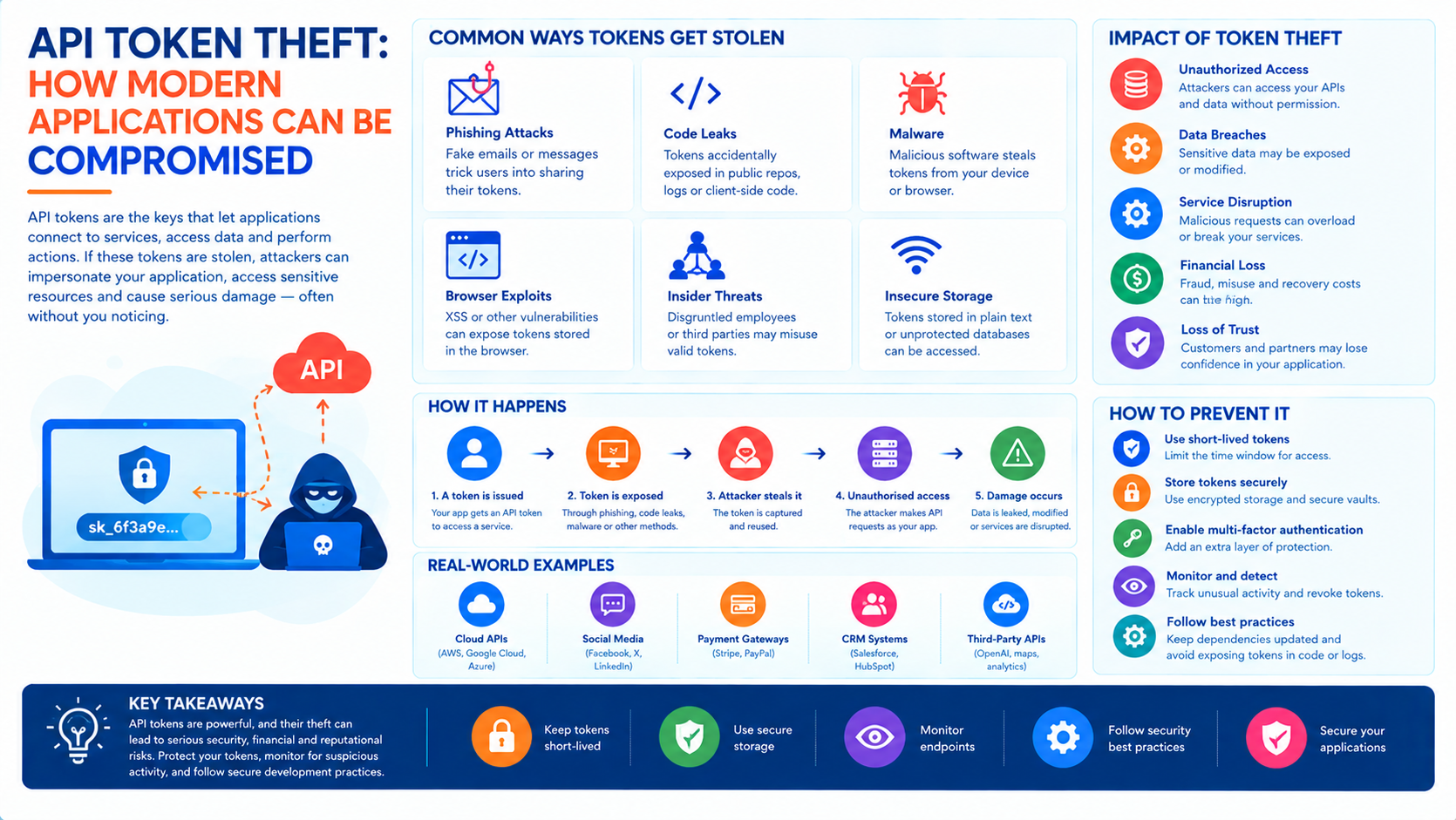
API token theft has become one of the most effective attack vectors in modern applications. Unlike password theft, token theft often bypasses multi-factor authentication entirely. The attacker doesn't need to log in they already have a valid credential.
Why Tokens Are the New Attack Surface
Modern applications are built on APIs, and APIs are built on tokens. Every mobile app session, every service-to-service call, every third-party integration depends on a token of some kind bearer tokens, API keys, OAuth access tokens, refresh tokens, session cookies, or JWTs.
The shift from session-based authentication to token-based authentication has improved scalability and enabled distributed architectures. It has also created a new class of credential that is:
-
Long-lived by default: Many organizations set token expiration to days, weeks, or longer for convenience.
-
Broadly scoped: Tokens frequently carry more permissions than the specific use case requires.
-
Widely distributed: Tokens are stored in browsers, mobile devices, CI/CD systems, partner systems, and logs.
-
Hard to monitor: A stolen token looks like a legitimate user or service.
The result is that a single leaked token can give an attacker access that would otherwise require compromising an entire account, including MFA.
How Tokens Are Stolen
Token theft follows a set of recurring patterns. Understanding them is the first step toward defense.
1. Client-Side Storage Extraction
Tokens stored in browser local storage or session storage are accessible to any JavaScript running on the page. A single cross-site scripting (XSS) vulnerability or a malicious third-party script can read tokens directly from storage and exfiltrate them.
Mobile apps face a related problem: tokens stored in plaintext on the device can be extracted from a rooted or jailbroken device, or from a backup.
2. Interception in Transit
Tokens transmitted over unencrypted connections, or through compromised network intermediaries, can be captured. Certificate pinning in mobile apps reduces this risk but does not eliminate it.
More subtly, tokens can leak through referrer headers, URL parameters (which end up in logs and browser history), and misconfigured proxies.
3. CI/CD and Source Code Exposure
Tokens are frequently committed to source repositories sometimes deliberately, sometimes accidentally. Automated scanners find them within minutes of a public commit. Tokens embedded in CI/CD pipeline configurations and environment variables can also be exposed through build logs or misconfigured runners.
4. Third-Party and Supply Chain Compromise
When an application integrates with third-party services, tokens are exchanged and stored by those services. A compromise of a third-party provider or of a software dependency with access to tokens gives the attacker access to every integration that provider touches.
5. Logs, Telemetry, and Debug Output
Tokens inadvertently logged by applications, proxies, or observability tools become available to anyone with access to those systems. The blast radius extends far beyond the original application.
6. Phishing and Social Engineering
While MFA reduces the risk of password phishing, token phishing is a different problem. Attackers can trick users into authorizing OAuth applications that then receive legitimate tokens with real permissions.
7. Insider Access and Over-Permissioned Service Accounts
Service accounts, by design, are often long-lived and broadly scoped. An insider or a compromised internal system can extract and reuse these tokens without triggering the controls that would apply to a human account.
Why Traditional Controls Miss Token Theft
The uncomfortable truth is that most security controls are designed for human authentication, not token misuse.
MFA doesn't help: A stolen token already represents an authenticated session. The attacker doesn't need to complete MFA again.
IP allowlisting helps only sometimes: Attackers frequently route through proxies in the same region as the legitimate user, or they operate from legitimate cloud infrastructure, making the request look normal.
Anomaly detection struggles: Behavioral baselines assume the token represents a single user with predictable behavior. A compromised service account behaves exactly like the service it impersonates.
Revocation is slow: Tokens are often validated locally (in the case of JWTs) or cached, so revocation doesn't take effect immediately. By the time the token is invalidated, the attacker may have already extracted data or performed privileged operations.
The result is a detection gap. Token theft often looks like normal application traffic.
The Blast Radius Problem
When a token is stolen, the damage is determined by three factors:
Scope: What can this token do? A token scoped to read a single resource is far less dangerous than one that can write to the entire tenant.
Lifetime: How long does the token remain valid? A token that expires in five minutes is a much smaller problem than one that expires in a year.
Detection: How quickly would you notice misuse? If the token's activity is not monitored separately from legitimate traffic, the attacker may operate undetected for months.
Every design decision about tokens should be evaluated against these three factors.
Defensive Strategies
1. Reduce Token Lifetime
Short-lived tokens are the single most effective control against token theft. Access tokens should expire in minutes, not days. Refresh tokens should be rotated on use and have reasonable absolute lifetimes.
The trade-off is implementation complexity applications must handle token refresh gracefully but the security gain is substantial.
2. Enforce Least Privilege at the Token Level
Tokens should be scoped to the specific operation they need. A reporting service should have read-only tokens. A user-facing app should not carry administrative scopes.
Where possible, use separate tokens for separate functions. This limits the damage when any single token is compromised.
3. Bind Tokens to Context
Token binding techniques binding tokens to a client certificate, a device fingerprint, or a specific origin make stolen tokens harder to reuse. Demonstrating Proof-of-Possession (DPoP) and mTLS-bound tokens are increasingly practical options.
The principle: a token should only be usable by the client it was issued to.
4. Never Store Tokens Where Scripts Can Read Them
In browsers, avoid storing tokens in local storage or session storage. Prefer httpOnly, Secure, SameSite cookies that are not accessible to JavaScript. In mobile apps, use the platform's secure storage (Keychain on iOS, Keystore on Android) rather than plaintext storage.
5. Rotate and Revoke Aggressively
Implement token rotation on a schedule and on security-relevant events (password change, privilege change, suspicious activity). Ensure revocation propagates quickly, including across caches and distributed validators.
6. Monitor Token Usage
Instrument token usage with enough granularity to detect anomalies:
-
Geographic anomalies: Token used from an unexpected location
-
Behavioral anomalies: Token performing operations outside its normal pattern
-
Velocity anomalies: Sudden increase in request volume
-
Concurrent use: The same token in use from two locations simultaneously
-
Scope escalation: Attempts to use a token for operations outside its historical pattern
These signals are only meaningful if you are tracking them per token, not just per user.
7. Detect and Prevent Token Leakage
Scan source repositories, build logs, and configuration files for tokens. Use secret scanning in CI/CD pipelines to block commits containing tokens. Rotate immediately when a leak is detected.
8. Design for Compromise
Assume a token will eventually be stolen. Design systems so that the compromise is survivable:
-
Scoped tokens limit what a stolen token can do
-
Short lifetimes limit how long it remains useful
-
Monitoring ensures the theft is detected
-
Revocation ensures the attacker can be shut out quickly
What to Do When a Token Is Stolen
Incident response for token theft has its own playbook:
-
Revoke the token immediately. Ensure revocation propagates across all validators and caches.
-
Revoke related tokens. If a refresh token was stolen, revoke the entire token family.
-
Identify the activity. Use token-level logs to determine what the attacker accessed or modified.
-
Rotate dependent secrets. Any secret the stolen token could access should be considered compromised.
-
Notify affected parties. Depending on what data was accessed, regulatory notification may be required.
-
Remediate the root cause. Fix the vulnerability or process that allowed the token to be stolen.
-
Review and update controls. Adjust token lifetimes, scopes, and monitoring based on what you learned.
Implementation Roadmap
Phase 1: Assess and Inventory (Weeks 1-3)
-
Inventory all tokens. API keys, OAuth tokens, service account credentials, session tokens.
-
Measure current lifetimes and scopes. Identify tokens that are long-lived or broadly scoped.
-
Identify storage locations. Where are tokens stored browsers, mobile devices, CI/CD, logs?
Phase 2: Harden (Weeks 4-6)
-
Reduce token lifetimes. Start with the highest-risk tokens.
-
Apply least privilege. Rescope tokens to the minimum required.
-
Move tokens out of script-readable storage. Adopt secure storage patterns.
-
Enable secret scanning in CI/CD and repositories.
Phase 3: Detect and Respond (Weeks 7-12+)
-
Implement token-level monitoring. Track usage per token, not just per user.
-
Establish anomaly detection for geographic, behavioral, and velocity signals.
-
Build incident response playbooks for token theft.
-
Test revocation propagation. Verify that revocation is effective across all validators.
Frequently Asked Questions
Q1: What is API token theft?
API token theft is the unauthorized acquisition of a token such as a bearer token, API key, or OAuth token that can then be used to access systems, data, or operations as if the attacker were the legitimate holder.
Q2: Does MFA protect against token theft?
No. A stolen token represents an already-authenticated session. MFA protects the initial authentication, not the subsequent use of a valid token.
Q3: What is the most effective mitigation?
Short-lived, narrowly scoped tokens combined with token-level monitoring. Reducing lifetime and scope limits the damage; monitoring ensures detection.
Q4: How do I detect a stolen token in use?
Look for anomalies at the token level: unexpected geography, unusual operations, spike in volume, concurrent use from multiple locations, and scope escalation attempts.
Q5: What is token binding?
Token binding ties a token to a specific client via a certificate, device key, or origin so that a stolen token cannot be replayed from a different client.
Q6: How can Innovative AI Solutions help?
We help organizations design and implement token security strategies from token scoping and lifetime policies to monitoring, detection, and incident response. Based in Delhi, serving clients across India.
Why Delhi is a Great Hub for API Security Innovation
Delhi is emerging as a hub for cybersecurity and API security innovation, backed by a thriving IT services ecosystem and growing regulatory focus on data protection. As Indian enterprises build API-driven platforms and expand into global markets, token security becomes a critical capability for maintaining trust and compliance.
What We Offer at Innovative AI Solutions
-
Token Security Strategy: We help you assess your token landscape and design a hardening roadmap.
-
Token Lifecycle Design: We define lifetimes, scopes, and rotation policies appropriate to each use case.
-
Detection and Monitoring: We implement token-level observability and anomaly detection.
-
Incident Response: We build playbooks for token theft and validate revocation propagation.
-
API Security Review: We evaluate existing APIs for token handling weaknesses.
Final Thought
The shift is clear: from treating tokens as incidental credentials to treating them as first-class security assets. Tokens are the keys to modern applications, and attackers know it. The organizations that reduce token lifetime, enforce least privilege, monitor usage, and design for compromise will be the ones that survive token theft with a contained incident rather than a catastrophic breach.
Contact Us:
Phone: +91 7464 099 059 / +91 9689967356
Email: info@innovativeais.com
Address: 904, 9th floor Pearls Best Heights-I, Netaji Subhash Place, Delhi-110034
Website: https://innovativeais.com
About the Author
Abhishek Kumar
Founder & CEO, Innovative AI Solutions
5+ years building AI, cloud, and enterprise systems. Based in Delhi, serving clients across India.