The Big Question
What happens when an engineer asks why the system uses a particular database, and no one knows? When a decision that made sense three years ago is now wrong, but no one knows what constraints drove it? When the same architectural debate is repeated every eighteen months because the original reasoning was never recorded?
Code documents what was built. It does not document why. Architecture Decision Records close that gap.
What an ADR Actually Is
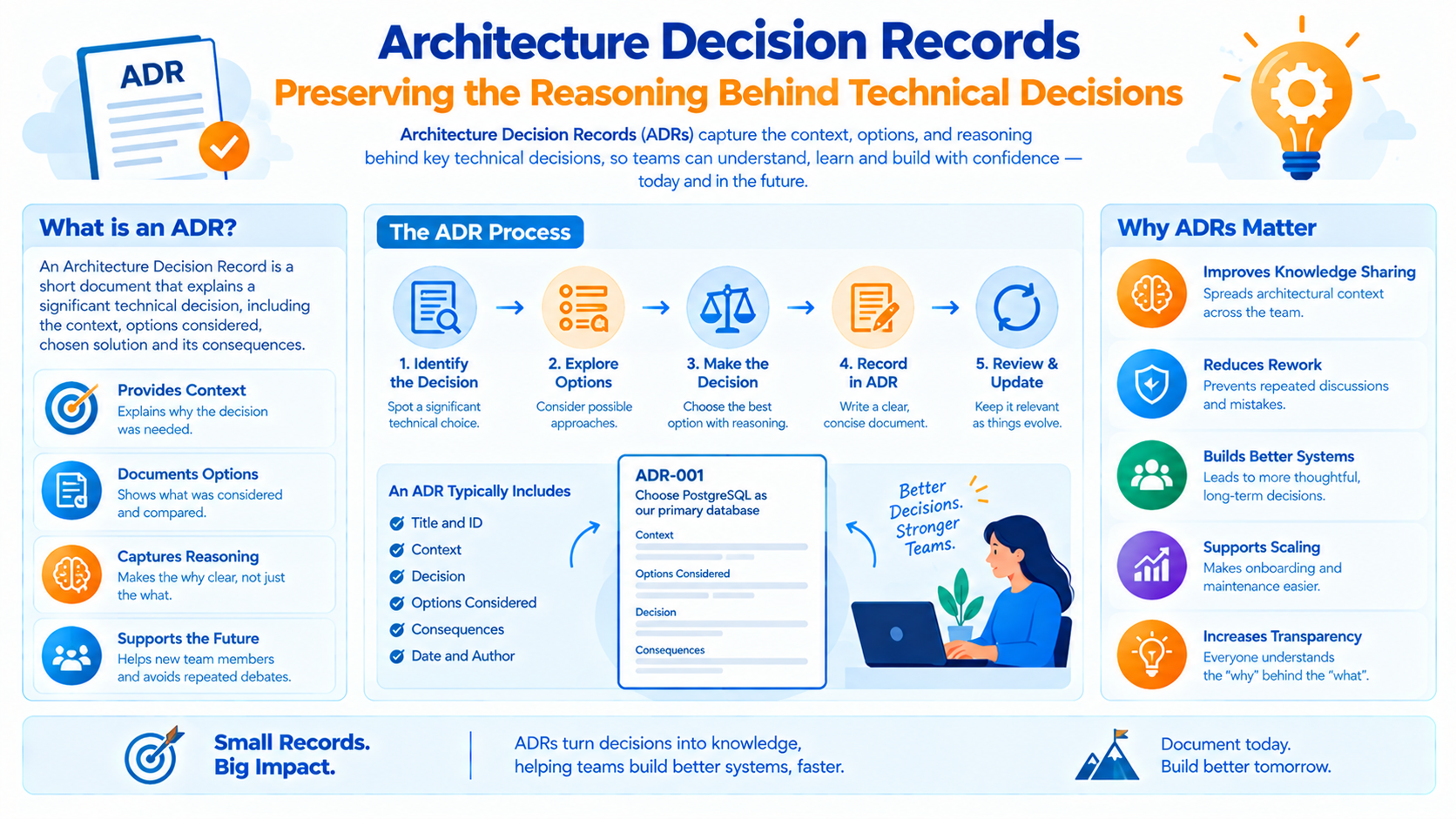
An Architecture Decision Record is a short document that captures a single architectural decision and the reasoning behind it.
What it contains:
-
The decision being made
-
The context and constraints that drove it
-
The options considered
-
The decision and the rationale
-
The consequences and trade-offs accepted
What it is not:
-
A design document
-
A specification
-
A replacement for code comments
-
A long-form analysis
An ADR is short, focused, and immutable. Once written, it is not edited if the decision changes, a new ADR supersedes it.
Why ADRs Matter
The value of ADRs is often invisible until they are missing.
Preserving Context
Decisions are made under constraints: time pressure, team composition, existing systems, budget, regulatory requirements. When the constraints are recorded, future engineers can judge whether the decision still applies.
Without ADRs: Engineers assume the decision was arbitrary and change it, sometimes reintroducing the original problem.
Enabling Reversibility
A decision that can be revisited is more valuable than one that is treated as permanent. ADRs make decisions revisitable by documenting the conditions under which they were made.
Without ADRs: Decisions calcify into assumptions, and no one knows they can be changed.
Onboarding New Engineers
New engineers face a system full of choices they did not make. ADRs explain the reasoning, which shortens the period of confusion.
Without ADRs: New engineers either accept the system as given or change things they do not understand.
Reducing Repeated Debate
Architectural debates recur when reasoning is not recorded. Each new engineer raises the same questions, and the team relitigates decisions made years ago.
Without ADRs: Teams spend time re-deciding instead of building.
Supporting Audit and Compliance
Regulated environments require documentation of decisions, particularly those affecting security, privacy, and data handling. ADRs provide that record.
Without ADRs: Compliance depends on reconstructing decisions after the fact, which is expensive and unreliable.
The Standard Structure
Most ADRs follow a similar structure.
| Section | Purpose |
|---|---|
| Title | Short, descriptive name of the decision |
| Status | Proposed, Accepted, Deprecated, Superseded |
| Context | The situation and constraints driving the decision |
| Decision | What was decided |
| Options Considered | The alternatives and why they were not chosen |
| Consequences | The trade-offs accepted, positive and negative |
| Date | When the decision was made |
Some organizations add fields for authors, related decisions, and review dates. The structure is less important than the discipline of capturing reasoning.
Writing an ADR That Lasts
The value of an ADR depends on its quality. A poor ADR is worse than none, because it creates the impression that reasoning was captured when it was not.
Be Specific About Context
Vague context produces unusable ADRs.
Weak: "We needed a database."
Strong: "We needed a database that supports multi-region replication, handles 10,000 writes per second, and can be operated by a team without dedicated database expertise. The existing team has experience with PostgreSQL but not with distributed systems."
The strong version records the constraints that matter. If the constraints change, the decision can be revisited.
Record the Options Considered
The rejected options are often more valuable than the chosen one. They explain what was traded away.
What to record: The alternatives, why they were rejected, and under what conditions they would become viable.
State the Consequences Honestly
Every decision has costs. ADRs should state them.
Weak: "This gives us better performance."
Strong: "This gives us better read performance at the cost of write latency and operational complexity. We accept the complexity because the read pattern dominates our workload."
Keep It Short
An ADR should be readable in a few minutes. If it is longer, it is probably a design document, not an ADR.
Typical length: One to two pages.
Write It When the Decision Is Made
ADRs written months later lose fidelity. The reasoning is reconstructed, and the constraints are forgotten.
The practice: Write the ADR as part of the decision-making process, not as documentation after the fact.
The Lifecycle of an ADR
ADRs are not static documents. They have a lifecycle.
| Status | Meaning |
|---|---|
| Proposed | Under discussion; not yet accepted |
| Accepted | The decision is in effect |
| Deprecated | Still in effect but discouraged |
| Superseded | Replaced by a newer ADR |
The principle: ADRs are immutable. When a decision changes, a new ADR supersedes the old one. The old ADR remains, with its status updated, so the history is preserved.
This matters because the history of decisions reveals how the system evolved and why it looks the way it does.
Where to Store ADRs
ADRs must be discoverable. If no one can find them, they provide no value.
Common locations:
-
In the repository. ADRs live alongside the code they describe. This keeps them close to the system and versioned with it.
-
In a dedicated directory. A
/docs/adrdirectory in the repository is a common convention. -
In a wiki or knowledge base. Searchable but potentially disconnected from the code.
The practical recommendation: Store ADRs in the repository. They are versioned with the code, discoverable by engineers working on the system, and reviewed alongside changes.
Making ADRs Part of the Workflow
ADRs fail when they are treated as documentation to write later. They succeed when they are part of the decision process.
The practice:
-
A significant decision is identified.
-
An ADR is drafted as part of the discussion.
-
The ADR is reviewed alongside the change.
-
The ADR is merged with the change.
-
The ADR becomes part of the repository history.
The trigger: Define what counts as "significant." Common triggers include choosing a technology, changing a protocol, introducing a dependency, or accepting a trade-off that will be hard to reverse.
What Not to Do
Do not document everything. ADRs are for architectural decisions, not for every code change. Over-documenting dilutes the value.
Do not write ADRs retroactively for everything. Focus on decisions that matter going forward. Reconstructing years of history is not the goal.
Do not treat ADRs as permanent. They are revisitable. The point is to preserve reasoning, not to prevent change.
Do not let ADRs become design documents. Keep them short and focused on the decision.
Do not write them in isolation. ADRs capture team reasoning, not individual opinion.
Implementation Roadmap
Phase 1: Introduce (Weeks 1-2)
-
Explain the purpose. Teams should understand why ADRs exist.
-
Define the trigger. What counts as an architectural decision?
-
Choose the location. Repository-based is recommended.
-
Provide a template.
Phase 2: Adopt (Weeks 3-6)
-
Write ADRs for current decisions. Start with decisions being made now.
-
Review ADRs as part of the change process.
-
Build a small library of decisions that already matter.
-
Iterate on the template based on what works.
Phase 3: Sustain (Weeks 7-12+)
-
Make ADRs part of onboarding. New engineers read them.
-
Reference ADRs in design discussions.
-
Supersede rather than edit when decisions change.
-
Review the ADR library periodically for decisions that may warrant revisiting.
Frequently Asked Questions
Q1: What is an Architecture Decision Record?
An ADR is a short document capturing a single architectural decision, the context that drove it, the options considered, and the consequences accepted.
Q2: How is an ADR different from a design document?
A design document describes how a system works. An ADR describes why a specific decision was made. They serve different purposes.
Q3: How long should an ADR be?
One to two pages. It should be readable in a few minutes. If it is longer, it is probably a design document.
Q4: Should ADRs be editable?
No. ADRs are immutable. When a decision changes, a new ADR supersedes the old one, and the old one's status is updated. The history is preserved.
Q5: What decisions warrant an ADR?
Decisions that are architecturally significant, hard to reverse, or likely to be questioned later. Choosing a database, changing a protocol, or accepting a performance trade-off are common examples.
Q6: How can Innovative AI Solutions help?
We help organizations introduce ADRs from templates and triggers to workflow integration and library maintenance. Explore our services to see how we approach architecture governance. Based in Delhi, serving clients across India.
Why Delhi is a Great Hub for Architecture Practice
Delhi is emerging as a hub for enterprise architecture and platform engineering, backed by a thriving IT services ecosystem and a large base of organizations running long-lived systems. As Indian enterprises scale their platforms and face increasing audit and compliance requirements, preserving the reasoning behind technical decisions becomes a practical necessity.
What We Offer at Innovative AI Solutions
-
ADR Introduction: We help teams adopt ADRs with templates, triggers, and workflow integration.
-
Decision Workshops: We facilitate the discussions that produce high-quality ADRs.
-
Library Design: We help structure and maintain the ADR library.
-
Governance Integration: We connect ADRs to change management and compliance.
-
Review Practices: We help teams revisit decisions when constraints change.
Final Thought
The shift is clear: from undocumented decisions to preserved reasoning. Architecture Decision Records are inexpensive to write and expensive to lack. They preserve context, enable reversibility, accelerate onboarding, and reduce repeated debate. Organizations that adopt them will make better decisions over time because they will know why the last ones were made.
Contact Us:
Phone: +91 7464 099 059 / +91 9689967356
Email: info@innovativeais.com
Address: 904, 9th floor Pearls Best Heights-I, Netaji Subhash Place, Delhi-110034
Website: https://innovativeais.com
About the Author
Abhishek Kumar
Founder & CEO, Innovative AI Solutions
5+ years building AI, cloud, and enterprise systems. Based in Delhi, serving clients across India.