The Big Question
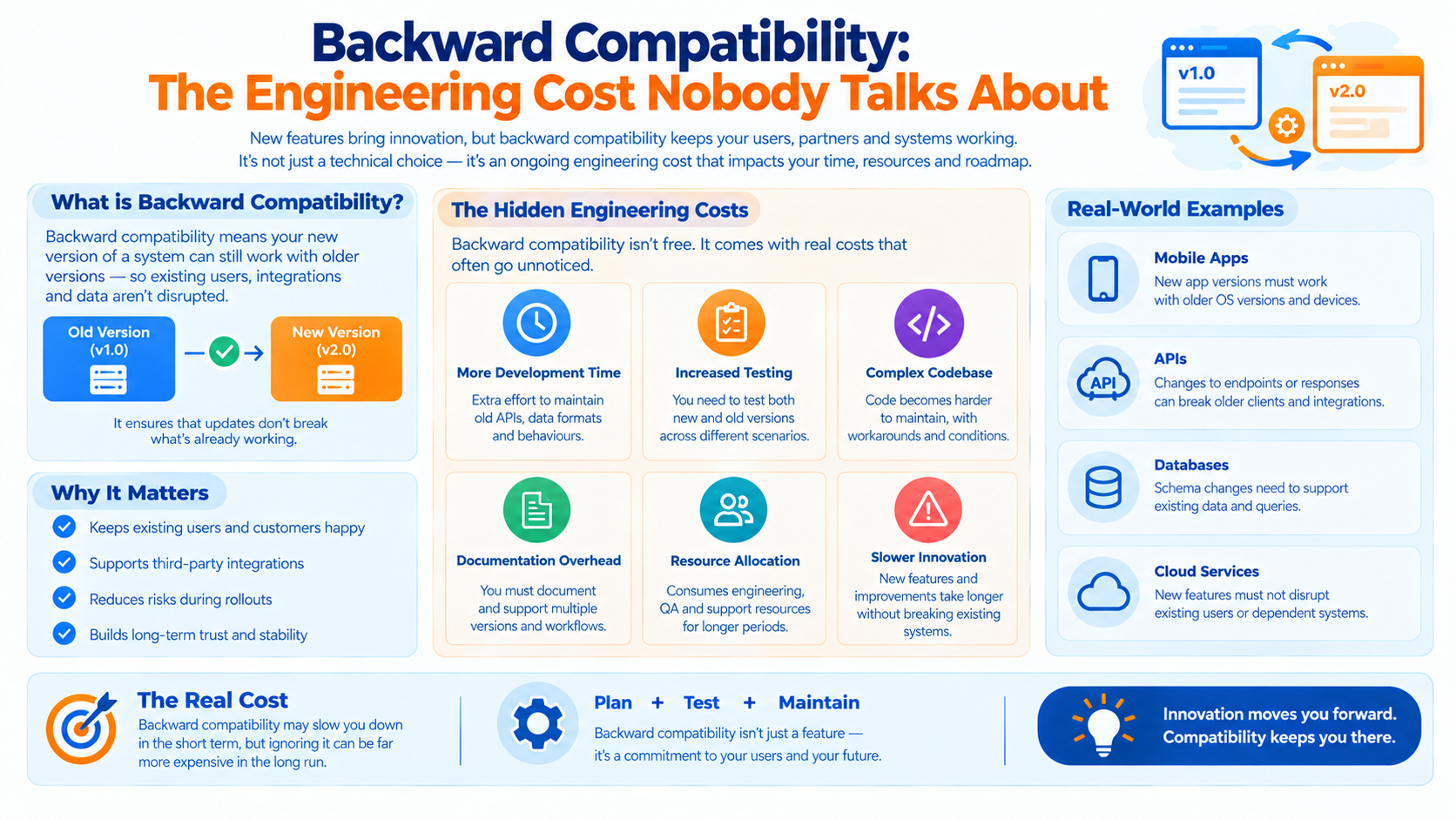
What happens when your API has eleven versions in production, each requiring maintenance, testing, and security patching? When a deprecated field cannot be removed because three customers still depend on it and no one knows who they are? When every new feature must be implemented in a way that does not break clients written five years ago?
Backward compatibility is a genuine engineering value. It protects customers, prevents outages, and builds trust. But it is not free. Every compatibility guarantee is a constraint on future design, and the cost accumulates silently.
What Backward Compatibility Actually Costs
Backward compatibility is usually discussed as a policy decision: how long do we support old versions? The engineering reality is more granular. The cost appears in several distinct forms.
1. Dual Implementation
When behavior must change but old behavior must be preserved, the codebase carries both.
Examples:
-
An API endpoint that returns the old response format for old clients and the new format for new clients
-
A database schema that maintains both the old and new column structures during migration
-
A serialization layer that supports both legacy and current formats
Each of these is code that exists only to serve compatibility, not to serve the product.
2. Expanded Test Surface
Every supported version multiplies the test matrix.
The arithmetic: Three API versions, four client platforms, and two authentication methods produce twenty-four test combinations. Each must be maintained, executed, and debugged.
The consequence: Test suites grow faster than features, and CI pipelines slow down. Engineers spend time fixing tests for versions they would prefer to retire.
3. Constrained Design
The most expensive cost is the least visible: backward compatibility constrains what you can build next.
Examples:
-
A data model that cannot be normalized because old clients expect the denormalized shape
-
A naming convention that cannot be fixed because it is baked into a public API
-
An authentication flow that cannot be improved because old clients depend on the current one
-
A performance optimization that is impossible because it would change observable behavior
Every compatibility constraint is a design decision made by someone who is no longer on the team, imposed on engineers who had no part in it.
4. Security Liability
Old versions often run old dependencies. Supporting old clients frequently means supporting old libraries, protocols, and configurations some of which have known vulnerabilities.
The tension: You cannot patch the old version without potentially breaking clients. You cannot retire the old version without breaking clients. So the vulnerability remains.
5. Cognitive Load
Engineers must know which behaviors apply to which versions. Documentation must cover every supported version. Onboarding takes longer. Questions like "why is this code here?" produce answers like "for the 2019 clients we cannot break."
This is not measurable in a cost report, but it is real.
6. Opportunity Cost
The least visible cost is the work not done. Every engineer-hour spent maintaining compatibility is an engineer-hour not spent on new capability.
The framing: Backward compatibility is not a cost that appears in a budget. It is a cost that appears in the features you did not ship.
How Compatibility Debt Accumulates
Compatibility debt accumulates the same way technical debt does: incrementally, with each decision appearing reasonable in isolation.
The pattern:
-
A change is proposed that would break some clients.
-
The decision is made to preserve compatibility.
-
The old behavior is maintained alongside the new.
-
No timeline is set for retirement.
-
The old behavior persists.
-
Step 1 repeats.
After several cycles, the codebase contains layers of compatibility code with no clear owner and no clear expiration.
Why it is rarely cleaned up: Removing compatibility is a breaking change. Breaking changes require justification, coordination, and customer communication. Maintaining compatibility requires none of these. So the default is to maintain.
The Categories of Compatibility
Not all compatibility is the same, and treating it uniformly is a mistake.
| Category | Description | Cost Level |
|---|---|---|
| API contract compatibility | Existing clients continue to work | High |
| Data format compatibility | Old data can still be read and processed | Medium |
| Behavioral compatibility | Same inputs produce same outputs | High |
| Configuration compatibility | Existing configs remain valid | Low |
| Protocol compatibility | Old protocols still supported | Medium |
| Dependency compatibility | Old library versions supported | High |
The cost depends on how deeply the compatibility is embedded. API contracts and behavioral compatibility are the most expensive because they constrain design and testing.
The Hidden Cost of "We Cannot Break Anyone"
The phrase "we cannot break anyone" is often treated as a settled constraint. It is rarely examined.
Questions worth asking:
-
Who are the clients that depend on this behavior?
-
Are they still active?
-
Is the dependency intentional or accidental?
-
What would it cost them to migrate?
-
What would it cost us to support them indefinitely?
-
Is the compatibility guarantee contractual, or assumed?
In many cases, the answer reveals that the clients are inactive, the dependency is accidental, or the migration cost is far lower than the ongoing maintenance cost.
The uncomfortable truth: Compatibility guarantees are often maintained out of habit rather than necessity.
Managing Compatibility Deliberately
Compatibility should be a decision, not a default. The following practices make it manageable.
Define Compatibility Policy Explicitly
State what compatibility guarantees the organization offers, for what, and for how long.
Example policy:
-
API versions are supported for 24 months after deprecation
-
Deprecated fields are removed after 12 months
-
Breaking changes require a new major version
-
Client migration support is provided during the transition window
A policy transforms compatibility from an unbounded commitment into a bounded one.
Instrument Client Usage
You cannot retire what you cannot measure.
What to track:
-
Which clients call which endpoints
-
Which fields they actually use
-
Which API versions they call
-
When they last called
This data reveals which compatibility guarantees are load-bearing and which are vestigial.
Set Retirement Timelines at Creation
When compatibility code is added, set a date for its removal.
The practice: Every compatibility shim, deprecated field, or old version is tagged with a target removal date. At that date, the question is asked: is this still needed?
Without a timeline, compatibility persists forever by default.
Deprecate Before Removing
Deprecation is the mechanism that makes removal possible. It gives clients time to migrate.
The pattern:
-
Announce deprecation with a timeline
-
Emit warnings when deprecated behavior is used
-
Provide migration guidance
-
Monitor migration progress
-
Remove at the end of the window
Removal without deprecation is a breaking change. Deprecation makes removal an expected event.
Distinguish Contractual from Assumed Compatibility
Some compatibility guarantees are contractual written into customer agreements. Others are assumed, maintained out of caution.
Contractual compatibility must be honored. Assumed compatibility should be reviewed. Often, the assumed guarantees are the ones consuming the most engineering time.
Make Compatibility Visible
Compatibility code should be identifiable, tagged, and counted.
The practice: Track the number of supported versions, deprecated fields, and compatibility shims. Report them the way you report technical debt. Visibility creates pressure to reduce.
The Cost of Not Managing Compatibility
The consequences of unmanaged compatibility debt are predictable.
Slower delivery. Every new feature must be implemented across all supported versions, or carefully isolated from them.
Higher defect rates. More code paths mean more opportunities for bugs. Compatibility code is often less tested than primary code.
Security exposure. Old versions carry old dependencies.
Onboarding friction. New engineers must learn not just how the system works, but how it works differently across versions.
Architectural stagnation. The system's design is constrained by decisions made years ago, by people who are no longer present, for reasons that may no longer apply.
Implementation Roadmap
Phase 1: Assess (Weeks 1-3)
-
Inventory compatibility commitments. What versions, fields, and behaviors are supported?
-
Instrument client usage. Which clients depend on which compatibility guarantees?
-
Identify vestigial compatibility. What is maintained but unused?
-
Estimate maintenance cost. How much engineering time goes to compatibility each quarter?
Phase 2: Define Policy (Weeks 4-6)
-
Establish a compatibility policy with explicit timeframes.
-
Classify existing commitments as contractual or assumed.
-
Set retirement timelines for compatibility code.
-
Define the deprecation process.
Phase 3: Reduce (Weeks 7-12+)
-
Deprecate unused compatibility and notify affected clients.
-
Monitor migration progress.
-
Remove compatibility at the end of deprecation windows.
-
Establish ongoing tracking of compatibility debt.
Frequently Asked Questions
Q1: Is backward compatibility always worth the cost?
No. Some compatibility is essential contractual guarantees, widely used APIs, and critical integrations. Some is maintained out of habit. The discipline is distinguishing between them.
Q2: How do I know if compatibility is still needed?
Instrument client usage. Track which clients call which endpoints and which fields they actually use. If a deprecated field has no callers, it is not needed.
Q3: What is the right deprecation window?
It depends on the client base and the cost of migration. Twelve to twenty-four months is common for public APIs. Internal APIs can retire faster.
Q4: What is the biggest mistake in managing compatibility?
Not setting timelines at creation. Compatibility added without a retirement date persists indefinitely.
Q5: How does this relate to technical debt?
Compatibility debt is a form of technical debt, but it is often invisible because it does not look like neglect. It looks like a deliberate commitment to customers. The commitment is real; the cost is not measured.
Q6: How can Innovative AI Solutions help?
We help organizations assess compatibility commitments, define policies, and manage deprecation and retirement. Explore our services to see how we approach platform and API lifecycle management. Based in Delhi, serving clients across India.
Why Delhi is a Great Hub for Platform Engineering
Delhi is emerging as a hub for platform and API engineering, backed by a thriving IT services ecosystem and a large base of organizations running long-lived, customer-facing systems. As Indian enterprises scale their platforms, managing compatibility deliberately becomes a competitive requirement rather than an engineering detail.
What We Offer at Innovative AI Solutions
-
Compatibility Assessment: We inventory commitments and identify vestigial compatibility.
-
Policy Design: We help define compatibility guarantees and deprecation processes.
-
Client Instrumentation: We implement usage tracking to reveal what is actually needed.
-
Deprecation Execution: We manage the migration and retirement process.
-
Platform Lifecycle Management: We help you manage versions and APIs over time.
Final Thought
The shift is clear: from treating compatibility as an unquestioned commitment to treating it as a managed cost. Backward compatibility protects customers and earns trust. But every guarantee has a price, and that price is invisible when it is never measured. Organizations that define compatibility policy explicitly, instrument actual usage, and set retirement timelines will spend their engineering effort on new capability rather than on maintaining decisions made years ago.
Contact Us:
Phone: +91 7464 099 059 / +91 9689967356
Email: info@innovativeais.com
Address: 904, 9th floor Pearls Best Heights-I, Netaji Subhash Place, Delhi-110034
Website: https://innovativeais.com
About the Author
Abhishek Kumar
Founder & CEO, Innovative AI Solutions
5+ years building AI, cloud, and enterprise systems. Based in Delhi, serving clients across India.