The Big Question
What happens when a user clears their cookies, switches to incognito mode, and is still recognized? When a fraudster creates a new account and is flagged before completing the transaction? When a legitimate user is blocked because their device characteristics resemble a known abuser?
Browser fingerprinting produces all three outcomes. Whether it is a privacy violation or a security control depends entirely on how it is used and whether the user knows.
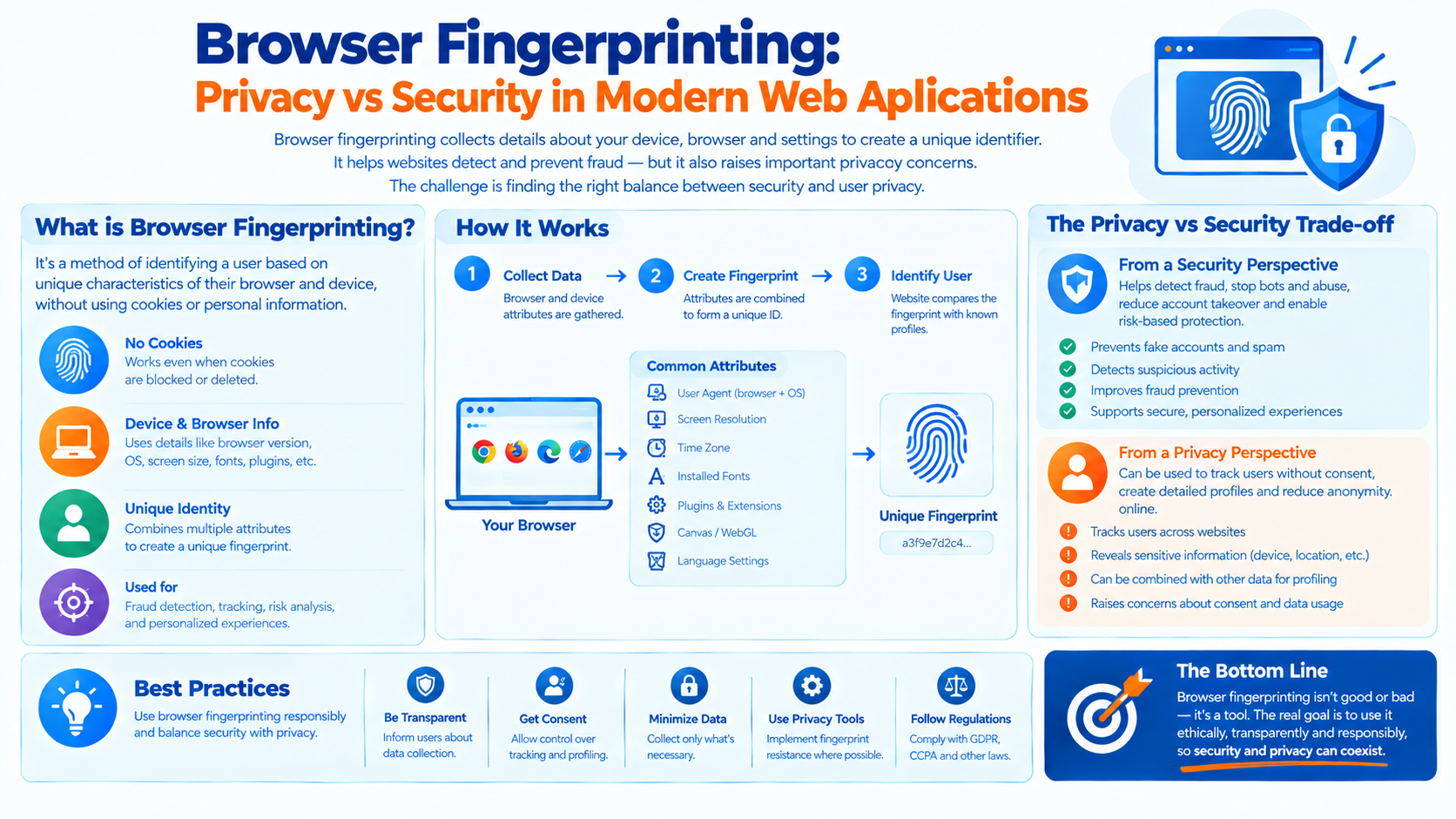
What Browser Fingerprinting Is
Browser fingerprinting is the practice of identifying a browser and device by collecting observable characteristics and combining them into a signature. No file is stored on the device. No identifier is persisted. The fingerprint is computed fresh on each visit.
The characteristics collected fall into several categories.
| Category | Examples |
|---|---|
| Device | Screen resolution, pixel density, GPU model, CPU architecture, device memory |
| Browser | User agent, version, language, timezone, installed fonts |
| Rendering | Canvas rendering, WebGL output, font metrics |
| Network | IP address, connection type, latency patterns |
| Behavioral | Typing cadence, mouse movement, scroll patterns |
| Audio | Audio processing output |
Individually, each characteristic is not identifying. Combined, they can produce a signature that is stable enough to recognize a returning device across sessions and sites.
How Fingerprinting Works
Passive Fingerprinting
Characteristics are collected without any action by the user. The browser reports them automatically when a page loads.
Examples: User agent, screen size, timezone, language settings.
Properties: Fast, invisible, and limited in distinguishing power because many devices share the same characteristics.
Active Fingerprinting
The page runs code that causes the browser to reveal characteristics that are not reported by default.
Examples: Canvas fingerprinting (rendering text and shapes to expose GPU and font differences), WebGL fingerprinting (querying GPU capabilities), audio fingerprinting (processing sound to expose audio stack differences).
Properties: More distinguishing, but more detectable and more likely to be blocked.
Behavioral Fingerprinting
Characteristics are derived from how the user interacts with the device.
Examples: Typing rhythm, mouse movement patterns, touch pressure, scroll behavior.
Properties: Hard to spoof, continuous, and often used in conjunction with other signals.
Cross-Session Stability
The fingerprint's value comes from its stability. If it changes on every visit, it cannot identify a returning device. If it is stable across sessions, it can.
The challenge: Browsers, devices, and networks change. A fingerprint that was stable last month may be unstable today. Fingerprinting systems must manage this drift.
The Security Use Cases
Fingerprinting has legitimate security applications. These are not hypothetical—they are used in production by banks, e-commerce platforms, and fraud prevention systems.
Fraud Detection
Detecting when one device is used to create multiple accounts, or when a known fraudulent device returns under a new identity.
Account Takeover Prevention
Detecting when an account is accessed from a device that does not match the account's historical fingerprint.
Bot Detection
Distinguishing automated traffic from human traffic by behavioral and environmental signals.
Abuse Prevention
Detecting when a banned user returns under a new account.
Risk Scoring
Contributing to a risk score that determines whether additional verification is required.
The common thread: These uses protect users and the platform from harm. The fingerprint is a signal, not a verdict.
The Privacy Concerns
Fingerprinting also enables tracking that users cannot easily prevent.
It Bypasses Consent Mechanisms
Cookies can be blocked and cleared. Fingerprints cannot, because nothing is stored on the device. This means fingerprinting can identify users without their knowledge or consent.
It Enables Cross-Site Tracking
A fingerprint computed on one site can be recognized on another site using the same fingerprinting provider, enabling tracking across the web.
It Is Difficult to Detect
Passive fingerprinting is invisible. Users cannot know they are being fingerprinted unless the site discloses it.
It Is Hard to Avoid
Blocking fingerprinting typically requires disabling features that break legitimate functionality—JavaScript, canvas, WebGL, fonts.
It Can Be Discriminatory
Fingerprints are more distinctive for users with unusual configurations, which can correlate with minority status, disability, or other sensitive characteristics.
The Regulatory Landscape
Regulators have begun to address fingerprinting directly.
GDPR: Fingerprinting that identifies individuals constitutes personal data processing and requires a lawful basis. Consent is typically required for tracking purposes.
ePrivacy Directive: Fingerprinting is treated similarly to cookies when used for tracking, requiring consent.
CCPA/CPRA: Fingerprinting falls within the definition of tracking and is subject to disclosure and opt-out requirements.
Emerging guidance: Regulators in several jurisdictions have clarified that fingerprinting for tracking requires consent even though no file is stored. The absence of a cookie does not mean the absence of consent requirements.
The distinction that matters: Fingerprinting for security (fraud prevention, abuse detection) is generally treated differently from fingerprinting for advertising and analytics. The purpose determines the legal basis.
Designing for Both Privacy and Security
The tension is real, but it is not absolute. Systems can be designed to use fingerprinting for security while respecting privacy.
Principle 1: Purpose Limitation
Use fingerprinting only for the purposes it is needed for. If the purpose is fraud detection, do not use the fingerprint for advertising.
The practice: Separate the fingerprinting systems used for security from those used for analytics. Do not share data between them.
Principle 2: Transparency
Tell users that fingerprinting is used and why.
The practice: Disclose fingerprinting in privacy policies in plain language. Where consent is required, obtain it.
Principle 3: Minimization
Collect only the characteristics needed for the purpose.
The practice: If behavioral fingerprinting is not needed for fraud detection, do not collect it. If coarse-grained signals are sufficient, do not collect fine-grained ones.
Principle 4: Retention Limits
Do not retain fingerprints longer than necessary.
The practice: Define retention periods for fingerprint data and enforce them. Delete fingerprints when they are no longer needed.
Principle 5: Proportional Response
Do not block users based on fingerprint alone.
The practice: Use fingerprints as one signal in a risk assessment, not as a verdict. Escalate to additional verification rather than blocking outright.
Principle 6: User Recourse
Provide a path for users who are incorrectly flagged.
The practice: Make it possible for a legitimate user to complete a transaction through an alternative verification path.
Principle 7: Separation of Concerns
Keep security fingerprinting and tracking fingerprinting architecturally separate.
The practice: Different systems, different data, different access controls, different retention policies.
The Technical Arms Race
Fingerprinting and anti-fingerprinting are in continuous competition.
Browser mitigations: Browsers increasingly randomize or limit the characteristics that fingerprinting relies on. Safari and Firefox block known fingerprinting scripts. Chrome has introduced fingerprinting protections.
Fingerprinting countermeasures: Fingerprinting vendors adapt by using more characteristics and more sophisticated statistical methods.
The consequence: Fingerprinting is becoming less reliable for tracking but remains useful for security, where signals can be combined with other evidence.
This is, in a sense, the right outcome. Fingerprinting as a security signal is more defensible than fingerprinting as a tracking mechanism.
Implementation Roadmap
Phase 1: Assess (Weeks 1-3)
-
Identify whether you fingerprint. Many organizations do so indirectly through third-party tools.
-
Classify the purpose. Is it security, analytics, or advertising?
-
Review regulatory requirements for each purpose.
-
Evaluate whether less invasive methods would achieve the same outcome.
Phase 2: Design (Weeks 4-6)
-
Separate security and tracking into distinct systems.
-
Apply purpose limitation and minimization.
-
Define retention periods.
-
Design proportional response risk scoring rather than blocking.
-
Build user recourse for incorrect flags.
Phase 3: Implement and Govern (Weeks 7-12+)
-
Implement disclosure in privacy policies.
-
Obtain consent where required.
-
Build access controls for fingerprint data.
-
Monitor accuracy and false positive rates.
-
Review periodically as regulations evolve.
Frequently Asked Questions
Q1: Is browser fingerprinting legal?
It depends on the purpose and jurisdiction. Fingerprinting that identifies individuals is generally subject to privacy regulation. Security uses are often treated differently from advertising and tracking uses.
Q2: Can fingerprinting be blocked?
Browsers block some fingerprinting techniques, and privacy tools block others. However, blocking all fingerprinting is difficult without breaking legitimate functionality.
Q3: Is fingerprinting more invasive than cookies?
In some ways, yes—it cannot be cleared and it is often invisible. In others, it is less invasive nothing is stored on the device. The invasiveness depends on how it is used.
Q4: Can fingerprinting be used ethically for security?
Yes, with purpose limitation, transparency, minimization, retention limits, proportional response, and user recourse.
Q5: How accurate is fingerprinting?
Accuracy varies widely. Fingerprints can identify returning devices with reasonable confidence in some cases and fail entirely in others, particularly as browsers introduce countermeasures.
Q6: How can Innovative AI Solutions help?
We help organizations design systems that use fingerprinting responsibly from purpose limitation and architecture separation to disclosure, consent, and governance. Explore our services to see how we approach privacy-aware engineering. Based in Delhi, serving clients across India.
Why Delhi is a Great Hub for Privacy Engineering
Delhi is emerging as a hub for privacy and security engineering, backed by a thriving IT services ecosystem and India's evolving data protection framework under the DPDP Act. As Indian enterprises build customer-facing platforms, designing systems that respect privacy while detecting abuse becomes a competitive and regulatory requirement.
What We Offer at Innovative AI Solutions
-
Fingerprinting Assessment: We identify where fingerprinting is used and for what purpose.
-
Architecture Separation: We separate security and tracking systems.
-
Privacy Design: We implement purpose limitation, minimization, and retention limits.
-
Governance: We build disclosure, consent, and recourse mechanisms.
-
Risk Scoring: We design proportional responses rather than blanket blocking.
Final Thought
The shift is clear: from treating fingerprinting as either a privacy violation or a security necessity to treating it as a capability that must be governed. The technique itself is neutral. Whether it protects users or surveils them depends on purpose, transparency, and restraint. Organizations that use fingerprinting for security while respecting privacy will build trust. Those that use it covertly for tracking will face both regulatory and reputational consequences.
Contact Us:
Phone: +91 7464 099 059 / +91 9689967356
Email: info@innovativeais.com
Address: 904, 9th floor Pearls Best Heights-I, Netaji Subhash Place, Delhi-110034
Website: https://innovativeais.com
About the Author
Abhishek Kumar
Founder & CEO, Innovative AI Solutions
5+ years building AI, cloud, and enterprise systems. Based in Delhi, serving clients across India.