The Big Question
Why do some software systems last decades while others fall apart in years?
The difference isn't the technology stack. It's not the programming language. It's not even the talent of the original developers.
It's maintainability the quality that determines whether a system can evolve gracefully or collapses under its own weight.
Here's the uncomfortable truth: most of a system's lifetime cost isn't building it. It's maintaining it. Industry research consistently shows that 60-80% of total software cost over a system's life is maintenance. Building the software is the easy part. Keeping it useful, secure, and adaptable for years is where the real challenge lies.
Yet most teams optimize for the wrong thing. They rush to ship. They cut corners on documentation. They skip testing. They accumulate technical debt because it's faster in the moment. And then they wonder why every new feature takes three times longer than it should.
Maintainable software isn't about perfection. It's about intentional design building systems that future developers (including your future self) can understand, modify, and extend without fear.
What Maintainable Software Actually Means
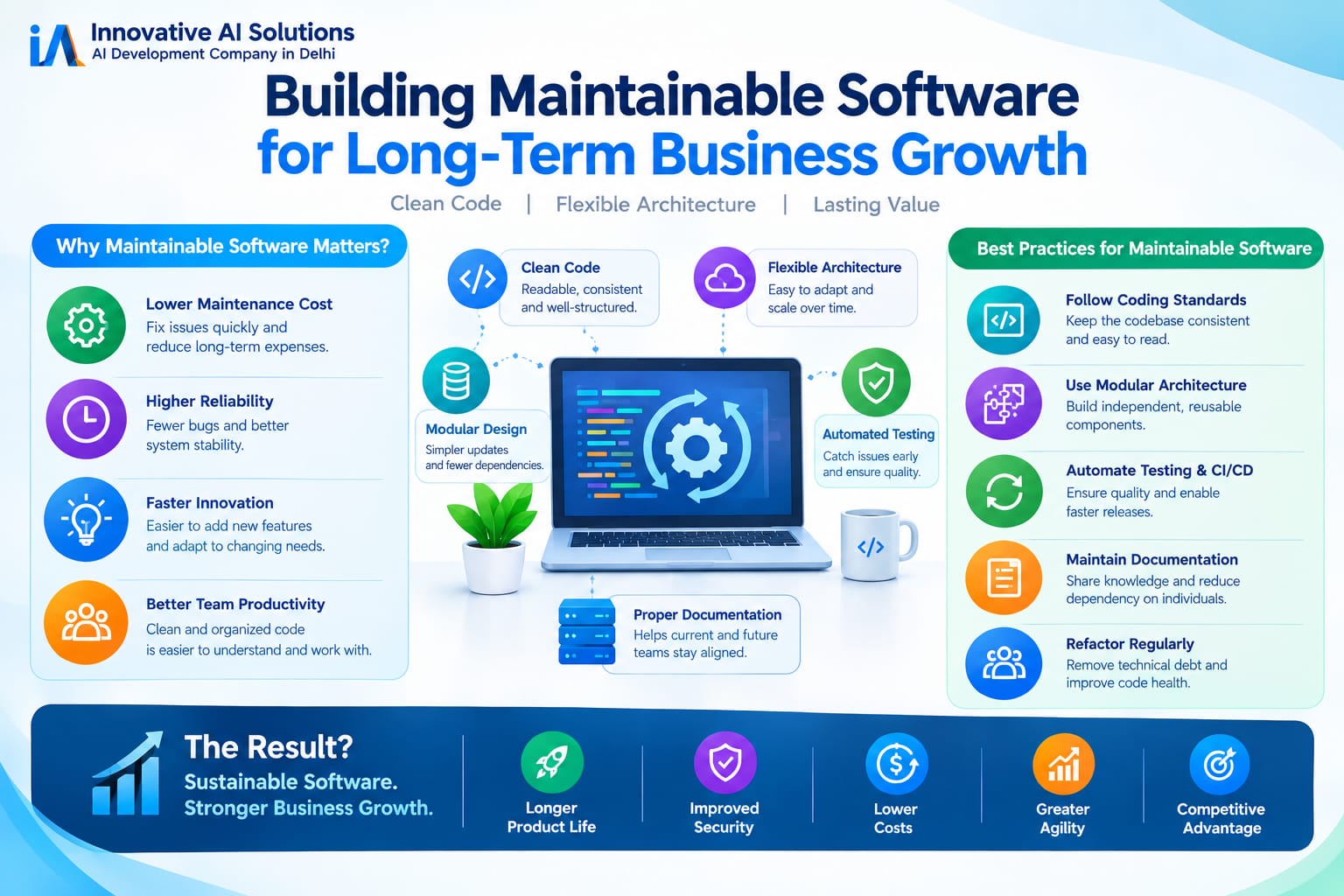
Maintainability is often confused with code quality. They're related, but not identical. Code quality is one dimension. Maintainability is the broader capability of a system to be understood, modified, tested, and deployed over time.
The characteristics of maintainable software:
Readable. A developer joining the team can understand what the code does without extensive explanation. Names are meaningful. Structure is logical. Complexity is managed.
Modular. Components have clear boundaries and responsibilities. Changes in one area don't cascade unpredictably through others. The system can be understood in pieces, not just as a whole.
Testable. The system has automated tests that verify behavior. Changes can be validated quickly. Regressions are caught before they reach production.
Documented. Critical decisions are explained. Architecture is clear. The "why" behind the code is preserved, not just the "what."
Deployable. The system can be released safely and frequently. Deployment doesn't require heroics or downtime. Rollbacks are possible.
Observable. When something goes wrong, the team can diagnose it quickly. Logs, metrics, and traces provide visibility into system behavior.
Evolvable. The system can adapt to new requirements without major rewrites. Technology can be upgraded incrementally. New capabilities can be added without destabilizing what exists.
This isn't an academic checklist. Each characteristic translates directly to business outcomes: faster time to market, lower maintenance costs, reduced risk, and the ability to respond to change.
Why Maintainability Matters for Business Growth
The business case for maintainability is straightforward: it's cheaper to maintain a healthy system than to rescue a broken one.
Cost of Change
In a maintainable system, adding a feature costs what it should—the effort of building the feature. In a poorly maintained system, the same feature costs more because developers must first understand the tangled code, work around the accumulated technical debt, and fix the bugs they introduce along the way.
The difference compounds over time. A system that's 20% harder to change this year will be 50% harder in three years. Eventually, the cost of change exceeds the value of the change, and the system becomes effectively frozen.
Speed to Market
Maintainable systems enable faster delivery. Teams understand the code. Tests catch regressions. Deployments are routine. Features ship when they're ready, not when the release window opens.
This matters in competitive markets. The business that can respond to customer needs fastest wins. Maintainability is a competitive advantage.
Risk Reduction
Technical debt is a risk. It increases the likelihood of outages, security vulnerabilities, and failed deployments. It makes onboarding slower. It drives away good developers.
Maintainable systems are more stable. Incidents are rarer. Recovery is faster. The business is more resilient.
Talent Retention
Developers want to work on systems they can be proud of. They want to build, not just patch. A maintainable codebase attracts better talent, and better talent produces better software. It's a virtuous cycle.
Conversely, a legacy mess drives developers away. The cost of turnover recruiting, onboarding, lost productivity adds to the already high cost of maintenance.
The Foundations of Maintainable Software
Maintainability isn't achieved through a single practice. It's built through consistent, deliberate choices.
Architecture Matters More Than Code
The most important decisions for maintainability are made at the architecture level. A well-architected system can tolerate imperfect code. A poorly architected system will eventually break regardless of how clean the individual files are.
Key architectural principles:
Separation of Concerns. Different parts of the system handle different responsibilities. Business logic is separate from data access. Presentation is separate from computation. This reduces coupling and makes changes more contained.
Modularity. The system is composed of independent, interchangeable components. Modules have clear interfaces. They can be understood, tested, and replaced independently. This is what allows systems to evolve incrementally rather than requiring full rewrites.
Loose Coupling. Components depend on each other through abstractions, not concrete implementations. A change in one module doesn't require changes in others. This is the key to independent deployment and scaling.
High Cohesion. Everything within a module is related to its single responsibility. This makes modules easier to understand and more likely to be reused.
Domain Alignment. The architecture reflects the business domain. Bounded contexts, ubiquitous language, and domain models make the system intuitive for people who understand the business.
These aren't new ideas. They're the foundation of maintainable systems. But they're often ignored in the rush to ship.
Testing Is Non-Negotiable
Untested code is unmaintainable code. Without tests, every change is a gamble. Developers don't know what they might break. They become afraid to touch anything.
Effective testing strategy:
Unit Tests. Verify individual functions and classes in isolation. Fast to run, easy to maintain. Form the foundation of the testing pyramid.
Integration Tests. Verify that components work together correctly. Catch issues at boundaries that unit tests miss.
End-to-End Tests. Verify complete workflows from the user's perspective. Slower and more brittle, but essential for critical paths.
Contract Tests. Verify that service interfaces are respected. Essential for modular and distributed systems.
The goal isn't 100% coverage. It's confidence. A well-tested system lets developers make changes without fear.
Documentation for Humans, Not Machines
Documentation is often neglected because it's seen as overhead. This is a mistake. Documentation is what allows knowledge to persist beyond the tenure of individual developers.
What to document:
Architecture Decisions. Why was this approach chosen? What alternatives were considered? What are the trade-offs? Future developers need to understand the reasoning, not just the result.
Getting Started Guides. How do new developers set up their environment, run tests, and deploy? Onboarding friction is a hidden cost of poor documentation.
API Contracts. What do interfaces expect and return? How do services communicate? Clear contracts reduce integration errors.
Runbooks. What to do when things go wrong? How to diagnose and fix common issues? Runbooks reduce incident response time.
The best documentation is written close to the code in docstrings, comments, and README files. It's maintained as the code evolves. It's treated as part of the deliverable, not an afterthought.
Consistent Conventions
Maintainable systems have consistent conventions. Naming. Formatting. Error handling. Logging. Configuration. When conventions are consistent, developers can predict how things work. Cognitive load decreases. Onboarding accelerates.
Conventions should be documented and automated where possible. Linters, formatters, and code quality tools enforce consistency without relying on discipline alone.
Continuous Refactoring
Technical debt accumulates. It's inevitable. The difference between maintainable and unmaintainable systems is whether that debt is actively managed.
Refactoring improving the structure of existing code without changing its behavior is the primary tool for managing technical debt. It should be continuous, not a special project. Small refactors as part of regular work. Larger refactors when the cost of the current structure exceeds the cost of changing it.
The "boy scout rule" applies: leave the code better than you found it. Every small improvement compounds.
The Cost of Neglect
What happens when maintainability is ignored?
Slow Feature Delivery. Features that should take days take weeks. Developers spend more time understanding and working around existing code than building new functionality.
High Defect Rates. Changes introduce bugs. Tests don't catch them. Quality suffers. Customer satisfaction drops.
Security Vulnerabilities. Outdated dependencies. Unpatched libraries. Poorly understood code paths. The attack surface grows.
Developer Burnout. Working on a legacy mess is demoralizing. Good developers leave. Recruiting replacements becomes harder.
Frozen Systems. Eventually, the system becomes too risky to change. The business is stuck. It can't respond to market changes. It can't adopt new technologies.
This is the trajectory of neglect. It's not dramatic. It's a slow decline. But the end result is the same: a system that no longer serves the business.
What This Means for Your Business
For engineering leaders:
Maintainability is a leadership decision. It requires investing in architecture, testing, and documentation before they're urgently needed. It means saying no to shortcuts that create long-term debt. It means measuring and managing technical debt, not just feature velocity.
For product leaders:
Maintainability affects roadmap predictability. A maintainable system delivers features when promised. An unmaintainable system is a source of constant surprises. When evaluating technical investments, consider the cost of not making them.
For business leaders:
Software is an asset. Like any asset, it requires maintenance to retain value. The cost of maintaining a healthy system is far less than the cost of rescuing a broken one. Invest in maintainability early. It pays dividends for years.
For Indian businesses:
The talent and practices are available. The challenge is prioritization. In fast-growing markets, it's tempting to prioritize speed over sustainability. But the businesses that last are those that build systems that last.
Frequently Asked Questions
Q1: What is maintainable software?
Maintainable software is designed to be understood, modified, tested, and deployed over time. It has clear architecture, automated tests, meaningful documentation, and consistent conventions. Maintainability determines whether a system can evolve gracefully or collapses under its own weight.
Q2: Why is maintainability important?
60-80% of total software cost over a system's life is maintenance. Maintainable systems are cheaper to change, faster to deliver features, less risky, and more attractive to developers. Unmaintainable systems become frozen too risky to change, too expensive to replace.
Q3: What's the difference between code quality and maintainability?
Code quality is one dimension of maintainability. Maintainability is the broader capability of a system to be understood, modified, tested, and deployed. A system with clean code but poor architecture is still unmaintainable.
Q4: How do I measure maintainability?
Track deployment frequency, change failure rate, mean time to recovery, and lead time for changes the DORA metrics. Also measure technical debt, test coverage, and onboarding time for new developers.
Q5: What is technical debt?
Technical debt is the accumulated cost of shortcuts and suboptimal decisions. Like financial debt, it accrues interest making future changes more expensive. It's managed through continuous refactoring, not eliminated entirely.
Q6: How much does it cost to maintain software?
Maintenance typically costs 15-20% of build cost annually. For legacy systems with high technical debt, it can be 30-50% . The cost is lower for maintainable systems and higher for neglected ones.
Q7: What is the boy scout rule?
Leave the code better than you found it. Every small improvement a clearer name, a simpler function, a missing test compounds over time. Maintainability is built through consistent small improvements, not occasional large refactors.
Q8: How does architecture affect maintainability?
Architecture is the most important factor. A well-architected system can tolerate imperfect code. A poorly architected system will eventually break regardless of how clean individual files are. Separation of concerns, modularity, and loose coupling are foundational.
Q9: How much testing is enough?
The goal isn't 100% coverage. It's confidence. Enough tests that developers can make changes without fear. Unit tests for logic. Integration tests for boundaries. End to end tests for critical paths. Contract tests for service interfaces.
Q10: How do I convince leadership to invest in maintainability?
Frame it in business terms. Maintainability reduces cost of change, accelerates time-to-market, reduces risk, and improves talent retention. Measure the cost of technical debt the extra time spent on workarounds, the incidents caused by fragile code, the developers lost to frustration.
Frequently Asked Questions (Continued)
Q11: What documentation is essential?
Architecture decisions (why, not just what), getting started guides (how to set up and deploy), API contracts (what interfaces expect and return), and runbooks (what to do when things go wrong).
Q12: How often should I refactor?
Continuously. Small refactors as part of regular work. Larger refactors when the cost of the current structure exceeds the cost of changing it. Refactoring is not a special project it's part of maintaining a healthy system.
Q13: What is the strangler fig pattern?
A gradual modernization approach where you route existing functionality to a new module, validate it, and retire the old code only after the new one stabilizes. It reduces risk and delivers value incrementally.
Q14: How does AI affect maintainability?
AI can help automated code review, test generation, documentation. But AI-generated code can also introduce new maintenance challenges if not properly reviewed and tested. Maintainability principles still apply.
Q15: Why should I choose Innovative AI Solutions?
Because we build software designed to last. Because we understand that maintainability is a business decision, not just a technical one. Because we've delivered 100+ projects. Because your code is always yours.
Contact Us
Phone:
+91 7464 099 059
+91 9689967356
Email:
info@innovativeais.com
Address:
9th Floor, Pearls Best Heights-I,
Head Office: 904, Netaji Subhash Place,
Delhi – 110034