The Big Question
What makes multi-tenant SaaS different from just "software in the cloud"?
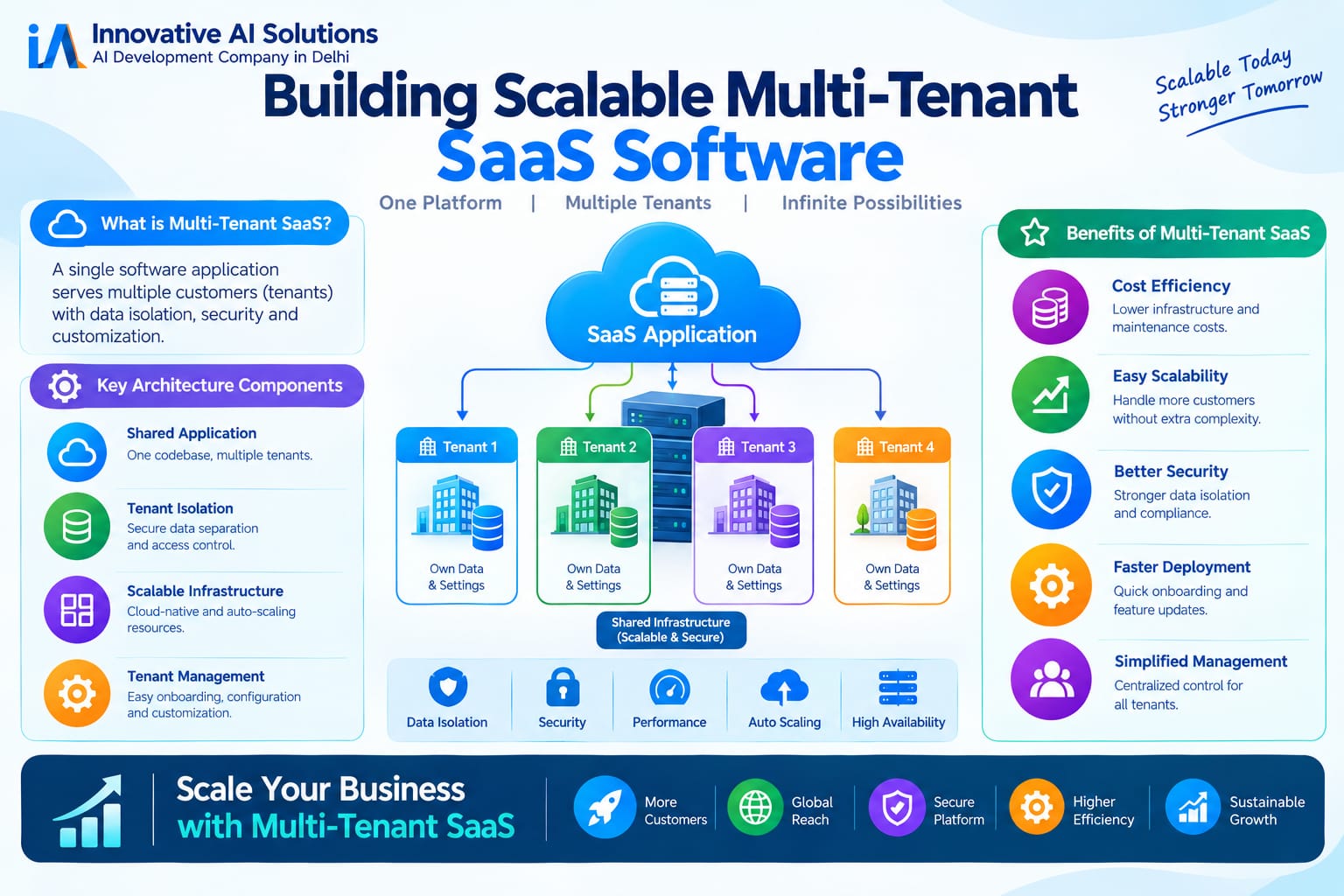
The answer is shared infrastructure with isolated experience.
In a single-tenant model, each customer gets their own instance. Their own database. Their own servers. Their own everything. This is simple to build but expensive to operate. You provision resources per customer, and you pay for resources per customer even when those resources sit idle.
Multi-tenant SaaS flips this. One application instance serves many tenants. Resources are pooled. Costs are shared. But the experience must remain isolated. Tenant A should never see Tenant B's data. Tenant A's heavy usage shouldn't degrade Tenant B's performance.
This is the core tension of multi-tenant architecture: cost efficiency versus isolation. You want to pool resources to reduce cost. But you need to isolate tenants to ensure security and performance .
Getting this balance right is what separates SaaS platforms that scale from those that collapse under their own weight.
The Isolation Spectrum: From Pool to Silo
Multi-tenant architecture is not binary. It's a spectrum, and different tenants may need different levels of isolation.
Pooled (Shared Everything)
All tenants share the same infrastructure, application, and database. Data is isolated logically typically through a tenant identifier column. This is the most cost-efficient model. Per-tenant costs can be as low as $0.50/month in shared infrastructure .
The risk: A missing filter clause in a query can expose one tenant's data to another. The "noisy neighbor" problem where one tenant's heavy usage degrades performance for others is a constant concern .
Bridge (Partitioned)
Tenants share some components but have dedicated resources for others. For example, a shared application but dedicated database schemas. This offers better isolation than pooling while maintaining reasonable cost efficiency .
Silo (Dedicated)
Each tenant gets dedicated infrastructure their own database, their own compute, their own storage. This is the most expensive model. A dedicated RDS instance, Redis, and monitoring can cost $200/month per tenant .
The benefit: Maximum isolation, maximum performance guarantees, and support for customer-managed encryption keys.
The trade-off: The 400x cost difference between pooled ($0.50) and siloed ($200) means you can't offer siloed isolation to free-tier tenants. The pricing model must match the isolation model .
The practical approach: Most production SaaS platforms use a hybrid model. Standard customers on pooled infrastructure. Enterprise customers on dedicated deployments. Tiered by pricing .
Database Architecture: The Decision You Can't Undo
The database model is the hardest decision to change after you have customers. The three patterns are fundamentally different .
Shared Schema (Pooled)
All tenants share the same tables, isolated by a tenant identifier column. This is the highest-volume, lowest-cost model. Ideal for SMB SaaS with thousands of tenants .
The risk: A missing WHERE tenant_id = ? clause can expose data across tenants. Row-level security (RLS) can enforce isolation at the database level, but it must be configured correctly .
Schema-per-Tenant
Each tenant gets their own schema within a shared database. This provides logical isolation a stronger boundary than shared tables while maintaining reasonable cost efficiency. Ideal for mid market SaaS .
The trade-off: Schema migrations must be applied across all tenants. With 1,000 tenants, that's 1,000 schema changes to coordinate .
Database-per-Tenant
Each tenant gets their own database. This provides the strongest isolation dedicated resources, dedicated performance, dedicated encryption keys. Ideal for enterprise and compliance-heavy tiers .
The trade-off: Management overhead. With 10,000 tenants, you're managing 10,000 databases. Schema changes become an operational challenge .
The scaling insight: For B2B SaaS with a handful of tenants, database-per-tenant works. For thousands of tenants, sharding on a tenant_id column is the more scalable approach. The data from the same tenant gets colocated, which dramatically reduces the cost of distributed transactions and joins .
The Noisy Neighbor Problem
In pooled models, one tenant's heavy usage can degrade performance for everyone else. This is the noisy neighbor problem, and it's the most common operational challenge in multi-tenant SaaS .
The symptoms: A single tenant's analytics query holds database connections for 30+ seconds. p99 latency spikes from 200ms to 8 seconds for all other tenants .
The detection: Monitor per-tenant query duration and connection hold time. Alert when any single tenant's p99 exceeds 10x the cluster median, or when one tenant holds more than 30% of available connections for more than 10 seconds .
The response: Terminate the offending query. Throttle the tenant. Enforce statement timeouts and connection quotas .
The prevention: Design for noise from day one. Use priority-based execution to ensure critical requests aren't blocked by batch jobs. Use throughput buckets to limit how much of the shared pool a single workload can consume .
Automated Tenant Provisioning: The Scaling Prerequisite
Manual tenant provisioning doesn't scale. As your tenant count grows, inconsistent configurations, slow onboarding,services and lack of audit trails become blockers .
Automated provisioning covers the full sequence :
-
Namespace creation with network policies and resource quotas
-
Database provisioning (schema, instance, or row-level scoping)
-
Secrets creation and scoping
-
DNS and subdomain configuration
-
RBAC assignment
Each step must be idempotent. If it runs twice, the result should be the same as if it ran once .
The tooling: Crossplane and ArgoCD for dynamic infrastructure provisioning. Terraform for static infrastructure. GitOps for declarative deployment .
The outcome: Cloud teams don't schedule installations. Human errors drop 30% of outages were caused by misconfiguration in one case study. Continuous drift detection and fleet upgrades become possible .
Cost Structure: What Multi-Tenant SaaS Actually Costs
Multi-tenant SaaS development costs vary widely by complexity .
By Product Type:
-
CRM SaaS: $60,000 to $150,000
-
E-commerce SaaS: $80,000 to $250,000
-
Healthcare SaaS (HIPAA): $150,000 to $400,000+
-
Fintech SaaS: $200,000 to $500,000+
-
AI SaaS: $150,000 to $450,000+
-
Enterprise Workflow SaaS: $250,000 to $700,000+
Hidden Costs After Launch :
-
Cloud hosting (grows with usage)
-
Third-party API fees (free tiers disappear at scale)
-
Payment gateway fees (percentage of every transaction)
-
Maintenance (15-20% of build cost annually)
-
Security updates and compliance audits
-
Customer support tools
-
Database scaling
The multi-tenancy premium: AI-assisted development reduces build time by 20-35% for well-understood features like CRUD screens and billing integration. But it provides near-zero gains on multi-tenancy models, billing edge cases, services and permission design the parts that sink SaaS products when wrong .
The honest framing: A quote that looks 25% cheaper has often just moved QA into "not included." Multi-tenancy and billing are architecture decisions you'll live with for years. Insist on seeing the tenant isolation model and billing integration plan in writing before the build starts .
What This Means for Your Business
For SaaS founders:
The database model is the decision you can't undo. Choose based on your target market. SMB SaaS → shared schema. Mid-market → schema-per-tenant. Enterprise → database-per-tenant or hybrid. Document your isolation model before you write code .
For growing SaaS platforms:
Automated tenant provisioning is the single most important investment before you scale. Manual provisioning works early. It becomes a blocker as tenant count grows. Invest in provisioning automation before you need it .
For enterprise SaaS:
Hybrid models are the reality. Standard customers on pooled infrastructure. Enterprise customers on dedicated deployments. Tiered by pricing. The 400x cost difference between pool and silo means you can't offer siloed isolation to free-tier tenants .
For everyone:
Design for isolation from day one. The noisy neighbor problem is inevitable. The question is whether you can detect it, respond to it, and prevent it. Row-level security, connection quotas, and priority-based execution are not optional .
Frequently Asked Questions
Q1: What is multi-tenant SaaS architecture?
Multi-tenant SaaS architecture is a design where a single application instance serves multiple customers (tenants). Resources are pooled to reduce cost. Data and experience are isolated to ensure security and performance .
Q2: What is the difference between pooled, bridge, and siloed isolation?
Pooled: All tenants share infrastructure and database. Lowest cost, logical isolation only. Bridge: Shared components but dedicated resources (e.g., schema-per-tenant). Siloed: Dedicated infrastructure per tenant. Highest cost, strongest isolation .
Q3: What is the noisy neighbor problem?
In pooled models, one tenant's heavy usage can degrade performance for others. A single tenant's analytics query holding connections can spike latency for all tenants .
Q4: What is the difference between shared schema, schema-per-tenant, and database-per-tenant?
Shared schema: All tenants share tables, isolated by tenant ID column. Schema-per-tenant: Each tenant gets their own schema. Database-per-tenant: Each tenant gets their own database. Isolation increases, cost increases, management overhead increases .
Q5: How much does it cost to build multi-tenant SaaS?
CRM SaaS: $60K-$150K. Healthcare (HIPAA): $150K-$400K+. Fintech: $200K-$500K+. Enterprise Workflow: $250K-$700K+ .
Q6: What is the cost difference between pooled and siloed tenants?
Pooled tenants cost approximately $0.50/month** in shared infrastructure. Siloed tenants cost approximately **$200/month for dedicated resources. That's a 400x difference .
Q7: How do I handle schema changes across thousands of tenants?
For schema per tenant, use automated migration tools. For database per tenant, use expand-contract migrations: add column, deploy code writing both, backfill, deploy code reading new, drop old . For shared schema, a single migration applies to all tenants .
Q8: What is automated tenant provisioning?
Automated provisioning handles the full onboarding sequence: namespace creation, database provisioning, secrets creation, DNS configuration, and RBAC assignment. Each step must be idempotent .
Q9: How do I prevent a tenant from seeing another tenant's data?
Use row-level security (RLS) to enforce isolation at the database level. Ensure every query includes the tenant identifier. Use separate encryption keys per tenant for stronger isolation .
Q10: What is the hybrid deployment model?
Most production SaaS platforms use a hybrid model. Standard customers on pooled infrastructure. Enterprise customers on dedicated deployments. Tiered by pricing. This balances cost efficiency with isolation requirements .
Frequently Asked Questions (Continued)
Q11: What is the "unit cost per tenant" in pool vs. silo?
Pool tenant: ~$0.50/month**. Silo tenant: **~$200/month. The 400x cost difference justifies the pricing page: enterprise tier at $5K/month can absorb silo cost; free tier at $0 cannot .
Q12: How do I migrate a tenant from pool to silo?
Dual-write to both pool and silo. Backfill historical data. Verify row counts and checksums. Cut reads to silo. Stop writes to pool. Clean up pool rows. Shopify's Pod Mover achieves this in under a minute .
Q13: What is crypto-shredding for GDPR erasure?
Encrypt each tenant's data with a tenant-scoped data key derived from a per-service CMK. On deletion, destroy the tenant's data key. Ciphertext remains in backups but is computationally unrecoverable .
Q14: What are the biggest mistakes in multi-tenant SaaS?
Missing tenant filter in queries (data leakage). Noisy neighbor problems (performance degradation). Manual provisioning (doesn't scale). Choosing a database model that can't evolve. Not investing in automated provisioning before you need it .
Q15: Why should I choose Innovative AI Solutions?
Because we build multi-tenant SaaS designed to scale. Because we understand that isolation and cost efficiency are architectural decisions, not afterthoughts. Because we've delivered 100+ projects. Because your code is always yours.
Contact Us
Phone:
+91 7464 099 059
+91 9689967356
Email:
info@innovativeais.com
Address:
9th Floor, Pearls Best Heights-I,
Head Office: 904, Netaji Subhash Place,
Delhi – 110034