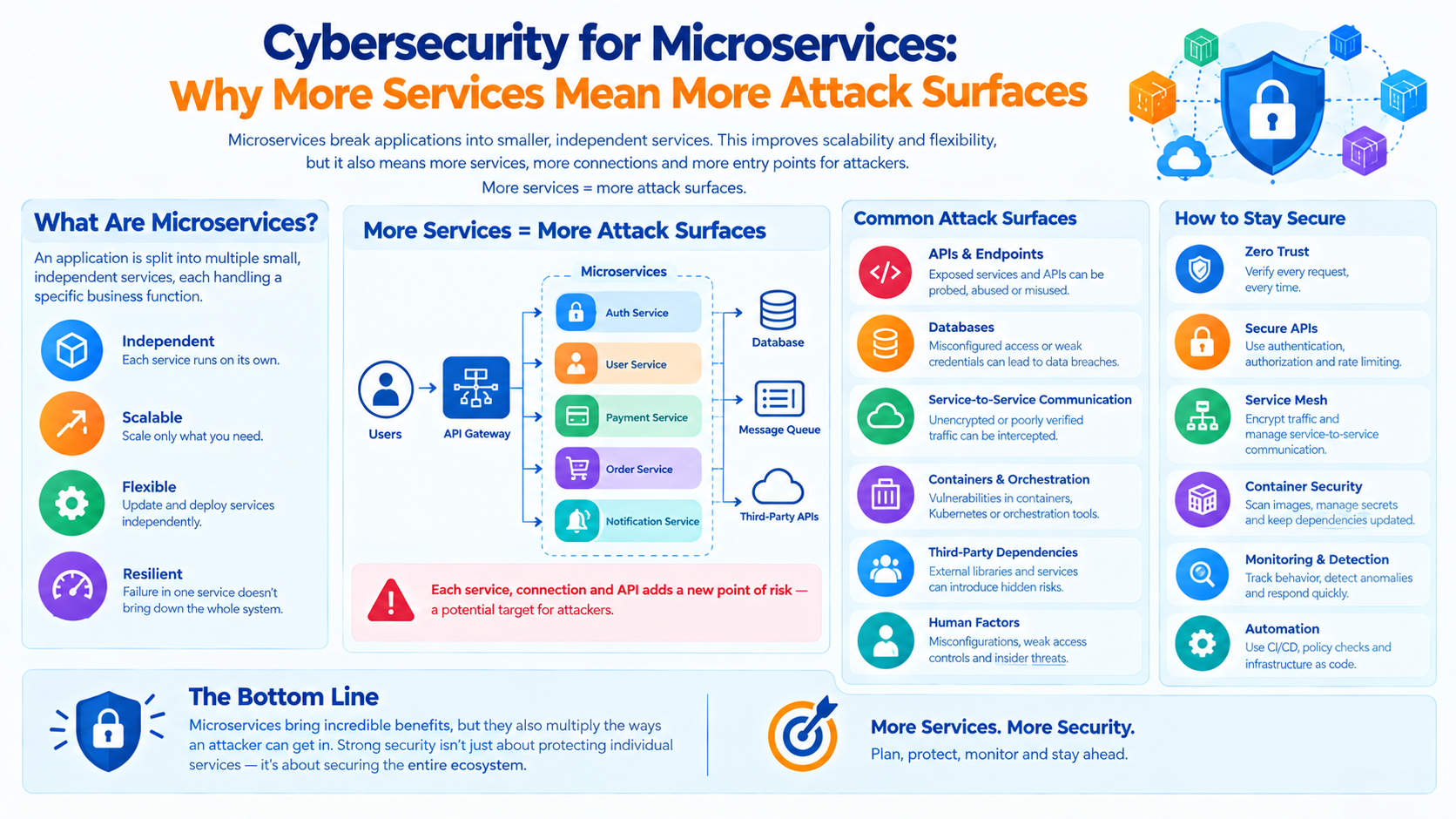
The Big Question
What happens when your monolith becomes forty services, each with its own API, its own database credentials, its own deployment pipeline, and its own network path? When a single compromised service can reach dozens of others because they all trust each other?
Monolithic applications had one attack surface. Microservices have many and the connections between them are often less guarded than the perimeter was.
Why Microservices Multiply Attack Surface
The security implications of microservices are structural, not incidental.
Every Service Is an Entry Point
A monolith presents one API surface. A microservices architecture presents one per service, plus internal APIs that were never designed for external scrutiny. Each endpoint is a potential entry point, and each must be secured independently.
The arithmetic: If a monolith exposes 50 endpoints, and those become 20 services each exposing 10 endpoints, the architecture now has 200 endpoints each requiring authentication, authorization, input validation, and rate limiting.
Every Inter-Service Call Is a Trust Boundary
In a monolith, function calls happen in-process. In microservices, they cross the network. Every network call is a trust boundary where authentication, encryption, and authorization must be enforced.
The consequence: The internal network is no longer implicitly trusted. East-west traffic must be secured the same way north-south traffic was.
Every Service Has Its Own Credentials
Each service needs credentials for databases, message queues, caches, and other services. These credentials must be issued, rotated, scoped, and revoked.
The consequence: Credential sprawl. A microservices architecture can have thousands of machine identities, each a potential compromise point.
Every Pipeline Is a Compromise Path
Each service has its own build and deployment pipeline. A compromised pipeline can inject malicious code into a service that is trusted by its peers.
The consequence: Supply chain risk multiplies with the number of pipelines.
Distributed Tracing Reveals More
Observability systems collect traces that span services. These traces often contain sensitive data—tokens, personal information, internal identifiers.
The consequence: The observability layer becomes a data exposure risk.
Configuration Drift Creates Inconsistency
With many services, security configuration drifts. One service has strict authentication; another does not. One encrypts data at rest; another does not.
The consequence: The weakest service determines the security of the system.
The Specific Risks
Service-to-Service Authentication Gaps
In many architectures, internal services trust each other implicitly. Once inside the network, a compromised service can call any other service without authentication.
The risk: Lateral movement. An attacker who compromises one service can reach all others.
The mitigation: Mutual authentication between services. Every service call should be authenticated, regardless of network location.
Over-Permissive Service Accounts
Service accounts are often granted broad permissions for convenience. A service that only needs to read from one database may have write access to several.
The risk: A compromised service inherits all its permissions.
The mitigation: Least privilege per service. Each service should have exactly the permissions it needs and no more.
Exposed Internal Endpoints
Internal endpoints health checks, metrics, admin functions are often less secured than public endpoints. If they become reachable, they can be exploited.
The risk: Administrative functions exposed to unauthorized callers.
The mitigation: Network segmentation, authentication on all endpoints, and explicit exposure policies.
Secrets in Configuration
Microservices frequently require secrets: API keys, database passwords, encryption keys. These are often stored in configuration files, environment variables, or container images.
The risk: Secret exposure through logs, repository commits, or compromised containers.
The mitigation: Centralized secret management with short-lived credentials and automated rotation.
Inconsistent Input Validation
Each service validates its own inputs. If one service skips validation because it "trusts" the caller, an attacker can exploit the gap.
The risk: Injection attacks, malformed data propagation, and cascading failures.
The mitigation: Validate at every boundary, regardless of caller.
Distributed Denial of Service
A microservices architecture multiplies the number of services that can be overwhelmed. A flood of requests to one service can propagate to its dependencies.
The risk: Cascading failure under load.
The mitigation: Rate limiting per service, circuit breakers, and backpressure handling.
The Zero Trust Approach to Microservices
The security model that fits microservices is Zero Trust: never trust, always verify.
Applied to microservices:
| Principle | Implementation |
|---|---|
| Verify every request | Mutual authentication between services |
| Least privilege | Minimal permissions per service |
| Assume breach | Network segmentation and lateral movement prevention |
| Encrypt everything | mTLS for all service-to-service traffic |
| Monitor continuously | Behavioral observability for services |
Zero Trust does not mean distrusting your own services. It means designing so that a compromise of one service does not become a compromise of all.
Practical Controls
Mutual TLS (mTLS)
Every service-to-service call is encrypted and mutually authenticated. Both the caller and the callee present certificates.
Why it matters: mTLS prevents eavesdropping and impersonation on the internal network. It also provides a foundation for identity-based authorization.
Implementation: Service meshes like Istio and Linkerd provide mTLS transparently. Cloud providers offer managed service mesh options.
Service Identity
Each service has a cryptographic identity that can be verified. Identity is not based on network location or IP address, which can be spoofed.
Implementation: SPIFFE/SPIRE provides a standard for service identity. Certificates are issued to workloads and rotated automatically.
Least Privilege per Service
Each service is granted exactly the permissions it requires no more.
Implementation: Define permissions per service, not per team. Review and audit regularly. Use short-lived credentials where possible.
Network Segmentation
Services are grouped into segments, and traffic between segments is restricted.
Implementation: Kubernetes NetworkPolicies, service mesh authorization policies, or cloud-native segmentation.
Secret Management
Secrets are stored in a centralized system, not in configuration files or environment variables.
Implementation: HashiCorp Vault, AWS Secrets Manager, Azure Key Vault, or cloud-native equivalents. Secrets are short-lived and rotated automatically.
Input Validation at Every Boundary
Every service validates its inputs, regardless of the caller.
Implementation: Schema validation at the API layer, consistent across all services. Never trust that a caller has validated.
Rate Limiting and Circuit Breakers
Each service limits the rate of requests it accepts and breaks circuits when dependencies fail.
Implementation: API gateways, service mesh policies, and application-level controls.
Behavioral Observability
Monitor service behavior for anomalies unusual call patterns, unexpected data access, elevated error rates.
Implementation: Distributed tracing combined with anomaly detection.
The Organizational Dimension
Microservices security is not only technical. It requires organizational clarity.
Ownership. Each service must have a named owner accountable for its security.
Standards. Security requirements must be defined centrally and enforced consistently.
Platform. The platform team should provide security primitives mTLS, identity, secret management as platform capabilities, not as per-service projects.
Review. New services should undergo security review before deployment.
Incident response. With many services, incident response must account for lateral movement and cascading failures.
Implementation Roadmap
Phase 1: Assess (Weeks 1-4)
-
Inventory services and endpoints. How many exist, and who owns each?
-
Map service-to-service communication. Which services call which, and how is that traffic secured?
-
Inventory credentials and secrets. Where are they stored, and how are they rotated?
-
Identify gaps. Where is authentication missing? Where are permissions excessive?
Phase 2: Build Controls (Weeks 5-10)
-
Deploy mTLS across service-to-service communication.
-
Implement service identity with automated certificate rotation.
-
Apply least privilege per service.
-
Centralize secret management.
-
Implement network segmentation.
-
Add rate limiting and circuit breakers.
Phase 3: Operate (Weeks 11-16)
-
Establish behavioral observability for services.
-
Define ownership for every service.
-
Establish security review for new services.
-
Test incident response for lateral movement scenarios.
-
Audit permissions regularly.
Frequently Asked Questions
Q1: Is microservices security harder than monolith security?
Yes, structurally. A monolith has one attack surface. Microservices have many, plus the connections between them. The effort required scales with the number of services.
Q2: What is the most important control?
Mutual authentication between services combined with least privilege. These two controls together limit lateral movement the primary risk in microservices architectures.
Q3: Do I need a service mesh?
Not strictly, but a service mesh makes mTLS, identity, and policy enforcement significantly easier. Without one, these controls must be implemented per service.
Q4: How do I prevent lateral movement?
Network segmentation, mTLS, least privilege, and behavioral monitoring. Assume any service can be compromised and design so that compromise does not spread.
Q5: What about secrets in Kubernetes?
Use external secret management rather than Kubernetes Secrets, which are base64-encoded rather than encrypted by default. Inject secrets at runtime from a vault rather than storing them in the cluster.
Q6: How can Innovative AI Solutions help?
We help organizations design and implement microservices security from service identity and mTLS to least privilege, secret management, and behavioral observability. Explore our services to see how we approach secure platform engineering. Based in Delhi, serving clients across India.
Why Delhi is a Great Hub for Microservices Security
Delhi is emerging as a hub for cloud-native and security engineering, backed by a thriving IT services ecosystem and a growing base of organizations running microservices at scale. As Indian enterprises modernize their architectures, securing the expanded attack surface becomes a critical capability.
What We Offer at Innovative AI Solutions
-
Microservices Security Assessment: We inventory services, endpoints, credentials, and gaps.
-
Service Identity and mTLS: We implement mutual authentication across service communication.
-
Least Privilege Design: We define and enforce minimal permissions per service.
-
Secret Management: We centralize secrets with automated rotation.
-
Behavioral Observability: We implement anomaly detection for service behavior.
-
Incident Response Design: We prepare for lateral movement and cascading failure scenarios.
Final Thought
The shift is clear: from securing a perimeter to securing every interaction. Microservices multiply attack surface because they multiply trust boundaries. Organizations that apply Zero Trust principles verify every request, grant least privilege, assume breach—will build architectures where a compromise of one service does not become a compromise of all. Those that rely on the internal network being trusted will discover that the perimeter moved and they did not move with it.
Contact Us:
Phone: +91 7464 099 059 / +91 9689967356
Email: info@innovativeais.com
Address: 904, 9th floor Pearls Best Heights-I, Netaji Subhash Place, Delhi-110034
Website: https://innovativeais.com
About the Author
Abhishek Kumar
Founder & CEO, Innovative AI Solutions
5+ years building AI, cloud, and enterprise systems. Based in Delhi, serving clients across India.