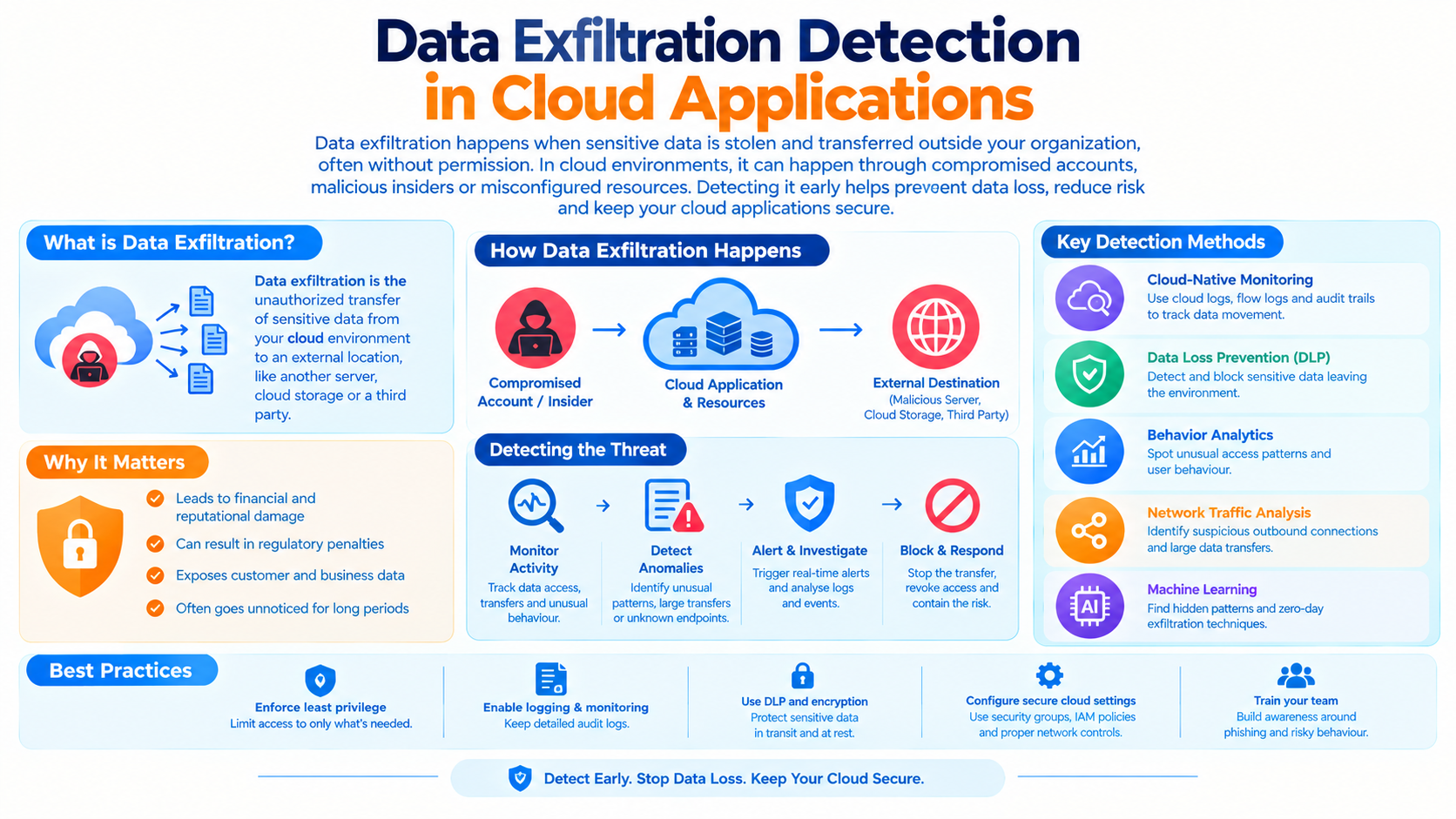
The Big Question
What happens when an attacker has already gained access and is now slowly moving data out through channels that look legitimate? When a compromised service account exports a customer table in small batches over weeks? When data leaves through an approved API endpoint at a rate nobody is monitoring?
Perimeter defences stop intrusion. Exfiltration detection addresses what happens after intrusion succeeds which is increasingly the assumption security teams must design for.
Why Exfiltration Detection Is Difficult
Data exfiltration is hard to detect because it is hard to distinguish from legitimate activity.
Exfiltration uses legitimate channels. Data leaves through APIs, database queries, file transfers, email, and third-party integrations. None of these are inherently malicious.
Exfiltration can be slow. Attackers often exfiltrate gradually to avoid volume-based detection. Small transfers over long periods look like normal usage.
Exfiltration can be encrypted. Data leaving over TLS is not inspectable by default. Content-based detection is limited without decryption.
Exfiltration can be authorized. A compromised service account has legitimate credentials. The access is authorized; only the intent is malicious.
Exfiltration is often detected late. By the time volume or behaviour triggers an alert, data may already be gone.
The consequence is that exfiltration detection depends on behavioural signals rather than signature-based controls.
How Data Leaves Cloud Applications
Understanding the channels is the prerequisite for detecting them.
| Channel | Examples |
|---|---|
| API responses | Bulk endpoints, pagination abuse, GraphQL queries |
| Database exports | Dumps, backup downloads, replication streams |
| Object storage | Bucket downloads, signed URL abuse, cross-account access |
| File sharing | Document exports, attachment downloads |
| Email and messaging | Attachments, forwarded content |
| Third-party integrations | SaaS connectors, webhooks, data pipelines |
| CI/CD pipelines | Build artifacts, logs, secrets |
| Backups | Snapshot exports, cross-region copies |
| Direct access | SSH, RDP, database clients |
Each channel has its own detection signals.
The Signals That Matter
Exfiltration detection relies on behavioural signals rather than content inspection.
Volume Anomalies
The most basic signal: how much data is leaving, compared to baseline.
What to measure:
-
Bytes transferred per principal, per hour
-
Rows returned per query
-
Objects downloaded per session
The challenge: Volume varies legitimately. Baselines must be established per principal, per service, and per time period.
Access Pattern Anomalies
Who is accessing what, and does it match their normal pattern?
What to measure:
-
New data sources accessed by a principal
-
Access to data outside the principal's normal scope
-
Sequential access patterns suggesting enumeration
-
Access at unusual times
The challenge: Legitimate roles change. Pattern detection must distinguish genuine change from compromise.
Query Pattern Anomalies
What is being queried, and how?
What to measure:
-
Unusually broad queries (SELECT *)
-
Unusually deep pagination
-
Access to sensitive columns not normally accessed
-
Queries that combine data sources in unusual ways
Egress Path Anomalies
Where is data going?
What to measure:
-
New destination IP addresses or domains
-
Destinations outside normal geographies
-
Transfers to personal cloud storage or unauthorized services
-
DNS queries for unusual domains
Identity Anomalies
Who is acting, and is that consistent?
What to measure:
-
Credential use from new locations
-
Concurrent use from multiple locations
-
Service account activity outside normal hours
-
Privilege escalation preceding data access
Sequence Anomalies
Exfiltration typically follows a sequence: access, discovery, collection, and transfer.
What to measure:
-
Data discovery activity (listing buckets, enumerating tables)
-
Permission changes preceding access
-
Credential creation or modification
-
Disabling of logging or monitoring
Detecting the sequence is often more reliable than detecting any single event.
Detection Approaches
Behavioural Baselining
Establish what normal looks like, then alert on deviation.
The practice: Model normal behaviour per principal, per data source, and per time period. Alert on statistically significant deviation.
The limitation: Baselines require time to establish and must adapt to legitimate change.
User and Entity Behaviour Analytics (UEBA)
UEBA platforms analyse behaviour across users, service accounts, and devices to identify anomalies.
What it provides: Correlated signals across multiple sources, risk scoring, and prioritisation.
The limitation: Requires integration across many data sources and tuning to reduce false positives.
Data Loss Prevention (DLP)
DLP inspects content to identify sensitive data leaving the organization.
What it provides: Content-aware detection credit card numbers, personal data, intellectual property.
The limitation: Limited effectiveness on encrypted traffic, and prone to false positives.
Cloud-Native Detection
Cloud providers offer native detection capabilities.
Examples: GuardDuty for AWS, Microsoft Defender for Cloud, Google Security Command Center.
What they provide: Cloud-specific signals unusual API calls, anomalous IAM activity, suspicious data access.
The limitation: Provider-specific and often focused on intrusion rather than exfiltration.
Egress Monitoring
Monitor what leaves the network or the cloud environment.
What it provides: Visibility into destinations, volumes, and patterns.
The limitation: Encrypted traffic limits content inspection; volume monitoring requires baselines.
The Encryption Problem
Most data in transit is encrypted. This limits content-based detection significantly.
What remains visible:
-
Metadata: source, destination, volume, timing
-
Endpoint accessed
-
Principal identity
-
Query structure (if within your own systems)
What is not visible:
-
Payload content
-
Data classification
-
Sensitive values
The practical implication: Detection must rely on metadata and behaviour rather than content. Where content inspection is required, it must happen at points where decryption occurs within your own applications, proxies, or cloud services.
Reducing the Attack Surface
Detection is one layer. Reducing what can be exfiltrated is another.
The practices:
-
Least privilege. Limit what each principal can access.
-
Data minimisation. Do not store what you do not need.
-
Egress restrictions. Limit where data can be sent.
-
Data classification. Know what is sensitive and where it lives.
-
Access reviews. Regularly verify that access is still appropriate.
Reducing the attack surface makes detection easier because there are fewer legitimate paths to confuse with malicious ones.
The Response Problem
Detection without response is monitoring, not security.
What response requires:
-
Rapid investigation. Can you determine what happened within minutes or hours?
-
Containment. Can you revoke credentials and block egress quickly?
-
Scope assessment. Can you determine what was accessed and what left?
-
Notification. Can you meet regulatory and contractual notification timelines?
The prerequisite: The same visibility that enables detection enables response. Without logs, lineage, and access records, investigation is guesswork.
Implementation Roadmap
Phase 1: Visibility (Weeks 1-4)
-
Inventory data sources and classify sensitivity.
-
Enable logging across data access paths APIs, databases, storage, and integrations.
-
Establish baselines for normal access and transfer volume.
-
Identify egress paths where data can leave.
Phase 2: Detection (Weeks 5-10)
-
Implement volume anomaly detection per principal and data source.
-
Implement access pattern detection new sources, unusual scope.
-
Implement egress monitoring destinations, volumes, geographies.
-
Correlate signals across identity, access, and transfer.
-
Tune thresholds to reduce false positives.
Phase 3: Response (Weeks 11-16+)
-
Build investigation capability rapid querying of access and transfer logs.
-
Build containment procedures credential revocation, egress blocking.
-
Practice response with tabletop exercises.
-
Review and refine based on incidents and near-misses.
Frequently Asked Questions
Q1: What is data exfiltration?
The unauthorized transfer of data out of an organization. It is the final stage of most breaches, occurring after an attacker has gained access.
Q2: Why is exfiltration hard to detect?
Because it uses legitimate channels, can be slow and small, is often encrypted, and may use authorized credentials.
Q3: What signals indicate exfiltration?
Volume anomalies, access pattern anomalies, query anomalies, egress path anomalies, identity anomalies, and sequence anomalies.
Q4: What is the most reliable detection signal?
Sequence anomalies detecting the pattern of discovery, collection, and transfer — are often more reliable than any single event.
Q5: Can DLP detect exfiltration over encrypted channels?
Not effectively. Content inspection requires decryption. Where inspection is needed, it must occur at points where decryption happens.
Q6: How can Innovative AI Solutions help?
We help organizations build exfiltration detection from data classification and logging to behavioural baselining, anomaly detection, and response procedures. Explore our services to see how we approach cloud security engineering. Based in Delhi, serving clients across India.
Why Delhi is a Great Hub for Cloud Security Engineering
Delhi is emerging as a hub for cloud and security engineering, backed by a thriving IT services ecosystem and increasing regulatory focus on data protection under the DPDP Act. As Indian enterprises scale cloud applications, detecting exfiltration becomes a practical requirement rather than a theoretical concern.
What We Offer at Innovative AI Solutions
-
Data Classification: We help identify and classify sensitive data.
-
Logging Implementation: We enable access and transfer logging across data paths.
-
Behavioural Baselining: We establish normal access and transfer patterns.
-
Anomaly Detection: We implement volume, access, and egress anomaly detection.
-
Response Capability: We build investigation and containment procedures.
Final Thought
The shift is clear: from assuming perimeter defences are sufficient to detecting what happens after they fail. Data exfiltration is difficult to detect because it looks like normal activity. Organizations that build behavioural baselines, monitor egress, and correlate signals across identity and access will detect exfiltration earlier and respond faster. Those that rely on perimeter controls alone will discover the breach when the data is already gone.
Contact Us:
Phone: +91 7464 099 059 / +91 9689967356
Email: info@innovativeais.com
Address: 904, 9th floor Pearls Best Heights-I, Netaji Subhash Place, Delhi-110034
Website: https://innovativeais.com
About the Author
Abhishek Kumar
Founder & CEO, Innovative AI Solutions
5+ years building AI, cloud, and enterprise systems. Based in Delhi, serving clients across India.