The Big Question
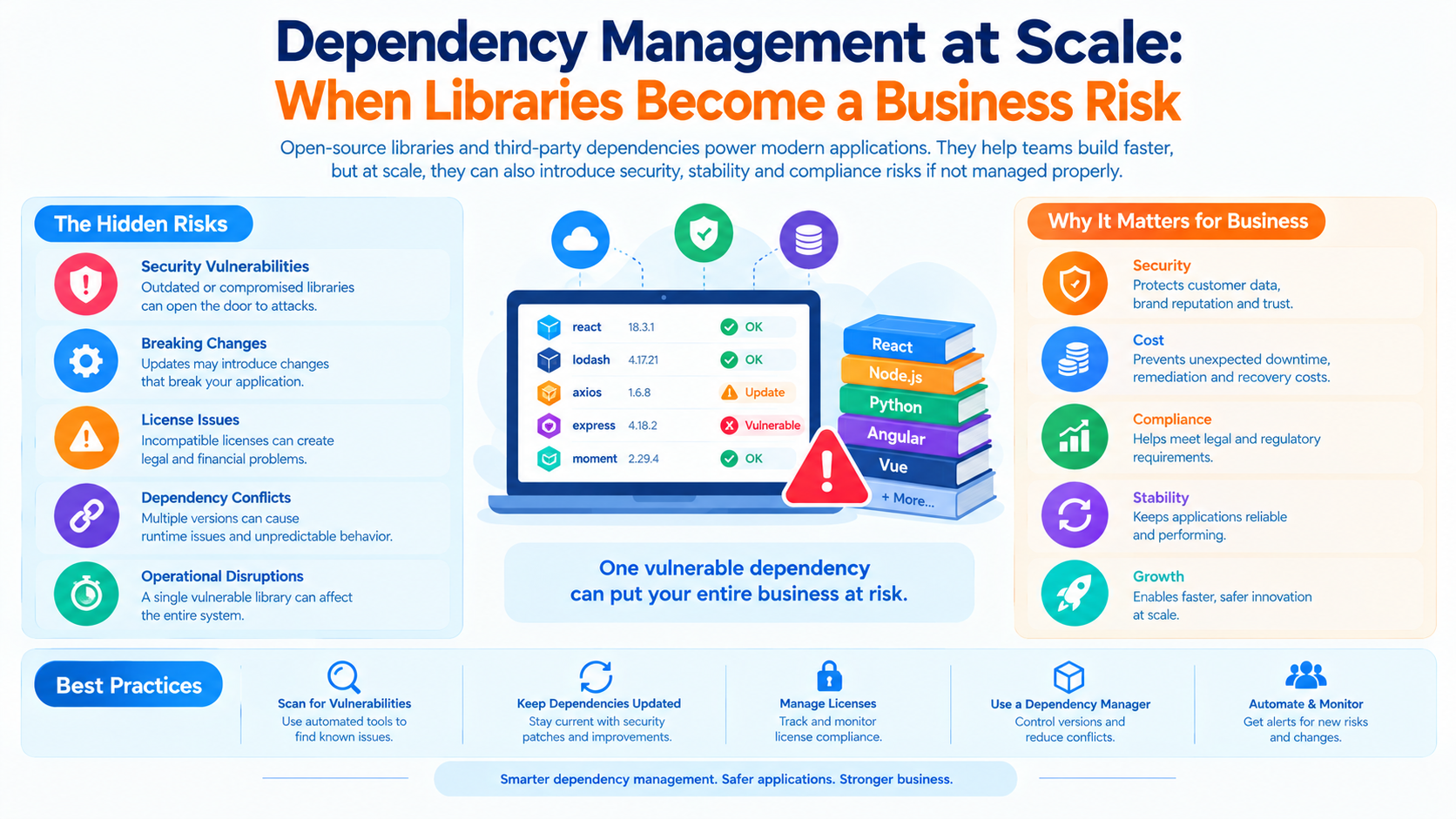
What happens when a library your product depends on is abandoned by its maintainer? When a transitive dependency introduces a licence your legal team will not accept? When a critical package is compromised and the malicious version is pulled automatically into your builds? When a major version upgrade requires changes across a dozen services and no one knows who owns them?
At the scale of a single project, dependencies are a convenience. At the scale of an organization, they are a portfolio of external risk that must be managed deliberately.
How Dependency Risk Accumulates
Dependency risk does not appear suddenly. It builds through a series of individually reasonable decisions.
Convenience over caution. Adding a library is faster than writing the functionality. The decision is correct in isolation.
Depth is invisible. A direct dependency brings its own dependencies, which bring theirs. Most organizations cannot name their full dependency tree.
Ownership is unclear. No one is accountable for the dependencies a service uses. They were added by engineers who have moved on.
Upgrades are deferred. Upgrading is risky and provides no visible feature value, so it is postponed until it becomes urgent.
Abandonment is gradual. A library does not announce that it is unmaintained. It simply stops receiving updates.
Security is periodic. Vulnerabilities are discovered continuously, but remediation happens in bursts.
The result is a large, poorly understood surface of external code on which the business depends.
The Categories of Dependency Risk
Not all dependency risk is the same. Classifying it clarifies where to invest.
| Risk Category | Description | Impact |
|---|---|---|
| Security | Known vulnerabilities in dependencies | Breach exposure |
| Abandonment | No longer maintained; no security updates | Growing vulnerability, no fixes |
| Licence | Terms incompatible with commercial use | Legal exposure |
| Breaking changes | Major versions with incompatible APIs | Upgrade cost, delayed adoption |
| Supply chain | Malicious versions, compromised maintainers | Direct compromise |
| Depth and complexity | Unmanageable transitive tree | Inability to audit or respond |
| Concentration | Many services depend on one library | Organization-wide exposure |
Each category requires different controls.
The Scale Problem
Dependency risk is fundamentally a scale problem.
The arithmetic: A service with 50 direct dependencies may have 500 or more transitive dependencies. An organization with 100 services may depend on thousands of distinct packages, at multiple versions.
What breaks at scale:
-
Manual review of every dependency is impossible
-
Tracking which services use which libraries becomes infeasible
-
Coordinating upgrades across teams is slow
-
Responding to a vulnerability requires knowing what is affected
At scale, dependency management must be automated, centralised, and continuously monitored.
The Security Dimension
Security vulnerabilities in dependencies are the most visible form of dependency risk.
Why it is difficult:
-
Vulnerabilities are discovered continuously, not in batches
-
Most vulnerabilities are in transitive dependencies, not direct ones
-
Many vulnerabilities have no fix available
-
Patching requires coordination across services
What helps:
-
Software Composition Analysis (SCA). Scanning dependencies for known vulnerabilities.
-
Software Bill of Materials (SBOM). A complete list of components, enabling response when a vulnerability is disclosed.
-
Continuous monitoring. Detecting new vulnerabilities as they are disclosed, not just at build time.
-
Prioritisation by exploitability. Not every critical vulnerability is being exploited.
The Abandonment Problem
Libraries that are no longer maintained stop receiving security updates. They become permanent liabilities.
How abandonment manifests:
-
No commits in over a year
-
Open security issues with no response
-
Maintainer explicitly steps back
-
Package is deprecated in favour of a successor
The consequence: A vulnerability in an abandoned library may never be fixed, forcing an organization to fork, replace, or accept the risk.
What helps:
-
Tracking maintenance status of critical dependencies
-
Identifying successor libraries
-
Planning migration before abandonment becomes critical
-
Preferring libraries with active maintainers and organizational backing
The Licence Dimension
Licences determine what an organization may legally do with a dependency.
Common licence categories:
| Category | Examples | Typical Constraint |
|---|---|---|
| Permissive | MIT, Apache 2.0, BSD | Minimal restrictions |
| Weak copyleft | LGPL, MPL | Limited obligations on derivative works |
| Strong copyleft | GPL, AGPL | Derivatives must be licensed the same way |
| Proprietary | Commercial licences | Terms vary; may restrict use |
The risk: A dependency with an incompatible licence can create legal exposure, particularly for organizations that distribute software or provide it as a service.
What helps:
-
Automated licence scanning
-
Policy defining which licences are acceptable
-
Review before adding dependencies, not after
-
Regular audits of existing dependency licences
The Upgrade Problem
Dependencies require maintenance. Upgrades cost time and introduce risk, which is why they are deferred.
Why upgrades are difficult:
-
Major versions introduce breaking changes
-
Upgrading one dependency may require upgrading others
-
Testing every upgrade is expensive
-
No single team owns the dependency portfolio
What happens when upgrades are deferred:
-
Versions fall far behind current
-
Upgrading later becomes exponentially harder
-
Security patches become unavailable for old versions
-
The organization loses the ability to adopt new capabilities
What helps:
-
Regular, small upgrades rather than rare, large ones
-
Automated dependency update tooling
-
Test coverage that makes upgrades safe
-
Central coordination for shared dependencies
The Concentration Risk
When many services depend on the same library, that library becomes a single point of failure.
The pattern: A widely used internal library, a common framework, or a popular open-source package becomes embedded across the organization. A vulnerability or breaking change in that library affects everything.
What helps:
-
Tracking which services depend on which critical libraries
-
Understanding blast radius before upgrading or responding
-
Considering alternatives when concentration is high
-
Planning coordinated response for critical dependencies
What Dependency Management at Scale Requires
Managing dependencies at scale is not a tooling problem alone. It requires capability across several dimensions.
1. Visibility
You cannot manage what you cannot see.
The requirement: A complete, continuously updated inventory of dependencies across all services, including transitive dependencies.
The practice: SBOM generation, dependency graphing, and centralised tracking.
2. Policy
Decisions about dependencies should be governed by policy, not made case by case.
The requirement: Defined rules for acceptable licences, maintenance status, and security posture.
The practice: Policy as code, enforced in the build pipeline.
3. Automation
Manual dependency management does not scale.
The requirement: Automated scanning, updating, and verification.
The practice: Automated update tooling, CI integration, and automated testing.
4. Ownership
Someone must be accountable for the dependency portfolio.
The requirement: Clear ownership at both the service level and the organization level.
The practice: Service teams own their dependencies; a platform team owns the tooling, policy, and coordination.
5. Response Capability
When a vulnerability is disclosed, response must be fast.
The requirement: The ability to identify affected services and remediate quickly.
The practice: SBOMs, dependency graphs, and pre-planned response procedures.
Implementation Roadmap
Phase 1: Visibility (Weeks 1-4)
-
Generate SBOMs for all services.
-
Build a dependency inventory across the organization.
-
Identify concentration risk which libraries are most widely used?
-
Assess current security posture how many known vulnerabilities exist?
Phase 2: Policy and Automation (Weeks 5-10)
-
Define dependency policy acceptable licences, maintenance requirements, security thresholds.
-
Implement SCA scanning in CI pipelines.
-
Implement licence scanning.
-
Implement automated update tooling.
-
Enforce policy in the build.
Phase 3: Sustain (Weeks 11-16+)
-
Track maintenance status of critical dependencies.
-
Plan migrations for abandoned or deprecated libraries.
-
Review dependency updates on a regular cadence.
-
Practice response for supply chain incidents.
-
Measure dependency health as an ongoing metric.
Frequently Asked Questions
Q1: What is dependency management at scale?
The practice of managing the external libraries an organization depends on across many services including visibility, policy, automation, ownership, and response capability.
Q2: What is the biggest dependency risk?
Security vulnerabilities in transitive dependencies, because most organizations cannot see them and most vulnerabilities are not in direct dependencies.
Q3: What is an SBOM?
A Software Bill of Materials a complete list of components in an artifact, with versions and sources. It is the prerequisite for responding to dependency vulnerabilities.
Q4: How do I handle abandoned libraries?
Track maintenance status, identify successors, and plan migration before abandonment becomes critical. Some organizations fork critical abandoned libraries.
Q5: What licences should I avoid?
Depends on your distribution model. Strong copyleft licences impose obligations that may be incompatible with proprietary or SaaS distribution. Define policy and enforce it automatically.
Q6: How can Innovative AI Solutions help?
We help organizations build dependency management capability from SBOM generation and dependency inventory to policy enforcement, automation, and response planning. Explore our services to see how we approach platform and security engineering. Based in Delhi, serving clients across India.
Why Delhi is a Great Hub for Platform Engineering
Delhi is emerging as a hub for cloud-native and platform engineering, backed by a thriving IT services ecosystem and a large base of organizations running many services with shared dependencies. As Indian enterprises scale their software portfolios, dependency management becomes a business risk that requires deliberate governance.
What We Offer at Innovative AI Solutions
-
Dependency Inventory: We build visibility into direct and transitive dependencies across services.
-
SBOM Implementation: We generate and maintain SBOMs for every build.
-
Policy Design: We define licence, maintenance, and security policies.
-
Automation: We implement SCA scanning, licence scanning, and automated updates.
-
Response Planning: We prepare procedures for dependency vulnerabilities and supply chain incidents.
Final Thought
The shift is clear: from treating dependencies as a convenience to treating them as a portfolio of external risk. Dependencies are not a technical detail they are external code on which the business depends. Organizations that build visibility, policy, automation, and response capability will manage that risk deliberately. Those that add libraries without accounting for their lifecycle will keep discovering that the dependency was a liability long before anyone noticed.
Contact Us:
Phone: +91 7464 099 059 / +91 9689967356
Email: info@innovativeais.com
Address: 904, 9th floor Pearls Best Heights-I, Netaji Subhash Place, Delhi-110034
Website: https://innovativeais.com
About the Author
Abhishek Kumar
Founder & CEO, Innovative AI Solutions
5+ years building AI, cloud, and enterprise systems. Based in Delhi, serving clients across India.