The Big Question
What happens when your app is 400MB because it includes features most users never touch? When a user in a low-bandwidth region abandons the download before it completes? When a feature you launched a year ago is still shipping to every user, consuming storage and download time, even though only 3% of users ever open it?
App size is not a vanity metric. It affects install conversion, retention, and the ability to reach users on constrained devices and networks particularly in markets like India.
Why App Size Matters
App size influences several outcomes that matter.
Install Conversion
Larger apps convert worse. Users on mobile data hesitate to download large files, and users on constrained storage avoid them entirely.
The pattern: Install conversion drops as app size increases, and the drop is steeper in markets with limited data plans and lower-end devices.
First Launch Experience
A larger app takes longer to install and to launch the first time. Users judge the app on that first experience.
The pattern: Abandonment rises when the first launch is slow, particularly in markets where users have alternatives.
Storage Pressure
Users delete apps when storage runs low, and larger apps are deleted first.
The pattern: Storage pressure causes churn that is invisible in traditional analytics.
Update Friction
Every update requires downloading the changed portions of the app. Larger apps mean larger updates.
The pattern: Users on constrained plans defer or skip updates, leaving them on older versions.
Market Reach
In markets where mid-range and low-end devices dominate, app size determines whether the app is usable at all.
The pattern: Apps that assume flagship devices and unlimited data exclude a large portion of potential users.
What Dynamic Feature Delivery Is
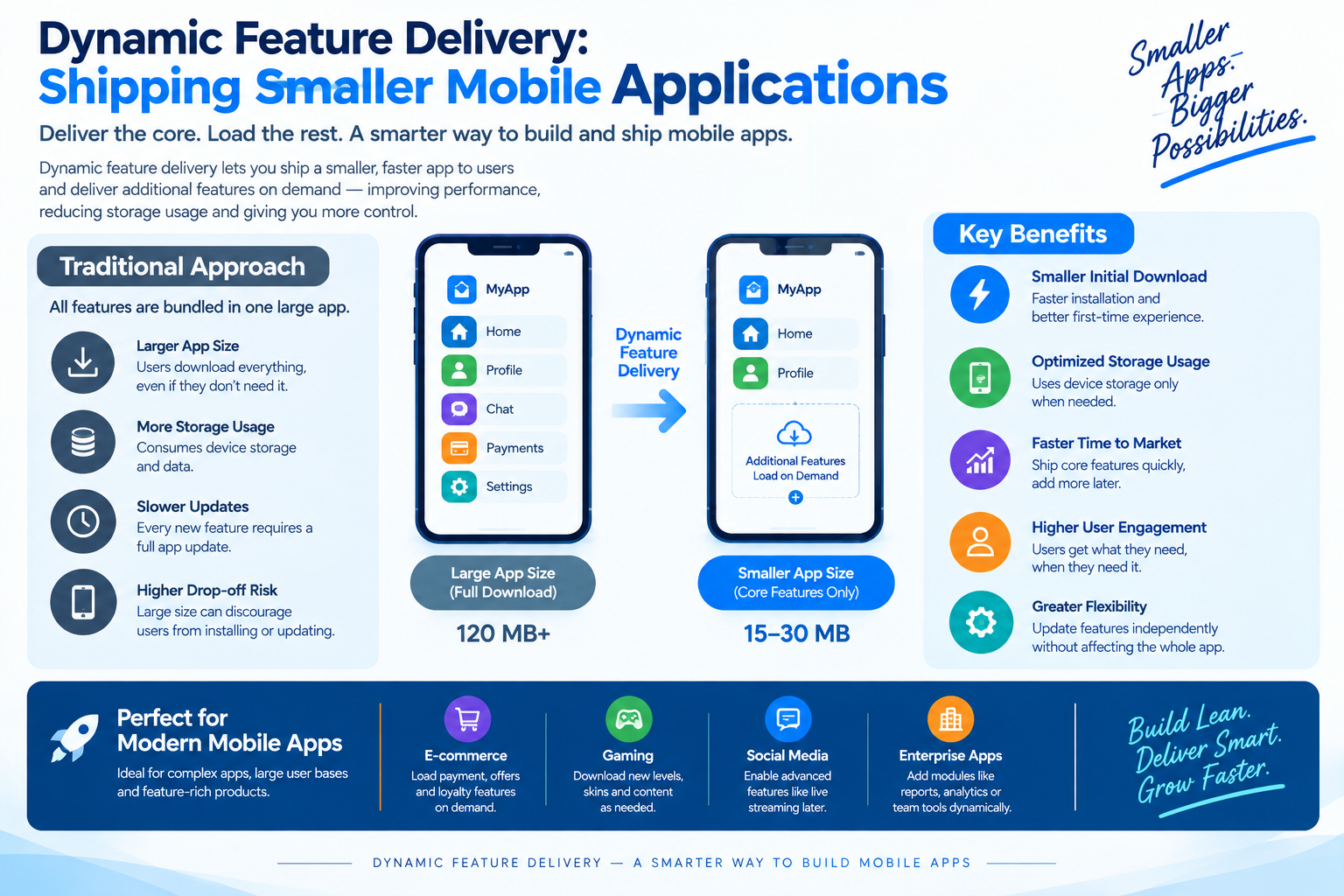
Dynamic feature delivery is the practice of shipping features separately from the base application, installing them on demand.
The core idea: The base app contains the minimum required to launch and function. Additional features are delivered as separate modules downloaded when the user needs them, and optionally removed when they are no longer used.
The user experience: The user installs a smaller app. When they access a feature that is not yet installed, the app downloads it transparently, usually in seconds.
The Platforms
Both major mobile platforms support dynamic feature delivery, though the implementations differ.
Android: Dynamic Feature Modules
Android supports dynamic feature modules separate modules that can be downloaded on demand.
What they provide:
-
Modularization of the app into base and feature modules
-
On-demand installation at runtime
-
Conditional delivery based on device characteristics
-
Install-time, fast-follow, and on-demand delivery modes
The practical benefit: The base app stays small, and features are delivered when they are actually needed. This is the same modularization approach used to reduce base app size in production applications.
iOS: On-Demand Resources
iOS supports on-demand resources assets and code that are downloaded from the App Store when needed.
What they provide:
-
Tag-based resource grouping
-
Download at runtime with progress reporting
-
Automatic removal when storage is needed
-
Integration with the app's lifecycle
The practical difference: iOS on-demand resources are primarily designed for assets rather than code. Android dynamic feature modules can include code, allowing functionality itself to be delivered on demand.
Cross-Platform Frameworks
Cross-platform frameworks have limited support for dynamic feature delivery. Flutter and React Native can use platform-specific mechanisms, but the abstraction adds complexity.
The practical consideration: Dynamic feature delivery is easier to implement in native development than in cross-platform frameworks.
What to Deliver Dynamically
Not every feature should be delivered dynamically. The choice depends on how often the feature is used and how large it is.
| Feature Type | Dynamic Delivery? |
|---|---|
| Core functionality | No : must be in the base app |
| Frequently used features | Usually no : the download overhead is not worth it |
| Occasionally used features | Yes : good candidates |
| Rarely used features | Yes : strong candidates |
| Large assets (media, models) | Yes : reduces initial download |
| Region-specific features | Yes : conditional delivery |
| Device-specific features | Yes : conditional delivery |
| Experimental features | Yes : trial without base app cost |
The decision framework: If the feature is large and infrequently used, dynamic delivery helps. If it is small and frequently used, the overhead of dynamic delivery outweighs the benefit.
The Benefits
Smaller Initial Download
The base app contains only what is required to launch and use core functionality. Everything else is delivered on demand.
The impact: Higher install conversion, particularly in constrained markets.
Faster First Launch
A smaller app installs faster and launches faster the first time.
The impact: Lower abandonment during onboarding.
Lower Storage Footprint
Features that are not used are not installed. Storage consumption matches actual usage.
The impact: Lower churn from storage pressure.
Smaller Updates
Updates to the base app are smaller because they do not include every feature.
The impact: More users update, which improves security and consistency.
Conditional Delivery
Features can be delivered only to devices that can use them. A feature requiring a specific sensor or a minimum OS version is not delivered to devices that cannot run it.
The impact: Reduced waste and better fit.
Modular Development
Feature modules encourage cleaner boundaries between parts of the app.
The impact: Better maintainability and clearer ownership.
The Costs
Dynamic feature delivery is not free.
Complexity
Modularizing an app requires restructuring. The base app and feature modules must be defined, boundaries must be enforced, and dependencies must be managed.
The cost: Engineering effort upfront and ongoing discipline to maintain boundaries.
Download Latency
Features delivered on demand are not available instantly. The user must wait for the download.
The cost: A worse experience if the download is slow or the feature is needed immediately.
Offline Limitations
A feature that has not been downloaded cannot be used offline.
The cost: Users in low-connectivity environments may not be able to access features when they need them.
Testing Complexity
Every combination of installed features must be tested. The test matrix grows.
The cost: More testing effort.
Framework Limitations
Cross-platform frameworks have limited support, which constrains the approach for teams using them.
The cost: Either native development or accepting the limitation.
The Design Considerations
Handle the Download Gracefully
The user should know what is happening and how long it will take.
The practice: Show progress, set expectations, and allow the user to continue with other parts of the app while the download completes.
Prefetch Where Predictable
If a feature is likely to be needed, prefetch it before the user requests it.
The practice: Use usage patterns to predict and prefetch during idle time or on Wi-Fi.
Respect Metered Connections
Do not download large features on metered connections without the user's awareness.
The practice: Detect network conditions and defer large downloads to unmetered connections, or ask the user.
Plan for Offline Use
If a feature must work offline, deliver it proactively rather than on demand.
The practice: Include offline-critical features in the base app or download them at install time.
Remove Unused Features
Features that are no longer used should be removed to reclaim storage.
The practice: Track feature usage and remove unused modules, with the ability to re-download if needed.
Implementation Roadmap
Phase 1: Assess (Weeks 1-4)
-
Measure current app size. What is the base, and what contributes most?
-
Analyze feature usage. Which features are used frequently, and which rarely?
-
Identify candidates for dynamic delivery. Large, infrequently used features are the best candidates.
-
Assess platform support. What do your target platforms and frameworks support?
Phase 2: Modularize (Weeks 5-12)
-
Define module boundaries. Separate the base app from feature modules.
-
Move candidates to feature modules.
-
Implement on-demand delivery.
-
Implement download UX with progress and error handling.
-
Implement conditional delivery for device and region-specific features.
Phase 3: Optimize (Weeks 13-16+)
-
Measure install conversion and app size.
-
Track feature usage and adjust which features are dynamic.
-
Implement prefetching where usage is predictable.
-
Monitor download failures and handle them gracefully.
Frequently Asked Questions
Q1: What is dynamic feature delivery?
Shipping features separately from the base application so they can be installed on demand rather than included in the initial download.
Q2: Does this work on both iOS and Android?
Both platforms support it, but differently. Android supports dynamic feature modules that can include code. iOS supports on-demand resources, which are primarily for assets.
Q3: Will this reduce my app's size?
The initial download will be smaller. The total installed size may be similar if the user downloads all features.
Q4: What features should I deliver dynamically?
Large features that are used infrequently. Small, frequently used features are usually better in the base app.
Q5: Does this work with Flutter and React Native?
Partially. Cross-platform frameworks have limited support, which adds complexity. Native development offers more complete support.
Q6: How can Innovative AI Solutions help?
We help organizations design and implement dynamic feature delivery from app modularization and module boundaries to on-demand delivery and download UX. Explore our services to see how we approach mobile engineering. Based in Delhi, serving clients across India.
Why Delhi is a Great Hub for Mobile Engineering
Delhi is emerging as a hub for mobile and product engineering, backed by one of the largest smartphone user bases in the world and a device landscape dominated by mid-range and low-end hardware. In a market where app size directly affects install conversion, dynamic feature delivery is a practical requirement rather than an optimization.
What We Offer at Innovative AI Solutions
-
App Size Assessment: We measure current size and identify the biggest contributors.
-
Module Design: We define module boundaries and separate base from feature.
-
On-Demand Delivery: We implement dynamic delivery with proper UX.
-
Conditional Delivery: We deliver features based on device and region.
-
Prefetching: We predict feature usage and prefetch during idle time.
-
Measurement: We track install conversion, size, and feature usage.
Final Thought
The shift is clear: from shipping one monolithic app to delivering features on demand. App size affects install conversion, retention, and market reach particularly in markets where users operate on constrained devices and networks. Organizations that modularize their apps and deliver features dynamically will reach more users and serve them better. Those that keep shipping everything to everyone will keep discovering that the download was the barrier.
Contact Us:
Phone: +91 7464 099 059 / +91 9689967356
Email: info@innovativeais.com
Address: 904, 9th floor Pearls Best Heights-I, Netaji Subhash Place, Delhi-110034
Website: https://innovativeais.com
About the Author
Abhishek Kumar
Founder & CEO, Innovative AI Solutions
5+ years building AI, cloud, and enterprise systems. Based in Delhi, serving clients across India.