The Big Question
What happens when your systems can't react fast enough?
Traditional software follows a request-response model. A user clicks a button. The system processes the request. It sends back a response. Then it waits for the next request.
This works when interactions are simple and volumes are low. It breaks when businesses need to react to events in real time—when a payment fails, when inventory drops below threshold, when a customer abandons a cart, when a fraud signal appears.
In a request-response world, someone has to ask: "Did this happen?" The system checks. It responds. But by then, the moment may have passed.
Event-driven architecture flips the model.
Instead of systems asking for information, they react to events. When something happens a transaction completes, a sensor reads, a user acts an event is published. Any system interested in that event reacts to it. No polling. No waiting. No missed signals.
The business case is compelling. Organizations using event-driven architecture report real-time visibility across operations, faster response times, and the ability to scale components independently. But the shift isn't just technical it's a different way of thinking about how software works.
What Event-Driven Architecture Actually Means
Event-driven architecture (EDA) is a software design pattern where the flow of the program is determined by events—significant changes in state that systems need to know about.
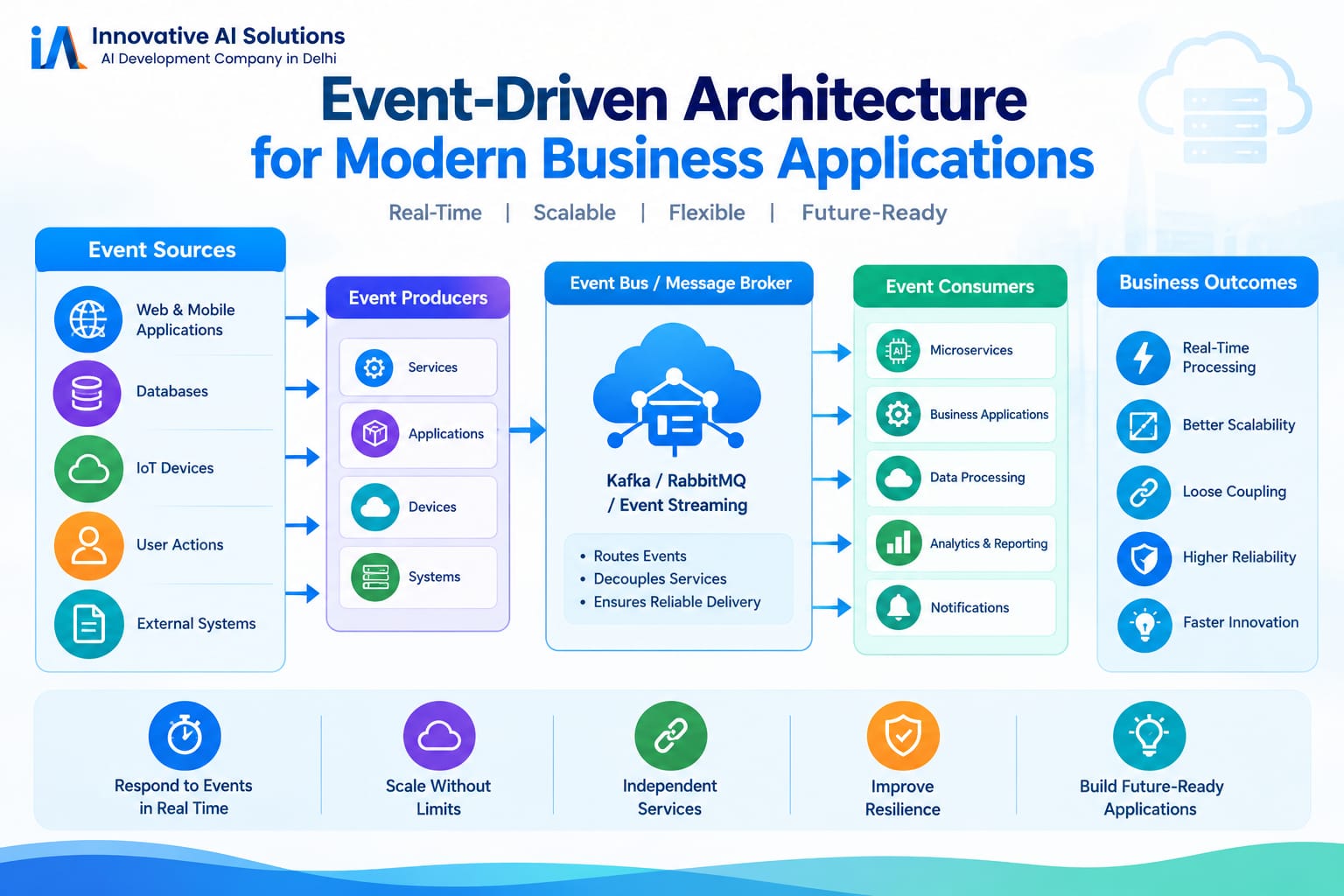
The core components are:
Event producers: Systems or services that detect and publish events. A payment service publishes a "payment.completed" event. An IoT sensor publishes a "temperature.threshold_exceeded" event.
Event brokers: The middleware that receives events and routes them to interested consumers. Apache Kafka, RabbitMQ, AWS EventBridge, and Google Pub/Sub are common examples.
Event consumers: Systems or services that subscribe to events and react to them. An inventory service consumes "order.placed" events to update stock levels. A notification service consumes "payment.failed" events to alert the customer.
Event streams: The persistent log of events that can be replayed, analyzed, or used to rebuild state.
The defining characteristic is decoupling. Producers don't know who consumes their events. Consumers don't know who produces them. They communicate through the event broker, which handles routing, delivery, and (in many cases) persistence.
This is fundamentally different from request-response, where the caller must know the recipient, wait for a response, and handle failures synchronously.
Why Event-Driven Architecture Matters Now
Three forces are driving EDA adoption.
First, real-time expectations. Customers expect immediate responses. A payment failure should trigger an instant notification. A fraud signal should block a transaction before it completes. Batch processing overnight is no longer acceptable.
Second, distributed systems. Modern applications are composed of many services microservices, serverless functions, third-party APIs. Coordinating them synchronously creates tight coupling and cascading failures. Events decouple them.
Third, AI and automation. AI agents need to react to events, not poll for state changes. An agent that monitors inventory needs to know when stock drops, not check every minute. Events are the natural trigger for agent actions.
The market reflects this. According to industry research, the global event stream processing market is projected to grow from $1.5 billion in 2024 to $6.6 billion by 2032, a compound annual growth rate of 20.3%. The event-driven architecture market is expected to reach $15.4 billion by 2030.
The Architecture: How EDA Works
Event-driven architecture can be implemented in several patterns.
Pub/Sub (Publish-Subscribe)
Producers publish events to a topic. Consumers subscribe to topics they care about. The broker delivers events to all subscribers. This is the most common pattern simple, scalable, and flexible.
Event Streaming
Events are stored in an ordered, persistent log. Consumers can read from any point in the stream. They can replay events, process them in order, or analyze them for patterns. Apache Kafka is the dominant platform for this pattern.
Event Sourcing
Instead of storing current state, the system stores the sequence of events that led to that state. State is rebuilt by replaying events. This provides a complete audit trail and enables temporal queries ("what did the system look like at this point in time?").
CQRS (Command Query Responsibility Segregation)
Commands (writes) and queries (reads) are separated. Commands produce events. Queries read from optimized read models that are updated by consuming events. This allows independent scaling of reads and writes.
Saga Pattern
For long-running business transactions that span multiple services, a saga coordinates the sequence of events and compensating actions. If one step fails, the saga triggers rollback events to undo previous steps.
Each pattern solves a different problem. Most systems combine several.
The Business Benefits
Event-driven architecture delivers benefits that go beyond technical elegance.
Real-Time Responsiveness
Events are processed as they happen. No polling. No batch delays. A fraud signal triggers immediate action. A stock-out event triggers immediate reorder. A customer action triggers immediate personalization.
Loose Coupling
Producers and consumers are independent. A new consumer can subscribe to existing events without changing producers. A producer can be replaced without affecting consumers. This reduces coordination overhead and enables team autonomy.
Scalability
Components scale independently. If event volume spikes, more consumers can be added. If a consumer is slow, it doesn't block producers. The system handles load gracefully.
Resilience
If a consumer fails, events are retained (in streaming platforms). When the consumer recovers, it resumes from where it left off. No data is lost. No manual intervention required.
Auditability
Events are a complete record of what happened. For compliance, debugging, and analytics, this is invaluable. You can trace exactly what occurred, when, and in what order.
AI Readiness
AI agents need to react to events. An agent that monitors supply chain disruptions needs to know when a shipment is delayed. An agent that qualifies leads needs to know when a prospect visits the pricing page. Events are the triggers for agent actions.
Real-World Use Cases
Event-driven architecture is being used across industries.
E-commerce
Events: order.placed, payment.completed, inventory.updated, shipment.dispatched, cart.abandoned.
Consumers: inventory service (updates stock), notification service (sends confirmations), recommendation service (updates personalization), analytics service (tracks conversion).
Financial Services
Events: transaction.initiated, fraud.signal_detected, account.balance_updated, payment.failed.
Consumers: fraud service (blocks suspicious transactions), notification service (alerts customer), compliance service (logs for audit), analytics service (detects patterns).
Manufacturing
Events: sensor.threshold_exceeded, machine.maintenance_required, quality.check_failed, inventory.low.
Consumers: maintenance service (schedules repair), quality service (triggers investigation), procurement service (reorders materials), dashboard service (updates real-time view).
Healthcare
Events: patient.admitted, lab.result_ready, medication.due, vital.sign_abnormal.
Consumers: care coordination service (notifies providers), pharmacy service (prepares medication), monitoring service (alerts on abnormal vitals), records service (updates patient history).
Logistics
Events: shipment.picked_up, package.delayed, delivery.attempted, customs.cleared.
Consumers: tracking service (updates customer view), notification service (alerts recipient), optimization service (reroutes if possible), analytics service (tracks performance).
The pattern is consistent: events represent things that happened. Consumers react to those events. The system stays synchronized without tight coupling.
What This Means for Your Business
For engineering leaders:
Event-driven architecture is not a silver bullet. It introduces complexity eventual consistency, distributed tracing, message ordering, and idempotency. Start with a bounded context. Use events where they solve a real problem (real-time reactions, decoupling, auditability). Don't use them everywhere.
For product leaders:
EDA enables features that are difficult or impossible with request-response. Real-time notifications. Dynamic pricing. Personalized recommendations. Fraud detection. If your roadmap includes these, you need EDA.
For business leaders:
EDA is a strategic investment in responsiveness. It enables your business to react to what's happening not what happened yesterday. The question is not whether to adopt it. It is where to start.
For Indian businesses:
The talent and tooling are available. Apache Kafka, AWS EventBridge, and Google Pub/Sub have strong adoption in India. The ecosystem of consultants and implementation partners is mature. Start with one domain. Prove value. Then expand.
Frequently Asked Questions
Q1: What is event-driven architecture?
Event-driven architecture is a software design pattern where the flow of the program is determined by events significant changes in state. Producers publish events. Consumers subscribe and react to them. Systems communicate through an event broker rather than direct calls.
Q2: How is EDA different from request-response?
In request-response, the caller must know the recipient, wait for a response, and handle failures synchronously. In EDA, producers don't know who consumes their events. Consumers don't know who produces them. Communication is asynchronous and decoupled.
Q3: What is an event broker?
The middleware that receives events and routes them to interested consumers. Examples include Apache Kafka, RabbitMQ, AWS EventBridge, and Google Pub/Sub. The broker handles routing, delivery, and (in streaming platforms) persistence.
Q4: What is the difference between pub/sub and event streaming?
Pub/sub delivers events to all subscribers in real time. Event streaming stores events in an ordered, persistent log that can be replayed. Kafka combines both it's a pub/sub system with persistent storage.
Q5: What is event sourcing?
Instead of storing current state, the system stores the sequence of events that led to that state. State is rebuilt by replaying events. This provides a complete audit trail and enables temporal queries.
Q6: What is CQRS?
Command Query Responsibility Segregation. Commands (writes) and queries (reads) are separated. Commands produce events. Queries read from optimized read models updated by consuming events. This allows independent scaling of reads and writes.
Q7: What is the saga pattern?
For long-running business transactions spanning multiple services, a saga coordinates the sequence of events and compensating actions. If one step fails, the saga triggers rollback events to undo previous steps.
Q8: What are the benefits of EDA?
Real-time responsiveness, loose coupling, independent scalability, resilience, auditability, and AI readiness. Systems react to events as they happen, not after polling or batch processing.
Q9: What are the challenges of EDA?
Eventual consistency (data is not immediately consistent across services), distributed tracing (harder to debug), message ordering (events may arrive out of order), and idempotency (consumers must handle duplicate events).
Q10: How much does it cost to implement EDA?
It depends on scope. A single-domain implementation ranges from $50,000 to $200,000 for setup. Enterprise-wide implementations can cost $500,000 to $2 million+. Ongoing costs include broker infrastructure, monitoring, and operational overhead.
Frequently Asked Questions (Continued)
Q11: When should I use EDA?
When you need real-time reactions, when systems need to be decoupled, when you need an audit trail, when AI agents need to react to events, or when you need to scale components independently. Not everywhere EDA introduces complexity.
Q12: What is an event mesh?
A layer that connects event brokers across environments, enabling events to flow between cloud, on-premises, and edge. It provides consistent governance, security, and routing across distributed systems.
Q13: How does EDA support AI agents?
AI agents need to react to events, not poll for state changes. An agent that monitors inventory needs to know when stock drops. An agent that qualifies leads needs to know when a prospect visits the pricing page. Events are the triggers for agent actions.
Q14: What is the difference between an event and a message?
An event is a statement of fact something that happened. A message is a request or command. Events are broadcast to any interested consumer. Messages are typically addressed to a specific recipient.
Q15: Why should I choose Innovative AI Solutions?
Because we build event-driven systems designed for real-time responsiveness. Because we understand that architecture is a business decision, not just a technical one. Because we've delivered 100+ projects. Because your code is always yours.
Contact Us
Phone:
+91 7464 099 059
+91 9689967356
Email:
info@innovativeais.com
Address:
9th Floor, Pearls Best Heights-I,
Head Office: 904, Netaji Subhash Place,
Delhi – 110034