The real estate industry is highly competitive. Managing leads, properties, site visits, agents, follow-ups, and sales manually can quickly become complicated. Real estate businesses need a centralized system that can organize their entire sales process and help teams close deals faster.
This is where a Real Estate CRM (Customer Relationship Management) system can make a major difference.
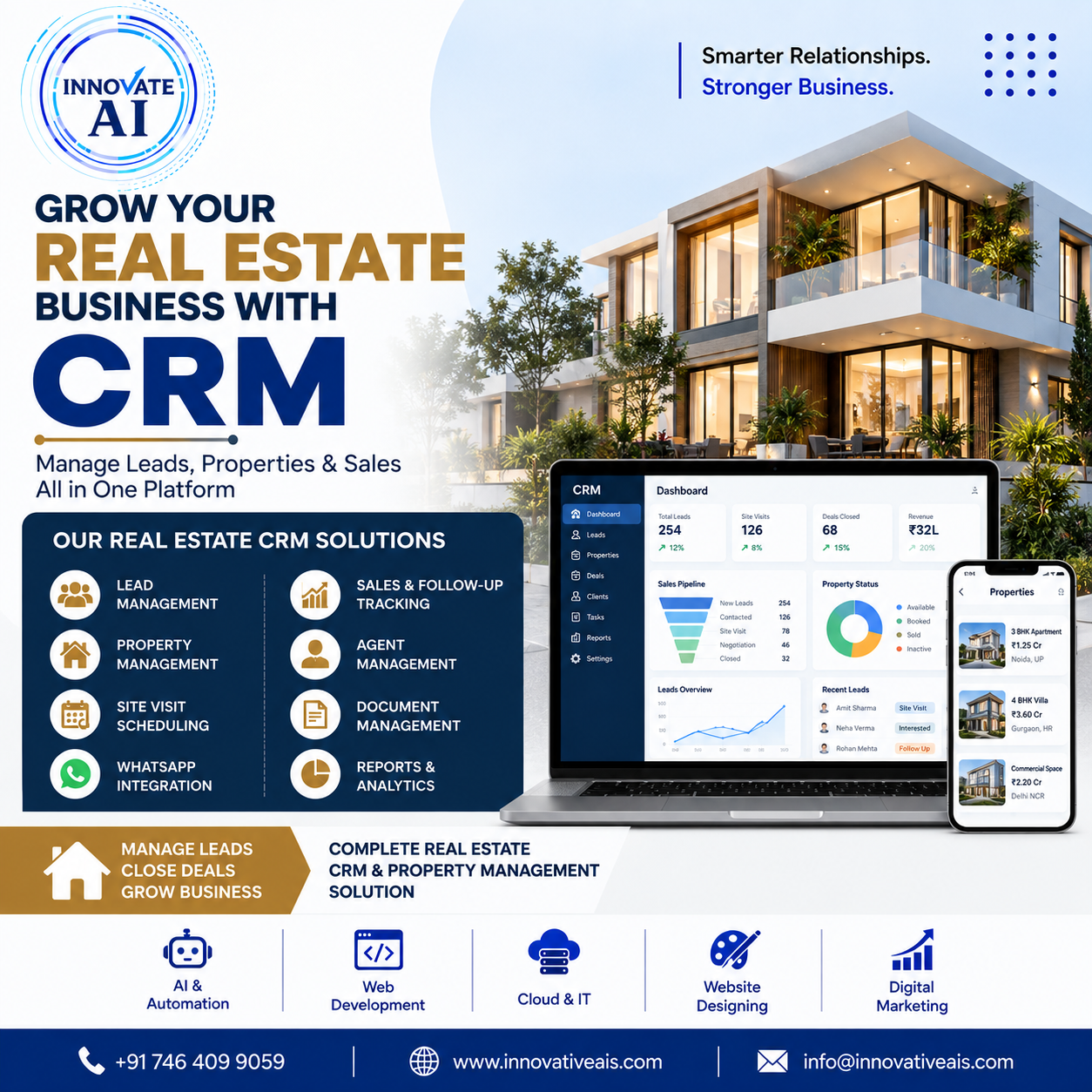
A modern real estate CRM brings lead management, property management, sales tracking, agent management, WhatsApp integration, site visit scheduling, document management, and analytics together in one platform.
What Is a Real Estate CRM?
A Real Estate CRM is software designed specifically to help real estate companies manage their customers, leads, properties, agents, and sales pipeline.
Instead of maintaining information across Excel sheets, WhatsApp conversations, emails, notebooks, and different applications, a CRM provides one centralized platform.
With a well-designed CRM, your team can:
- Capture and manage leads
- Track property inquiries
- Assign leads to sales agents
- Schedule site visits
- Manage property information
- Track sales follow-ups
- Monitor deal progress
- Manage customer documents
- Generate business reports
- Analyze sales performance
The result is a more organized and efficient real estate operation.
Why Real Estate Businesses Need CRM Software
Real estate sales involve multiple interactions before a deal is completed. A potential customer may call, send a WhatsApp message, visit a property, request documents, negotiate the price, and then finally make a purchase.
Without a centralized system, important information can easily get lost.
A CRM helps businesses maintain a complete history of every lead and interaction.
For example:
New Lead → Lead Qualification → Agent Assignment → Follow-Up → Site Visit → Negotiation → Deal Closed
Your sales team can track every stage from a single dashboard.
1. Lead Management
Lead management is one of the most important features of a real estate CRM.
Businesses receive leads from multiple sources such as:
- Website
- Google Ads
- Facebook Ads
- Property portals
- Phone calls
- Referral campaigns
A CRM can bring these leads into one centralized system.
Sales managers can see:
- New leads
- Contacted leads
- Interested customers
- Site-visit leads
- Negotiation leads
- Converted customers
- Lost leads
This allows sales teams to prioritize the leads most likely to convert.
2. Property Management
Managing hundreds of properties using spreadsheets can become difficult.
A real estate CRM can maintain property information including:
- Property name
- Location
- Property type
- Price
- Size
- Availability
- Images
- Amenities
- Customer requirements
- Booking status
Sales agents can quickly find properties based on customer requirements.
For example, if a customer wants a 3 BHK apartment in Noida under ₹1.5 crore, the agent can quickly identify suitable properties instead of manually checking multiple files.
3. Sales & Follow-Up Tracking
Many real estate deals are lost because follow-ups are missed.
A CRM allows sales teams to schedule and track follow-ups.
Managers can monitor:
Who needs a call today?
Which customer requested a site visit?
Which lead has not been contacted?
Which deal is close to conversion?
Automated reminders can help sales representatives stay consistent with their follow-up activities.
4. Agent Management
Real estate companies often have multiple sales agents.
A CRM can help managers assign leads to specific agents and monitor their performance.
Managers can track:
- Leads assigned
- Calls completed
- Follow-ups
- Site visits
- Deals closed
- Revenue generated
- Conversion rate
This creates transparency across the sales team.
5. Site Visit Scheduling
Site visits are an important part of the real estate buying journey.
A CRM can simplify site visit scheduling by maintaining:
- Customer details
- Property details
- Agent details
- Visit date
- Visit time
- Visit status
- Follow-up requirements
After the visit, the sales agent can update the customer's response and move the lead to the next stage.
6. WhatsApp Integration
WhatsApp has become an important communication channel for real estate businesses.
A CRM with WhatsApp integration can help businesses communicate with customers more efficiently.
Businesses can use WhatsApp for:
- Lead notifications
- Property details
- Site visit reminders
- Follow-up messages
- Offers
- Appointment confirmations
- Customer communication
When combined with automation and AI, WhatsApp can become a powerful sales channel.
7. Document Management
Real estate transactions involve a large amount of documentation.
A CRM can help organize documents related to:
- Customers
- Properties
- Agreements
- KYC
- Booking
- Payments
- Sales transactions
Centralized document management makes it easier for authorized team members to find the required information.
8. Reports & Analytics
Data-driven decision-making is essential for growing a real estate business.
A CRM dashboard can provide insights into:
- Total leads
- New leads
- Conversion rate
- Site visits
- Deals closed
- Revenue
- Property availability
- Agent performance
- Lead sources
For example, management may discover that Google Ads generates more qualified leads than another marketing channel.
This information can help businesses allocate their marketing budget more effectively.
AI & Automation in Real Estate CRM
The next generation of CRM platforms is moving beyond simple data management.
AI can help automate several repetitive activities.
For example:
AI Lead Qualification
AI can analyze customer inquiries and identify high-intent leads.
Automated Follow-Ups
Customers can receive personalized follow-up messages based on their stage in the sales funnel.
AI Chatbots
An AI chatbot can answer common questions about properties, pricing, locations, and availability.
Lead Scoring
AI can rank leads based on their likelihood of conversion.
Sales Predictions
Businesses can analyze historical data to identify sales trends and opportunities.
Combining CRM + AI + Automation can significantly improve sales productivity.
Benefits of a Real Estate CRM
A properly implemented CRM can help businesses achieve:
Better Lead Conversion
Sales teams can respond faster and follow up consistently.
Higher Productivity
Employees spend less time managing spreadsheets and repetitive administrative tasks.
Better Customer Experience
Customers receive faster responses and more organized communication.
Improved Sales Visibility
Managers can see the complete sales pipeline from one dashboard.
Reduced Lead Leakage
Every lead can be tracked from acquisition to conversion.
Data-Driven Decisions
Real-time reports help management make better business decisions.
Choosing the Right Real Estate CRM
Every real estate company has different requirements.
Before selecting or developing a CRM, consider:
- Number of users
- Number of leads
- Property inventory
- WhatsApp requirements
- Mobile application requirements
- AI automation requirements
- Reporting requirements
- Integration requirements
- Security
- Scalability
For growing businesses, a custom real estate CRM can be a better option because the platform can be designed around the company's exact sales process.
Why Choose Innovative AI Solutions?
At Innovative AI Solutions, we build technology solutions designed around real business requirements.
Our approach combines CRM development, AI automation, web development, cloud technology, and digital solutions to help businesses improve their operations.
For real estate companies, a customized CRM can bring lead management, property management, agent management, site visits, follow-ups, WhatsApp communication, documents, and analytics into one centralized platform.
The goal is simple:
Manage Leads → Close Deals → Grow Your Business
Conclusion
Real estate businesses cannot afford to lose valuable leads because of missed follow-ups, scattered customer information, or inefficient sales processes.
A modern Real Estate CRM provides a centralized platform for managing leads, properties, agents, site visits, sales, documents, communication, and analytics.
When AI and automation are added to the CRM, businesses can go one step further by automating repetitive tasks, improving lead qualification, and helping sales teams focus on high-value opportunities.
If you're looking to build a custom Real Estate CRM for your business, Innovative AI Solutions can help you design and develop a scalable platform tailored to your workflow.
Innovative AI Solutions
AI & Automation | Web Development | Cloud & IT | Software Solutions
Phone: +91 746 409 9059
Website: www.innovativeais.com
Email: info@innovativeais.com