The Big Question
Why does software become harder to change as it grows?
Every growing business hits the same wall. The system that worked at 10,000 users struggles at 100,000. The codebase that three developers could manage now requires twenty. The feature that took a week to build takes a month. Every change breaks something else.
This is not a people problem. It is an architecture problem.
Monolithic software where everything is connected to everything else creates hidden dependencies. A change to the billing module breaks the reporting module. A database schema update cascades through a dozen services. Testing becomes a full-time job. Deployment becomes a weekend event.
The cost compounds. According to industry research, 40–50% of total IT investment spend goes to technical debt the accumulated cost of maintaining and working around architectural limitations.
Modular architecture changes this equation.
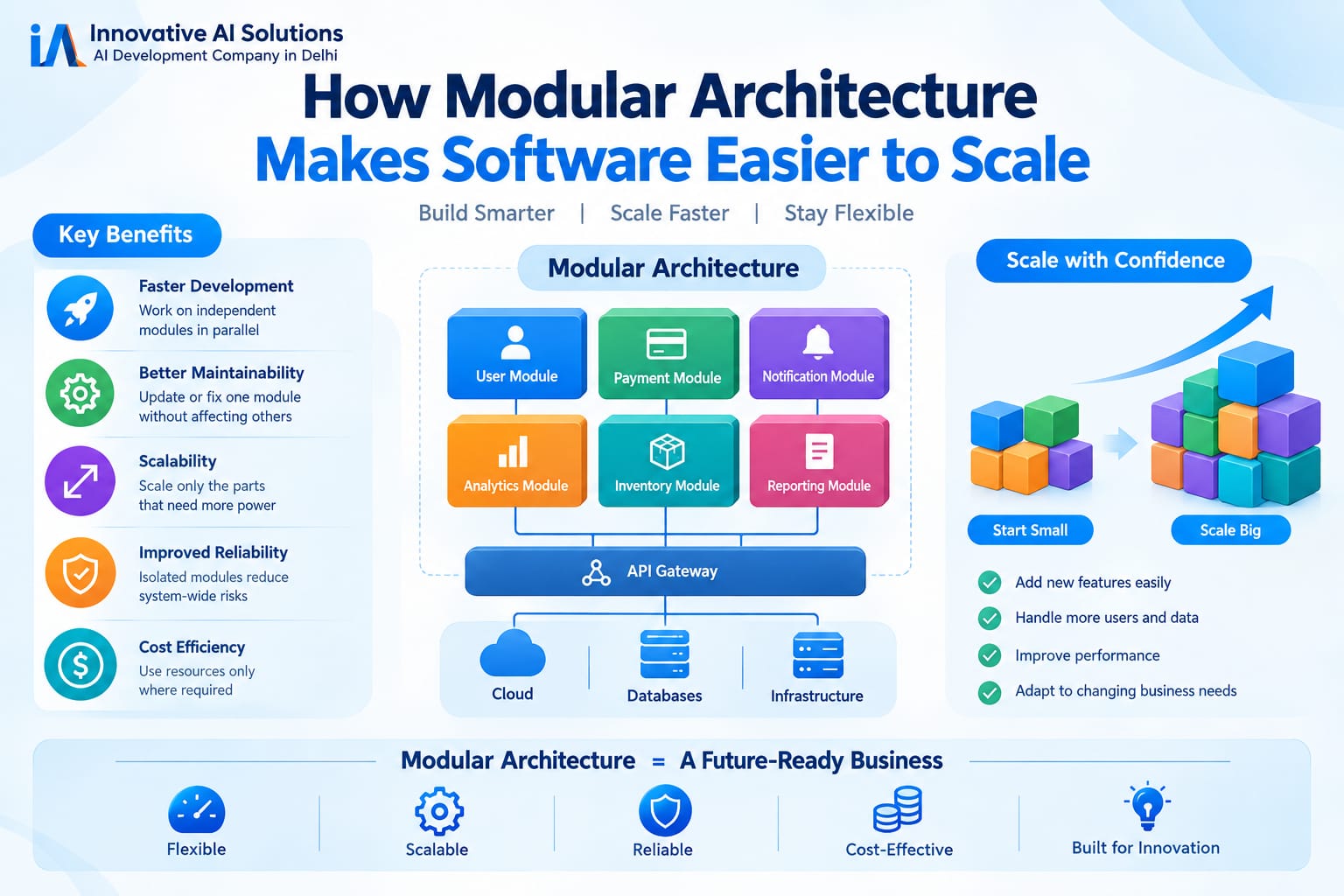
Instead of one tightly coupled system, modular software is built from independent, interchangeable components that communicate through well-defined interfaces. Each module can be developed, deployed, and scaled independently. Changes stay contained. Failures don't cascade. Growth happens without rewrites.
The data confirms the shift. Gartner predicts that by 2027, 80% of AI-generated business applications will be 80% composable to support engineering and business agility.
What Modular Architecture Actually Means
Modular architecture is not a single pattern. It is a philosophy building software from separable, self-contained components that can be recombined in different ways.
The defining characteristics are:
Encapsulation: Each module hides its internal complexity behind a well-defined interface. Other modules interact with it only through that interface.
Loose coupling: Modules have minimal dependencies on each other. A change in one module does not require changes in others.
High cohesion: Each module focuses on a single responsibility. Everything within the module is related to that responsibility.
Independent deployability: Modules can be updated, replaced, or scaled without redeploying the entire system.
Composability: Modules can be assembled into different configurations to serve different purposes.
This is different from the traditional enterprise software model, where functionality is bundled into monolithic applications. An ERP that handles finance, HR, inventory, and CRM in a single codebase is monolithic. A system where each of those functions is a separate, integrable module is modular.
The Spectrum: From Monolith to Microservices
Modular architecture exists on a spectrum. Understanding the options helps you choose the right approach.
Traditional Monolith
Everything in one codebase. One deployment unit. Simple to start, increasingly difficult to scale. Changes require full system testing and redeployment.
Modular Monolith
A single deployment unit, but internally organized into well-defined modules with clear boundaries. This approach offers many benefits of modularity separation of concerns, independent testing without the operational complexity of distributed systems. It is often the right starting point for growing businesses.
Microservices
Independent services that communicate over a network. Each service can be deployed, scaled, and updated independently. This approach offers maximum flexibility but introduces operational complexity service discovery, network latency, distributed tracing, and data consistency challenges.
Composable Architecture
The most advanced form. Packaged business capabilities (PBCs) are assembled into solutions. According to Gartner, PBCs are "modular building blocks that encapsulate a well-defined business capability, are discoverable and self-contained, and provide business value."
The right choice depends on scale, team size, and operational maturity. A startup should not build microservices on day one. An enterprise cannot remain monolithic forever.
Why Modular Architecture Scales Better
The scalability benefits of modular architecture are structural, not incremental.
Independent Scaling
In a monolithic system, scaling means replicating the entire application even if only one function is under load. If your payment processing needs more capacity, you scale the whole system.
In a modular system, you scale only the modules that need it. The payment module can be replicated independently while the rest of the system runs unchanged. This reduces infrastructure costs and improves efficiency.
Faster Deployment
Monolithic deployments require coordinated releases. Every change even a minor one requires regression testing of the entire system. Deployment windows are narrow. Risk is high.
Modular deployments are independent. A change to the search module can be deployed without touching billing. Testing is scoped to the affected module. Risk is contained. Teams can deploy multiple times per day.
Technology Flexibility
Monolithic systems lock you into a single technology stack. The entire application must be written in the same language, use the same framework, and run on the same infrastructure.
Modular systems allow polyglot architecture. The recommendation engine can be built in Python. The transaction processor can be built in Java. The user interface can be built in React. Each module uses the best tool for its job.
Team Autonomy
Monolithic systems create coordination overhead. Every team touches the same codebase. Every change requires negotiation.
Modular systems enable team autonomy. Each module has a clear owner. Teams can make decisions independently. This is why Amazon's famous "two-pizza team" model works small teams own independent services and move fast without blocking each other.
Fault Isolation
Monolithic systems fail as a unit. A bug in one component can crash the entire application.
Modular systems isolate failures. If the recommendation module goes down, the transaction module keeps running. Users may lose personalization, but they can still buy.
Incremental Modernization
Monolithic systems are all-or-nothing. Modernizing requires a full rewrite an expensive, risky proposition that often fails.
Modular systems enable incremental modernization. You can replace one module at a time while the rest of the system continues running. The strangler fig pattern gradually routing traffic from old modules to new ones reduces risk and delivers value incrementally.
The AI Factor: Why Modularity Matters for AI
AI adoption has made modular architecture more urgent.
Legacy systems are not suitable for AI acceleration. If data cannot be trusted or accessed, AI remains advisory rather than operational. Organizations pursuing AI transformation frequently discover that outdated applications become the biggest obstacle to innovation.
Modular architecture enables AI in three ways:
AI-Ready Data Access
Modular systems have well-defined interfaces. Data flows through documented APIs. AI agents can access the data they need without custom integration work.
Incremental AI Integration
AI capabilities can be added module by module. A recommendation agent can be added to the product module. A forecasting agent can be added to inventory. Each delivers value independently.
Agent Orchestration
AI agents operate across modules. An agent that qualifies leads needs access to CRM, email, and calendar modules. Modular systems make this coordination possible.
SAP's Autonomous Enterprise vision captures this: AI-native applications with an agent-based engagement layer that operates across applications, workflows, and data domains.
What This Means for Your Business
For startups and growing businesses:
Start with a modular monolith. Organize your code into clearly separated modules with defined boundaries. This gives you the benefits of modularity independent testing, clear ownership without the operational complexity of distributed systems. You can evolve to microservices when scale demands it.
For mid-market businesses:
Assess your architecture. Where are the bottlenecks? Where do changes break other things? Identify the modules that need to be separated. Use the strangler fig pattern to modernize incrementally. Don't attempt a full rewrite.
For enterprises:
Adopt composable architecture. Build your capabilities as packaged business capabilities (PBCs) that can be assembled into solutions. This enables faster adaptation, vendor flexibility, and AI integration.
For everyone:
Measure modularity. Track deployment frequency, change failure rate, mean time to recovery, and lead time for changes. These DORA metrics reveal whether your architecture is enabling or constraining your business.
Frequently Asked Questions
Q1: What is modular architecture?
Modular architecture is a software design approach where the system is built from independent, interchangeable components that communicate through well-defined interfaces. Each module can be developed, deployed, and scaled independently.
Q2: How is modular architecture different from microservices?
Modular architecture is the broader principle building software from separable components. Microservices are a specific implementation where modules are independent services communicating over a network. You can have modular architecture without microservices (modular monolith).
Q3: What is a modular monolith?
A single deployment unit that is internally organized into well-defined modules with clear boundaries. It offers many benefits of modularity—separation of concerns, independent testing without the operational complexity of distributed systems.
Q4: Why does modular architecture scale better?
Because modules can be scaled independently. In a monolithic system, scaling means replicating the entire application. In a modular system, you scale only the modules that need it reducing infrastructure costs and improving efficiency.
Q5: What are packaged business capabilities (PBCs)?
According to Gartner, PBCs are "modular building blocks that encapsulate a well-defined business capability, are discoverable and self-contained, and provide business value." They are the foundation of composable architecture.
Q6: How does modular architecture help with AI adoption?
Modular systems have well-defined interfaces and documented APIs. AI agents can access data without custom integration work. AI capabilities can be added module by module. Agent orchestration becomes possible because modules have clear boundaries.
Q7: What is the strangler fig pattern?
A gradual replacement approach where you route existing functionality to a new module, validate it, and retire the old code only after the new one stabilizes. This reduces modernization risk and delivers value incrementally.
Q8: When should I move from monolith to microservices?
When your team has grown beyond what a single codebase can support. When deployment coordination becomes a bottleneck. When different modules have different scaling requirements. When your operational maturity can handle distributed systems. Not before.
Q9: What metrics measure modular architecture success?
Deployment frequency, change failure rate, mean time to recovery, and lead time for changes. These DORA metrics reveal whether your architecture is enabling or constraining your business.
Q10: How much does it cost to modernize to modular architecture?
It depends on scope. Incremental modernization replacing one module at a time ranges from $50,000 to $500,000+ depending on complexity. Full re-architecture of a monolithic system can cost $500,000 to $5 million+.
Frequently Asked Questions (Continued)
Q11: What is composable architecture?
The most advanced form of modular architecture. Packaged business capabilities (PBCs) are assembled into solutions. Gartner predicts that by 2027, 80% of AI-generated business applications will be 80% composable.
Q12: Does modular architecture increase operational complexity?
Microservices do. Modular monoliths do not. The key is choosing the right approach for your scale and maturity. Most businesses should start with a modular monolith.
Q13: How does modular architecture reduce technical debt?
By containing change. When modules are independent, a change to one module does not cascade through others. Testing is scoped. Deployment is independent. Technical debt stops compounding.
Q14: What is the biggest mistake in modular architecture?
Premature microservices. Building distributed systems before you have the operational maturity to run them. Start with a modular monolith. Evolve when scale demands it.
Q15: Why should I choose Innovative AI Solutions?
Because we build modular systems designed to scale. Because we understand that architecture is a business decision, not just a technical one. Because we've delivered 100+ projects. Because your code is always yours.
Contact Us
Phone:
+91 7464 099 059
+91 9689967356
Email:
info@innovativeais.com
Address:
9th Floor, Pearls Best Heights-I,
Head Office: 904, Netaji Subhash Place,
Delhi – 110034