Why does product development slow down as software grows?
It's not because teams get lazy. It's not because priorities change. It's because the architecture becomes a bottleneck.
In a monolithic system, everything is connected to everything else. A change to the billing module risks breaking the reporting module. A database schema update cascades through a dozen services. Testing requires running the entire system. Deployment requires coordinating across teams.
The result: features that should take days take weeks. Developers spend more time understanding dependencies than building functionality. Teams become afraid to touch the code.
This is the architectural tax on speed. And it compounds as the system grows.
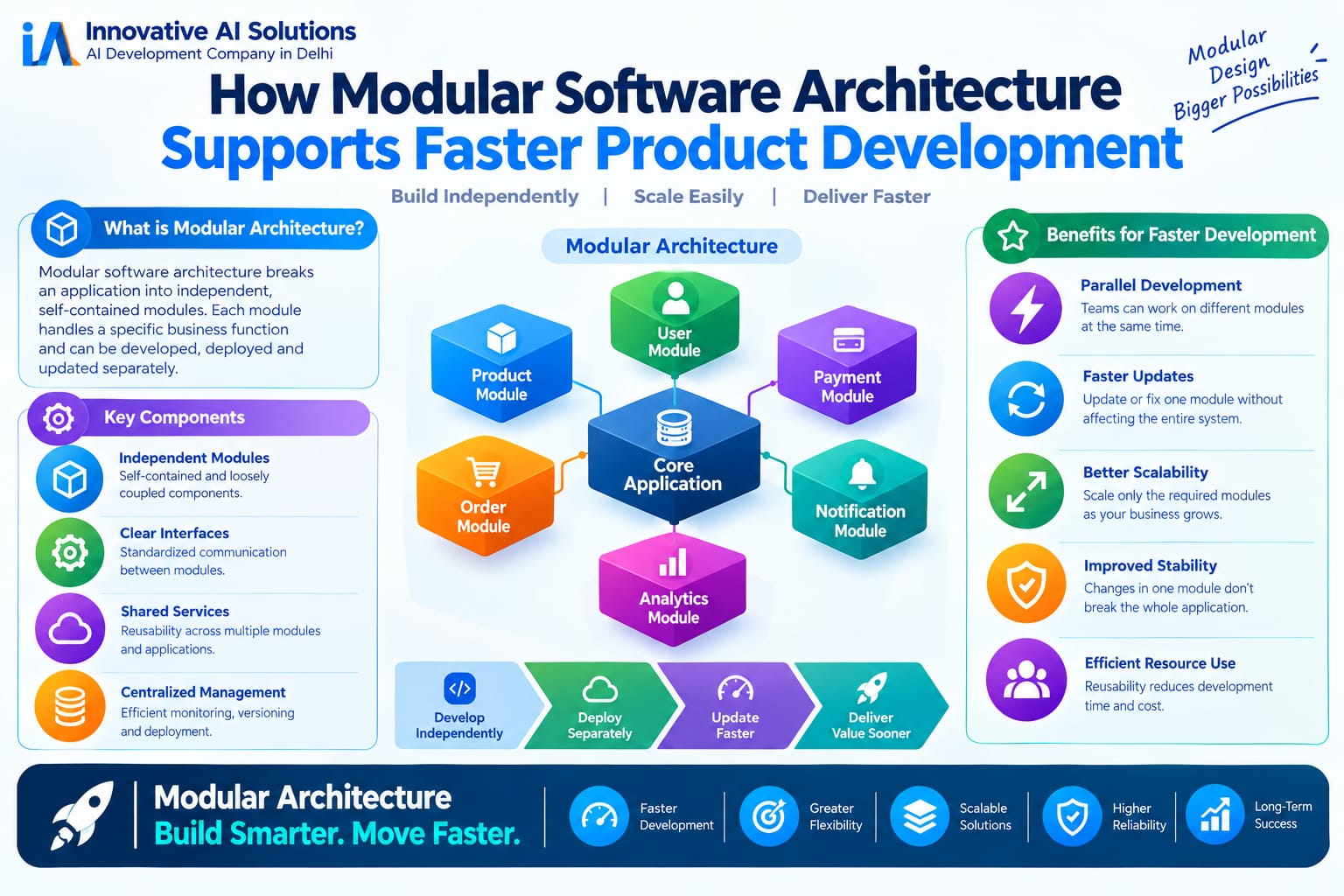
Modular software architecture removes this tax by design. It breaks the system into independent, interchangeable components that communicate through well-defined interfaces. Teams can work on different modules without interfering with each other. Changes stay contained. Deployment becomes independent.
The business case is direct: faster product development means faster time-to-market, faster response to customer needs, and faster capture of opportunities.
What Modular Software Architecture Actually Means
Modular architecture is a design approach where the system is built from independent, interchangeable components that communicate through well-defined interfaces.
The defining characteristics are:
Encapsulation. Each module hides its internal complexity behind a well-defined interface. Other modules interact with it only through that interface.
Loose coupling. Modules have minimal dependencies on each other. A change in one module does not require changes in others.
High cohesion. Each module focuses on a single responsibility. Everything within the module is related to that responsibility.
Independent deployability. Modules can be updated, replaced, or scaled without redeploying the entire system.
Composability. Modules can be assembled into different configurations to serve different purposes.
This is different from the traditional enterprise software model, where functionality is bundled into monolithic applications. An ERP that handles finance, HR, inventory, and CRM in a single codebase is monolithic. A system where each of those functions is a separate, integrable module is modular.
How Modular Architecture Accelerates Development
The speed benefits of modular architecture are structural, not incremental.
Parallel Development
In a monolithic system, teams working on different features must coordinate constantly. They share the same codebase. They risk merge conflicts. They depend on each other's changes.
In a modular system, teams work on different modules independently. They have clear boundaries. They can develop, test, and deploy without waiting for other teams. This parallelism multiplies effective capacity without adding headcount.
Independent Deployment
Monolithic deployments require coordinated releases. Every change—even a minor one—requires regression testing of the entire system. Deployment windows are narrow. Risk is high.
Modular deployments are independent. A change to the search module can be deployed without touching billing. Testing is scoped to the affected module. Risk is contained. Teams can deploy multiple times per day.
Faster Testing
In a monolithic system, testing requires running the whole application. Test suites become large, slow, and brittle. Developers wait for feedback.
In a modular system, testing is scoped. Unit tests cover individual modules. Integration tests verify boundaries. The feedback loop is faster, and developers iterate more quickly.
Contained Changes
In a monolithic system, a change to one area can break something unexpected elsewhere. Developers must understand the whole system to make safe changes.
In a modular system, changes are contained within module boundaries. A change to the billing module doesn't affect the inventory module. Developers can reason about their module in isolation.
Technology Flexibility
Monolithic systems lock you into a single technology stack. The entire application must be written in the same language, use the same framework, and run on the same infrastructure.
Modular systems allow polyglot architecture. The recommendation engine can be built in Python. The transaction processor can be built in Java. Each module uses the best tool for its job.
Team Autonomy
Monolithic systems create coordination overhead. Every team touches the same codebase. Every change requires negotiation.
Modular systems enable team autonomy. Each module has a clear owner. Teams can make decisions independently. This is why Amazon's famous "two-pizza team" model works small teams own independent services and move fast without blocking each other.
The Spectrum: From Monolith to Microservices
Modular architecture exists on a spectrum. Understanding the options helps you choose the right approach.
Traditional Monolith
Everything in one codebase. One deployment unit. Simple to start, increasingly difficult to scale. Changes require full system testing and redeployment.
Modular Monolith
A single deployment unit, but internally organized into well-defined modules with clear boundaries. This approach offers many benefits of modularity separation of concerns, independent testing without the operational complexity of distributed systems. It is often the right starting point for growing businesses.
Microservices
Independent services that communicate over a network. Each service can be deployed, scaled, and updated independently. This approach offers maximum flexibility but introduces operational complexity service discovery, network latency, distributed tracing, and data consistency challenges.
Composable Architecture
The most advanced form. Packaged business capabilities (PBCs) are assembled into solutions. Gartner predicts that by 2027, 80% of AI-generated business applications will be 80% composable.
The right choice depends on scale, team size, and operational maturity. A startup should not build microservices on day one. An enterprise cannot remain monolithic forever.
The Business Impact
Modular architecture doesn't just speed development. It changes what the business can do.
Faster Time-to-Market
Features ship faster. Products reach customers sooner. Revenue starts earlier. This is the most direct business impact.
Faster Response to Change
When the market shifts, the business can respond. New pricing rules. New product lines. New compliance requirements. Modular systems adapt without full rewrites.
Lower Risk
Independent deployment reduces the blast radius of failures. A bug in one module doesn't crash the entire system. This resilience is a competitive advantage.
Better Resource Allocation
Teams can be organized around modules. Ownership is clear. Accountability is clear. Resources are allocated to the areas that matter most.
Easier Modernization
Legacy systems can be modernized incrementally. The strangler fig pattern gradually routing traffic from old modules to new ones reduces risk and delivers value incrementally.
The Cost of Modular Architecture
Modular architecture requires investment. The trade-offs are real.
Higher Initial Build Cost
Building modular software costs 20-40% more initially than building a monolith. The additional cost goes into designing module boundaries, defining interfaces, and building the orchestration layer.
Operational Complexity
Microservices introduce distributed system challenges. Network latency. Service discovery. Data consistency. Distributed tracing. These challenges require operational maturity to manage.
Governance Overhead
Modular systems need governance. Interface contracts must be maintained. Versioning must be managed. Without governance, modules drift and dependencies become tangled.
Team Coordination
Modular systems require coordination across teams. Interface changes must be communicated. Dependencies must be managed. This requires discipline.
When the Investment Pays Off
The investment pays off when:
-
Teams are growing and coordination overhead is increasing
-
Deployment frequency needs to increase
-
Different modules have different scaling requirements
-
Technology flexibility is needed
-
The system needs to evolve continuously
For most growing businesses, the investment in modularity pays for itself within 12-18 months through faster development and lower maintenance costs.
What This Means for Your Business
For engineering leaders:
Modular architecture is a speed decision. It requires investment in boundaries, interfaces, and governance. Start with a modular monolith. Evolve to microservices when scale demands it. Measure the impact through DORA metrics deployment frequency, lead time for changes, change failure rate, and mean time to recovery.
For product leaders:
Modular architecture affects roadmap predictability. A modular system delivers features when promised. An unmaintainable monolith is a source of constant surprises. Consider architecture as a product enabler, not just a technical detail.
For business leaders:
Speed is a competitive advantage. Modular architecture enables faster time to market, faster response to change, and lower risk. The investment in modularity is an investment in agility.
For Indian businesses:
The talent and tooling are available. Frameworks like Spring Modulith, .NET Aspire, and Node.js with NestJS support modular development. The challenge is discipline consistently applying modular principles as teams grow. Start now. Don't wait until architecture becomes a bottleneck.
Frequently Asked Questions
Q1: What is modular software architecture?
Modular software architecture is a design approach where the system is built from independent, interchangeable components that communicate through well-defined interfaces. Each module can be developed, deployed, and scaled independently.
Q2: How does modular architecture speed development?
By enabling parallel development (teams work independently), independent deployment (no coordinated releases), faster testing (scoped to modules), and contained changes (no cascading failures).
Q3: What is the difference between a monolith and a modular monolith?
A traditional monolith has everything connected to everything else. A modular monolith has a single deployment unit but is internally organized into well-defined modules with clear boundaries. It offers modularity benefits without distributed system complexity.
Q4: When should I move from monolith to microservices?
When your team has grown beyond what a single codebase can support. When deployment coordination becomes a bottleneck. When different modules have different scaling requirements. When your operational maturity can handle distributed systems.
Q5: How much does modular architecture cost?
Building modular software costs 20-40% more initially than a monolith. The investment pays off through faster development and lower maintenance costs, typically within 12-18 months.
Q6: What are the challenges of modular architecture?
Operational complexity (for microservices), governance overhead (interface contracts, versioning), and team coordination (communicating interface changes, managing dependencies).
Q7: What is composable architecture?
The most advanced form of modular architecture. Packaged business capabilities (PBCs) are assembled into solutions. Gartner predicts that by 2027, 80% of AI-generated business applications will be 80% composable.
Q8: How do I measure the impact of modular architecture?
Track deployment frequency, lead time for changes, change failure rate, and mean time to recovery the DORA metrics. These reveal whether your architecture is enabling or constraining your business.
Q9: What is the strangler fig pattern?
A gradual modernization approach where you route existing functionality to a new module, validate it, and retire the old code only after the new one stabilizes. It reduces risk and delivers value incrementally.
Q10: Can I start with a monolith and migrate later?
Yes. This is the recommended path for most businesses. Start with a modular monolith. Evolve to microservices when scale demands it. The key is to maintain clear module boundaries from the beginning.
Frequently Asked Questions (Continued)
Q11: What is a packaged business capability (PBC)?
According to Gartner, PBCs are "modular building blocks that encapsulate a well-defined business capability, are discoverable and self-contained, and provide business value." They are the foundation of composable architecture.
Q12: How does modular architecture support AI adoption?
Modular systems have well-defined interfaces and documented APIs. AI agents can access data without custom integration work. AI capabilities can be added module by module. Agent orchestration becomes possible because modules have clear boundaries.
Q13: What is the biggest mistake in modular architecture?
Premature microservices. Building distributed systems before you have the operational maturity to run them. Start with a modular monolith. Evolve when scale demands it.
Q14: How do I organize teams around modules?
Use Conway's Law: system design mirrors organizational structure. Organize teams around module boundaries. Each module has a clear owner. Teams can make decisions independently.
Q15: Why should I choose Innovative AI Solutions?
Because we build modular systems designed to scale with your business. Because we understand that architecture is a speed decision. Because we've delivered 100+ projects. Because your code is always yours.
Contact Us
Phone:
+91 7464 099 059
+91 9689967356
Email:
info@innovativeais.com
Address:
9th Floor, Pearls Best Heights-I,
Head Office: 904, Netaji Subhash Place,
Delhi – 110034