The Big Question
AI agent development is not like hiring someone to build a website. With a website, you get a quote, you pay it, you own the thing. With an AI agent, you pay for the build, and then you pay for every conversation it has, every document it reads, and every decision it makes forever.
That's why pricing feels opaque. Vendors quote the build cost. They rarely quote the running cost. And the running cost is where the surprises live.
The data is stark. Per-token prices for GPT-4-equivalent performance have collapsed by 98% since late 2022 from $20 per million tokens to roughly $0.40 . Yet enterprise AI bills have risen by an estimated 320% . Uber blew through its entire 2026 AI coding budget by April. One company reportedly ran up a $500 million Claude bill in a single month after forgetting to set usage limits .
The culprit is volume. Agentic AI tools don't just answer questions. They plan, execute, retry, and orchestrate. A simple linear workflow in 2023 cost about $0.04 per interaction. An orchestrated agentic system in 2026 costs roughly $1.20 about 30 times more . Individual engineers at Microsoft were reportedly spending between $500 and $2,000 a month on tokens before licenses were pulled .
So when you ask "how much does AI agent development cost in India?", the honest answer has two parts. The build cost is knowable and finite. The running cost is where you need to pay attention.
Cost Based on Agent Type
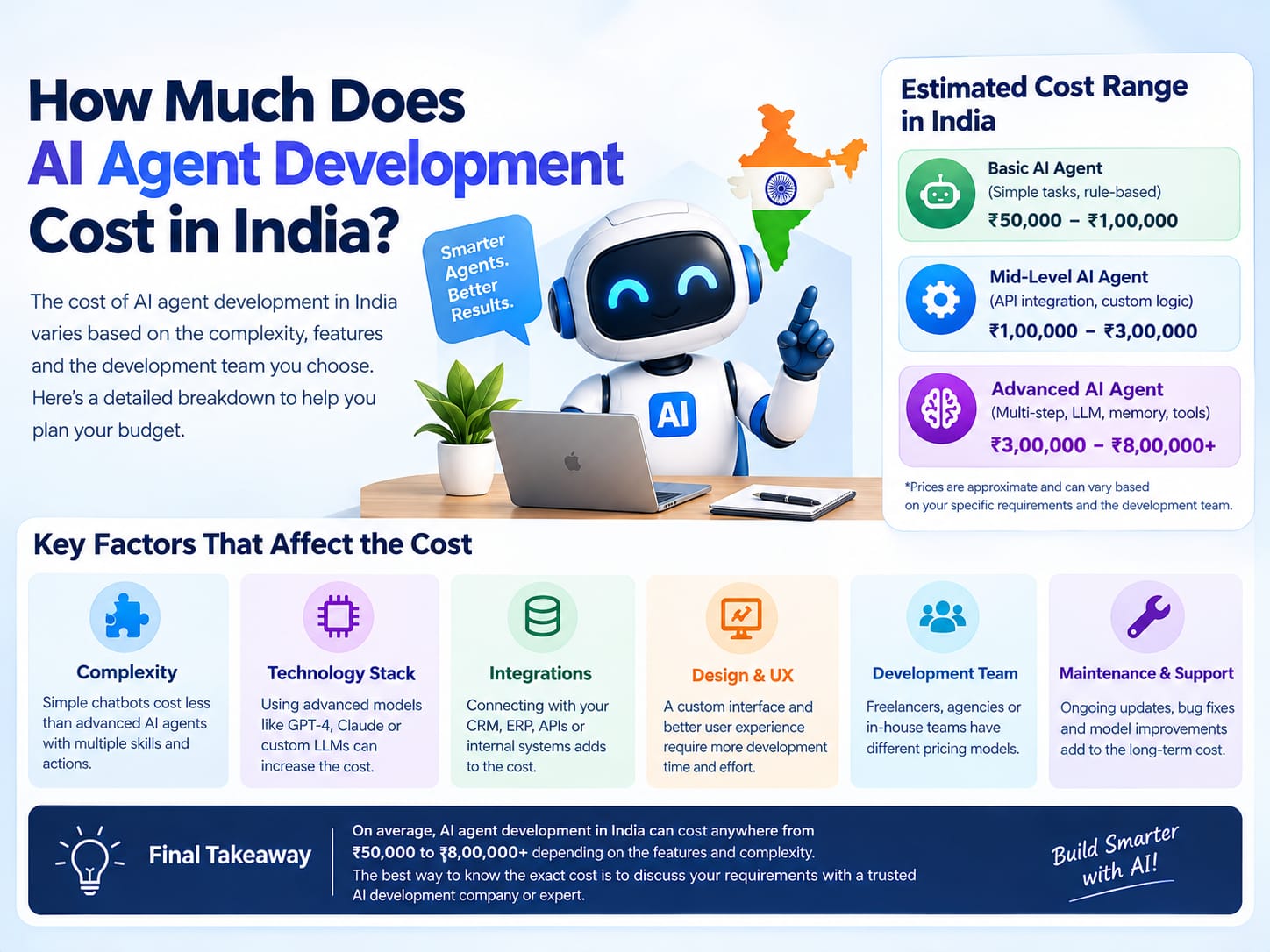
The build cost of an AI agent in India depends on three factors: what the agent does, how it connects to your systems, and whether you need private deployment. Here's the 2026 market landscape:
| Agent Type | Build Cost (India) | Monthly Run Cost | Typical Use Case |
|---|---|---|---|
| Lightweight / No-Code | ₹25,000 – ₹3,00,000 | ₹1,200 – ₹2,500 | Basic Q&A, data extraction, simple workflows |
| RAG Knowledge Assistant | ₹45,000 – ₹85,000 | ₹1,500 – ₹3,500 | Internal knowledge base, support deflection |
| Sales / Booking Agent | ₹85,000 – ₹1,80,000 | ₹3,000 – ₹7,500 | Lead qualification, appointment scheduling |
| Autonomous Transactional Agent | ₹1,80,000 – ₹4,00,000 | ₹8,000 – ₹25,000 | Order management, payment processing, logistics |
| Multi-Agent System | ₹5,00,000 – ₹15,00,000+ | ₹25,000 – ₹1,00,000+ | Revenue operations, complex workflow orchestration |
A lightweight agent built on platforms like Dify or Coze can be scoped for as little as ₹25,000 . A mid-tier RAG agent that connects to your internal CRM and knowledge base typically lands between ₹85,000 and ₹1,80,000 .
The jump to multi-agent systems is steep. These require AI architects to design agent communication protocols, orchestration layers, and guardrails. One Indian agency in Chennai publishes starting prices for AI agent builds from $2,500 (roughly ₹2.1 lakh) for international clients, with India-specific packages ranging from ₹60,000 to ₹6,00,000 .
The hidden cost: token consumption. A backend agent building APIs and querying databases burns roughly 8 to 20 times more tokens than a simple chat exchange . Postman's research team found that the same task can cost ten times more depending on how it's set up not because of the model, but because of the context services . Give the agent structured context upfront and it succeeds at 91% with 15K tokens. Make it figure things out and the cost explodes.
Breakdown by Developer Type (2020-2026 Rates)
Who builds your AI agent matters enormously. The Indian market offers a wide range of options, from freelancers to enterprise AI firms, with dramatically different pricing and capability.
| Developer Type | Hourly Rate (India) | Typical Project Minimum | What You Get |
|---|---|---|---|
| Freelancer | ₹1,000 – ₹3,000 | ₹12,500 – ₹37,500 | Basic chatbots, simple automation, variable quality |
| Small Agency / Studio | ₹2,500 – ₹6,000 | ₹60,000 – ₹6,00,000 | Scoped RAG systems, workflow automation, maintained delivery |
| Mid-Size AI Firm | ₹6,000 – ₹12,000 | ₹15,00,000 – ₹50,00,000 | Multi-agent systems, enterprise integration, compliance |
| Enterprise AI Engineering | ₹12,000 – ₹20,000+ | ₹50,00,000+ | Custom orchestration, private deployment, 24/7 support |
The India advantage is structural. Comparable engineering talent bills at $100 to $200 an hour in the US versus ₹2,500 to ₹12,000 an hour in India—a 60% to 80% savings for the same scope . A senior AI engineer in India costs roughly ₹12 to ₹24 lakhs per year, compared to $150K-$250K in the US .
But there's a warning worth repeating. India is flooded with "AI experts" right now . The three questions that separate real operators from wrappers: Can they show you a live agent shipped in the last 90 days? Can they explain their data pipeline and latency strategy? And how do they handle hallucinations in production? If the answer is "it doesn't happen," they're lying to you .
Why Prices Changed in 2026
Three forces have reshaped AI agent economics in India this year.
First, token prices collapsed but consumption exploded. GPT-4-equivalent performance now costs $0.40 per million tokens, down from $20 in late 2022 . But agentic tools consume 18.6 times more tokens per developer than they did nine months ago . The result is a paradox: the unit cost of intelligence has never been lower, but the total bill has never been higher.
Second, the evaluation tax became real. Five frontier models shipped between September 1 and 10, 2026, with a 67x pricing spread . For agent builders, each new model isn't a drop-in replacement—it requires benchmarking, integration rework, safety review, and procurement negotiation. Evaluating a single agent across eight benchmarks costs a median of $800 in API fees**. Running the full leaderboard costs approximately **$40,000 . Gartner forecasts that 40% of AI agent projects will be cancelled by 2027—not because of technical failure, but because of cost overruns .
Third, India's regulatory environment tightened. The DPDP Rules, 2025 mandate reasonable security safeguards including encryption, access control, and one-year log retention. For AI agents handling personal data, this means data residency requirements that increase cloud costs by 15-20%. But it also created opportunity: the Technology Development Board is actively supporting indigenous agentic AI commercialization, with Delhi-based One2X Tech receiving TDB-DST backing for its Fixit platform .
The result: building "small AI" is cheaper than ever, while the cost-performance of large agentic systems keeps getting worse for most enterprise scenarios.
Pro Tips to Save Money in 2026
1. Start with a lightweight MVP, not a multi-agent system. A D2C brand built a GPT assistant in 8 days for ₹58,000. After 60 days, it handled 70% of support tickets automatically less than two months of one support person's salary . You don't need to start with a fully autonomous agent.
2. Measure cost per task, not cost per token. The most common optimization error is optimizing token price instead of task cost. A cheap-but-flaky model costs more per completed task because of retries and failures . Log every task's cost, tag it with complexity class and quality score, and tune your routing from there.
3. Give the agent context upfront. Postman's research found that structured context upfront achieved 91% task success at 15K tokens. Making the agent figure things out on its own explodes the cost . Your schema, endpoint contracts, and function library should be sitting on disk, not discovered through round trips.
4. Use prompt caching aggressively. A 10,000-token system prompt processed repeatedly costs money every time. Caching the K/V tensors for that prefix eliminates redundant computation. For high-volume agents, this is the highest-ROI optimization available .
5. Negotiate retained operations from day one. Most "AI automations" rot. Models change, APIs change, edge cases appear. A serious Indian agency offers retained ops for ₹25,000 to ₹75,000 per month, covering monitoring, prompt updates, and adding flows as your business changes .
6. Route simple tasks to cheap models. The healthy distribution is most traffic in the cheap lane, a steady trickle escalating, and quality scores holding . Reserve premium models for the complex minority. Never downgrade mid-task switch on the next task only.
Questions to Ask Before Hiring
Before you hand your budget to any AI agent development company in India, ask these questions.
1. "Show me an agent you shipped in the last 90 days not a demo, a live one in production." Vendors show demos. Operators show production systems with real users .
2. "What's our cost per task, and how will you measure it?" If they can't answer this, they haven't built production agents. Cost per task is the only metric that captures the full economic picture .
3. "How do you handle hallucinations in production?" The right answer involves human-in-the-loop on edge cases, output classifiers, and fallback paths. "It doesn't happen" means they've never shipped .
4. "What's your human-in-the-loop policy?" "Always escalates to a human" defeats the purpose. "Always responds with the LLM's best guess" sends hallucinations to customers. The right answer is "AI drafts, human approves on edge cases" .
5. "Who maintains it after launch?" Most AI automations degrade. If there's no retained operations plan with specific metrics and ownership, your agent will quietly stop working .
Why Delhi is a Great Hub for AI Agent Development
Delhi-NCR has become a serious destination for AI agent development, and the reason isn't just cost.
The region hosts a dense cluster of enterprise HQs, government agencies, and financial institutions the exact clients who need agents for revenue operations, customer engagement, and workflow automation. The Technology Development Board recently backed Delhi-based One2X Tech for its Fixit agentic AI platform, focusing initially on revenue operations where multiple agents work across market intelligence, qualification, nurturing, and sales handover .
That government backing signals something important. Delhi isn't just a place where agencies build agents. It's becoming a place where indigenous agentic AI platforms are being commercialized. The vision articulated by One2X that "even a small business should one day be able to build its own AI workforce"is exactly the kind of thinking that makes Delhi competitive .
And the talent density keeps improving. With a steady pipeline of AI engineers, orchestration specialists, and prompt engineers, Delhi offers a combination of cost and capability that's hard to match.
What We Offer
At Innovative AI Solutions, we treat AI agent development as an engineering discipline, not a buzzword.
Our approach:
-
Scoped MVP First. We build a lightweight agent that proves ROI in weeks, not months. A working build every week, or you walk away.
-
Cost-per-Task Visibility. We instrument every agent call, tool invocation, and retry. You see exactly what each task costs, broken down by model and workflow.
-
Hybrid Architecture. SLMs for routine tasks, LLM APIs for complex reasoning. Intelligent routing keeps costs down without sacrificing quality.
-
Human-in-the-Loop by Default. AI drafts. Humans approve edge cases. We build the fallback paths that keep hallucinations away from your customers.
-
Retained Operations. Monitoring, prompt updates, and flow additions. Your agent doesn't rot because someone forgot it existed.
Our principle is simple: small steps, fast iteration, data speaks. No big promises, no chasing hype—only things where the math works.
Frequently Asked Questions
Q: What's the cheapest way to start with AI agents in India?
A lightweight no-code agent built on Dify or Coze can be scoped for ₹25,000 to ₹3,00,000 with monthly run costs under ₹2,500 . But "cheapest" isn't always "best value." A ₹58,000 GPT assistant handled 70% of support tickets for a D2C brand in 60 days that's a better ROI than a ₹25,000 agent that handles nothing .
Q: Why did my AI bill triple when token prices dropped 98%?
Volume. Agentic AI consumes 18.6 times more tokens per developer than standard chat tools . An orchestrated agentic system costs roughly 30 times more per interaction than a simple linear workflow . The unit cost fell. The consumption exploded.
Q: Should I build a multi-agent system or start simple?
Start simple. Gartner forecasts that 40% of AI agent projects will be cancelled by 2027, largely due to cost overruns . The teams that survive are the ones that prove ROI with a single agent before scaling to multi-agent orchestration.
Q: How do I control token consumption?
Four tactics: (1) Give the agent structured context upfront instead of making it discover this alone can cut costs 10x . (2) Use prompt caching for long system prompts . (3) Route simple tasks to cheap models and reserve premium for complex minority . (4) Set token, time, and cost ceilings per task with a budget-aware circuit breaker .
Q: What's the biggest mistake companies make with AI agents?
Buying the demo and ignoring the operations. A flashy agent that works in a pitch deck but has no retained operations plan, no cost-per-task visibility, and no human-in-the-loop policy will quietly stop working within 90 days .
Frequently Asked Questions (Extended)
Q: Is AI agent development in India really cheaper than the US?
Yes, structurally. Senior AI talent in India costs 60-80% less than comparable US talent . But for agents specifically, the build cost is only half the equation. Running costs depend on architecture and consumption, not geography.
Q: How long does it take to deploy an AI agent?
Single-flow WhatsApp or chatbot: 2 to 4 weeks. Multi-channel voice + chat + CRM: 6 to 12 weeks. Enterprise multi-location: 3 to 6 months . Anyone promising "live in a week" is selling a no-code template, not a system.
Q: Can AI agents handle Hindi and regional Indian languages?
Yes. Vapi and Retell support 30+ languages including Malayalam, Hindi, Tamil, Telugu, Bengali, and Gujarati . Quality varies Hindi and English are strongest. Always ask for an audio sample in your target language before signing.
Q: What's the first step I should take tomorrow?
Pick one process. Just one. Something repetitive, rule-based, and time-consuming. Run a two-week pilot with a lightweight agent. Measure the cost per task and the hours saved. That's how you start. Not with a strategy document about AI workforce transformation.
Q: Will AI agents replace my team?
No. AI agents handle volume and repetition the calls everyone answers the same way, the messages everyone sends the same response to. Your team gets the closeable, complex, creative work . The businesses that thrive use agents to amplify human judgment, not replace it.
Contact Us:
Phone: +91 7464 099 059 / +91 9689967356
Email: info@innovativeais.com
Address: 9th Floor, Pearls Best Heights-I, Head Office: 904, Netaji Subhash Place, Delhi, 110034