The Big Question
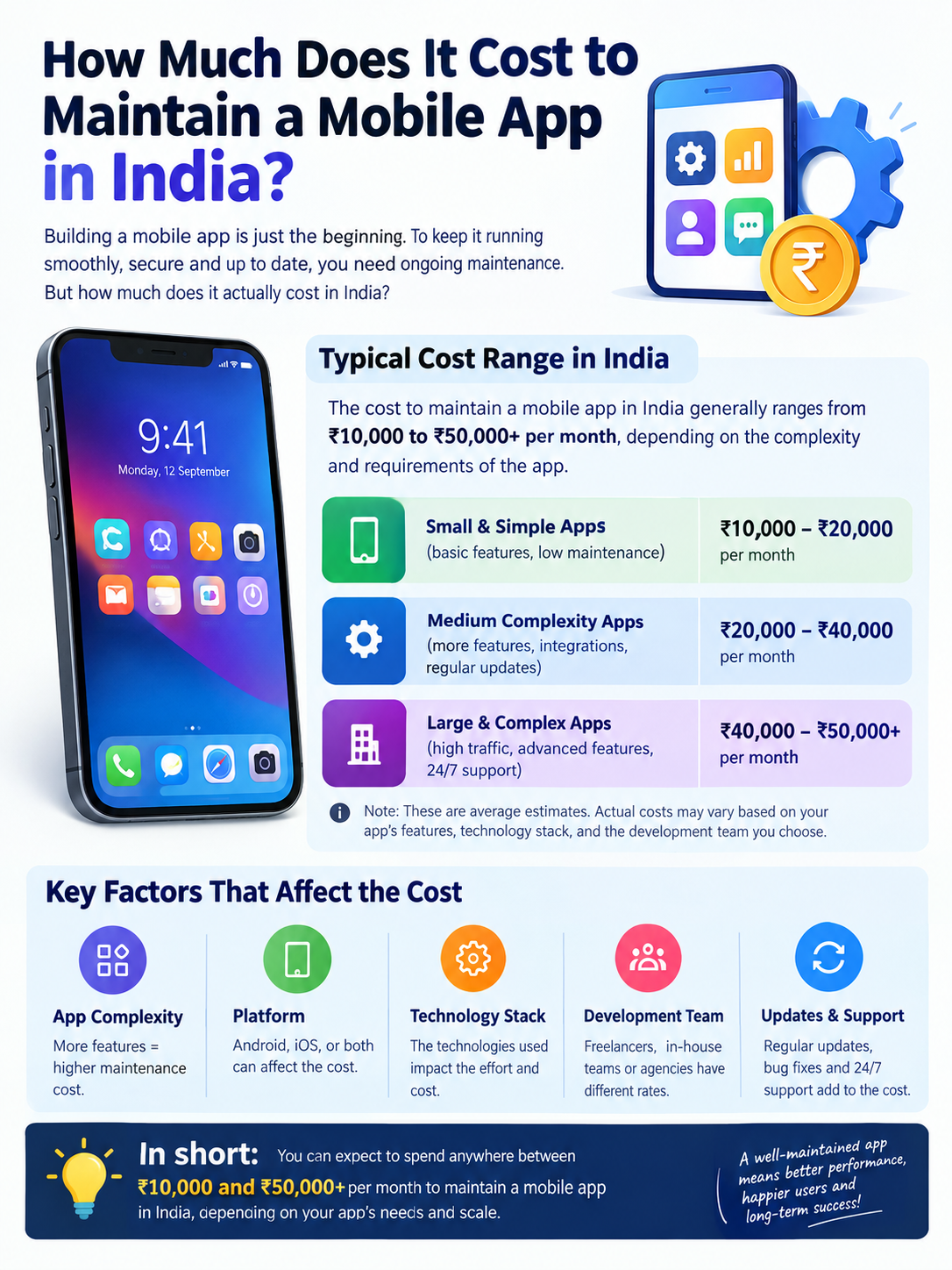
The cost to maintain a mobile app in India is not a single fixed fee. It is an ongoing operational expense that varies dramatically based on your app's complexity, user base, and how much you plan to grow it.
For a standard, customer-facing app with moderate traffic, you should budget roughly ₹20,000 to ₹50,000 per month. A simple internal tool might cost ₹8,000 to ₹20,000 monthly, while a high-traffic, revenue-generating app could require ₹50,000 to ₹1,50,000 or more each month just to stay healthy.
Here's the uncomfortable truth: an app is not a one-time expenditure. It is an asset that requires continuous investment to remain functional, secure, and competitive. Over a multi-year life, cumulative maintenance routinely exceeds the original build cost. If you budget only for development, you've funded the smaller half of the app's true cost.
The apps that "suddenly" break were never suddenly broken. They were slowly becoming incompatible, and nobody was watching. Maintenance is the act of watching, and acting before small issues become catastrophic ones.
Cost Based on App Type
The monthly cost depends heavily on what kind of app you're running and how many users depend on it. These ranges assume a professionally built app with moderate-to-good usage in the Indian market:
| App Type / Stage | Expected Monthly Range | % of Original Dev Cost |
|---|---|---|
| Internal / Low-usage MVP | ₹8,000 – ₹20,000 | 15–20% |
| Customer-facing mid-size app | ₹20,000 – ₹50,000 | 18–25% |
| Revenue-critical high-traffic app | ₹50,000 – ₹1,50,000+ | 20–30%+ |
| Enterprise / multi-country scale | ₹1,00,000 – ₹4,00,000+ | 25%+ |
A simple app built for ₹4 lakhs runs ₹5,000–₹8,000/month. A standard ₹12 lakh app runs ₹15,000–₹25,000/month. A complex ₹30 lakh platform runs ₹38,000–₹63,000/month.
Notice the pattern. The more your app does, the more moving parts it has, the more it costs to keep those parts moving. Real-time features, AI integrations, and complex third-party services push you toward the higher end of the range year-round.
Breakdown by Developer Type (2020–2026 Rates)
The cost of maintaining an app depends heavily on who does the work. The Indian market offers a significant structural advantage here, but the variance in quality is enormous.
| Model | Annual Cost (India) | What You Get | What You Don't Get |
|---|---|---|---|
| In-house engineer | ₹35–45 lakhs fully loaded | Deep product knowledge, immediate availability, full control | Multi-skill coverage. One mobile engineer isn't also a backend, QA, and DevOps engineer. You pay for idle capacity in quiet months. |
| Agency retainer | ₹2.5–8 lakhs ($30,000–$96,000) | iOS, Android, backend, QA, and DevOps skills. Cover during leave. Contracted response times. | Instant context on a codebase they didn't write, unless you fund a handover. |
| Freelance / ad-hoc | ₹1–3.5 lakhs | Lowest cost in quiet months | Guaranteed availability, cover, or accountability. |
The India advantage is real. Comparable engineering talent bills at $90 to $200 an hour in the US versus $20 to $80 an hour in India a 60% to 80% savings for the same scope and quality.
But be careful. India has massive quality variance. The top 10% of Indian maintenance teams cost 40–50% more than the median but deliver 3–4x productivity, retention, and code quality. If you're paying ₹500 an hour, you're probably getting exactly what you paid for.
Why Prices Changed in 2026
Three forces have reshaped app maintenance economics in India this year.
First, platform update cadence has accelerated. Apple releases a major iOS update every September, and Android updates roll out on a similar cadence. Each major release introduces breaking changes to APIs your app depends on, deprecates UI components, and adds new privacy requirements. Budget 1–3 days of developer time per major OS update ₹40,000 to ₹2 lakhs per year per platform.
Second, third-party SDK proliferation has exploded. The average app now embeds 10–15 third-party SDKs payment gateways, analytics, crash reporting, push notifications, maps, authentication. Every embedded SDK is a deprecation you didn't schedule and a privacy manifest you must maintain. The count matters more than the complexity.
Third, cross-platform frameworks added a third deprecation calendar. Flutter and React Native teams now navigate Apple's, Google's, and their framework's own release cycles. Flutter teams have faced three structural migrations in close succession Impeller becoming mandatory, CocoaPods giving way to Swift Package Manager, and Material/Cupertino moving to standalone packages. None were requested by a product owner. All consume the same engineer.
The result: maintenance costs haven't dropped. They've become more predictable for teams who plan, and more expensive for teams who don't.
Pro Tips to Save Money in 2026
1. Audit before you commit. An agency that quotes an annual maintenance figure without asking which SDK version you're on, how many third-party SDKs you embed, and when you last shipped is quoting a number it made up. The right first question is not "what's your budget," it's "when did you last upload a build."
2. Upgrade on schedule, not when things break. Platform lag compounds. Skipping a year doesn't defer the work it multiplies it, because you cross two sets of behavior changes at once with no working baseline in between. The team that upgrades every year does a boring week. The team that upgrades every third year does a quarter and a war room.
3. Choose a maintainable stack from day one. Cross-platform frameworks like Flutter reduce maintenance to one cycle instead of two. A single codebase saves 30% to 40% on ongoing costs compared to running separate native teams.
4. Negotiate a fixed monthly retainer. Most Indian agencies offer 10–20% discounts for 12-month commitments. Predictable billing beats hourly surprises, especially for calendar-driven work like OS updates.
5. Model maintenance from day one. If you're building a ₹10 lakh app, plan for ₹1.5 to ₹2 lakh in annual maintenance before you write a single line of code. Founders who lock their feature list before development starts consistently spend less than those who iterate requirements every sprint.
Questions to Ask Before Hiring
Before you hand your budget to any maintenance provider, ask these questions.
1. "Show me your L1-L3 support structure." A serious provider defines how tickets escalate. L1 handles routine triage. L2 handles bug isolation and minor fixes. L3 handles production outages and code-level fixes. If they can't explain their escalation model, they don't have one.
2. "What's your MTTR for a P0 incident?" Mean time to resolve. Top-tier Indian vendors target P0 restoration under one hour and P1 under 2–4 hours during business hours. If they can't quote an SLA, they're guessing.
3. "Who actually does the work the person I'm talking to, or an offshore team?" If it's the latter, you're paying consulting fees for outsourced quality.
4. "What happens when an OS update breaks something?" The answer should involve a planned release window, not emergency war-room pricing.
5. "What's NOT included in this quote?" An honest provider lists exclusions immediately. New features, redesigns, and platform migrations should be scoped separately. If they're vague, you'll find out the hard way.
Why Delhi is a Great Hub for App Maintenance
Delhi has become a serious destination for post-launch app support, and not just because of cost.
The National Capital Region hosts India's most concentrated network of corporate headquarters, financial institutions, and healthcare providers. That means maintenance teams here see the full spectrum of app types fintech, healthtech, ecommerce, logistics and build the muscle memory that only comes from volume.
More importantly, Delhi's time zone is ideal for global clients. A team in Delhi can hold morning calls with Dubai and Singapore, afternoon calls with London, and late-evening syncs with US East Coast. For companies that need their maintenance partner available when their users are awake, that overlap matters.
And the talent density keeps improving. With AI Centres of Excellence being established across the region and a steady pipeline of experienced mobile engineers, Delhi offers a combination of cost and capability that's hard to match.
What We Offer
At Innovative AI Solutions, we run mobile app maintenance as an ongoing engagement, not a break-fix retainer. Because the work is calendar-driven, and the calendar is published a year ahead.
Our approach:
-
Audit first. We establish your SDK version, your Play Store target level, your third-party SDK inventory, and your pending framework migrations. That audit is what makes a real number possible.
-
Scheduled releases. Apple's SDK minimum and Google Play's target-level deadlines are planned as fixed releases not discovered in September.
-
Continuous monitoring. Crash triage, dependency updates, security patches, and OS behavior changes as betas land.
-
Feature work on top. When the platform calendar is clear, we build.
Our teams are senior-led. A toolchain migration on a live app with paying users is not junior work the code is unfamiliar, the tests are thin, and the blast radius is your install base.
Who this fits: Teams with a live app and no dedicated mobile engineer, or one mobile engineer who can't be spared for a fortnight in August.
Frequently Asked Questions
Q: Can I just skip maintenance for a few months to save money?
You can, but the cost compounds. Unmaintained apps break on new OS releases and get flagged by app stores for targeting outdated SDKs. Catching up after six months of neglect often costs 30% to 60% more than staying current.
Q: Is in-house maintenance cheaper than an agency?
Usually not for a single app. An agency gives you a mobile developer, backend support, and QA for a fraction of one full-time salary. In-house teams only make sense if you have multiple apps or genuinely need 40+ hours of work per month.
Q: How much should I budget for a mid-complexity app?
For an app built for ₹5–15 lakhs, expect ₹4.5–13 lakhs per year in total maintenance, including hosting, bug fixes, OS updates, and minor improvements.
Q: What's the single biggest cost driver I should watch?
The number of third-party SDKs you embed. An app carrying eleven paid SDKs has eleven vendors who can change their terms, deprecate an endpoint, or raise a price without asking you.
Q: Does Android cost more to maintain than iOS?
Yes. Android maintenance runs 40% to 60% higher than iOS, driven by device fragmentation thousands of screen sizes, chipsets, and manufacturer customizations from Samsung, Xiaomi, and Realme. Testing across that matrix consumes far more QA hours.
Frequently Asked Questions (Extended)
Q: Can I maintain my app with a freelance developer instead of an agency?
Yes, for low-traffic apps with simple requirements. But freelancers rarely provide guaranteed availability, cover during leave, or accountability during production outages. For revenue-critical apps, the risk usually outweighs the savings.
Q: How often should I release updates?
At minimum, align with the two major OS releases per year (iOS and Android). Beyond that, monthly patch releases for bugs and security are ideal. Quarterly releases are acceptable for low-usage internal tools.
Q: What happens if I stop maintaining my app entirely?
Within 12–18 months, your app will likely break on new OS versions, get flagged by app stores for targeting outdated SDKs, and fail security requirements. The recovery cost is typically 30–60% higher than staying current.
Q: Does cloud hosting cost extra?
Yes. Hosting is almost always billed separately from the maintenance retainer. A small Firebase-backed app might run under ₹5,000/month. A high-traffic platform on AWS can easily exceed ₹50,000/month.
Q: How do I know if my maintenance provider is doing a good job?
Track three metrics: crash-free user rate (should stay above 99.5%), time-to-resolve for critical bugs, and OS update compliance. If your provider can't show you these numbers, they're not maintaining they're reacting.