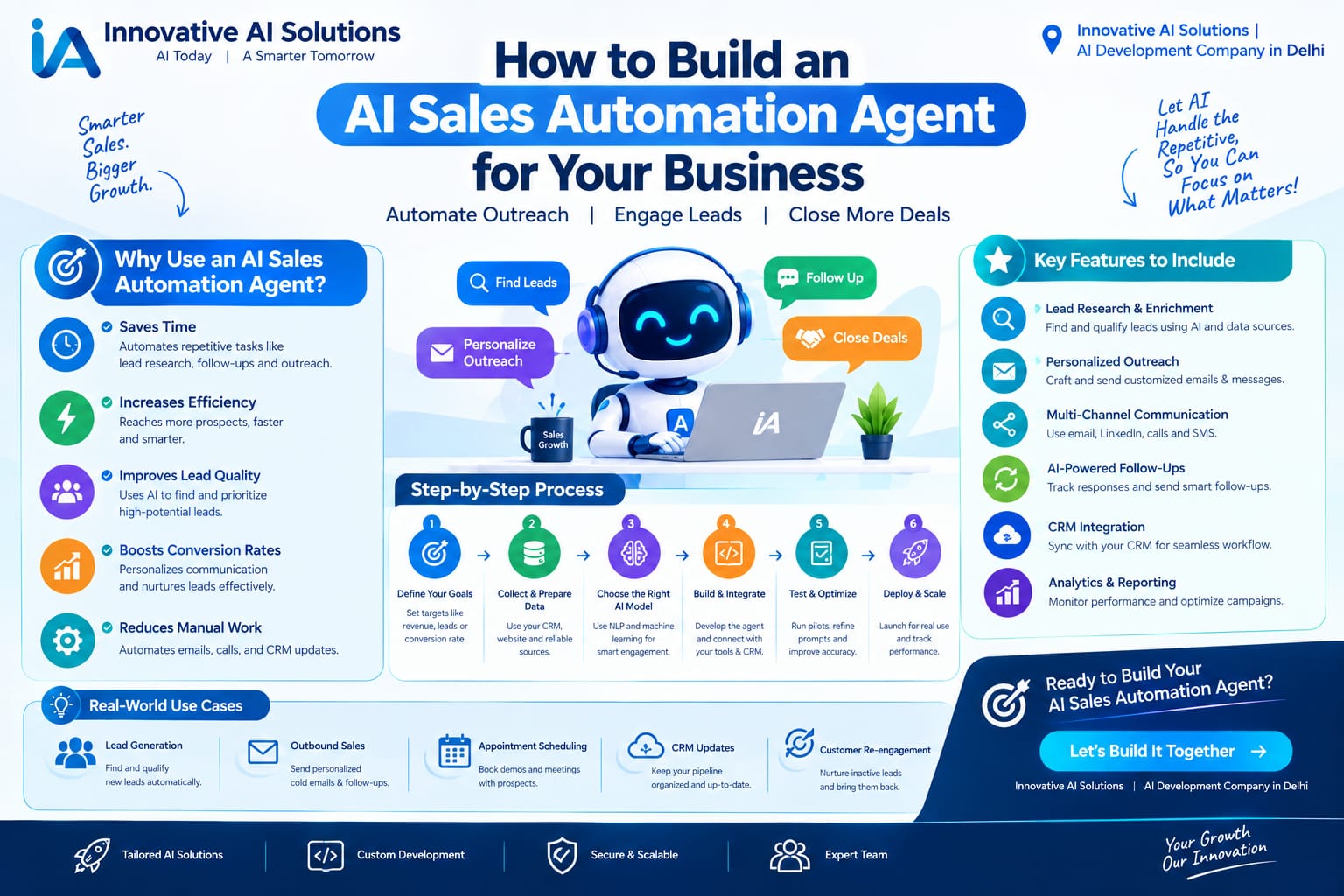
The Big Question
What would your sales team do with 20 extra hours per week?
That's the average time a sales services development representative wastes on non-selling tasks. Researching prospects. Updating CRM records. Sending follow-up emails that go nowhere. Chasing leads that will never convert.
The data is brutal. Sales reps spend only about 28% of their week actually selling. The rest disappears into administrative work, internal meetings, and pipeline management that could be automated.
AI sales automation agents change this equation. Not by replacing humans—by handling the repetitive, high-volume work that consumes their time.
Microsoft's Sales Qualification Agent, for example, autonomously researches leads, evaluates them against Ideal Customer Profile criteria, and even engages prospects with personalized outreach—all before a human seller opens the record . Salesforce's Engagement Agent handles over 1 million monthly outreach actions across global sales operations .
But here's the reality check: most AI sales agent projects fail. Not because the technology doesn't work. Because businesses treat them as technology experiments instead of business tools.
They build without guardrails. They skip compliance. They underestimate the integration complexity. And they end up with an expensive chatbot that hallucinates deal details and spams prospects.
This guide is the antidote. It's the practical playbook for building a sales agent that actually drives revenue—not just demos well.
Cost Based on Solution Type
Let's talk numbers. What does it actually cost to build an AI sales automation agent in 2026?
Basic Outreach Agent (Email Only, Single Channel)
Think: an agent that sends personalized cold emails, handles basic replies, and updates a simple CRM field. No complex qualification. No multi-channel orchestration.
Typical cost: ₹1,50,000 to ₹3,00,000 for the build. Monthly running cost: ₹15,000–₹35,000 (platform, API calls, email infrastructure). Timeline: 4–6 weeks.
This is where most businesses should start. Prove the concept on one channel before expanding.
Qualification-Focused Agent (Lead Scoring + Multi-Channel)
Think: an agent that researches leads, scores them against your ICP, engages via email and WhatsApp, and routes qualified leads to sales reps. Includes CRM integration and basic workflow automation.
Typical cost: ₹4,00,000 to ₹8,00,000. Monthly running cost: ₹40,000–₹75,000. Timeline: 8–12 weeks.
Microsoft's Sales Qualification Agent operates in this tier—research mode builds lead profiles, engage mode reaches out with personalized messages .
Full Autonomous Sales Agent (Multi-Channel, End-to-End)
Think: an agent that discovers leads, researches them with evidence, qualifies with confidence scores, personalizes outreach, handles replies, follows up on schedule, books meetings, and briefs sales reps before calls.
Typical cost: ₹10,00,000 to ₹25,00,000+. Monthly running cost: ₹75,000–₹2,00,000+. Timeline: 16–24 weeks.
The AutoSDR project demonstrates this architecture: 11 specialized agents working together, from company PDF ingestion to meeting booking .
The AI vs SDR Cost Comparison
MyOperator's analysis of AI sales agents in India shows a fully loaded AI agent handling one SDR's outbound volume at roughly ₹81,000/month (platform fee, usage, configuration, amortized implementation) .
An SDR costs approximately ₹1,18,000/month fully loaded. But the comparison isn't just about cost. It's about output.
An SDR produces about 44 qualified leads per month (2 per day). An AI agent making 3,000 calls per month at a conservative 3% qualification rate produces 90 qualified leads .
Cost per qualified lead: SDR at ₹2,680. AI agent at ₹900 .
That's a 3x efficiency advantage—if the agent works properly. And that's the catch. The numbers assume a well-built agent. A poorly built agent produces zero qualified leads and costs you the same ₹81,000.
Breakdown by Component (2020–2026)
How has sales automation evolved over the past six years?
2020–2021: Scripted Email Sequences
Sales automation meant Mailchimp and HubSpot sequences. Pre-written emails, timed sends, basic open tracking. No intelligence. No personalization at scale. Cost: ₹50,000–₹1,50,000 for setup.
2022–2023: The Conversational Wave
Chatbots entered the sales stack. They could answer questions, qualify with scripted flows, and book meetings. But they broke outside their scripts. Cost: ₹2,00,000–₹5,00,000.
2024–2025: LLM-Powered Outreach
Large language models enabled genuine personalization. Agents could research prospects, write contextual emails, and interpret replies. Cost: ₹5,00,000–₹12,00,000.
2026: The Agentic Sales Era
Today, sales agents are autonomous. They plan multi-step workflows, use tools, remember context, and coordinate with other agents. Salesforce's Engagement Agent scaled from a single-agent MVP to a dispatcher-orchestrated system handling 1.08 million messages monthly using 20 parallel agents .
The Model Context Protocol (MCP) has standardized how agents connect to CRMs. Dynamics 365 Sales now exposes MCP tools for listing leads, retrieving summaries, qualifying leads, and sending outreach emails—without custom integration code .
Cost: ₹10,00,000–₹25,00,000+ for production-grade agentic systems.
Why Prices Changed in 2026
Sales agent development costs have shifted. Here's why.
Reason 1: MCP Standardized CRM Integration
Before MCP, connecting an agent to Salesforce or Dynamics required weeks of custom API work. MCP provides a common protocol. Agents discover CRM capabilities as tools and use them without bespoke integrations . Development time dropped by 40–50%.
Reason 2: Native Platform Agents Emerged
Microsoft, Salesforce, and HubSpot now ship pre-built sales agents. Dynamics 365 includes Sales Qualification, Sales Opportunity, and Sales Close Agents out of the box . These reduce the need for custom development—for standard workflows.
Reason 3: Framework Maturity
LangGraph, CrewAI, and similar frameworks provide production-ready orchestration. The AutoSDR project demonstrates how 11 specialized agents can coordinate through an event bus with full memory .
Reason 4: The Compliance Tax
Here's the counter-trend: DPDP Act compliance adds cost. India's Digital Personal Data Protection Act requires consent-first processing, algorithmic due diligence for significant data fiduciaries, and breach notification within 72 hours . AI agents that process personal data must be built with compliance from day one—not bolted on later.
Reason 5: Rate Limit Realities
Email providers impose hard caps. Gmail limits ~2,000 messages daily. O365 caps at ~10,000 . Agents must be designed with these constraints, not against them. This adds architectural complexity.
Reason 6: Open Source Options
For businesses with privacy concerns, locally-hosted models like Llama 3.2 (3B) can handle real-time conversation while cloud models handle complex queries—reducing cost and preserving data .
Pro Tips for Building Sales Agents
After building these systems, here's what actually works.
Tip 1: Start with Research Mode, Not Outreach Mode
The safest way to prove value is research-only. Let the agent gather information and score leads—without contacting anyone. This builds operational trust and validates your data pipeline before you introduce outreach risk .
Tip 2: Build the Guardrail Loop First
Every agent action should follow: Trigger → Policy Check → Action → Log. The policy layer checks consent status, frequency caps, and account stage before any outreach fires. The log proves it happened responsibly .
Tip 3: Compose Memory Layers
Production agents need more than session memory. AutoSDR uses short-term working state plus long-term SQLite storage for leads, evidence, messages, and meetings . Memory compounds value over time.
Tip 4: Design for the Multilingual Reality
In India, sales conversations move between English, Hinglish, and regional languages—often mid-sentence. An agent built in one language with a translation layer breaks. Build for mid-call switching .
Tip 5: Use Cheap Filters Before Deep Research
AutoSDR's architecture includes a "cheap filter" stage—fast model, snippets only—before committing to expensive deep research . Don't burn tokens on prospects who don't pass basic criteria.
Tip 6: Plan for DPDP Compliance from Day One
Under DPDP Rules 2025, you need clear notice, consent capture with audit trails, data minimization, and breach response procedures . Build these into the agent architecture. Don't retrofit.
Tip 7: Implement Human-in-the-Loop for Complex Decisions
The agent should flag complex, multi-stakeholder, or emotionally sensitive conversations for human handling. The goal isn't full automation—it's right automation .
Tip 8: Own Your Data and Integration Logic
Platform-native agents are convenient but can lock you in. Build your integration layer so you can switch platforms without rebuilding everything.
Questions to Ask Before Hiring
Before you commit to a sales agent project, ask these questions.
1. "Can you show me a production sales agent handling real volume?"
Not a demo. Not a prototype. A live system processing thousands of leads. If they can't show you, walk away.
2. "How do you handle DPDP compliance?"
The answer should include consent capture, audit logging, data retention policies, and breach response procedures. "We'll figure it out" is not acceptable .
3. "What's your architecture for rate limits?"
Email providers have hard caps. CRMs have API limits. Good vendors have channel-aware quotas and persistent queues .
4. "How do you prevent the agent from spamming prospects?"
Look for frequency caps, consent checks, and opt-out handling built into the policy layer .
5. "What's your memory architecture?"
Session-only memory is insufficient. Look for short-term state plus long-term storage with evidence trails .
6. "How do you handle multilingual conversations?"
In India, this matters. Mid-call language switching should be native, not translated .
7. "Who owns the code and the data?"
You do. Full transfer. No exceptions.
8. "Can I start with research-only and add outreach later?"
You should be able to. Any vendor who insists on full autonomy from day one is optimizing for their revenue, not your risk .
9. "What's your testing process?"
Good vendors have sandbox environments, test prospect lists, and simulated reply scenarios. They test edge cases before production.
10. "Can I speak with your existing clients?"
References matter. Ask for named contacts. Ask about the good and the bad.
Why Delhi is a Great Hub for AI Development
I run an AI company in Delhi. I'm biased. But there are real reasons why Delhi NCR is a powerhouse for sales agent development.
Talent Density
Delhi-NCR is second only to Bengaluru in tech talent concentration. IIT Delhi, DTU, and NSIT produce thousands of graduates annually. Many specialize in AI, ML, and enterprise integrations.
Enterprise Client Base
Delhi is India's administrative and corporate capital. Large enterprises with complex sales operations are here. For agents serving B2B sales teams, proximity matters.
Cost Advantage
Delhi offers a 20–30% cost advantage over Bengaluru and Mumbai. Office rents are lower. Salaries are competitive.
Time Zone Advantage
IST overlaps with US, UK, and Southeast Asian business hours. Real-time communication is possible without overnight shifts.
Multilingual Talent
Delhi's workforce includes native speakers of Hindi, English, Punjabi, and other languages. Building multilingual agents is easier when your team speaks the languages.
What We Offer
At Innovative AI Solutions, we've spent five years building AI systems that actually work. Not hype. Not buzzwords. Results.
AI Sales Agent Development
We build agents that research leads, qualify prospects, personalize outreach, handle replies, and book meetings. From research-only pilots to full autonomous systems.
CRM Integration
We connect agents to Salesforce, Dynamics 365, HubSpot, Pipedrive, and custom CRMs. MCP-based and custom API integrations.
DPDP-Compliant Architecture
Consent capture, audit logging, data retention policies, and breach response—built in from day one.
Multilingual Outreach
English, Hindi, Hinglish, and regional languages with mid-conversation switching.
Human-in-the-Loop Design
Complex conversations flagged for human handling. The right automation, not full automation.
Ongoing Support
Agents need tuning. We offer flexible support packages to keep your systems performing.
What Sets Us Apart
We focus on Small AI. Practical solutions. Right-sized for your actual problem. Affordable pricing. Fast delivery. And a team that actually cares about your success.
Frequently Asked Questions
Q1: What is an AI sales automation agent?
An AI sales automation agent is a software system that autonomously handles sales tasks—lead research, qualification, outreach, follow-up, and meeting booking—using AI to reason, personalize, and coordinate across channels.
Q2: How much does it cost to build a sales AI agent in India?
Basic outreach agents start at ₹1,50,000. Qualification-focused agents range from ₹4,00,000 to ₹8,00,000. Full autonomous systems cost ₹10,00,000 to ₹25,00,000+. Monthly running costs range from ₹15,000 to ₹2,00,000+ .
Q3: How does AI agent cost compare to hiring an SDR?
MyOperator's analysis shows an AI agent at roughly ₹81,000/month vs an SDR at ₹1,18,000/month fully loaded. The AI agent produces 90 qualified leads/month vs the SDR's 44—at ₹900 per lead vs ₹2,680 .
Q4: What is the Sales Qualification Agent in Dynamics 365?
It's a native AI agent that autonomously researches leads, evaluates them against ICP criteria and BANT, and can engage prospects with personalized outreach—all before a human seller reviews the record .
Q5: How do I ensure DPDP compliance for my sales agent?
Build consent capture with audit trails, implement data minimization, define retention policies, and prepare breach response procedures. DPDP Rules 2025 require algorithmic due diligence for significant data fiduciaries .
Q6: What is MCP, and why does it matter for sales agents?
MCP (Model Context Protocol) standardizes how agents connect to CRMs. Dynamics 365 Sales exposes MCP tools for listing leads, qualifying, and sending emails—without custom code .
Q7: Can the agent handle multiple languages?
Yes. In India, mid-call language switching between English, Hinglish, and regional languages is essential. Build for this natively, not with translation layers .
Q8: How long does it take to build a sales agent?
Research-only: 4–6 weeks. Qualification + outreach: 8–12 weeks. Full autonomous: 16–24 weeks.
Q9: What's the biggest risk with sales agents?
Spamming prospects. Without frequency caps, consent checks, and opt-out handling, agents can damage your sender reputation and violate DPDP requirements .
Q10: Can I start small and expand?
Absolutely. Start research-only. Prove value. Add outreach on one channel. Then expand to multi-channel automation .
Frequently Asked Questions (Continued)
Q11: How do you test a sales agent before production?
Sandbox environments, test prospect lists, simulated reply scenarios, and edge case testing. Never launch an untested agent to real prospects.
Q12: What happens when the agent doesn't know how to handle a reply?
Good systems have escalation paths. Complex, emotional, or multi-stakeholder conversations get flagged for human handling .
Q13: Can the agent book meetings directly on my calendar?
Yes. Integration with Google Calendar, Outlook, or Calendly enables direct booking. The agent can also brief you before the call.
Q14: Who owns the code and the conversation data?
You do. Full transfer. No exceptions.
Q15: Why should I choose Innovative AI Solutions?
Because we build production systems, not demos. Because we focus on DPDP compliance. Because we've delivered 100+ projects. Because your code is always yours.
Contact Us
Ready to build an AI sales automation agent? Let's talk.
Phone:
+91 7464 099 059
+91 9689967356
Email:
info@innovativeais.com
Address:
9th Floor, Pearls Best Heights-I,
Head Office: 904, Netaji Subhash Place,
Delhi – 110034