The Big Question
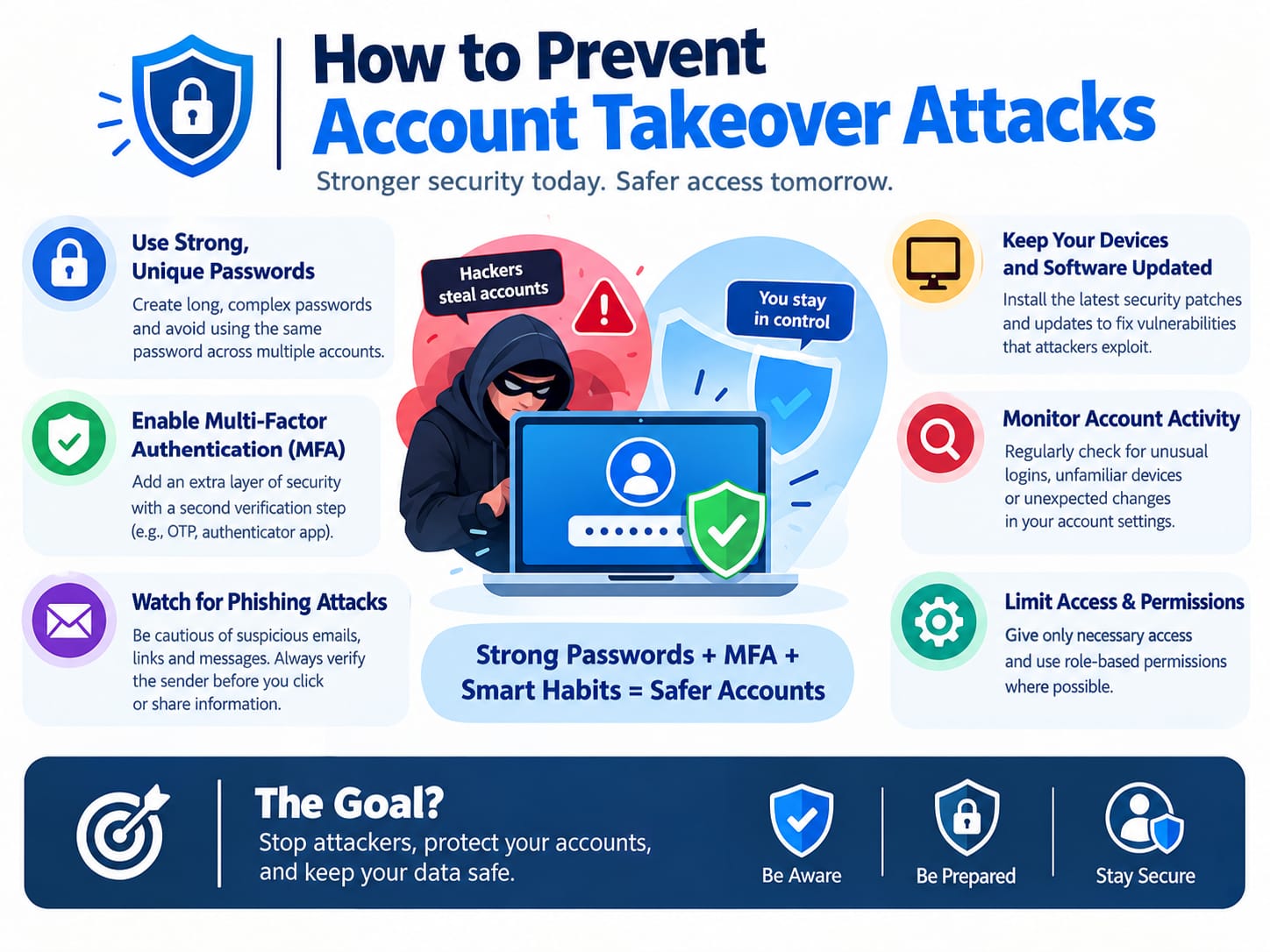
Account takeover is not a single attack. It’s a category of attacks that all end the same way: a criminal gains access to a legitimate user’s account and uses it for fraud, data theft, or resale.
The entry points are varied. Phishing emails trick users into handing over credentials . Social engineering calls impersonate bank support staff . Credentials from old data breaches get tested against new services . Infostealer malware harvests session cookies, bypassing multi-factor authentication entirely .
But the common thread across all these methods is simpler: organizations still rely on passwords as the primary authentication method. And passwords are the weakest link in the chain.
The data is stark. India’s suspected digital fraud rate stood at 7.10% in 2025, nearly double the global average of 3.80% . Account logins emerged as the riskiest stage in the digital consumer journey, with 3.90% of all login attempts suspected to be fraudulent higher than account creation (3.10%) or transactions (1.20%) . Once attackers are in, they’re in. The damage happens after authentication.
What makes ATO particularly damaging is the asymmetry. The attacker only needs to succeed once. The defender needs to succeed every time. And 73% of users blame the brand, not themselves, when an account takeover happens . The cost isn’t just fraud losses. It’s churn, support tickets, and reputation damage.
So the question isn’t “how do we stop all attacks?” It’s “how do we make the attacker’s job so expensive that they go after easier targets?”
Cost Based on Application Type
The cost of preventing ATO depends on how many users you have, what’s at stake per account, and how mature your current defenses are. Here’s the 2026 market landscape:
| Application Type | Monthly Cost Range | What You’re Actually Funding |
|---|---|---|
| Small SaaS / Internal Tool | $200 – $800 | Passkeys, MFA enforcement, basic login monitoring |
| Mid-size Consumer App | $800 – $5,000 | Behavioral analytics, device fingerprinting, bot detection |
| Ecommerce / Fintech | $5,000 – $25,000+ | Real-time risk scoring, session monitoring, dedicated fraud analyst |
| Enterprise / Regulated | $25,000 – $100,000+ | Custom risk engines, compliance reporting, 24/7 SOC integration |
What drives the range:
The biggest cost driver is how much you’re willing to spend per login attempt. Basic MFA costs almost nothing beyond implementation time. Behavioral analytics tools which flag suspicious login patterns, impossible travel, and device anomalies cost more but catch attacks that MFA alone misses.
The second driver is industry risk profile. Ecommerce and fintech face the highest attack volumes. The average direct fraud loss per confirmed ATO in ecommerce is $442, with all-in costs reaching $1,200 to $1,800 when you add chargeback fees, support tickets, and churn . For financial services, the per-incident loss averages $6,700 . Spending $5,000 a month on prevention is trivially justified when a single successful attack costs more than the annual prevention budget.
The third driver is compliance. India’s Digital Personal Data Protection (DPDP) Rules, 2025 mandate reasonable security safeguards including encryption, access control, and one-year log retention . If you’re a Significant Data Fiduciary, you need annual Data Protection Impact Assessments . These aren’t optional costs. They’re the price of doing business legally.
Breakdown by Defense Layer (2020-2026 Evolution)
The cost of each ATO defense layer has shifted dramatically over five years. Here’s the 2026 talent and tooling landscape:
| Defense Layer | Implementation Cost | Ongoing Cost | Effectiveness | Notes |
|---|---|---|---|---|
| Passkeys (FIDO2) | $2,000 – $8,000 | $0 – $500/mo | Highest | Phishing-resistant by design. No shared secret to steal |
| MFA (Authenticator Apps) | $1,500 – $5,000 | $100 – $500/mo | High | SMS is the weakest option. Authenticator apps preferred |
| MFA (SMS/OTP) | $500 – $2,000 | $200 – $1,000/mo | Medium | Vulnerable to SIM swap and social engineering |
| Behavioral Analytics | $5,000 – $15,000 | $1,000 – $5,000/mo | High | Catches session hijacking that MFA misses |
| Device Fingerprinting | $2,000 – $6,000 | $500 – $2,000/mo | Medium-High | Flags new devices and impossible travel |
| Bot Detection | $1,500 – $4,000 | $300 – $1,500/mo | Medium | Stops credential stuffing attacks |
| Login Monitoring & Alerts | $1,000 – $3,000 | $200 – $800/mo | Foundational | You can’t respond to what you can’t see |
The evolution from 2020 to 2026:
In 2020, basic MFA was considered sufficient. By 2022, attackers had adapted with real-time phishing proxies that relayed MFA codes. By 2024, session hijacking emerged as the primary bypass technique . In 2026, passkeys are the only authentication method that structurally resists phishing because there’s no shared secret to steal and no code to relay .
The cost of implementing passkeys has dropped significantly. What required custom cryptography work in 2023 is now available through standard libraries and managed services. The hard part isn’t the technology. It’s getting users to adopt it.
Why Prices Changed in 2026
Three shifts have reshaped ATO defense economics:
First, the attack economics changed. Credential stuffing is nearly free for attackers automated tools test millions of username/password pairs against login endpoints. The result is that even small apps face constant attack pressure. Sift data showed mid-market retailers saw a 167% year-over-year jump in ATO attempts in Q4 2024 . Defense isn’t optional at any scale anymore.
Second, India’s regulatory environment tightened. The DPDP Rules, 2025 introduced mandatory breach notification to both the Data Protection Board and affected individuals within 72 hours . There’s no “no-harm threshold” like GDPR has. Any personal data breach must be reported. This means organizations must have tested incident response playbooks—not just theoretical plans. The compliance cost is real, but so is the penalty: up to ₹250 crore for security failures .
Third, session hijacking made traditional defenses insufficient. Infostealer malware steals session cookies, allowing attackers to bypass MFA entirely . The median account takeover exposure rate across platforms is 1.4% . For a platform with 10 million users, that’s 140,000 accounts vulnerable at any given time. MFA alone doesn’t stop this. You need behavioral monitoring that detects when a session is being used from an unusual location or device.
Pro Tips to Save Money in 2026
1. Deploy passkeys wherever possible. Passkeys are phishing-resistant by design. You can’t be tricked into sharing a passkey because the private key never leaves your device . Many major platforms PayPal, Amazon, LinkedIn, WhatsApp already support them . The cost of implementation is lower than the cost of a single successful ATO.
2. Enforce MFA on every account that touches money or data. This is non-negotiable. SMS-based MFA is better than nothing, but authenticator apps are significantly better . The NCSC explicitly recommends passkeys first, then MFA with authenticator apps, with SMS as a last resort .
3. Monitor sessions, not just logins. The median time to identify and contain a breach is 241 days . You cannot afford to discover an ATO six months after it happened. Real-time session monitoring that flags impossible travel, device changes, and unusual access patterns catches attacks while they’re happening .
4. Remove dormant accounts. Over time, organizations accumulate accounts for former employees, contractors, and old integrations. These accounts often have outdated passwords and security settings. Make account reviews a quarterly habit .
5. Build a tested incident response plan. India’s DPDP Rules require breach notification within 72 hours . If you’re discovering your response process during an actual incident, you’re already too late. Test your playbook with tabletop exercises. The cost of preparation is trivial compared to the cost of a botched response.
Questions to Ask Before Hiring
Before you hand your ATO defense budget to any vendor or consultant, ask these questions.
1. “What’s our current MFA adoption rate, and how many accounts still rely on passwords alone?” If they can’t answer this in the first meeting, they haven’t looked at your authentication logs.
2. “How do you detect session hijacking, not just credential theft?” This is the critical question for 2026. If they only talk about MFA, they’re solving yesterday’s problem. Session monitoring and behavioral analytics are essential .
3. “What’s your false positive rate on login challenges?” Security that frustrates users gets bypassed or disabled. A good partner balances risk detection with user experience.
4. “How do you handle the DPDP breach notification requirements?” India requires notification to both the Data Protection Board and affected individuals within 72 hours . If they haven’t built this into their incident response workflow, they’re not ready for the Indian market.
5. “Show me a post-mortem from a real ATO incident you’ve handled.” Honest partners learn from incidents. Vague partners don’t handle them.
Why Delhi is a Great Hub for ATO Defense
Delhi-NCR has become a serious destination for fraud prevention and identity security work, and the reason isn’t just cost.
The region hosts a dense concentration of fintech, ecommerce, and digital lending companies the exact industries hit hardest by ATO . Fraud prevention teams here see the full spectrum of attack vectors: credential stuffing, social engineering, session hijacking, and synthetic identity fraud. That pattern recognition compounds.
Experian’s research found that Delhi, Haryana, Rajasthan, Uttar Pradesh, and West Bengal have the highest application anomaly catch rates in India—above 10% . This means fraud teams in these regions are actively detecting and responding to attacks at scale. The muscle memory exists.
And the talent pool is deep. With a steady pipeline of cybersecurity professionals, fraud analysts, and identity engineers, Delhi offers a combination of cost and capability that’s hard to match for companies building serious ATO defenses.
What We Offer
At Innovative AI Solutions, we treat account takeover prevention as an engineering discipline, not a checkbox.
Our approach:
-
Authentication Audit. We map every login endpoint, every authentication method, and every account recovery flow. You cannot secure what you haven’t inventoried.
-
Passkey Deployment. We implement FIDO2 passkeys for your highest-risk accounts. Phishing-resistant authentication, deployed in weeks, not months.
-
Session Monitoring. Real-time detection of suspicious session activity impossible travel, device changes, concurrent sessions from different locations. We catch attacks while they’re happening.
-
Incident Response Playbook. Tested workflows for detection, containment, notification, and recovery. Built to meet India’s 72-hour DPDP reporting requirement.
-
Continuous Review. Quarterly access reviews, dormant account cleanup, and defense tuning based on attack patterns we observe.
Who this fits: Companies with user accounts that hold value—money, data, or reputation—who can’t afford the churn and compliance costs of a successful ATO.
Frequently Asked Questions
Q: What’s the single most effective defense against account takeover?
Passkeys. They’re phishing-resistant by design because there’s no shared secret to steal and no code to relay . Where passkeys aren’t available, authenticator-app MFA is the next best option. SMS-based MFA is better than nothing but vulnerable to SIM swap and social engineering .
Q: How much does a single ATO cost?
In ecommerce, the average direct fraud loss per incident is $442**, with all-in costs reaching **$1,200 to $1,800** after chargeback fees, support tickets, and churn . For financial services, the per-incident loss averages **$6,700 . The all-in figure for financial services reaches $8,500 to $11,000 .
Q: Is MFA enough to stop ATO?
No. Session hijacking bypasses MFA entirely by stealing session cookies . You need behavioral monitoring that detects when a legitimate session is being used by an attacker. MFA is necessary but not sufficient.
Q: What are India’s legal requirements for ATO prevention?
The DPDP Rules, 2025 mandate reasonable security safeguards including encryption, access control, and one-year log retention . Breaches must be reported to the Data Protection Board and affected individuals within 72 hours . Penalties for non-compliance reach ₹250 crore .
Q: How long does it take to implement passkeys?
For a standard web application, passkey deployment takes 2 to 6 weeks depending on the complexity of your authentication flows and the number of client platforms (web, iOS, Android) you support.
Frequently Asked Questions (Extended)
Q: What’s the difference between ATO and credential stuffing?
Credential stuffing is an attack method testing leaked username/password pairs against login endpoints. ATO is the outcome successfully gaining unauthorized access to an account. Credential stuffing is one of many paths to ATO, alongside phishing, social engineering, and session hijacking .
Q: How do I detect an ATO attack in progress?
Watch for: impossible travel (login from two distant locations in a short time), new device logins, password reset requests the user didn’t initiate, and unusual account activity (new payment methods, changed contact info) . Real-time monitoring is essential because the average breach takes 241 days to identify .
Q: Should I use SMS-based MFA or wait for passkeys?
Use SMS MFA now if passkeys aren’t yet available. It’s better than passwords alone. But plan a passkey migration. SMS is vulnerable to SIM swap and real-time phishing proxies that relay codes .
Contact Us:
Phone: +91 7464 099 059 / +91 9689967356
Email: info@innovativeais.com
Address: 9th Floor, Pearls Best Heights-I, Head Office: 904, Netaji Subhash Place, Delhi, 110034