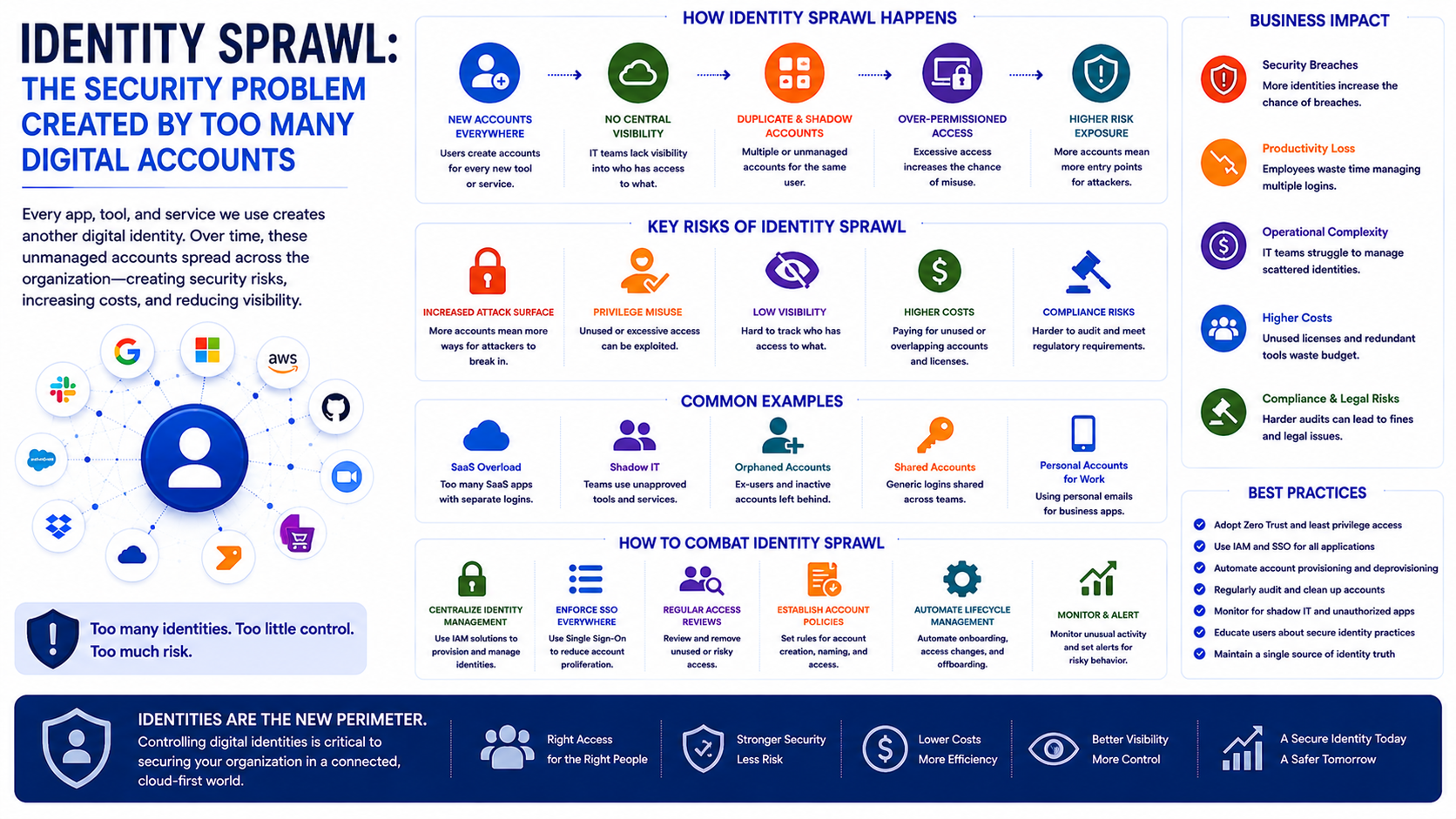
The Big Question
What happens when your organization has thousands of human users, hundreds of machine identities, and dozens of disconnected systems each with its own access controls, each creating new accounts, each leaving orphaned identities behind? When no single team has complete visibility into who has access to what, and why?
This is identity sprawl. It's the accumulation of digital identities across systems without consistent governance. And it's one of the fastest-growing security challenges organizations face today .
What Is Identity Sprawl?
Identity sprawl is the uncontrolled growth of user, service, and machine identities across on-premises, cloud, and SaaS environments . It occurs when organizations adopt new applications and platforms faster than they retire old ones or align them under a single identity strategy .
Each system creates its own identities, roles, and permissions. Over time, this results in duplicate accounts, stale access, inconsistent enforcement of least privilege, and limited visibility into who has access to what .
The Three Drivers of Identity Sprawl
Identity sprawl typically grows from a combination of three primary factors :
-
Increase in the number of users: Internal employees, external partners, contractors, and customers all require access.
-
Increase in the number of machine identities: IoT devices, bots, and robotic process automation (RPA) create identities that operate independently.
-
Ever-expanding number of accounts: Cloud platforms, SaaS tools, and legacy systems each create separate identities and access controls.
One Identity's 2021 global survey found that more than eight in ten respondents reported the number of identities they manage has more than doubled, with 25% reporting a 10X increase during the period . The average large enterprise now uses more than 25 different systems to manage access rights, with more than one in five using more than 100 .
Why Identity Sprawl Is a Security Risk
Every unmanaged identity is an open door. When hundreds or thousands of such doors exist in parallel, attackers don't need to force their way in they just wait for one to be left ajar .
The Root Cause of Breaches
The connection between identity sprawl and breaches is well-documented. The 2025 Verizon DBIR found that nearly 80% of all breaches involved compromised credentials, a statistic that has been consistent over time . As one industry analyst put it, "Identity sprawl" contributes to today's biggest cybersecurity vulnerability .
Real-world examples:
-
Colonial Pipeline ransomware attack (2021): Originated from a single orphaned VPN account .
-
23andMe data breach (2023): Leveraged reused credentials from prior breaches to scrape genetic data .
-
Dropbox Sign breach (2024): Traced back to a mismanaged service account with excessive privileges .
The Common Attack Patterns
Cybercriminals specifically target the gaps that identity sprawl creates :
| Attack Vector | How It Exploits Sprawl |
|---|---|
| Credential reuse | Users reuse passwords across accounts; attackers use stolen credentials from one breach to access others |
| Orphaned accounts | Dormant identities retain privileges long after employees or services are gone |
| Overprivileged identities | 85% of organizations have employees with more privileged access than necessary |
| Shadow IT | Employees signing up for tools outside IT's purview creates unmanaged rogue accounts |
| Lateral movement | Attackers exploit over-privileged identities to move across the network |
The Confidence Gap
Only 12% of security professionals are fully confident they can prevent a credential-based attack . This lack of confidence reflects the scale of the problem: organizations simply don't have visibility into all their identities, creating gaps, inconsistencies, and expanding windows of exposure .
The Operational and Compliance Costs
Beyond security breaches, identity sprawl creates significant operational and compliance challenges:
Audit Failures and Regulatory Exposure
Regulations like GDPR, HIPAA, ISO 27001, and DORA require organizations to demonstrate who has access to what and why. When identities are scattered across dozens of systems, maintaining access logs, performing audits, and revoking stale credentials becomes an impossible task . Over 67% of organizations acknowledge they have identity sprawl but admit they don't know how to remediate it .
Productivity and Financial Consequences
Identity sprawl also takes a toll on daily operations :
-
64% of organizations report reduced employee morale due to credential fatigue.
-
66% of IT leaders say identity sprawl has increased the complexity and cost of maintaining secure systems.
In one SaaS company with just 2,000 employees, identity sprawl had generated over 100,000 human and AI identities many of them orphaned .
How AI Is Both the Driver and the Fix
AI has created a paradox in identity management :
AI as the driver: AI-driven systems and agentic workflows are now the primary source of new identity creation especially privileged ones . Automation platforms spin up accounts dynamically for short-term tasks, often without proper deprovisioning. Machine identities now massively outnumber human ones .
AI as the fix: AI is also key to mitigating sprawl. Modern identity governance platforms use machine learning to detect anomalies, automate provisioning, and reduce privilege creep. AI-powered analytics flag risky accounts, identify orphaned credentials, and ensure access is aligned with roles in real time .
The Five Key Drivers of Identity Sprawl
Understanding what causes identity sprawl is the first step to controlling it :
| Driver | Impact |
|---|---|
| Remote and hybrid work | Users access systems from multiple locations, devices, and networks |
| SaaS expansion | Each new tool creates isolated identity stacks and more silos |
| AI agents and bots | Machine identities are created at scale, often without proper governance |
| Mergers and acquisitions | Integrating systems leads to unmanaged accounts and legacy identity debt |
| Shadow IT | Employees adopt tools without IT's approval, creating blind spots |
How to Reduce Identity Sprawl
1. Gain Centralized Visibility
Organizations need a centralized view of all identities human and non-human across directories, cloud platforms, and applications . A unified identity governance layer makes it clear who has access to what, why they have it, and whether that access is still required .
2. Automate Identity Lifecycle Management
Automated joiner, mover, and leaver workflows ensure access is provisioned, adjusted, and removed based on real role changes, not manual processes . This prevents orphaned accounts and stale permissions from accumulating.
3. Enforce Least Privilege
Role-based access models and policy-driven enforcement help prevent privilege creep and maintain least privilege as environments evolve . Regular access certifications help remove unnecessary permissions .
4. Implement Continuous Access Reviews
Built-in access certifications and attestations make it easy to regularly review access and eliminate orphaned accounts, stale permissions, and excessive entitlements . Every access decision should be tracked and documented to support audit readiness .
5. Consolidate Identity Sources
Standardizing policies across environments limits sprawl over time. A unified identity and access management platform can streamline the approach for organizations struggling with fragmented identity security .
The Unify-Verify-Adapt Framework
A three-step approach can help organizations address identity sprawl and future-proof for ongoing growth :
1. Unify: Use intelligent platforms to centrally correlate identity data into a secure fabric, ensuring administrators have visibility over all identities, accounts, and entitlements.
2. Verify: Continuously authenticate, authorize, and validate accounts before granting access to ensure users only access what they need, when they need it, for a logical period that doesn't pose a security risk.
3. Adapt: The cybersecurity landscape is ever-changing, and new vulnerabilities are always being discovered. Organizations must stay informed and adjust their identity strategies accordingly.
Implementation Roadmap
Phase 1: Discovery and Assessment (Weeks 1-4)
-
Inventory all identities: Catalog human users, machine identities, service accounts, and privileged identities across all systems.
-
Identify orphaned accounts: Flag accounts that persist beyond their intended lifecycle.
-
Map access entitlements: Document who has access to what, and why.
-
Assess risk: Prioritize high-risk identities and excessive privileges.
Phase 2: Consolidation and Governance (Weeks 5-8)
-
Implement a unified identity governance platform: Consolidate identity data from directories, cloud platforms, and applications into a single governance layer.
-
Automate lifecycle management: Deploy joiner, mover, and leaver workflows.
-
Enforce least privilege: Implement role-based access controls and policy-driven enforcement.
-
Establish access review cadence: Schedule regular access certifications and attestations.
Phase 3: Continuous Monitoring and Improvement (Weeks 9-12+)
-
Deploy AI-driven anomaly detection: Monitor for risky accounts, orphaned credentials, and privilege creep.
-
Integrate with threat intelligence: Align identity monitoring with emerging threats.
-
Regularly audit and adapt: Review and refine identity governance practices based on evolving threats and business needs.
Frequently Asked Questions
Q1: What is identity sprawl?
Identity sprawl is the uncontrolled growth of user, service, and machine identities across environments without consistent governance. It results in duplicate accounts, stale access, and limited visibility into who has access to what .
Q2: Why is identity sprawl a security risk?
Each unmanaged identity is a potential entry point for attackers. Identity sprawl expands the attack surface, complicates audits, and makes it difficult to enforce least privilege. Nearly 80% of breaches involve compromised credentials .
Q3: What causes identity sprawl?
Key drivers include remote and hybrid work, SaaS expansion, AI agents and automation, mergers and acquisitions, and shadow IT .
Q4: Can AI help reduce identity sprawl?
Yes. AI-powered identity governance platforms use machine learning to detect anomalies, automate provisioning, and reduce privilege creep. AI analytics flag risky accounts and identify orphaned credentials .
Q5: How can Innovative AI Solutions help?
We help organizations assess their identity landscape, implement unified governance frameworks, and deploy AI-driven identity monitoring to detect and remediate sprawl. Based in Delhi, serving clients across India.
Why Delhi is a Great Hub for Identity Security Innovation
Delhi is emerging as a hub for cybersecurity and identity management innovation, backed by a thriving IT services ecosystem and a growing focus on compliance and governance. As Indian enterprises accelerate cloud adoption and AI integration, identity sprawl is becoming a critical risk that requires disciplined identity governance. Organizations that invest in centralized visibility, automated lifecycle management, and continuous monitoring will be well-positioned to secure their digital future.
What We Offer at Innovative AI Solutions
-
Identity Governance Assessment: We help you inventory identities and identify sprawl.
-
Unified Identity Strategy: We design and implement governance frameworks.
-
Automated Lifecycle Management: We deploy joiner, mover, and leaver workflows.
-
AI-Driven Monitoring: We implement continuous identity risk detection.
Final Thought
The shift is clear: from managing identities in silos to centralizing governance, from manual access reviews to automated lifecycle management, from reacting to breaches to preventing them at the identity layer. Organizations that address identity sprawl now will be the ones that maintain security, compliance, and operational efficiency in an increasingly complex digital ecosystem.
Contact Us:
Phone: +91 7464 099 059 / +91 9689967356
Email: info@innovativeais.com
Address: Netaji Subhash Place, Pitampura, Delhi – 110034
Website: https://innovativeais.com
About the Author
Abhishek Kumar
Founder & CEO, Innovative AI Solutions
5+ years building identity, security, and enterprise systems. Based in Delhi, serving clients across India.
Related services: to apply this in your business, explore our AI development services and SaaS development.