The Big Question
What happens when your website's performance is bottlenecked by a database query on every request? When a traffic spike overwhelms your origin server? When a security vulnerability in your CMS exposes your entire application?
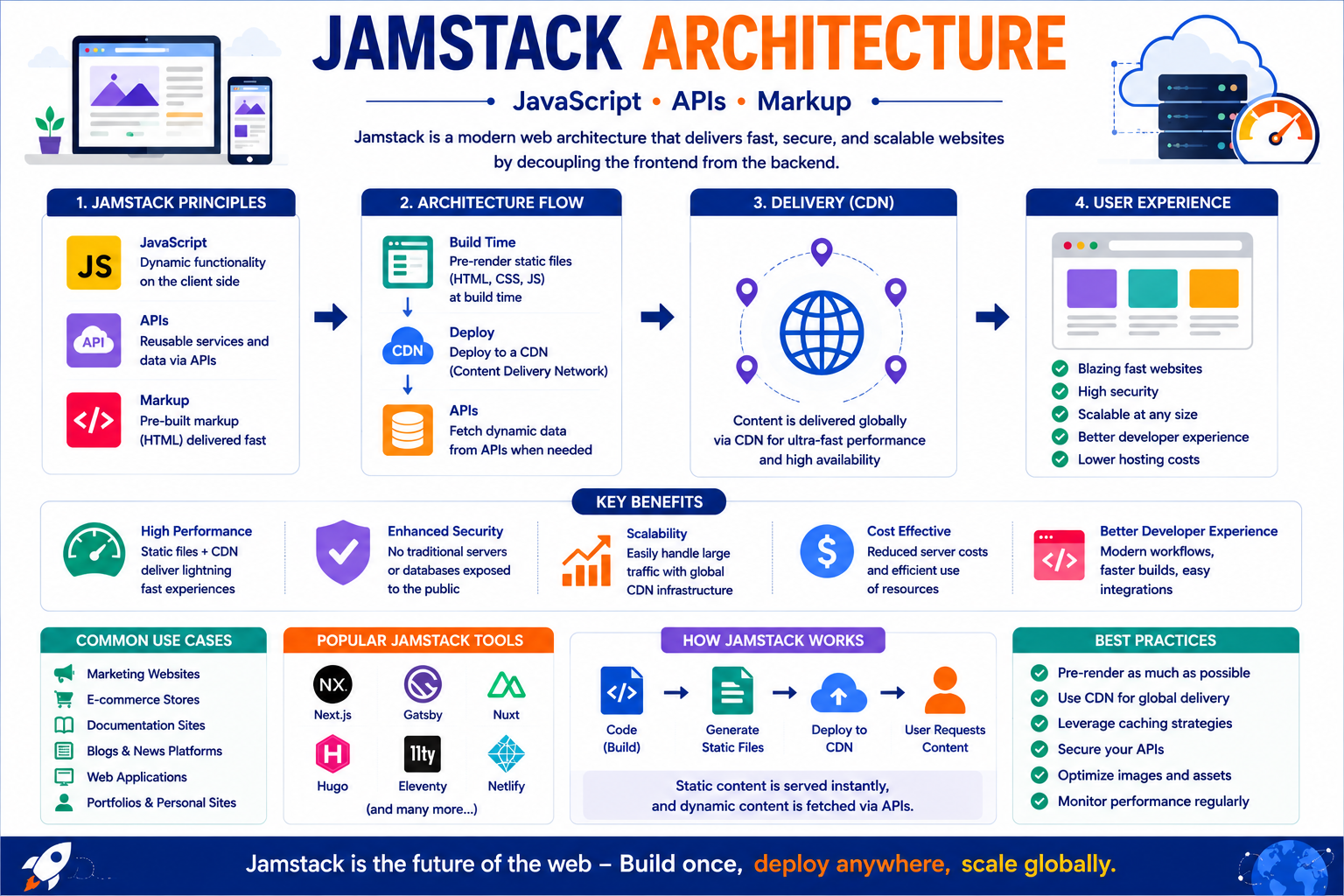
Jamstack addresses these problems by fundamentally changing how web applications are built and delivered. Instead of generating pages on every request, Jamstack pre-builds pages into static assets and serves them from a CDN. Dynamic functionality is handled through APIs. The result is an architecture that is faster, more secure, and more scalable than traditional monolithic approaches.
What Is Jamstack?
Jamstack is an architectural approach that decouples the web experience layer from data and business logic, improving flexibility, scalability, performance, and maintainability . The name is an acronym :
| Component | Role |
|---|---|
| JavaScript | Handles client-side interactivity and dynamic functionality in the browser |
| APIs | Replace the monolithic backend—anything not pre-rendered is requested over HTTP from a service |
| Markup | Pre-built HTML generated ahead of time and served as static files |
The architecture rests on two core ideas: pre-rendering and decoupling . Pages are built into static HTML and assets during a build step, then served from a CDN. The frontend is decoupled from any single backend, so the presentation layer talks to many independent services instead of one application server .
Why Jamstack Matters: Key Benefits
Performance
Jamstack sites eliminate the overhead caused by server and database layers, rendering and loading more quickly than monolithic architectures . Static files served from a CDN are fast and hard to take down, since there's no origin server to overload per request . Pages are pre-rendered during the build phase, so the work is hidden from visitors who will never pay the price of a cold page render . The result: super low Time to First Byte (TTFB), typically below 50ms .
Security
No database and no runtime software layer means Jamstack sites are not vulnerable to SQL injection or server-side code injection attacks . Pages are compiled in advance, so they aren't at risk of server-side includes injection attacks. Hosting on a CDN provides protection from denial-of-service attacks . Shifting to Jamstack limits or eliminates entire classes of vulnerabilities .
Scalability
Since pre-baked pages are served from a global CDN, Jamstack sites can sustain great performance at virtually any load, across the globe . CDNs are elastic in nature and handle traffic spikes effortlessly, while autoscaling of heavy monolithic backends typically takes time sometimes minutes to spin up and warm up .
Developer Experience
Frontend developers can build sites without needing to know a server-side language. Backend developers can focus on building APIs . Decoupled development teams can work in parallel, each team focusing on what they do best .
Cost
Since they are made up mostly of static files, Jamstack sites have much lower hosting costs . Files bundled and delivered via a CDN can bring down hosting bills significantly . This is especially true compared to PaaS at larger scale for global multi-tenant solutions, where the only way to scale is to add more web worker instances, scale up the database, and geo-replicate environments all of which is often cost-prohibitive .
How Jamstack Works: Build-Time vs. Runtime
The core distinction in Jamstack is when data gets fetched :
| Aspect | Build-Time Data | Runtime (Client-Side) Data |
|---|---|---|
| When It Runs | Once, during the build | On every page load, in the browser |
| Good For | Blog posts, docs, product catalogs, anything slow-changing | Carts, user profiles, prices, anything personal or live |
| How It's Served | Baked into static HTML on the CDN | Fetched via JavaScript calling an API |
| Trade-off | Stale until the next build | Slower first paint; needs a live API |
A blog pulls its posts at build time, so every reader gets the same fast static page. A shopping cart fetches over an API in the browser . Most real sites mix both: pre-render what you can and call APIs for what you can't .
The Build Process
In a Jamstack architecture, the frontend consists of JavaScript, HTML, and CSS files generated during a build process . A static site generator or meta-framework such as Gatsby, Hugo, Jekyll, Eleventy, or Next.js fetches content via APIs and renders it into static HTML, CSS, and JavaScript . The build output is deployed to a CDN, where files are distributed globally .
The API Layer
APIs enrich websites with functionality that can't be done at build-time: commerce, payment, fetching dynamic data based on user behavior, executing search, retrieving auth context, and accessing protected content . There is an API for practically anything today, and the Jamstack ecosystem is rich with API-centric services .
The API can be a headless CMS, a payments service, a search provider, your own backend, or a third-party SaaS. Each service is replaceable because the contract between them is the API, not shared code . This decoupling is why software keeps going headless the API becomes the interface everyone builds against .
When to Use Jamstack
Use Jamstack When You Need :
-
Content-driven websites (blogs, documentation, marketing sites)
-
Fast page loads with minimal latency
-
Reduced server infrastructure and maintenance
-
High security with reduced attack surface
-
Variable or unpredictable traffic spikes
-
Git-based workflows and atomic deployments
Do Not Use Jamstack When You Need :
-
Real-time data updates without API polling or webhooks
-
Complex server-side logic for every request
-
Tight integration with legacy monolithic systems
-
Heavy user-generated content requiring immediate visibility
Common Implementation Mistakes and Mitigations
Mistake 1: Treating All Data as Build-Time Data
If every data request is baked into static files, the build becomes slow and data becomes stale. Instead, use build-time for slow-changing content and runtime client-side APIs for dynamic, user-specific data .
Mistake 2: Underestimating API Reliability
The frontend depends entirely on APIs. If an API fails or drifts, the site breaks in ways that are hard to trace . Invest in API contracts, versioning, and observability. Monitor API health and implement graceful degradation.
Mistake 3: Overlooking Build Performance
Build phase is critical. Ensure build servers are fast enough and use parallelization, caching, and incremental exports to reduce build times .
Mistake 4: Neglecting Security at the API Layer
Pre-rendered pages are secure, but API endpoints can be compromised. Implement proper authentication, rate limiting, and input validation at the API layer .
Mistake 5: Not Setting Up Preview Environments
Business users need to preview changes before publication. Set up preview environments that render drafts using server-side rendering or static generation with draft content .
Implementation Roadmap
Phase 1: Foundation (Weeks 1-4)
-
Identify target use case: Start with a content-driven section of your site a marketing site, documentation, or blog .
-
Select a static site generator or meta-framework: Gatsby, Hugo, Jekyll, Eleventy, Next.js, or Nuxt .
-
Choose a headless CMS or API source: Contentful, Sanity, Strapi, or a custom API .
-
Select a CDN or hosting provider: Netlify, Vercel, Azion, AWS S3 + CloudFront, or Azure Blob Storage .
Phase 2: Build and Pilot (Weeks 5-8)
-
Set up build pipeline: Configure the static site generator to pull content from the CMS or API.
-
Implement API integrations: Connect to payment processing, search, authentication, and form handling APIs .
-
Configure environment split: Set up development, staging, and production environments. Implement preview deployments for draft content .
-
Optimize build performance: Use parallel exports, incremental builds, and build caching .
Phase 3: Scale and Optimize (Weeks 9-12+)
-
Enable advanced caching: Implement CDN cache control headers and purge strategies.
-
Add serverless functions: Handle dynamic operations like form submissions and API proxying .
-
Monitor performance: Track Core Web Vitals, TTFB, and user experience metrics .
-
Scale to additional content: Gradually migrate additional sections of the site.
Frequently Asked Questions
Q1: What is Jamstack?
Jamstack is a web architecture that decouples the frontend from backend services using JavaScript, APIs, and pre-rendered markup. It emphasizes pre-rendering and decoupling to deliver faster, more secure, and more scalable web experiences .
Q2: How does Jamstack differ from traditional monolithic architecture?
In traditional architectures, the frontend and backend are tightly coupled. Every request requires a server to fetch data from a database and render HTML. In Jamstack, pages are pre-built as static files and served from a CDN, while dynamic functionality is handled through APIs .
Q3: Can Jamstack handle dynamic content?
Yes. Dynamic content carts, user profiles, live prices is fetched at runtime via JavaScript calling APIs. The static foundation is enhanced by API calls for personalized and real-time data .
Q4: What tools do I need to build a Jamstack site?
A static site generator or meta-framework (Gatsby, Hugo, Next.js, etc.), a headless CMS or API source, and a CDN or hosting platform (Netlify, Vercel, Azion, etc.) .
Q5: How can Innovative AI Solutions help?
We help organizations design, build, and operationalize Jamstack architectures from use case identification and framework selection to API integration and performance optimization. Based in Delhi, serving clients across India.
Why Delhi is a Great Hub for Modern Web Development
Delhi is emerging as a hub for modern web development, backed by a thriving IT services ecosystem and growing adoption of composable, API-driven architectures. As Indian enterprises modernize their web presence, Jamstack offers a proven path to faster performance, stronger security, and lower operational costs.
What We Offer at Innovative AI Solutions
-
Jamstack Strategy: We help you identify use cases and design a migration roadmap
-
Framework Selection: We help you choose the right static site generator or meta-framework
-
API Integration: We help you connect to headless CMS, commerce, search, and authentication services
-
Performance Optimization: We help you achieve Core Web Vitals targets and maximize CDN delivery
Final Thought
Jamstack has moved from a niche architectural pattern to the default way the modern web is being built . The combination of pre-rendered static pages, API-driven dynamic functionality, and CDN delivery delivers performance, security, and scalability that traditional monolithic architectures cannot match.
The shift is clear: from server-rendered pages on every request to pre-built assets served globally, from tight coupling to decoupled APIs, from fragile infrastructure to resilient CDN delivery.
Contact Us:
Phone: +91 7464 099 059 / +91 9689967356
Email: info@innovativeais.com
Address: Netaji Subhash Place, Pitampura, Delhi – 110034
Website: https://innovativeais.com
About the Author
Abhishek Kumar
Founder & CEO, Innovative AI Solutions
5+ years building AI, cloud, and enterprise systems. Based in Delhi, serving clients across India.
Related services: to apply this in your business, explore our API development and integration and web development.