The Big Question
Here's a number that should keep every app founder awake at night: 77% of daily active users stop opening an app within three days of installing it . The average Day 30 retention rate across categories hovers around 5-6% .
But the real problem isn't that users leave. It's when they leave, and why.
Most apps don't have a Day 30 churn problem. They have a first-session problem . The users who never experienced the product's core value in their first 60 seconds are the ones who never come back. The data is unambiguous on this: users who complete a meaningful action in their first session are 2-3 times more likely to still be active on Day 30 .
So the retention question isn't "how do we bring people back?" It's "how do we make the first visit so valuable that leaving feels like a loss?"
The second hard truth: retention is not a marketing problem. It's a product design problem, a communication problem, and an operational discipline problem. You can't push-notify your way out of a bad first experience. You can only build a system that earns the right to send that notification in the first place.
What the Numbers Actually Look Like
Before we get into strategies, let's set realistic benchmarks. Retention varies wildly by category and platform, and comparing your app to a universal target is a recipe for bad decisions .
| Metric | 2026 Cross-Industry Average | Strong Performance |
|---|---|---|
| Day 1 Retention | ~24% | 30-40% |
| Day 7 Retention | ~11% | 15-25% |
| Day 30 Retention | ~5% | 5-15% |
| Day 90 Retention | ~3% | 5-10%+ |
Category matters enormously. Finance apps retain better because users need them for recurring tasks Day 30 averages around 13% . News apps sit highest at over 15% on iOS . Hyper-casual gaming is the brutal opposite: Day 30 retention often drops below 2% .
The right question isn't "is my retention good?" It's "is my retention improving cohort over cohort, and does it match how often my app is supposed to be used?" . A tax app with 5% Day 30 retention might be perfectly healthy. A social app with 5% Day 30 retention is dying.
The Three Levers That Actually Move Retention
Retention strategy is not a single tactic. It's three distinct systems working together.
Lever 1: First-Session Activation. Get users to a meaningful action before they have a chance to get bored. Delay the sign-up wall. Skip the feature tour. Let them do the thing they downloaded the app for .
Lever 2: Re-engagement Before Churn. Don't wait 30 days to notice someone has gone quiet. Monitor behavioral cooling signals. A daily user who misses three days is a different situation than a weekly user who misses a week .
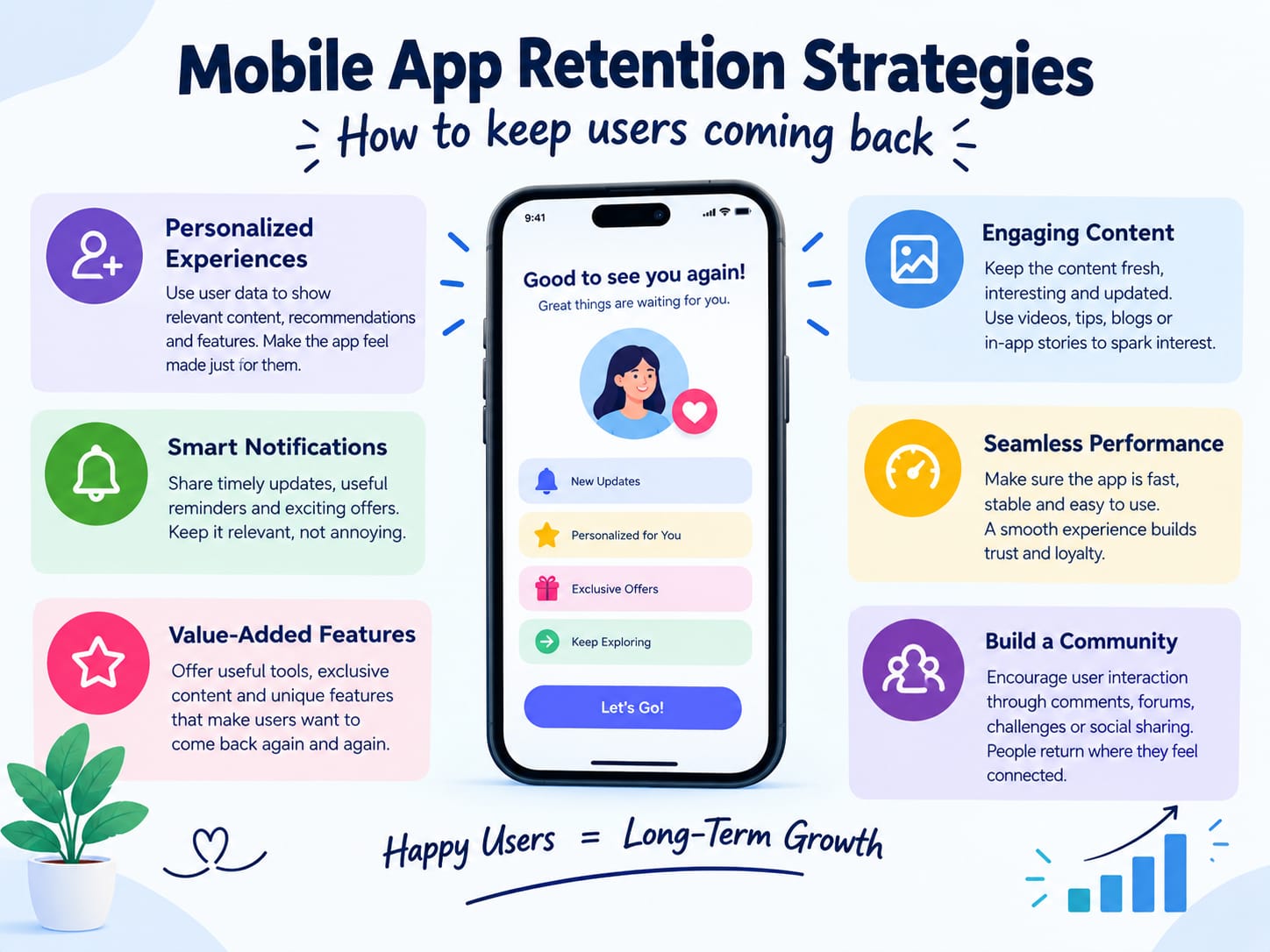
Lever 3: Habit Formation. For apps meant to be used regularly, retention is about becoming part of a routine. Streaks, progress bars, and behavioral triggers tied to real-life moments not arbitrary schedules are what turn a user into a habit .
Cost Based on App Type
Retention strategy costs money. Here's what to budget for in 2026, depending on your app's stage and complexity:
| App Type / Stage | Monthly Budget (India) | What You're Actually Funding |
|---|---|---|
| MVP / Early-stage | ₹15,000 – ₹40,000 | Basic analytics, crash monitoring, simple push setup |
| Growth-stage consumer app | ₹40,000 – ₹1,20,000 | Behavioral analytics, A/B testing, lifecycle messaging, cohort analysis |
| Revenue-critical app | ₹1,20,000 – ₹3,00,000+ | Full engagement platform, AI personalization, dedicated growth analyst |
| Enterprise / subscription | ₹3,00,000 – ₹8,00,000+ | Custom loyalty integration, predictive churn modeling, omnichannel automation |
What drives the range:
A basic retention stack costs almost nothing beyond the analytics SDK. But once you start segmenting users by behavior, personalizing messages, and running experiments, you're paying for an engagement platform (Braze, OneSignal, Userpilot, etc.) plus the engineering time to wire it up.
The single highest-ROI investment is not a fancy AI tool. It's a two-week sprint to fix your onboarding flow so users hit value faster. That costs almost nothing compared to what you save in wasted acquisition spend .
Breakdown by Developer Type (2020-2026 Rates)
Who builds and maintains your retention system matters. Here's the 2026 talent landscape:
| Role | India (Hourly) | US (Hourly) | What They Do |
|---|---|---|---|
| Mobile Developer | $20-$45 | $80-$160 | Implements in-app events, deep links, SDK integrations |
| Growth/Product Analyst | $25-$55 | $90-$180 | Defines retention cohorts, runs A/B tests, interprets data |
| Lifecycle/CRM Specialist | $20-$50 | $80-$170 | Builds push, email, and in-app message flows |
| Full Growth Team (3-4 people) | $70-$150/hr combined | $250-$500/hr combined | End-to-end retention ownership |
The India advantage remains structural: a skilled growth analyst in Delhi costs 60-70% less than their US counterpart . But for retention work specifically, proximity to product decisions matters more than cost. The best retention work happens when the analyst and the product team are in the same room physical or virtual and can iterate fast.
Why Prices Changed in 2026
Three shifts have reshaped retention economics:
First, AI personalization became table stakes. In 2024, personalized push was a competitive advantage. In 2026, it's expected. Personalization engines now adjust content and timing in real time, and users who receive personalized notifications retain at roughly twice the rate of those getting generic blasts .
Second, privacy changes broke the old re-engagement playbook. Third-party tracking restrictions mean you can't rely on retargeting networks to bring people back. The winning apps are leaning into first-party and zero-party data information users voluntarily share to drive retention .
Third, frequency fatigue has a hard ceiling. Sending more notifications doesn't scale results. It scales opt-outs. The data is clear: sending just one push per week can cause 10% of users to disable notifications entirely and 6% to uninstall . More isn't more. More is less.
Pro Tips to Save Money in 2026
1. Fix the first 60 seconds before spending a rupee on re-engagement. The highest-leverage retention work is getting users to a meaningful action during onboarding. This costs almost nothing beyond design and engineering time .
2. Delay the sign-up wall. Every field in a sign-up flow reduces completion by 5-10% . Let users experience the value first. Ask for the account later.
3. Ask for notification permission at the moment of value, not at launch. Opt-in rates jump from 40-45% to 65%+ when you ask after a user completes a valuable action, not on the welcome screen .
4. Build a "cooling" segment, not a "lapsed" segment. Don't wait 30 days. A power user who misses three days is already cooling. A dynamic re-engagement system catches them earlier and cheaper .
5. Cap your frequency and respect channel preferences. Two to three pushes per day is a hard ceiling for most categories. And if a user hasn't opened a push in two weeks, try email or in-app instead .
Questions to Ask Before Hiring
Before you hand your retention budget to anyone, ask these questions.
1. "What's our Day 1, Day 7, and Day 30 retention by cohort?" If they can't answer this in the first meeting, they haven't looked at your data.
2. "What meaningful action do our best-retained users take in their first session?" This is the activation metric. If they don't know it, they're guessing.
3. "How do you define a 'cooling' user versus a 'churned' user?" The answer reveals whether they think in static thresholds or behavioral patterns .
4. "What's our push opt-out rate, and what frequency ceiling are we enforcing?" If they haven't thought about fatigue, they'll burn your audience .
5. "Show me a retention experiment you've run that failed." Honest answerers learn from failures. Vague answerers don't run experiments.
Why Delhi is a Great Hub for App Retention Talent
Delhi's advantage in app retention is not cost. It's proximity to the full spectrum of app types.
The National Capital Region hosts India's most concentrated cluster of fintech, healthtech, and consumer subscription apps. Retention teams here have seen what works for a payments app, what breaks for a fitness tracker, and why a news app retains differently than a gaming app.
That cross-category pattern recognition is worth more than any single platform certification.
And the talent density keeps improving. With a steady pipeline of growth analysts, lifecycle marketers, and mobile engineers, Delhi offers a combination of cost and capability that's hard to match for companies building serious retention systems.
What We Offer
At Innovative AI Solutions, we treat retention as an engineering discipline, not a marketing afterthought.
Our approach:
-
Retention Audit. We map your current cohort curves, identify activation gaps, and benchmark against your category.
-
First-Session Redesign. We work with your product team to shorten time-to-value and define the activation metric that predicts long-term retention.
-
Lifecycle Messaging System. Triggered, behavioral, and personalized not scheduled blasts. We build the flows, set the frequency ceilings, and monitor opt-out rates.
-
Continuous Experimentation. Weekly A/B tests on onboarding, notifications, and in-app prompts. We measure what actually moves retention, not what looks good in a dashboard.
Who this fits: Apps with at least 1,000 monthly active users who have acquisition working but retention leaking.
Frequently Asked Questions
Q: What's a good Day 30 retention rate?
Depends entirely on your category and how often users are supposed to open your app . Finance and news apps run higher (10-15%+). Hyper-casual games run lower (2-3%). Social and subscription apps should target 5-15%. Compare against your own cohort trend first .
Q: Should I focus on retention or acquisition first?
Retention, always. A leaky bucket makes every acquisition rupee less effective. Get Day 1 and Day 7 retention stable before scaling spend .
Q: How many push notifications is too many?
More than 2-3 per day for most categories is risky. More than 5 per day from a single app makes users 3x more likely to uninstall . One push per week can still cause 10% opt-out .
Q: Do loyalty programs actually help retention?
Yes, when they reward real behavior, not just purchases. BabyCenter's mobile-first loyalty program rewards reading, tracking, and using in-app tools the high-frequency actions that actually form habits . Deuna's tiered fintech loyalty program increased monthly payments per user by 12% and monthly retention by 10% .
Q: What's the fastest retention win available?
Delay the sign-up wall and shorten your onboarding to a meaningful first action within 60 seconds. This is the single highest-leverage change most apps can make, and it requires almost no budget .
Frequently Asked Questions (Extended)
Q: Can I just buy re-engagement ads to bring users back?
Paid retargeting can work, but it's a bandage. The data shows retargeted users are 43% more likely to convert than cold traffic but that's because they already knew you. If you're retargeting people who never experienced value, you're paying to remind them of a bad first impression.
Q: What metrics should I track weekly?
Three numbers: Day 1 retention by cohort (is onboarding working?), push opt-out rate (are you burning your audience?), and activation rate (what % of new users hit your core value action?). If any of these slip, you have a retention problem before it shows up in Day 30.
Q: Is AI personalization worth the investment?
Only after you've fixed the basics. Personalization amplifies a good experience. It can't fix a bad one. Start with behavioral segments usage frequency, feature adoption, recency and only add AI once you have enough data to train it .
Contact Us:
Phone: +91 7464 099 059 / +91 9689967356
Email: info@innovativeais.com
Address: 9th Floor, Pearls Best Heights-I, Head Office :- 904, Netaji Subhash Place, Delhi, 110034