The Big Question
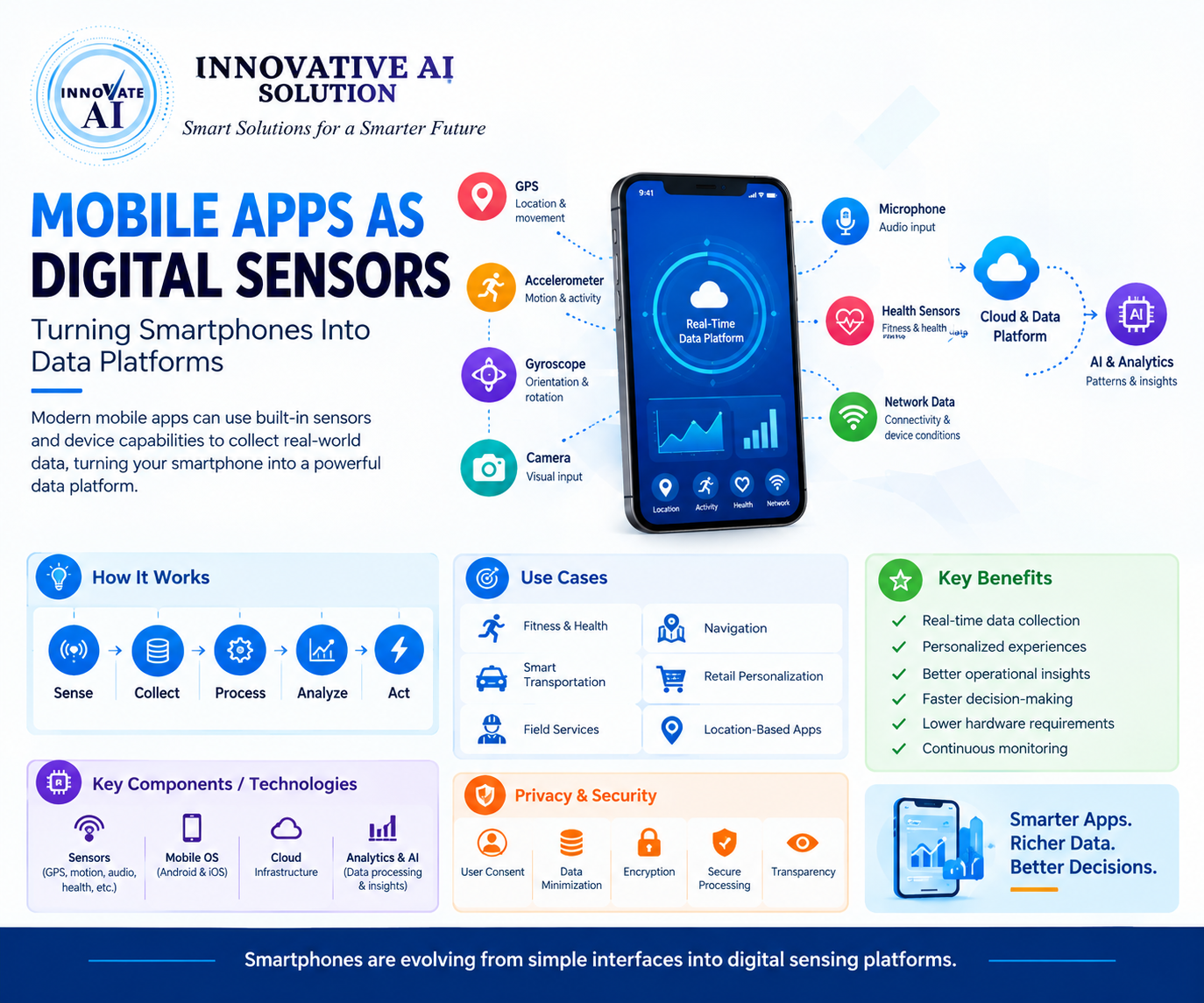
What happens when every smartphone in your customer base becomes a sensor? When the device in a user's pocket can measure motion, location, sound, light, and more and contribute that data to a system that improves with every additional user?
This is the shift from apps as software to apps as instruments. The smartphone is no longer just a place where software runs. It is a sensing platform that happens to also make phone calls.
What Makes a Smartphone a Sensor Platform
The sensors in a modern smartphone fall into several categories, each with distinct capabilities and constraints.
| Sensor Category | Examples | What It Measures |
|---|---|---|
| Motion | Accelerometer, gyroscope, magnetometer | Orientation, movement, rotation, magnetic field |
| Position | GPS, GNSS, Wi-Fi positioning, cell triangulation | Location, speed, heading |
| Environmental | Barometer, ambient light, thermometer | Altitude, illumination, temperature |
| Acoustic | Microphone, speaker | Sound levels, voice, ambient audio |
| Visual | Camera, depth sensors, LiDAR | Images, video, distance, spatial mapping |
| Biometric | Fingerprint, face recognition, heart rate | Identity, physiological signals |
| Connectivity | Bluetooth, NFC, Wi-Fi | Proximity to other devices, environmental signals |
Individually, each sensor is limited. Combined, they produce a rich, continuous picture of the user's context: where they are, what they are doing, what is happening around them, and how they are responding.
The key insight is that this capability already exists in billions of devices. No new hardware is required to begin treating smartphones as sensors only a change in how applications are designed.
Why This Shift Is Happening Now
The Sensors Are Already Deployed
The hardware barrier is gone. Smartphones shipping today include sensor suites that would have required dedicated equipment a decade ago. The distribution problem has already been solved by the market.
On-Device Processing Is Practical
Historically, sensor data had to be transmitted to a server for analysis. Modern devices can run machine learning models locally, meaning raw data can be processed on-device and only insights transmitted. This changes the economics and the privacy calculus simultaneously.
Privacy-Preserving Architectures Have Matured
Differential privacy, federated learning, and on-device inference make it possible to extract aggregate value from sensor data without collecting raw data centrally. This addresses the primary objection to large-scale sensing.
Connectivity Is Ubiquitous
Continuous connectivity makes it possible to coordinate sensing across millions of devices not just collecting data, but distributing tasks, updating models, and responding in real time.
Patterns of Sensor-Based Applications
Pattern 1: Passive Environmental Sensing
The device collects environmental data continuously in the background air quality proxies, noise levels, road conditions, weather observations and contributes to a shared dataset. Individual users get a personal dashboard; the aggregate produces a map of environmental conditions at a density no dedicated sensor network could achieve.
Key design considerations: Battery consumption, background execution limits (as covered in the constraints of modern mobile OS scheduling), and calibration across heterogeneous devices.
Pattern 2: Activity and Behavior Recognition
Motion sensors combined with on-device machine learning can classify what a user is doing walking, driving, cycling, sleeping, exercising. This is the foundation of fitness tracking, but it generalizes to insurance, healthcare, and safety applications.
Key design considerations: Model accuracy across diverse populations, false positives, and the privacy implications of behavioral inference.
Pattern 3: Spatial Mapping and Crowd Data
Cameras, LiDAR, and GPS together allow devices to build maps of the physical world and observe conditions in real time. Traffic conditions, parking availability, indoor navigation, and augmented reality all depend on this pattern.
Key design considerations: Data volume, offline operation, and handling the reality that many devices will report conflicting observations.
Pattern 4: Acoustic and Visual Monitoring
Microphones and cameras can detect events glass breaking, alarms sounding, equipment anomalies without transmitting raw audio or video. On-device detection means the device reports "an anomaly was detected," not the underlying recording.
Key design considerations: Detection accuracy, false alarm rates, and the distinction between detecting an event and capturing its content.
Pattern 5: Distributed Measurement Networks
Some applications deliberately recruit devices as measurement nodes. A network of smartphones can measure network quality, signal strength, latency, and coverage at a density that traditional network testing cannot match.
Key design considerations: Fairness (whose devices do the sensing), incentive design, and ensuring participants benefit from the data they contribute.
Design Constraints You Cannot Ignore
Treating smartphones as sensors introduces constraints that traditional application design does not face.
Battery
Continuous sensing drains battery. Modern mobile operating systems restrict background execution precisely because unrestricted sensing has a direct cost to the user. Any sensing application must be designed for the constraint-aware scheduling model the OS provides.
Practical implication: Sensing must be opportunistic, batched, or event-triggered not continuous.
Heterogeneity
Devices differ in sensor quality, calibration, sampling rates, and availability. A reading from a low-end device is not directly comparable to a reading from a flagship device. Calibration and normalization are essential.
Privacy
Sensor data is inherently personal. Location reveals habits and relationships. Motion reveals health and behavior. Audio and visual data can reveal far more than intended. The design must minimize collection, process locally where possible, and be transparent with users.
Trust and Consent
Users must understand what is being sensed, why, and what happens to the data. Consent must be informed, revocable, and respected. Applications that obscure their sensing behavior erode the trust the entire category depends on.
Data Quality
Sensor data is noisy. Devices are carried in pockets, dropped, covered, and handled unpredictably. Models must be robust to unreliable input and must be able to recognize when a reading should be discarded.
Regulatory
Location data, health data, and biometric data are subject to regulation in most jurisdictions. Sensing applications must be designed with compliance in mind from the start.
The Privacy-Preserving Architecture
The pattern that makes large-scale sensing viable is the separation of raw data from derived insight.
Collect locally. The device reads its sensors continuously.
Process locally. An on-device model interprets the raw readings and produces a derived signal an activity classification, an anomaly flag, a summary statistic.
Transmit minimally. Only the derived signal leaves the device. Raw data stays on the phone.
Aggregate with privacy guarantees. The server combines signals from many devices using techniques like differential privacy, so that no individual's data can be reconstructed from the aggregate.
Feed back improvements. Updated models are distributed to devices, improving local processing without requiring central collection of raw data.
This architecture delivers the value of distributed sensing while respecting the constraints of privacy, regulation, and user trust.
Implementation Roadmap
Phase 1: Define the Sensing Goal (Weeks 1-2)
-
Identify the specific signal you need. What are you measuring, and for what decision?
-
Determine the minimum data required. Prefer derived signals over raw data.
-
Assess privacy and regulatory implications before designing anything.
Phase 2: Design the Architecture (Weeks 3-5)
-
Choose the sensing pattern from the catalog above.
-
Design for local processing. Identify which model runs on-device.
-
Define what leaves the device. Minimize this aggressively.
-
Plan for battery and background execution constraints.
Phase 3: Build and Validate (Weeks 6-10)
-
Implement on-device processing with appropriate models.
-
Build calibration and normalization across device types.
-
Implement consent, transparency, and user controls.
-
Validate accuracy and battery impact on real devices across the device spectrum.
-
Implement aggregation with privacy guarantees.
Frequently Asked Questions
Q1: What does it mean to treat a mobile app as a sensor?
It means designing the app to continuously collect, process, and act on data from the device's sensor suite—treating the phone as a distributed sensing platform rather than just a place where software runs.
Q2: Do I need special hardware?
No. Modern smartphones already contain the sensors required. The barrier is software design and privacy architecture, not hardware.
Q3: How do I handle battery drain?
Use the constraint-aware scheduling model the OS provides. Sense opportunistically rather than continuously, batch data, use event triggers, and process locally to avoid radio usage.
Q4: How do I preserve user privacy?
Process raw data on-device, transmit only derived signals, aggregate with privacy guarantees such as differential privacy, and provide clear consent and user controls.
Q5: How do I handle device heterogeneity?
Calibrate across device types, normalize readings, and design models that can recognize when a reading is unreliable. Track which device models produce which data quality.
Q6: How can Innovative AI Solutions help?
We help organizations design and build sensor-based mobile applications from sensing architecture and on-device model design to privacy-preserving aggregation and compliance. Based in Delhi, serving clients across India.
Why Delhi is a Great Hub for Mobile Sensing Innovation
Delhi is emerging as a hub for mobile and AI innovation, backed by one of the largest smartphone user bases in the world and a thriving developer ecosystem. The density and diversity of devices in India make the region an ideal environment for building and validating distributed sensing applications particularly in areas like traffic, air quality, agriculture, and public health, where high-density sensing can deliver outsized value.
What We Offer at Innovative AI Solutions
-
Sensing Strategy: We help you define what to sense, what to derive, and what to transmit.
-
On-Device Model Design: We build and optimize models that run locally on smartphones.
-
Privacy Architecture: We implement on-device processing and privacy-preserving aggregation.
-
Battery and Scheduling Design: We work within OS constraints to minimize battery impact.
-
Compliance and Consent: We design transparency, consent, and regulatory alignment into the app.
Final Thought
The shift is clear: from apps as software to apps as instruments. The smartphone is the most widely distributed sensor platform ever built, and it is already in the hands of billions of people. Organizations that design applications to treat it as such while respecting battery, privacy, and trust will unlock data at a scale and density that was previously impossible. The constraint is no longer hardware. It is imagination and discipline.
Contact Us:
Phone: +91 7464 099 059 / +91 9689967356
Email: info@innovativeais.com
Address: 904, 9th floor Pearls Best Heights-I, Netaji Subhash Place, Delhi-110034
Website: https://innovativeais.com
About the Author
Abhishek Kumar
Founder & CEO, Innovative AI Solutions
5+ years building AI, mobile, and enterprise systems. Based in Delhi, serving clients across India.