The Big Question
What happens when a user taps a link in an email and lands on the app's home screen instead of the product they were promised? When a marketing campaign link opens the app store and the user has to find the app again after installing? When a partner integration sends traffic that cannot be attributed because the link lost its context?
Deep linking is the mechanism that connects the outside world to the right place inside your app. When it works, users move seamlessly from link to destination. When it fails, the journey breaks at the most critical moment.
What Deep Linking Actually Is
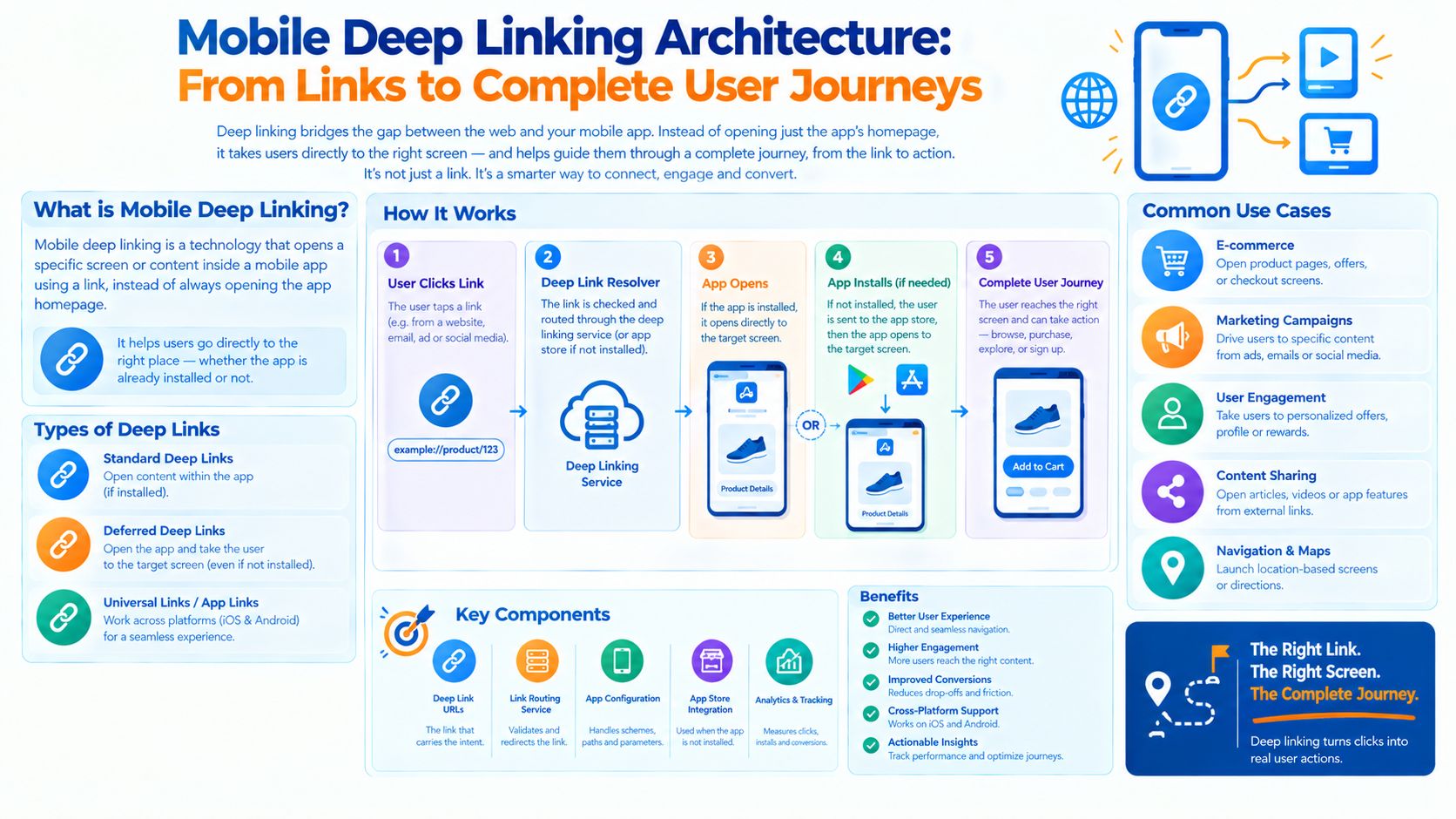
Deep linking is the practice of linking to a specific location within a mobile application rather than to the app's home screen.
The categories:
| Type | What It Does |
|---|---|
| Traditional deep link | Opens a specific screen in an installed app |
| Deferred deep link | Survives app installation—the user lands on the right screen after installing |
| Universal link / App link | Uses standard web URLs that open the app if installed, or the website if not |
| Contextual deep link | Carries additional data through the link to the destination |
The distinctions matter because each solves a different part of the problem. A traditional deep link fails if the app is not installed. A deferred deep link solves that but adds complexity. Universal links unify the web and app experience but require platform-specific configuration.
Why Deep Linking Is Harder Than It Looks
Deep linking appears simple. It is not, because it must work across multiple platforms, states, and conditions.
Platform differences. iOS and Android handle linking differently. Universal Links on iOS and App Links on Android are conceptually similar but configured separately. Schemes, domains, and verification differ.
Installation state. The link behaves differently depending on whether the app is installed, not installed, or being installed.
App state. The app may be closed, backgrounded, or already open. Each requires different handling.
Context preservation. The link's data must survive the entire journey from tap, through app store, through installation, through first launch, to the destination screen.
Attribution. Marketing and partner teams need to know which link produced which outcome. Without proper architecture, attribution is lost.
Fallback behavior. When the app cannot handle the link, the experience must degrade gracefully usually to the web.
The Journey a Link Must Survive
Consider a user tapping a link in an email promoting a specific product. The ideal journey:
-
The user taps the link.
-
The system determines whether the app is installed.
-
If installed, the app opens to the product detail screen with the correct product identifier.
-
If not installed, the user is directed to the app store.
-
After installing, the app opens to the same product detail screen.
-
The attribution system records which campaign produced the conversion.
Every step has failure modes. The link may not be recognized. The app may open to the wrong screen. The context may be lost during installation. The attribution may not be recorded.
A well-architected deep linking system handles all of these cases.
The Core Components
Link Generation
Links are generated with the data needed to route the user correctly and attribute the outcome.
What a link should carry:
-
Destination identifier (which screen or content)
-
Contextual parameters (product ID, campaign ID, referral source)
-
Attribution data (channel, partner, campaign)
-
Fallback URL (where to send the user if the app is unavailable)
Design consideration: Links must be short enough to survive email clients and messaging platforms, but complete enough to route and attribute correctly.
Domain Association
Universal Links and App Links require the app and the website to declare a trusted relationship.
On iOS: An apple-app-site-association file hosted on the domain declares which paths the app can handle.
On Android: A assetlinks.json file declares the same.
Design consideration: This association must be maintained. If the file is missing or malformed, links fall back to the browser.
Routing
The app receives the link and determines where to navigate.
The routing layer:
-
Parses the incoming URL
-
Extracts parameters
-
Validates the destination
-
Navigates to the appropriate screen
Design consideration: Routing must handle invalid or unrecognized links gracefully. A link to a deleted product should not crash the app.
Deferred Deep Linking
When the app is not installed, the link's context must survive the installation process.
How it works:
-
The link is stored server-side against a device identifier or a fingerprint
-
The app, on first launch, requests the pending link
-
The app routes to the stored destination
Design consideration: Deferred deep linking depends on accurately matching the install to the original tap. This is probabilistic, not deterministic, and must be treated as such.
Attribution
Attribution records which link produced which outcome.
What to capture:
-
The link source (channel, partner, campaign)
-
The destination
-
The user action (install, open, purchase, signup)
-
The time between tap and action
Design consideration: Attribution data must be captured at the moment of the tap and preserved through the journey. If it is captured later, it may be lost.
Where Deep Linking Breaks
The Link Opens the Wrong Screen
Common causes: routing logic does not handle the URL pattern, the destination no longer exists, or the app version does not support the feature.
Mitigation: Validate destinations before navigating. Handle missing content gracefully. Test with real links, not synthetic ones.
The Link Opens the App Store Instead of the App
Common causes: domain association is broken, the app does not claim the URL pattern, or the link uses a scheme the app does not register.
Mitigation: Verify association files are correctly hosted and formatted. Test both installed and non-installed scenarios.
The Context Is Lost During Installation
Common causes: deferred deep linking is not implemented, the fingerprint match fails, or the app does not check for pending links on first launch.
Mitigation: Implement deferred deep linking with a clear fallback. Accept that some installs will not match and design the experience to work without the context.
Attribution Is Missing
Common causes: attribution parameters are stripped by the link, the app does not forward them to the attribution system, or the attribution system is not integrated.
Mitigation: Test the full attribution path. Verify parameters survive from link generation to conversion.
The Link Works on One Platform but Not the Other
Common causes: platform-specific configuration is incomplete or inconsistent.
Mitigation: Test on both platforms in all states installed, not installed, app closed, app backgrounded.
The Architecture of a Deep Linking System
A complete deep linking architecture has several layers.
Link service. Generates links with the appropriate data, handles shortening, and provides fallback URLs.
Domain association. Hosts the verification files that establish the trusted relationship between the app and the domain.
In-app router. Parses incoming links, validates destinations, and navigates appropriately.
Deferred link resolver. Stores link context during installation and retrieves it on first launch.
Attribution service. Records the link source, the destination, and the outcome.
Analytics integration. Feeds attribution and journey data into analytics platforms.
Each layer has responsibilities and failure modes. A well-architected system treats them as a pipeline, not as independent components.
Implementation Roadmap
Phase 1: Define (Weeks 1-2)
-
Map the journeys. Which links should open which screens?
-
Define the parameters. What data must travel with each link?
-
Define attribution requirements. What must be recorded, and where?
-
Define fallback behavior. What happens when the app cannot handle a link?
Phase 2: Build (Weeks 3-6)
-
Implement domain association for both platforms.
-
Build the in-app router with validation and graceful failure.
-
Implement deferred deep linking.
-
Integrate attribution into the link journey.
-
Build the link generation service.
Phase 3: Validate (Weeks 7-10)
-
Test all states. Installed, not installed, app closed, app backgrounded.
-
Test both platforms.
-
Test attribution end-to-end.
-
Test fallback behavior.
-
Monitor real-world link performance.
Frequently Asked Questions
Q1: What is the difference between a deep link and a universal link?
A deep link uses a custom URL scheme that opens the app if installed. A universal link (iOS) or App Link (Android) uses a standard web URL that opens the app if installed or the website if not. Universal links are generally preferred because they degrade gracefully.
Q2: What is deferred deep linking?
Deferred deep linking preserves the link's context through the app installation process. The user taps a link, installs the app, and lands on the intended screen rather than the home screen.
Q3: How reliable is deferred deep linking?
It is probabilistic, not deterministic. It depends on matching the install to the original tap, which can fail due to privacy restrictions, network conditions, or device changes. Design for the case where the match fails.
Q4: Why do my links open the browser instead of the app?
Usually because the domain association is broken or the app does not claim the URL pattern. Verify the association files are correctly hosted and formatted.
Q5: How do I measure deep link performance?
Track tap-to-open rates, tap-to-install rates, destination accuracy, and attribution completion. Monitor by platform and by link source.
Q6: How can Innovative AI Solutions help?
We help organizations architect deep linking systems from domain association and routing to deferred deep linking and attribution. Explore our services to see how we approach mobile engineering. Based in Delhi, serving clients across India.
Why Delhi is a Great Hub for Mobile Engineering
Delhi is emerging as a hub for mobile and product engineering, backed by one of the largest smartphone user bases in the world and a thriving developer ecosystem. In a market where users move between apps, browsers, and messaging platforms constantly, deep linking architecture determines whether journeys complete or break.
What We Offer at Innovative AI Solutions
-
Deep Linking Strategy: We help you define journeys, parameters, and attribution requirements.
-
Implementation: We build domain association, routing, and deferred deep linking.
-
Attribution Integration: We connect link journeys to your analytics and attribution systems.
-
Validation: We test all states and platforms to ensure links work reliably.
-
Monitoring: We track real-world link performance and diagnose failures.
Final Thought
The shift is clear: from treating deep links as configuration to treating them as architecture. Every link is a potential user journey, and every broken link is a lost user. Organizations that architect deep linking properly will convert more of the traffic they already generate. Those that treat it as an afterthought will keep losing users at the exact moment they were most engaged.
Contact Us:
Phone: +91 7464 099 059 / +91 9689967356
Email: info@innovativeais.com
Address: 904, 9th floor Pearls Best Heights-I, Netaji Subhash Place, Delhi-110034
Website: https://innovativeais.com
About the Author
Abhishek Kumar
Founder & CEO, Innovative AI Solutions
5+ years building AI, cloud, and enterprise systems. Based in Delhi, serving clients across India.